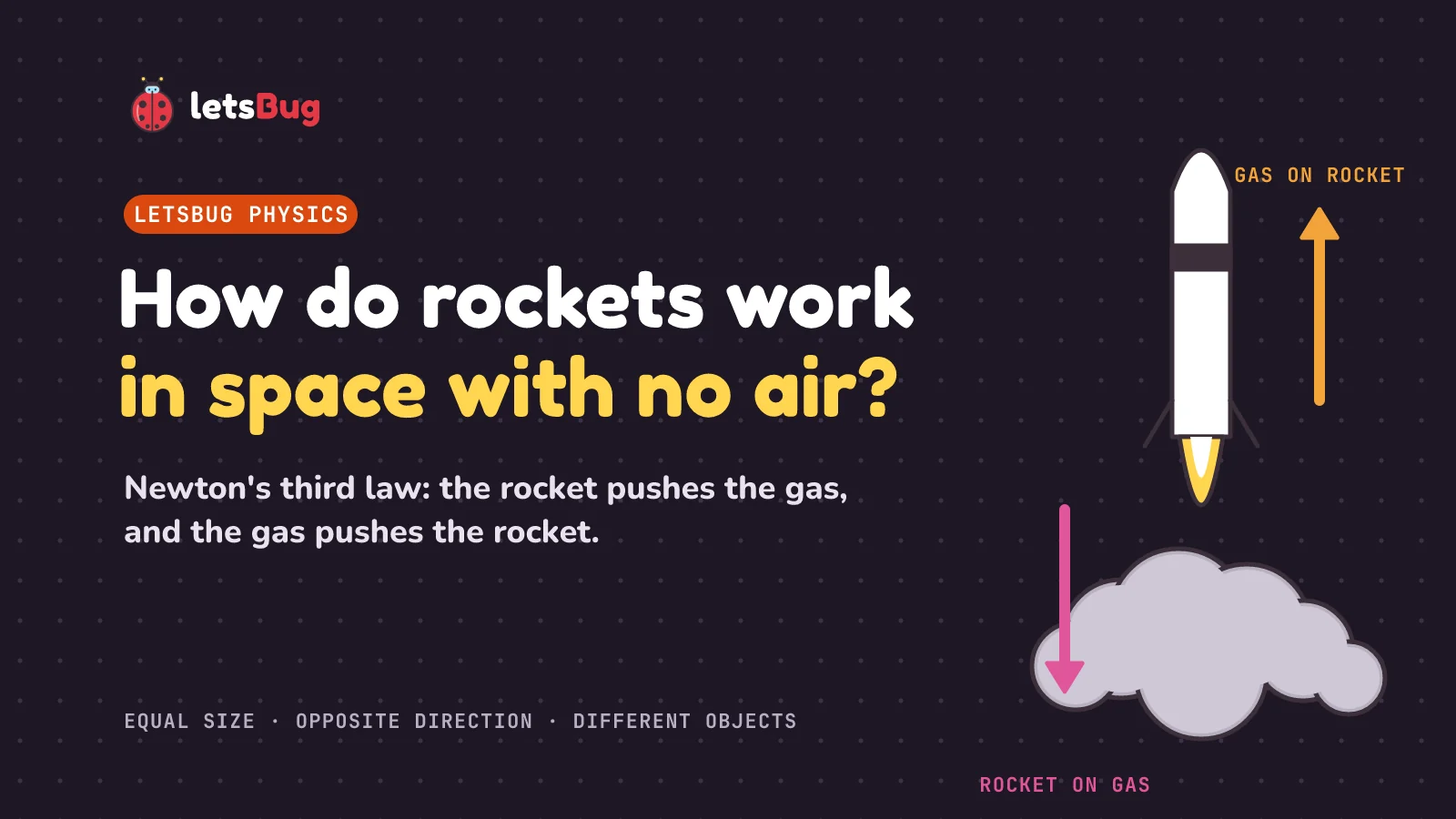
A rocket doesn't push on air or on the ground. It pushes on its own exhaust gas. The engines throw hot gas out of the bottom, and by Newton's third law the gas pushes the rocket the other way with an equal force. That works just as well in empty space; in fact rockets work better in a vacuum. In this post we state the law properly, see why the two forces don't cancel, work out a real Falcon 9's acceleration at lift-off, and clear up an exam trap that catches a lot of students.
Key takeaways
- When A pushes on B, B pushes on A with a force that's equal in size, opposite in direction and the same type.
- The two forces act on different objects, so they never cancel. Only forces on the same object add up.
- A Falcon 9 at lift-off: 7.6 MN of thrust minus 5.4 MN of weight leaves 2.2 MN, an acceleration of about 4 m/s² upwards.
- Equal forces don't mean equal accelerations: the lighter object accelerates more (F = ma).
- A book's weight and the table's push are not a third-law pair. Both act on the book.
This post goes with letsBug Physics, episode 2 (Class 9 science in India, GCSE and IGCSE physics). Watch it, or read on: the post adds exam-style questions with model answers.
Rockets push on their own exhaust, not on the air
It's a common belief that rockets lift off by pushing on the ground or on the air below them. They don't. A Falcon 9 has a mass of about 549,000 kg at lift-off, and its nine engines push with about 7.6 million newtons. That push is on the hot gas the engines throw out of the bottom: the rocket pushes the gas down, and the gas pushes the rocket up.
Nothing in that needs air. Out in space there's no air to push against, and rockets still work. They actually work better in a vacuum, where the exhaust escapes more easily. The upward push of the gas on the rocket is called thrust.
Newton's third law, stated properly
When object A exerts a force on object B, object B exerts a force on object A that is:
- equal in size,
- opposite in direction,
- and of the same type: both contact forces, or both gravity.
Forces always come in pairs. You can't push something without it pushing you back. Press your hand against a wall, and the wall presses back on your hand just as hard. The famous short version, "every action has an equal and opposite reaction", is true, but it leaves out the part that matters most: which object each force acts on.
Why the two forces don't cancel
Here's the tempting idea: the two forces are equal and opposite, so they add up to zero, and nothing could ever start moving. A rocket couldn't lift off. You couldn't even take a step. But rockets do lift off, so the idea must be wrong.
The answer: the two forces act on different objects. The rocket pushes on the gas. The gas pushes on the rocket. Forces only cancel when they act on the same object. To find out how the rocket moves, you add up only the forces on the rocket.
Worked example: a Falcon 9 at lift-off
Let's draw the free-body diagram for the rocket alone, at the moment it leaves the pad. Take g = 9.8 N/kg.
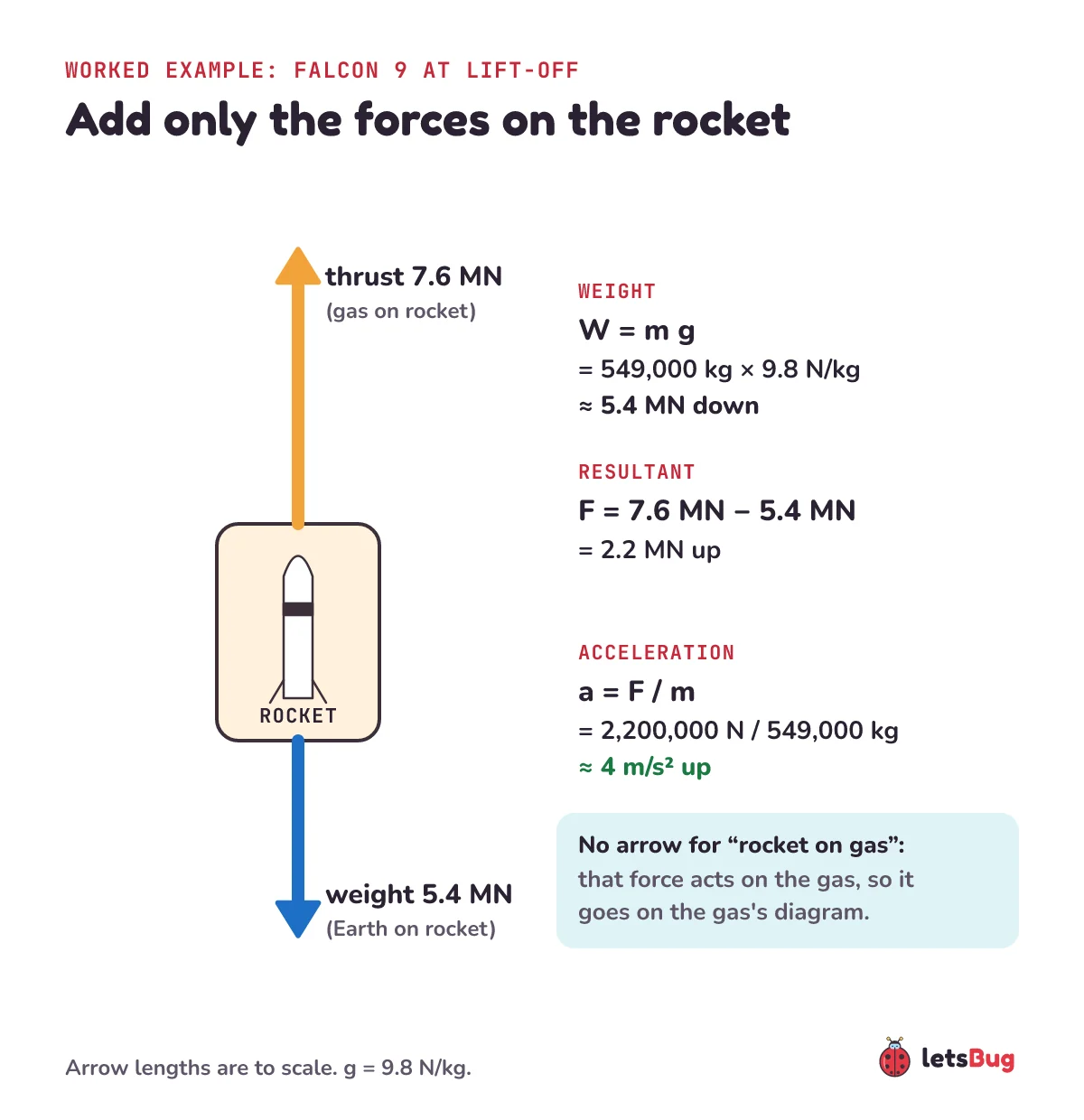
- Thrust (gas on rocket): about 7.6 MN upwards. Units first: 1 MN = 1,000,000 N.
- Weight (Earth on rocket): W = mg = 549,000 kg × 9.8 N/kg = 5,380,200 N ≈ 5.4 MN downwards.
- Resultant force: 7.6 MN − 5.4 MN = 2.2 MN upwards.
- Acceleration: a = F / m = 2,200,000 N / 549,000 kg ≈ 4 m/s² upwards.
Notice there's no arrow for "rocket on gas". That force acts on the gas, so it belongs on the gas's diagram, not the rocket's. Be careful: the rocket burns fuel fast, so its mass drops and its acceleration grows. The 4 m/s² is only true at the moment of lift-off.
Walking and swimming use the third law too
Every step you take is a third-law pair. Your foot pushes backwards on the ground; the ground pushes forwards on your foot, and that forward push is what moves you. It's a friction force, which is why walking on ice is so hard: with almost no friction, your foot can't push backwards on the ice, so the ice can't push you forwards. Swimmers do the same with water: your hands push the water backwards, and the water pushes you forwards.
Myth: the bigger object pushes harder
Picture two ice skaters pushing off each other, one of 50 kg and one of 75 kg. Who pushes harder? Neither. The forces are equal, say 150 N on each. But F = ma still works for each skater on their own:
- lighter skater: a = 150 / 50 = 3 m/s²
- heavier skater: a = 150 / 75 = 2 m/s²
Same force, different acceleration. It's the same when a small car hits a lorry: the forces on the two are equal, but the car's speed changes far more, because its mass is so much smaller.
You pull the Earth too
Gravity comes in pairs as well. The Earth pulls a 60 kg person down with 588 N (their weight: 60 × 9.8, roughly 600 N), and the person pulls the Earth up with exactly the same force. So why doesn't the Earth jump towards you? Its mass is about 6 × 10²⁴ kg. Divide roughly 600 N by that and the Earth's acceleration is about 10⁻²² m/s². It's real, but far too small ever to notice.
Exam trap: the book on the table
A book rests on a table. Its weight pulls it down, and the table pushes it up with an equal force. Equal and opposite, so is that a third-law pair? No. Use this check:
- Do the two forces act on different objects?
- Are they the same type of force?
- Are they between the same two objects, just swapped round?
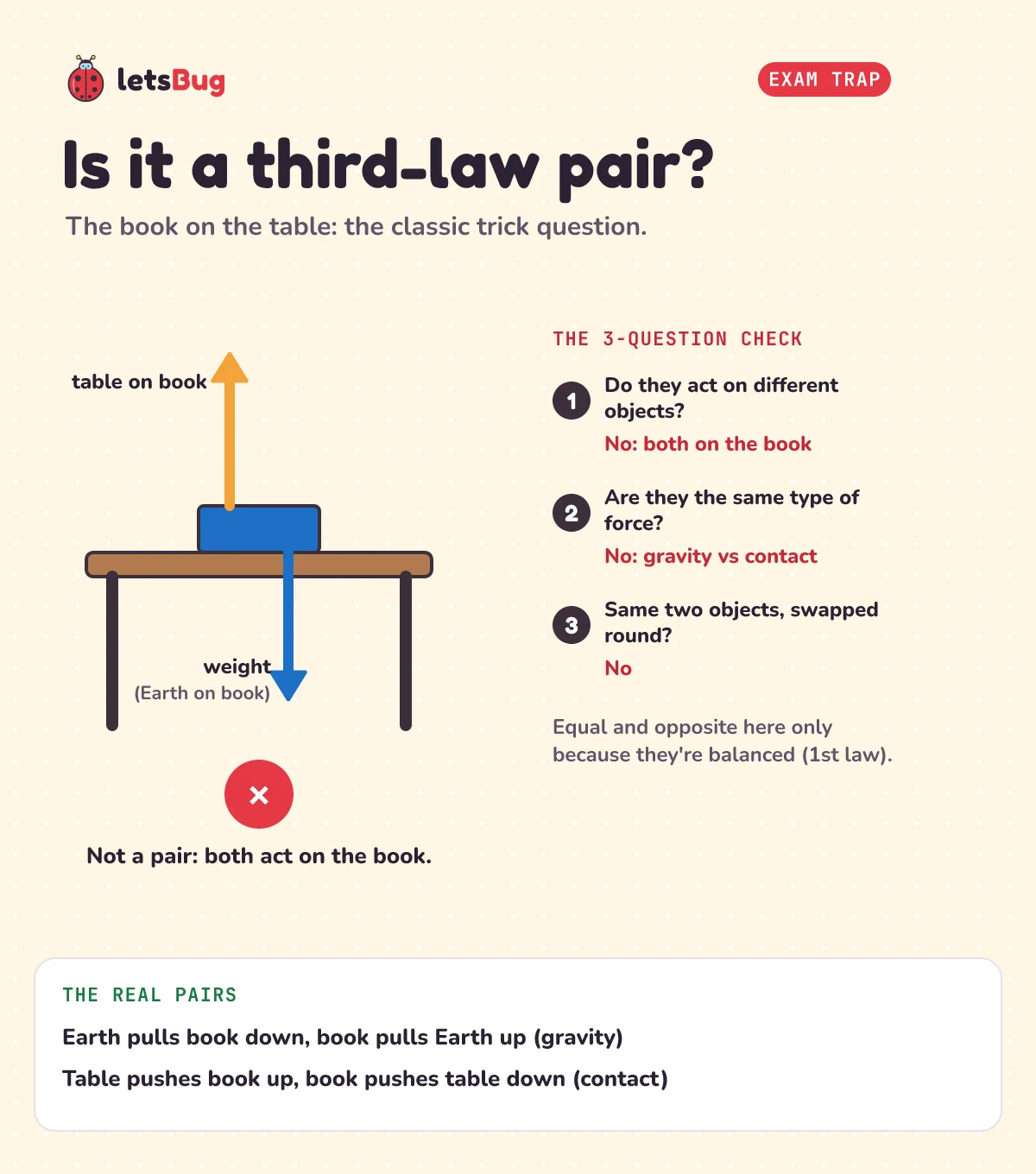
The weight and the table's push both act on the book, so they fail the very first test. They're simply balanced forces (that's Newton's first law). The real partner of the book's weight is the book pulling the Earth upwards. The real partner of the table's push is the book pushing down on the table.
How to write it in an exam
When a question asks you to describe a third-law pair, vague words score nothing. "Action and reaction" on its own isn't enough, and "they cancel out" is simply wrong. Answers that score name both objects and both directions:
A 60 kg swimmer pushes off a pool wall with a force of 300 N. (1) What force does the wall exert on her? (2) What is her acceleration at that moment? Ignore water resistance.
Show the answers
(1) 300 N, forwards (away from the wall): equal in size and opposite in direction to her push.
(2) a = F / m = 300 / 60 = 5 m/s².
Exam-style questions with model answers
Q1 (2 marks). A person stands on the ground. Their weight is 700 N. Describe the force that forms a Newton's third law pair with their weight.
Model answer
The person pulls the Earth upwards [1] with a gravitational force of 700 N [1]. Saying "the reaction force from the ground" scores 0: that's the normal contact force, a different interaction, and it acts on the person.
Q2 (3 marks). A student says: "A horse pulls a cart forwards and the cart pulls the horse backwards with an equal force, so they can never move." Explain why the student is wrong.
Model answer
The two forces act on different objects, one on the cart and one on the horse [1], so they cannot cancel [1]. The horse moves forwards because the ground pushes forwards on the horse (friction) with a bigger force than the cart's backward pull on it, so there is a resultant force on the horse [1]. Also accepted: the cart moves because the horse's forward pull on it is bigger than the friction on the cart [1].
Q3 (3 marks). Skaters A (40 kg) and B (80 kg) push apart. A accelerates at 3 m/s². Calculate the force on A and B's acceleration.
Model answer
F = ma = 40 × 3 = 120 N on A [1]. By the third law, the force on B is 120 N, in the opposite direction to the force on A [1]. a = 120 / 80 = 1.5 m/s² [1].
Questions people ask
Do rockets need air to push against?
No. A rocket pushes on its own exhaust gas, and the gas pushes back on the rocket. That works in empty space, and rockets actually work better in a vacuum, where the exhaust escapes more easily.
Why don't action and reaction forces cancel each other?
Because they act on different objects. Forces only cancel when they act on the same object. To see how one object moves, add up only the forces acting on that object.
Are weight and the normal force a third-law pair?
No. For a book on a table, both act on the book, so they're balanced forces. The partner of the weight is the book pulling the Earth up; the partner of the normal force is the book pushing down on the table.
Does the heavier object exert a bigger force?
No. The two forces in a pair are always equal. The heavier object just accelerates less, because a = F / m.
What are examples of Newton's third law in daily life?
Walking (your foot pushes the ground back, the ground pushes you forward), swimming (hands push water back, water pushes you forward), rockets (they push gas down, gas pushes them up) and helicopters (the blades push air down, the air pushes the helicopter up).
Keep going
- Watch the full lesson, Newton's Third Law Explained, and the episode before it on Newton's second law, F = ma.
- Another letsBug explainer about space: how GPS works without internet, and why it needs Einstein.
Sources
- OpenStax Physics: 4.4 Newton's third law of motion (why the pair doesn't cancel; walking, swimming)
- OpenStax University Physics: 5.5 Newton's third law (rockets, thrust, "better in a vacuum", helicopters)
- NASA Glenn Research Center: Newton's laws of motion
- Wikipedia: Reaction (physics) (third-law pairs vs balanced forces), Falcon 9 (549,000 kg, 7,600 kN) and Earth mass
- Smith and Wittmann (2008): research on students' "bigger object pushes harder" idea
Every number in this post was checked against these sources, and the arithmetic was run in Python before publishing.