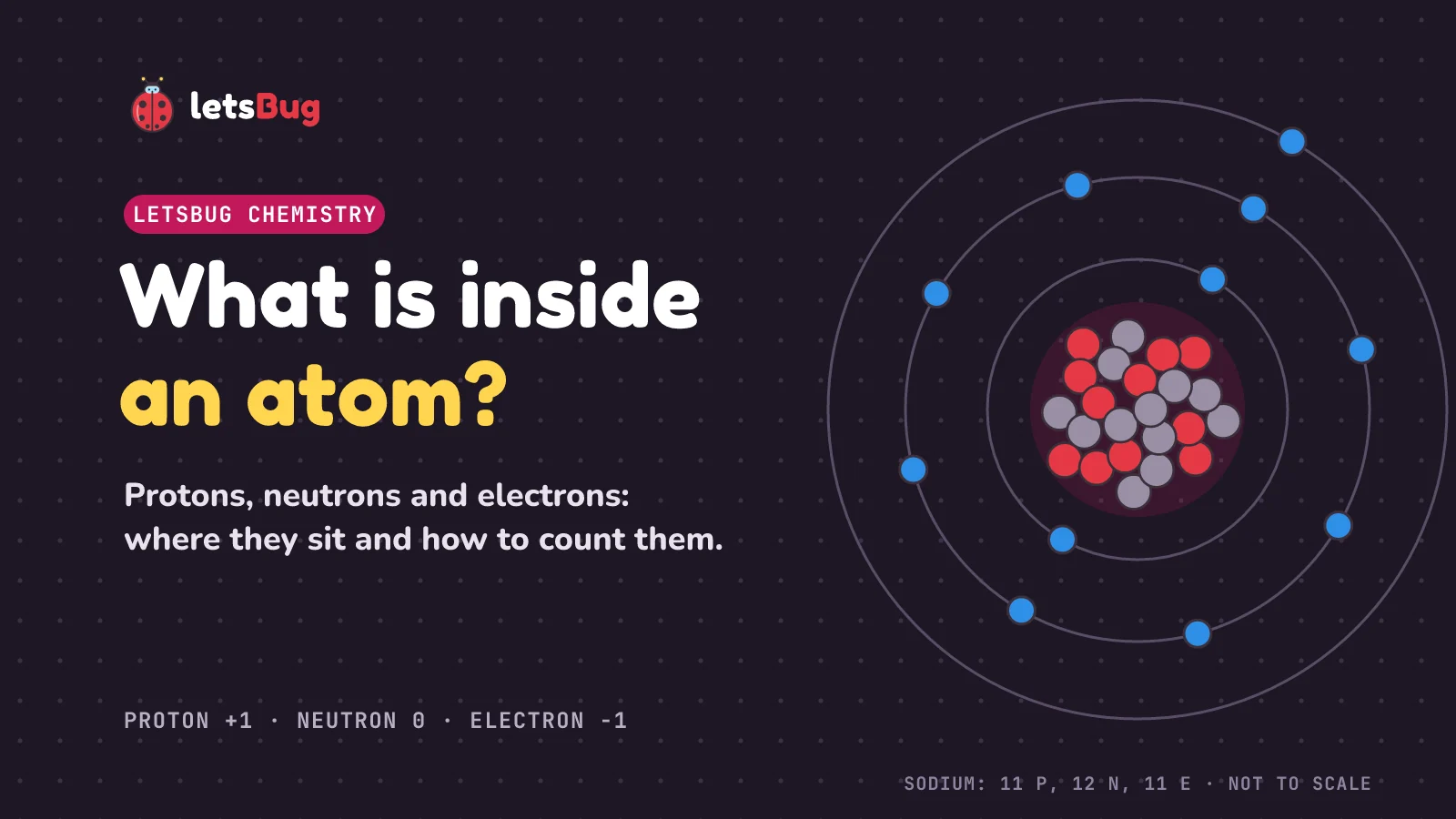
An atom holds three kinds of particle. Protons and neutrons are packed into a tiny nucleus at the centre, and electrons move around it through what is mostly empty space. A proton has a charge of +1, an electron −1, and a neutron 0. Protons and neutrons each have a relative mass of 1, while an electron weighs about 1/1836 as much. So the nucleus carries almost all of the mass but takes up almost none of the space. In this post we'll see how small the nucleus really is, read any atom from its atomic number and mass number, and finish with isotopes and electron shells.
Key takeaways
- Proton: charge +1, mass 1. Neutron: charge 0, mass 1. Electron: charge −1, mass very small (about 1/1836).
- The nucleus is tens of thousands of times smaller across than the atom. Textbooks usually quote about 100,000.
- Atomic number = number of protons. Mass number = protons + neutrons. So neutrons = mass number − atomic number.
- In an atom, electrons = protons, so the atom has no overall charge.
- Isotopes have the same number of protons but different numbers of neutrons. That's why chlorine's relative atomic mass is 35.5.
- Electrons fill shells from the inside out. For the first 20 elements: 2, then 8, then 8. Sodium is 2,8,1.
This post goes with letsBug Chemistry, episode 1. It covers the atomic structure you need for Class 9 science in India (in the new NCERT book, Exploration, it's Chapter 8, "Journey Inside the Atom") and for GCSE and IGCSE chemistry. Watch it, or read on: the post adds exam-style questions with model answers.
What is inside an atom?
Right at the centre of every atom is the nucleus. It holds two kinds of particle: protons and neutrons. Around the nucleus move the electrons. Everything you have ever touched is built from just these three.
In kilograms, particle masses are tiny (a proton is about 1.67 × 10⁻²⁷ kg), so chemists compare them instead. These are the relative charges and masses, the numbers you need to learn:
| Particle | Where it is | Relative charge | Relative mass |
|---|---|---|---|
| Proton | in the nucleus | +1 | 1 |
| Neutron | in the nucleus | 0 | 1 |
| Electron | in shells around the nucleus | −1 | very small (about 1/1836) |
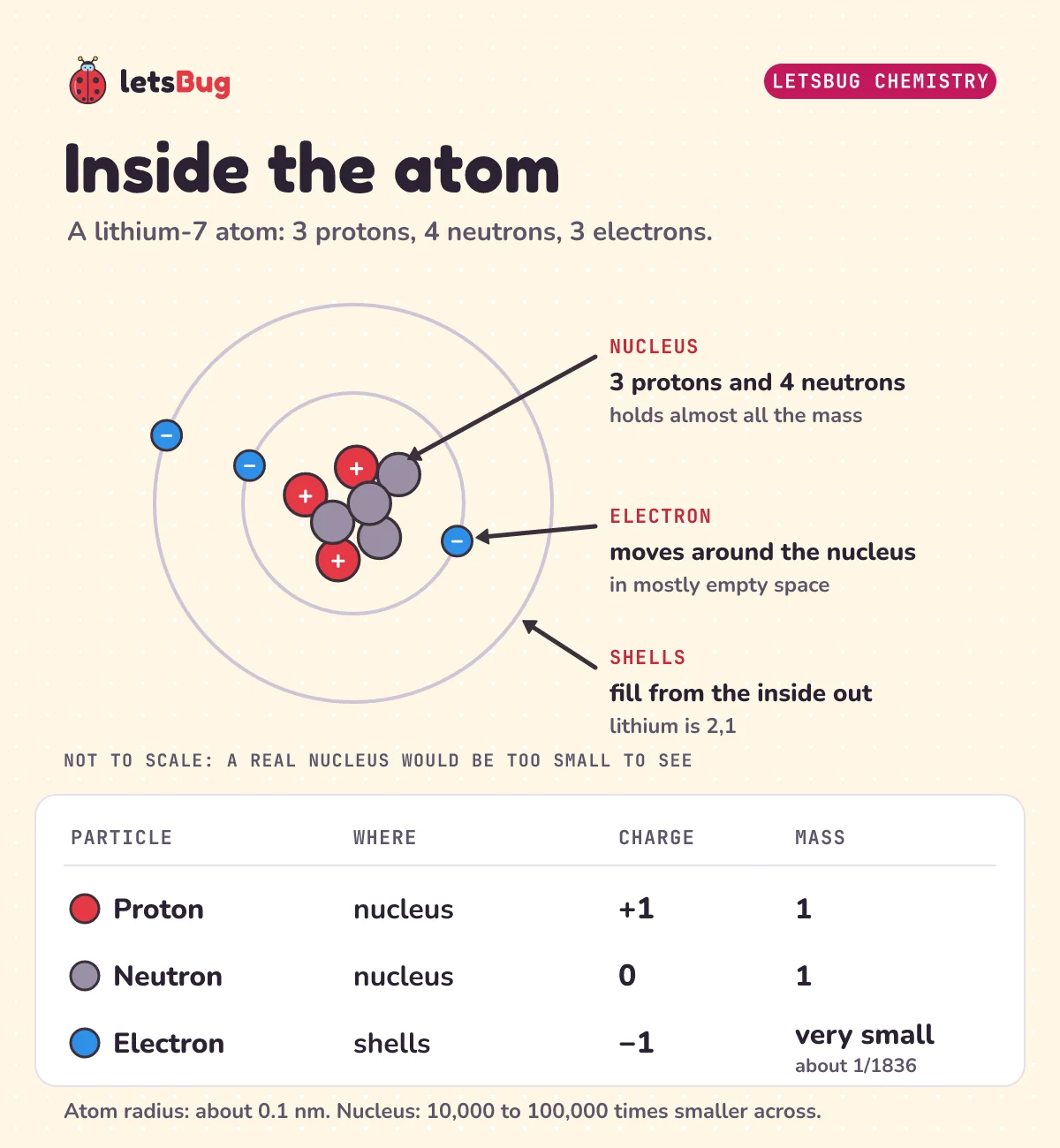
The name gives the neutron away: it's neutral. For the electron, the AQA specification just says "very small", and NCERT calls its mass "almost negligible". If you want the number, it takes about 1836 electrons to balance one proton.
Almost all the mass, almost none of the space
Because protons and neutrons are each about 1836 times heavier than an electron, nearly all of an atom's mass sits in the nucleus. Even in hydrogen, with one proton and one electron, the electron is only about 0.05% of the mass.
But the nucleus is tiny. The AQA specification gives an atom's radius as about 0.1 nm (1 × 10⁻¹⁰ m) and a nucleus's radius as about 1 × 10⁻¹⁴ m: less than 1/10,000 of the atom's. OpenStax and NCERT quote diameters of about 10−10 m for the atom and 10−15 m for the nucleus, which is where the popular figure of about 100,000 times smaller comes from (NCERT says "one lakh"). The real figure depends on the element. Either way, the nucleus is tens of thousands of times smaller across than the atom.
NCERT's picture: if an atom were the size of a cricket ground, the nucleus would be a grain of black pepper at the centre, and the electrons would be out around the boundary. Everything in between is empty.
Why an atom has no overall charge
Protons are positive and electrons are negative, so why isn't an atom charged? Because in an atom the number of electrons equals the number of protons. Every +1 is cancelled by a −1, so the total is zero. If an atom gains or loses electrons, the balance breaks and it becomes an ion. A sodium atom that loses one electron, for example, has 11 protons but only 10 electrons, so it's a sodium ion with a charge of +1.
Atomic number and mass number
Two numbers describe any atom:
- Atomic number = the number of protons. It's the atom's identity card: every atom with 6 protons is carbon, and every atom with 17 is chlorine.
- Mass number = the number of protons + neutrons. Electrons aren't counted, because they weigh almost nothing.
So neutrons = mass number − atomic number, and in an atom, electrons = atomic number.
Let's try it with sodium, written 2311Na. The mass number (23) goes at the top and the atomic number (11) at the bottom:
- Protons = atomic number = 11.
- Electrons = protons = 11 (it's an atom, so there's no overall charge).
- Neutrons = 23 − 11 = 12.
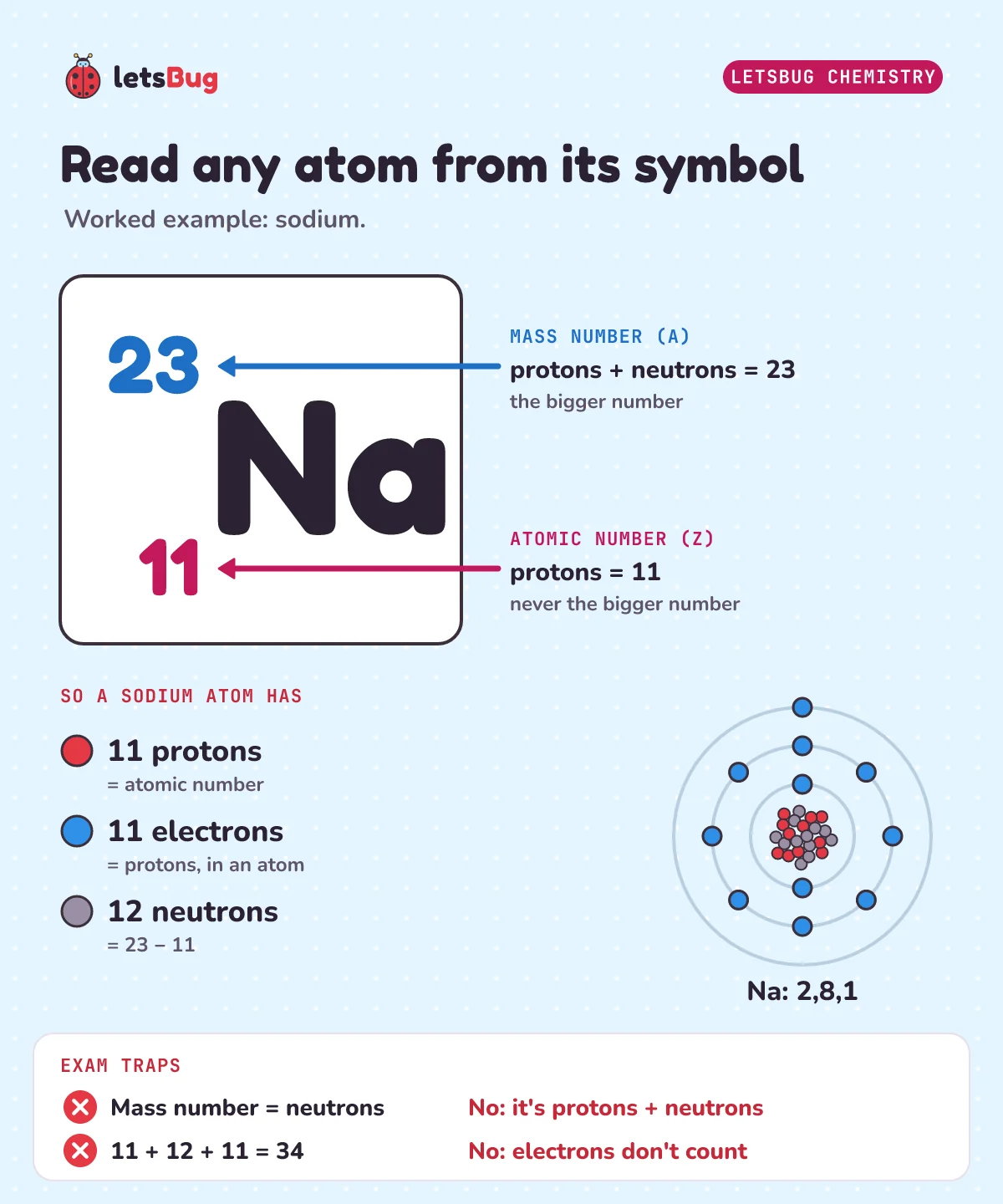
Periodic tables don't all use the same layout. On some the bigger number is on top, on others the atomic number is. The safe rule: the atomic number is never the bigger number (it's the smaller one, except in hydrogen-1, where both are 1), and the key on your exam's periodic table tells you which is which. One more detail: on a periodic table the bigger number is really the relative atomic mass, an average over the element's isotopes (more on that below). For one particular atom, use the mass number you're given. If you only have the periodic table, round the relative atomic mass to a whole number: potassium's 39 gives 39 − 19 = 20 neutrons. Chlorine's 35.5 is the exception, so a question will tell you which chlorine atom it means.
Two mistakes that lose marks
Mistake 2: adding the electrons in. 11 + 12 + 11 = 34 is wrong. Electrons are far too light to count towards the mass number.
Isotopes: same protons, different neutrons
Isotopes are atoms of the same element with the same number of protons but a different number of neutrons. Chlorine has two common ones:
- Chlorine-35 (3517Cl): 17 protons, 35 − 17 = 18 neutrons.
- Chlorine-37 (3717Cl): 17 protons, 37 − 17 = 20 neutrons.
Both have 17 electrons arranged in the same way, so they react in the same way: chemistry depends on electrons, not neutrons. The main difference is their mass, though some isotopes are also radioactive. Carbon works the same way. Carbon-12 has 6 neutrons; carbon-14 has 8 and is radioactive, which is what makes it useful for dating ancient wood and bone.
Why chlorine's relative atomic mass is 35.5
Look up chlorine on a periodic table and you'll find 35.5, not a whole number. No single chlorine atom has a mass of 35.5. Natural chlorine is a mixture: about three quarters chlorine-35 and one quarter chlorine-37. The periodic table gives the weighted average:
NCERT does the same sum with 4 atoms, 3 of chlorine-35 and 1 of chlorine-37: (3 × 35 + 37) ÷ 4 = 142 ÷ 4 = 35.5. The real split is closer to 75.8% and 24.2%, and with exact isotope masses you get chlorine's standard value of 35.45, which rounds to the 35.5 you use in exams.
Electron shells: 2, 8, 8
Electrons sit in shells (energy levels) and fill from the inside out. For the first 20 elements:
- the first shell holds up to 2 electrons,
- the second up to 8,
- the third up to 8 before the fourth shell starts.
Sodium's 11 electrons go 2, then 8, then 1: we write 2,8,1. Chlorine's 17 go 2,8,7. Magnesium (12) is 2,8,2.
If you follow the NCERT book, you'll meet the same idea as the K, L and M shells with a 2n² rule: 2, 8 and 18 electrons. The M shell can hold 18, but the outermost shell can't hold more than 8, so the answers for the first 20 elements come out the same: potassium is 2,8,8,1 either way. (After calcium, the third shell does fill up to 18, but you won't need that yet.)
Potassium has atomic number 19 and mass number 39. How many protons, neutrons and electrons does an atom of it have, and what's its electron arrangement?
Show the answers
19 protons and 19 electrons. Neutrons = 39 − 19 = 20. Electron arrangement: 2,8,8,1 (2 + 8 + 8 + 1 = 19).
Exam-style questions with model answers
Q1 (3 marks). Give the relative charge and relative mass of a proton, a neutron and an electron.
Model answer
Proton: charge +1, mass 1 [1]. Neutron: charge 0, mass 1 [1]. Electron: charge −1, mass very small [1]. Write "very small" (the AQA wording) or "about 1/1836" for the electron, not 0: an electron does have mass.
Q2 (2 marks). An atom has 20 protons and a mass number of 41. How many neutrons and electrons does it have?
Model answer
Neutrons = 41 − 20 = 21 [1]. Electrons = 20, because in an atom electrons equal protons [1].
Q3 (2 marks). Chlorine-35 and chlorine-37 are isotopes. Explain what this means, using the numbers of particles.
Model answer
They are atoms of the same element with the same number of protons, 17 [1], but different numbers of neutrons: 18 and 20 [1].
Q4 (3 marks). Copper is 69% copper-63 and 31% copper-65. Calculate its relative atomic mass to 3 significant figures.
Model answer
(69 × 63) + (31 × 65) = 4347 + 2015 = 6362 [1]; 6362 ÷ 100 = 63.62 [1]; = 63.6 to 3 significant figures [1]. Check: the answer lies between 63 and 65, closer to 63 because copper-63 is more common.
Q5 (2 marks). A sodium ion, Na+, has mass number 23 and atomic number 11. Give its numbers of protons, neutrons and electrons.
Model answer
11 protons and 12 neutrons [1]. 10 electrons, because it has lost one electron to get its +1 charge [1].
Questions people ask
What is inside an atom?
A tiny nucleus of protons and neutrons at the centre, with electrons moving around it. Almost all of the atom's mass is in the nucleus, and almost all of its volume is empty space where the electrons are.
What is the charge and mass of a proton, neutron and electron?
Proton: relative charge +1, relative mass 1. Neutron: charge 0, mass 1. Electron: charge −1, mass very small (about 1/1836 of a proton).
How do you find the number of neutrons?
Subtract the atomic number from the mass number. Sodium has mass number 23 and atomic number 11, so it has 23 − 11 = 12 neutrons.
Is an atom really mostly empty space?
Yes. The nucleus is tens of thousands of times smaller across than the whole atom. If an atom were a cricket ground, its nucleus would be about the size of a grain of pepper.
Why is chlorine's relative atomic mass 35.5?
Natural chlorine is a mixture of about 75% chlorine-35 and 25% chlorine-37. The weighted average is (75 × 35 + 25 × 37) ÷ 100 = 35.5.
Keep going
- Next lesson: why are noble gases unreactive? Electron shells, and the electronic configuration of the first 20 elements.
- Watch the full lesson, Inside the Atom: Protons, Neutrons and Electrons, or the one-minute version: your body is almost entirely empty space.
- Atoms keep time too: how GPS works without internet uses clocks that count the vibrations of caesium and rubidium atoms.
- More Class 9 science: how rockets work in space with no air (Newton's third law).
Sources
- NCERT Class 9 Science, Exploration: Chapter 8, Journey Inside the Atom (nucleus "one lakh" times smaller, cricket ground and pepper grain, 2n² shells, chlorine 35.5)
- AQA GCSE Chemistry 8462 specification: Atomic structure and the periodic table (radius 0.1 nm, nucleus less than 1/10,000, sodium 2,8,1)
- OpenStax Chemistry 2e: 2.3 Atomic structure and symbolism (particle masses and charges, 10−10 m and 10−15 m, chlorine 75.76% and 24.24%)
- NIST CODATA 2022: proton-electron mass ratio (1836.15)
- Wikipedia: Isotopes of chlorine (75.8%, 24.2%, 35.45), Carbon-14 and Radiocarbon dating, Nuclear density (2.5 × 10¹⁷ kg/m³), World population (about 8.3 billion)
- Walpole and others (2012): The weight of nations (average adult body mass 62 kg)
Every number in this post was checked against these sources, and the arithmetic was run in Python before publishing.