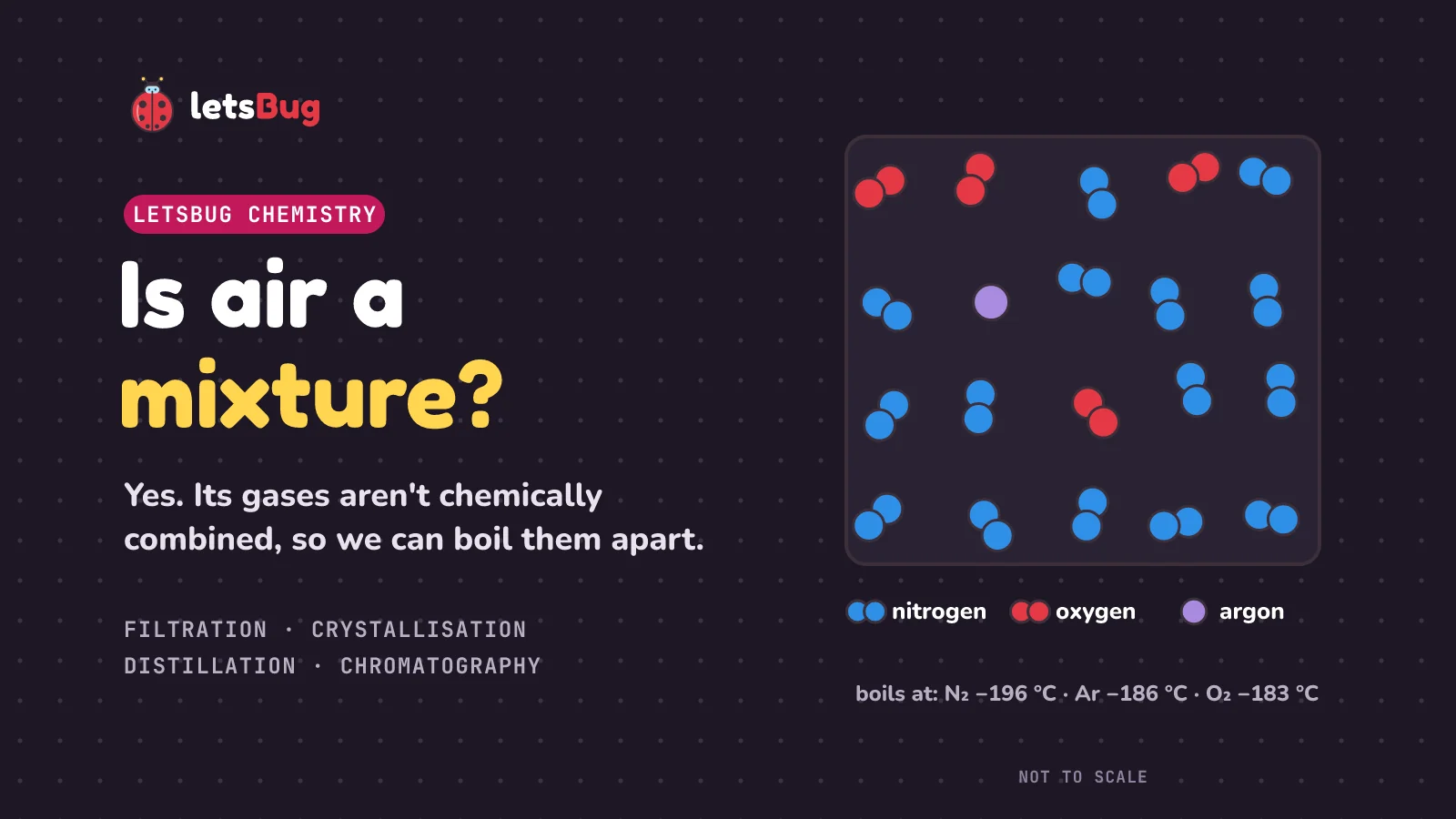
Yes, air is a mixture. Its gases (mostly nitrogen, oxygen and a little argon) are not chemically combined, its make-up changes from day to day, and you can separate it without any chemical reaction: cool air until it turns liquid, then boil the gases off one at a time. That's how most of the oxygen that hospitals use is made. If air were a compound, you'd need a chemical reaction to pull the oxygen out. In this post we'll pin down the difference between a mixture and a compound, then work through the five separation methods GCSE and IGCSE list (filtration, crystallisation, simple and fractional distillation and paper chromatography), the extra ones in the NCERT chapter, and how to pick the right one.
Key takeaways
- A compound is elements chemically combined in fixed proportions. Only a chemical reaction splits it.
- A mixture is substances that are not chemically combined. Each keeps its own properties, and physical methods separate them.
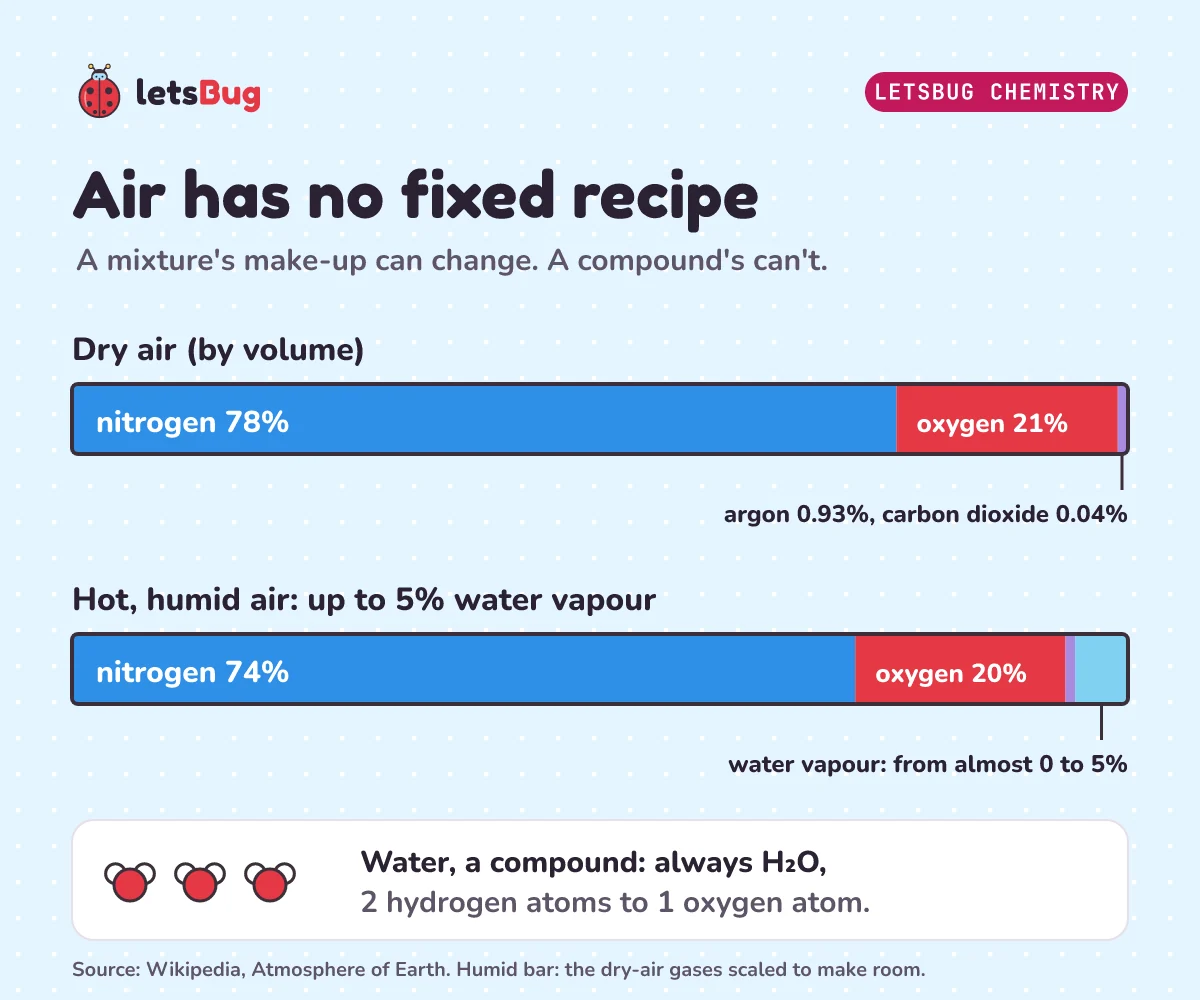
- Air is a mixture: dry air is about 78% nitrogen, 21% oxygen and almost 1% argon, plus water vapour that changes from almost none to about 5%.
- Insoluble solid in a liquid: filter. Dissolved solid you want back: crystallise. The liquid you want back: simple distillation. Liquids that mix and boil less than about 25 °C apart: fractional distillation. Coloured dyes: chromatography.
- Rf = distance moved by the substance ÷ distance moved by the solvent. A pure substance gives a single spot.
- In an exam, describe a mixture in the specification's own words: "not chemically combined", with no fixed proportions.
This post goes with letsBug Chemistry, episode 3. It covers Chapter 5 of the new NCERT Class 9 science book, Exploration, "Exploring Mixtures and their Separation", and the mixtures, separation and chromatography topics of GCSE and IGCSE chemistry. Watch the lesson, or read on: the post adds the method flowchart, worked Rf examples and exam-style questions with model answers.
Element, compound or mixture?
Let's get the three words straight first, because every separation question depends on them.
- An element has only one type of atom. Oxygen is an element.
- A compound is two or more elements joined by chemical bonds. The AQA GCSE specification says compounds contain "two or more elements chemically combined in fixed proportions", and that "Compounds can only be separated into elements by chemical reactions." Water is a compound: always two hydrogen atoms to one oxygen atom, H2O, never anything else.
- A mixture is substances sitting together without being joined. AQA again: "A mixture consists of two or more elements or compounds not chemically combined together. The chemical properties of each substance in the mixture are unchanged."
The last point is the useful one. Because the parts of a mixture keep their own properties (their own boiling point, their own solubility, their own colour), we can use those differences to pull them apart. AQA lists the methods: "Mixtures can be separated by physical processes such as filtration, crystallisation, simple distillation, fractional distillation and chromatography. These physical processes do not involve chemical reactions", so no new substances are made.
Is air a mixture or a compound?
Air is a mixture, and there are two pieces of evidence you can give in an exam.
1. Air has no fixed recipe. Dry air is 78.084% nitrogen, 20.946% oxygen and 0.934% argon by volume, with about 0.04% carbon dioxide. But real air also carries water vapour, and that changes all the time: on average around 1% at sea level, from almost nothing in the coldest air to "as much as 5% by mole fraction in hot, humid air masses". A compound can't change its recipe. Water is 2 hydrogens to 1 oxygen in a glacier and in a kettle. Air on a humid day in Mumbai and air over Antarctica are different mixtures, and both are still air.
2. Air can be separated with no chemical reaction. Factories cool air until it liquefies, then distil it in a tall column, where each gas boils off at its own boiling point. That's fractional distillation, a physical process, and we'll look at it in detail below. Nitrogen comes out as nitrogen and oxygen as oxygen, each with its own properties, just as they went in.
How to choose a separation method
Before you write a single step, ask what is in the mixture and which part you want. Then work down these questions:
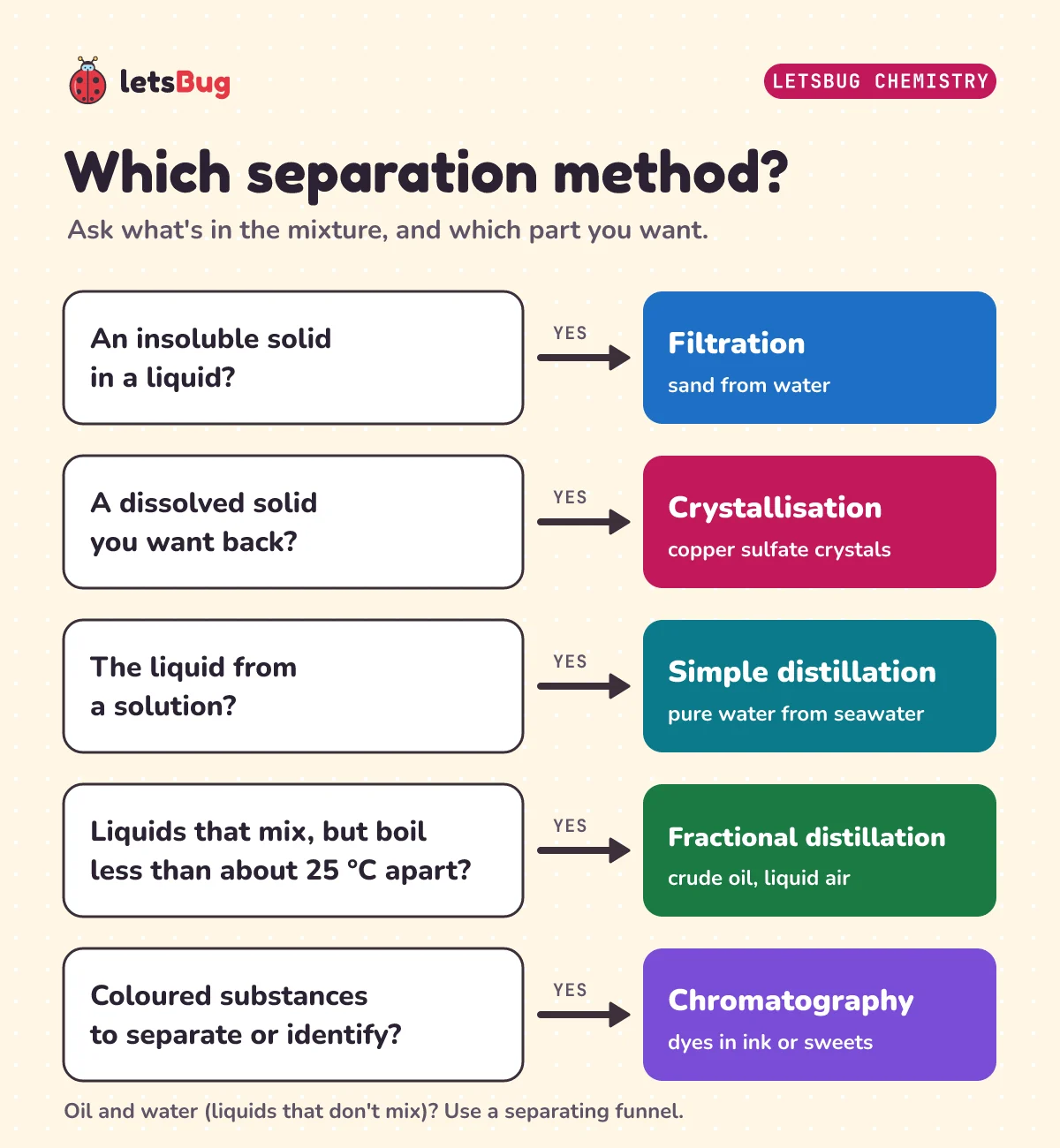
- An insoluble solid in a liquid, like sand in water? Filtration.
- A dissolved solid you want back, like copper sulfate from its solution? Crystallisation.
- The liquid from a solution, like pure water from seawater? Simple distillation.
- Two liquids that mix, with boiling points less than about 25 °C apart? Fractional distillation.
- Coloured substances to separate or identify, like the dyes in ink? Paper chromatography.
NCERT's chapter adds three more for particular mixtures. Two liquids that don't mix (immiscible liquids), like mustard oil and water, settle into layers in a separating funnel: open the tap and the lower layer drains out first. A solid that turns straight into vapour when heated, like camphor mixed with sand, is separated by sublimation. And tiny solid particles that won't settle out of a liquid, as in muddy water, can be spun out by centrifugation.
Filtration
Stir sand into blue copper sulfate solution. The copper sulfate has dissolved, but the sand is insoluble: it doesn't dissolve. Pour the mixture through filter paper folded into a funnel. The sand grains are too big to get through the paper, so they stay behind. The blue solution runs through into the beaker.
Two words earn marks here, and the Cambridge IGCSE syllabus defines both. The residue is "a substance that remains after evaporation, distillation, filtration or any similar process": here, the sand. The filtrate is "a liquid or solution that has passed through a filter": here, the blue solution.
Crystallisation (and why not to evaporate to dryness)
Now we want the copper sulfate out of the filtrate. The tempting way is to boil it until it's completely dry. Don't.
Crystallisation does it properly:
- Heat the solution gently in an evaporating basin until crystals start to form at the edge. Then stop heating.
- Leave it to cool slowly. NCERT's activity says "Allow the solution to cool slowly without disturbing it": slow cooling gives bigger, better-shaped crystals.
- Filter the crystals off and dry them between pieces of filter paper.
Simple distillation: drinking water from seawater
Crystallisation keeps the solid and throws the water away. What if you want the water? Seawater has a salinity of about 3.5%: every kilogram holds roughly 35 grams of dissolved salts. Simple distillation gets the water back:
- Heat the seawater in a flask. The water boils and turns to steam. The salt doesn't boil, so it stays in the flask.
- The steam passes into a condenser, a tube with cold water flowing around it. NCERT: the vapour is "cooled, usually by circulating water or air and condensed as a pure liquid".
- Pure water drips out of the condenser into a beaker.
The same idea works on a giant scale. Ras Al-Khair in Saudi Arabia was described, as of January 2017, as "the world's largest hybrid water desalination plant". It "uses a hybrid system of eight multi-stage flashing units and 17 reverse osmosis units". Multi-stage flash is distillation (evaporate the water, condense it) done at low pressure in many stages. Reverse osmosis, the other half, pushes water through membranes instead.
Fractional distillation: when boiling points are close
Simple distillation works when the boiling points are far apart. NCERT gives the rule of thumb: it separates "liquids that differ in boiling point by at least about 25 °C", and fractional distillation is for "relatively small differences (less than 25 °C)".
Fractional distillation adds a fractionating column on top of the flask, often packed with glass beads. The column has a temperature gradient: "it is coolest at the top and hottest at the bottom". Vapour rising up the column condenses on the beads and boils again, over and over. Each time, the vapour gets richer in the liquid with the lower boiling point, so that liquid reaches the top first and goes into the condenser.
Ethanol (boiling point 78 °C) and water (100 °C) are only 22 °C apart, so separating them needs fractional distillation. Crude oil is the biggest example: refineries split it into fractions such as petroleum gas, petrol, kerosene, diesel, lubricating oil and bitumen. NCERT's chapter covers this, and the Cambridge syllabus asks you to "Describe the separation of petroleum into useful fractions by fractional distillation".
How oxygen is separated from air
Back to the hospital cylinder. The air separation process works like this: "Pure gases can be separated from air by first cooling it until it liquefies, then selectively distilling the components at their various boiling temperatures."
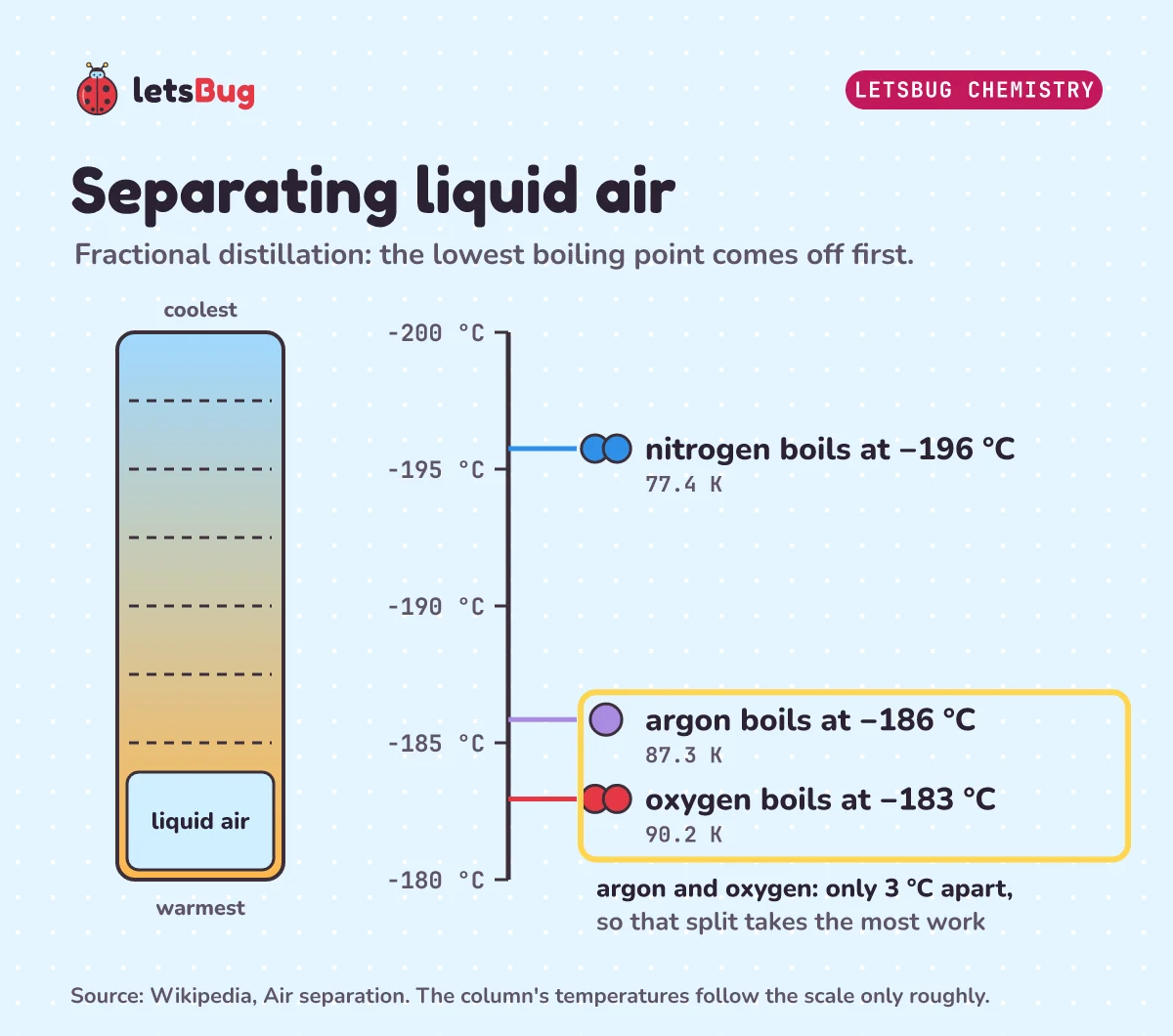
- Cool air to below about −200 °C and it's liquid.
- Nitrogen boils at 77.4 K, which is −196 °C.
- Argon boils at 87.3 K, −186 °C.
- Oxygen boils at 90.2 K, −183 °C.
Nitrogen and oxygen are 13 °C apart, closer than the 25 °C rule, so this is fractional distillation. Argon and oxygen are only about 3 °C apart, and that's the hard part: the argon column "requires a significant amount of energy due to the high reflux ratio required (about 30)". In plain words, for every part of argon taken off, about 30 parts of liquid are sent back down the column to be boiled again.
What comes out is used everywhere. "Pure oxygen is delivered to large hospitals for use with patients", in tankers that refill the liquid-oxygen tanks standing outside them. And steel needs huge amounts: "Modern basic oxygen steelmaking uses almost two tons of oxygen per ton of steel." All of it comes from air, with no chemical reaction at any step. That's the strongest evidence that air is a mixture.
Paper chromatography and Rf values
Inks and food colourings are often mixtures of several dyes. Paper chromatography separates them:
- Draw a start line in pencil about 2 cm from the bottom of the paper. Not pen: "Pen ink dissolves in solvent and interferes with the results." Pencil is graphite, which doesn't dissolve.
- Put a small spot of the mixture on the line.
- Stand the paper in a beaker of solvent (water or ethanol, say), so that the start line is above the solvent. If the spot sat in the solvent, it would wash off into the beaker.
- The solvent soaks up the paper. Each dye travels a different distance, so the spots separate. Stop before the solvent reaches the top and mark the solvent front.
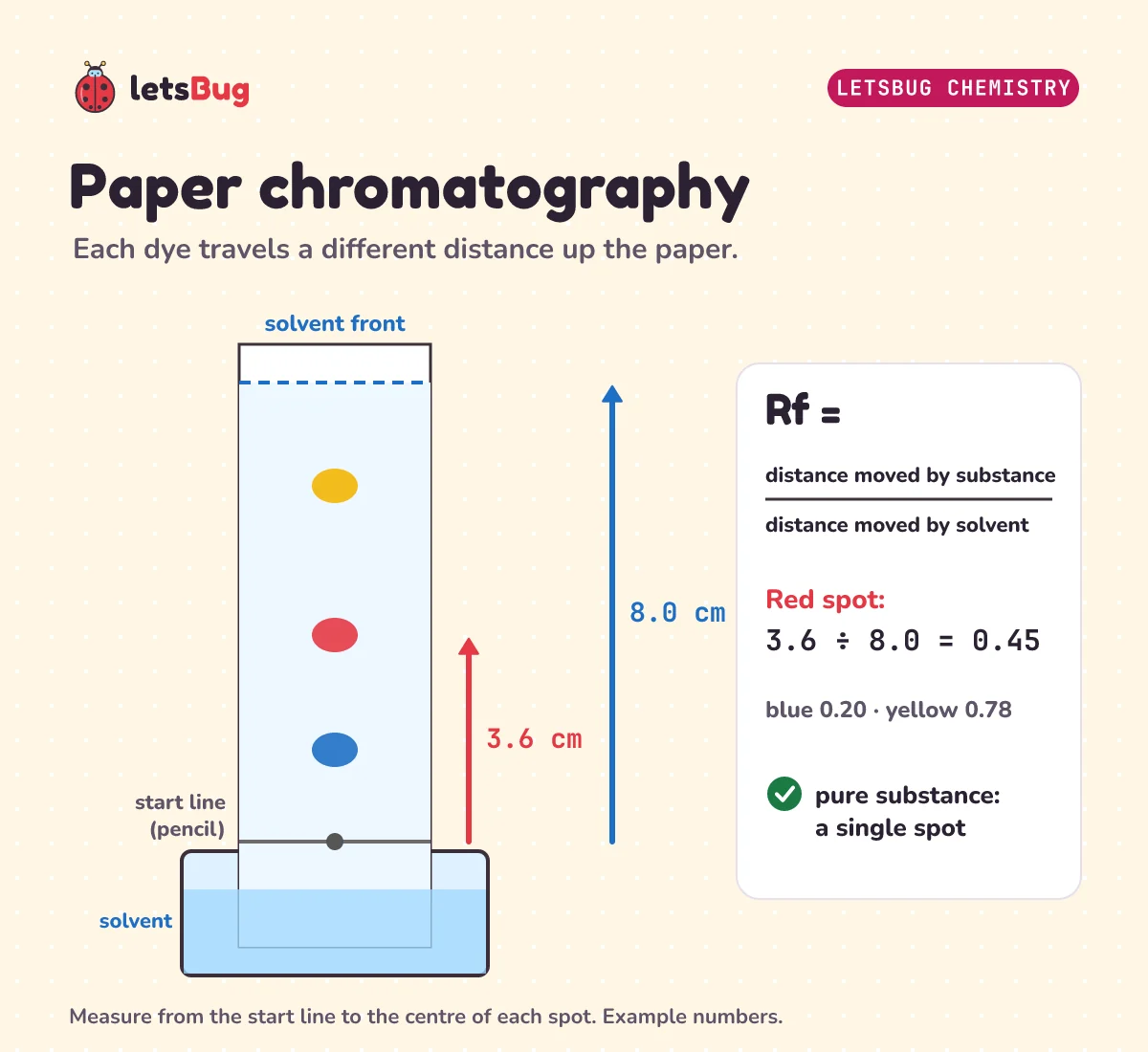
To compare substances, we work out the Rf value. AQA defines it as "The ratio of the distance moved by a compound (centre of spot from origin) to the distance moved by the solvent":
Rf = distance moved by the substance ÷ distance moved by the solvent
Let's try it. On the chromatogram above, the red spot moved 3.6 cm and the solvent front 8.0 cm. Rf = 3.6 ÷ 8.0 = 0.45. The blue spot: 1.6 ÷ 8.0 = 0.20. The yellow spot: 6.2 ÷ 8.0 = 0.775, which is 0.78 to two decimal places. An Rf value is always between 0 and 1, because nothing travels further than the solvent carrying it.
Two more rules. A pure substance gives one spot: AQA says "a pure compound will produce a single spot in all solvents". And to identify an unknown, you compare it "with known substances" run on the same paper in the same solvent. A match in one solvent means it could be the same substance. A match in a second solvent as well makes it much more likely.
Your turn. A food scientist tests the red dye in a sweet. On the chromatogram the dye moved 4.2 cm and the solvent front 7.0 cm. A permitted food colouring has an Rf of 0.60 in the same solvent. Work out the dye's Rf. Could it be that colouring?
Show the answer
Rf = 4.2 ÷ 7.0 = 0.60. That matches the permitted colouring, so it could be the same dye. To be surer, run both again in a second solvent: they should match there too, and the dye should give a single spot.
Exam-style questions with model answers
Q1 (2 marks). Air is a mixture, not a compound. Give two pieces of evidence.
Model answer
Its composition varies, for example the amount of water vapour changes, so there are no fixed proportions [1]. Its gases can be separated by a physical method, the fractional distillation of liquid air, with no chemical reaction [1].
Q2 (4 marks). Rock salt is salt mixed with sand. Describe how to get pure, dry salt from rock salt.
Model answer
Crush the rock salt and stir it into warm water so the salt dissolves [1]. Filter to remove the sand, which stays on the filter paper as the residue [1]. Heat the filtrate gently until crystals start to form [1]. Leave it to cool so crystals grow, then filter them off and dry them between filter papers [1]. "Filter it" on its own isn't enough: it removes the sand but doesn't get the salt out of the water.
Q3 (2 marks). Explain why the start line on a chromatogram is drawn in pencil, and why it must be above the solvent.
Model answer
Pencil (graphite) doesn't dissolve in the solvent, but ink would, and it would run and spoil the results [1]. If the spots were below the solvent level they would dissolve into the solvent instead of moving up the paper [1].
Q4 (2 marks). A dye moves 2.7 cm and the solvent front 9.0 cm. Calculate the Rf value.
Model answer
Rf = 2.7 ÷ 9.0 [1] = 0.30 [1].
Q5 (2 marks). Ethanol boils at 78 °C and water at 100 °C. Which method separates them, and why?
Model answer
Fractional distillation [1]. Their boiling points are only 22 °C apart, less than about 25 °C, so simple distillation would not separate them well [1]. (Even fractional distillation can't get past about 95.6% ethanol by mass, because the two form a constant-boiling mixture called an azeotrope. You won't be asked for that at this level.)
Q6 (3 marks). Suggest a method to get drinking water from seawater, and explain how it works.
Model answer
Simple distillation [1]. The water boils and turns to steam, and the salt stays behind in the flask [1]. The steam is cooled in a condenser and condenses to pure water [1].
Questions people ask
Is air a mixture or a compound?
A mixture. Its gases are not chemically combined, its composition varies (especially the water vapour), and it can be separated by fractional distillation of liquid air with no chemical reaction.
What is the difference between a mixture and a compound?
A compound is two or more elements chemically combined in fixed proportions, and only a chemical reaction separates it. A mixture is not chemically combined, has no fixed proportions, each part keeps its properties, and physical methods separate it.
Is brass a mixture or a compound?
A mixture. Brass is an alloy of copper and zinc whose proportions are varied to change its colour and strength, so it has no fixed formula. NCERT adds that physical methods can't separate an alloy's metals, so don't suggest filtering or distilling it.
How do you separate a mixture?
Ask what's in it and which part you want. Filter an insoluble solid, crystallise a dissolved solid, use simple distillation to get the liquid from a solution, fractional distillation for liquids with close boiling points, and chromatography for coloured substances.
When do you use fractional distillation instead of simple distillation?
When the liquids' boiling points are close: NCERT's rule of thumb is less than about 25 °C apart. Ethanol and water (78 °C and 100 °C) need fractional distillation.
How do you calculate an Rf value?
Divide the distance moved by the substance (start line to the centre of the spot) by the distance moved by the solvent (start line to the solvent front). A spot at 3.6 cm with the front at 8.0 cm has Rf = 0.45.
Why shouldn't you evaporate copper sulfate solution to dryness?
Copper sulfate decomposes if you keep heating it, and hot crystals can spit out of the basin. Heat until crystals start to form, then stop and let it cool.
Keep going
- Watch the full lesson, Is Air a Mixture? Separating Mixtures Explained, or the one-minute version: why is air a mixture, not a compound?
- The argon in air is a noble gas: why are noble gases unreactive? (episode 2, electron shells).
- Next in the series is isotopes and relative atomic mass. For a head start, what is inside an atom explains why chlorine's relative atomic mass is 35.5.
Sources
- NCERT Class 9 Science, Exploration: Chapter 5, Exploring Mixtures and their Separation (alloys, crystallisation Activity 5.3, distillation and the 25 °C rule, fractional distillation of petroleum, paper chromatography Activity 5.5, separating funnel, sublimation, centrifugation)
- AQA GCSE Chemistry 8462 specification: Atomic structure and the periodic table (4.1.1.1 to 4.1.1.2, compounds and mixtures) and Chemical analysis (4.8.1, pure substances, chromatography, Rf)
- Cambridge IGCSE Chemistry 0620: syllabus for 2026 to 2028 (9.3 alloys, 10.3 air, 11 petroleum, 12 residue, filtrate, chromatography)
- Physics & Maths Tutor: Edexcel core practical 3, preparing copper sulfate
- MyEdSpace: AQA required practical 6, chromatography
- Wikipedia: Air separation (boiling points, argon column, hospitals, steelmaking), Atmosphere of Earth (composition, water vapour), Oxygen, Brass, Fractional distillation, Seawater, Ras Al-Khair Power and Desalination Plant, Halite (rock salt), Ethanol (boiling point, azeotrope)
Every number in this post was checked against these sources, and every calculation (Rf values, boiling points converted from kelvin, the air percentages) was checked in Python before publishing.