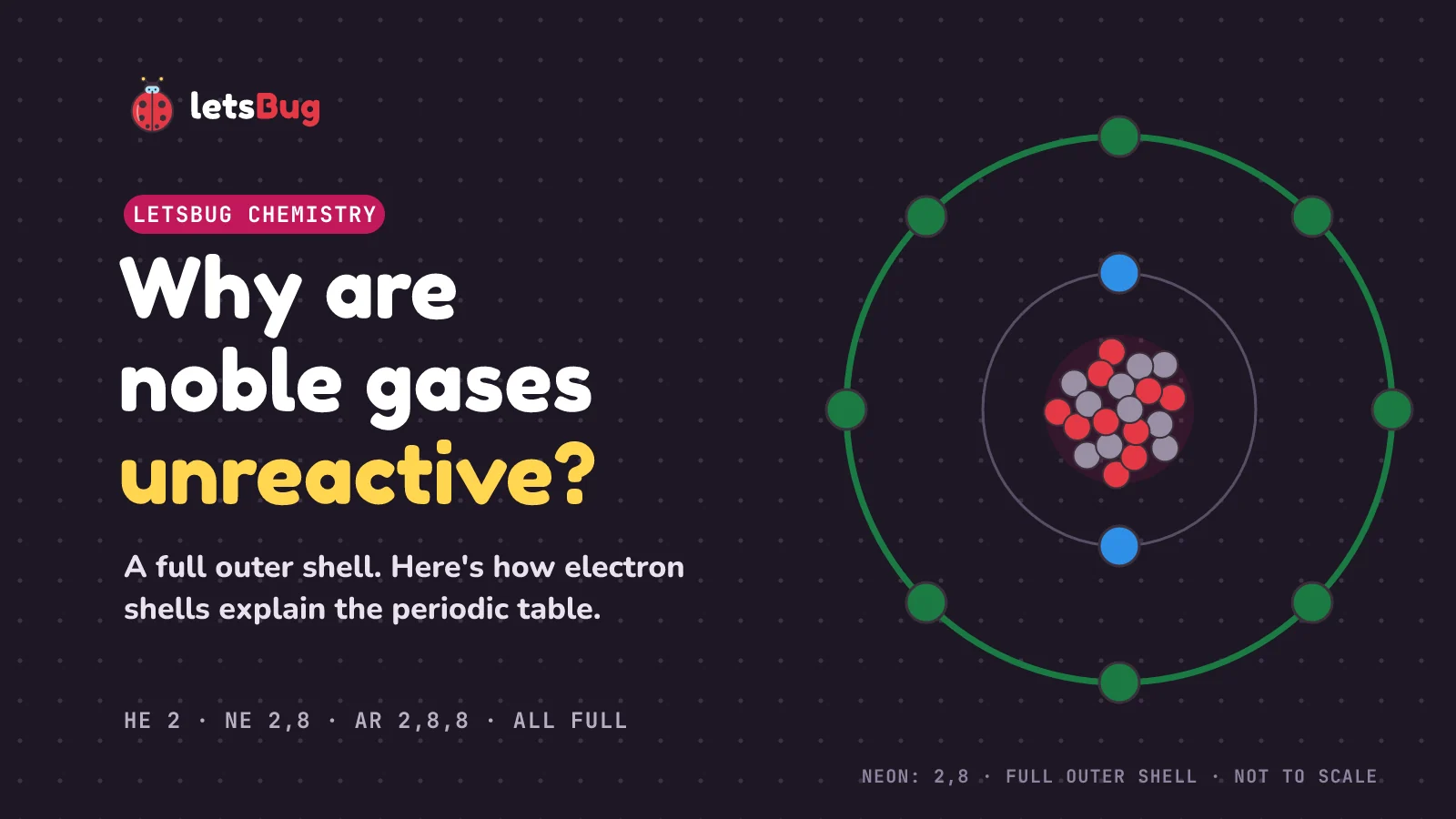
Noble gases are unreactive because their outer shell of electrons is already full: 8 electrons, or 2 for helium. That's a stable arrangement, so a noble gas atom doesn't easily gain, lose or share electrons, and reactions are all about electrons being gained, lost or shared. Sodium is the opposite. Its 11 electrons are arranged 2,8,1, and that single outer electron is lost easily, which is why a lump of sodium fizzes across water while helium sits safely inside party balloons. In this post we'll fill electron shells for the first 20 elements (with the full table), see why the periodic table is really a map of those shells, and learn the exact words that earn the marks in an exam.
Key takeaways
- Electrons fill shells from the inside out. For the first 20 elements: up to 2, then 8, then 8, then the fourth shell. Calcium is 2,8,8,2, never 2,8,10.
- Valence electrons are the electrons in the outermost shell. They decide how an atom reacts.
- Period = number of shells. In groups 1 and 2 the group number is the number of outer electrons; in groups 13 to 17 (3 to 7 at GCSE) it's the last digit.
- Noble gases (group 18, called group 0 at GCSE) have a full outer shell, a stable arrangement, so they don't easily gain, lose or share electrons.
- Group 1 metals have one outer electron and lose it easily: sodium 2,8,1 reacts with water, helium doesn't.
- In an exam, answer in terms of electrons. "Argon doesn't form bonds" isn't enough.
This post goes with letsBug Chemistry, episode 2, and carries on from episode 1. If protons, electrons and atomic number are new to you, read what is inside an atom first. It covers the electron arrangements in Class 9 science in India (in the new NCERT book, Exploration, it's section 8.7 of Chapter 8, "Journey Inside the Atom") and the electronic structure and periodic table topics of GCSE and IGCSE chemistry. Watch the lesson, or read on: the post adds the full table, exam-style questions and model answers.
Why are noble gases unreactive?
Among the first 20 elements there are three noble gases: helium, neon and argon. Write out their electrons and you'll see what they share:
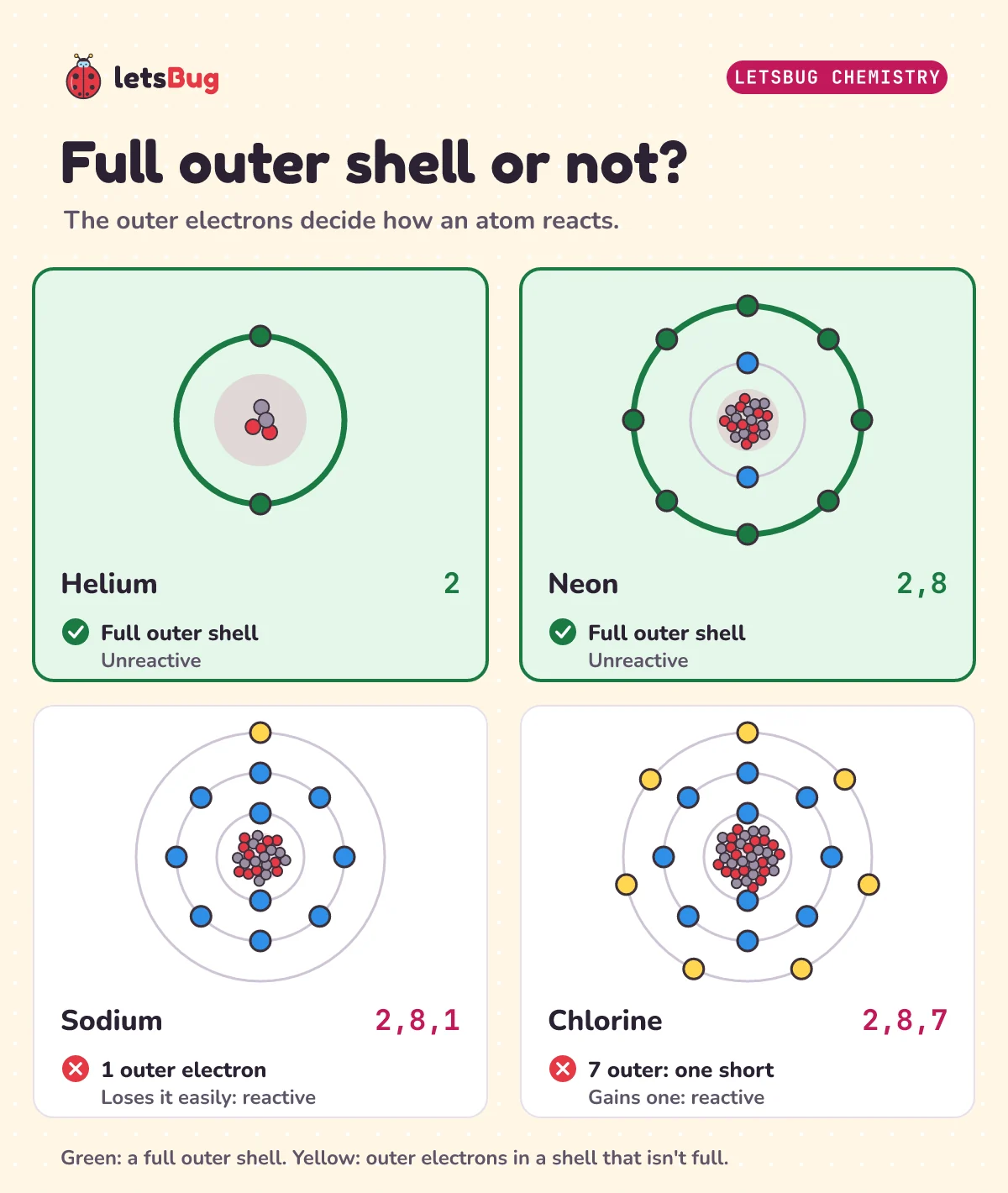
- Helium: 2. The first shell holds only 2, so it's full.
- Neon: 2,8. The second shell is full with 8.
- Argon: 2,8,8. Eight in the outer shell again.
The AQA GCSE specification puts it plainly: the noble gases are unreactive "because their atoms have stable arrangements of electrons", with eight electrons in the outer shell "except for helium, which has only two electrons". NCERT says the same thing: atoms with 8 outer electrons, or 2 for helium, are "largely unreactive and more stable", while "atoms with incomplete valence shells are usually more reactive".
Every chemical reaction comes down to electrons moving: one atom gives electrons away, another takes them, or two atoms share a pair. A noble gas atom doesn't easily do any of these three things, so there's nothing to drive a reaction. That is the whole answer, and it's also the answer examiners want.
How electrons fill shells: 2, 8, 8
Electrons sit in shells (energy levels) around the nucleus. The AQA specification says they "occupy the lowest available energy levels (innermost available shells)": the first shell fills before the second, the second before the third. For the first 20 elements:
- the first shell holds up to 2 electrons,
- the second up to 8,
- the third up to 8, and then the fourth shell starts.
NCERT names the shells K, L, M and N and gives the maximum for each shell as 2n²: 2 for K, 8 for L and 18 for M. But it adds a second rule: the outermost shell can hold at most 8 electrons. That's why the M shell stops at 8 for potassium and calcium, so both versions of the rule give the same answers for the first 20 elements.
Let's build atoms one electron at a time. Hydrogen's single electron goes in the first shell: 1. Helium's two fill it: 2. Lithium's third electron has to start the second shell: 2,1. Keep adding one at a time and you reach neon, 2,8, with two full shells. Sodium's 11th electron starts the third shell: 2,8,1. Argon fills it to 2,8,8, then potassium starts the fourth: 2,8,8,1.
Electronic configuration of the first 20 elements
Here is every arrangement you need for Class 9 and GCSE, with each element's group and period. Groups are numbered 1 to 18, the system used on most periodic tables today; the number in brackets is the GCSE group number (1 to 7 and 0).
| Element | Symbol | Atomic number | Shells (K, L, M, N) | Group (GCSE) | Period |
|---|---|---|---|---|---|
| Hydrogen | H | 1 | 1 | 1 | 1 |
| Helium | He | 2 | 2 | 18 (0) | 1 |
| Lithium | Li | 3 | 2,1 | 1 | 2 |
| Beryllium | Be | 4 | 2,2 | 2 | 2 |
| Boron | B | 5 | 2,3 | 13 (3) | 2 |
| Carbon | C | 6 | 2,4 | 14 (4) | 2 |
| Nitrogen | N | 7 | 2,5 | 15 (5) | 2 |
| Oxygen | O | 8 | 2,6 | 16 (6) | 2 |
| Fluorine | F | 9 | 2,7 | 17 (7) | 2 |
| Neon | Ne | 10 | 2,8 | 18 (0) | 2 |
| Sodium | Na | 11 | 2,8,1 | 1 | 3 |
| Magnesium | Mg | 12 | 2,8,2 | 2 | 3 |
| Aluminium | Al | 13 | 2,8,3 | 13 (3) | 3 |
| Silicon | Si | 14 | 2,8,4 | 14 (4) | 3 |
| Phosphorus | P | 15 | 2,8,5 | 15 (5) | 3 |
| Sulfur | S | 16 | 2,8,6 | 16 (6) | 3 |
| Chlorine | Cl | 17 | 2,8,7 | 17 (7) | 3 |
| Argon | Ar | 18 | 2,8,8 | 18 (0) | 3 |
| Potassium | K | 19 | 2,8,8,1 | 1 | 4 |
| Calcium | Ca | 20 | 2,8,8,2 | 2 | 4 |
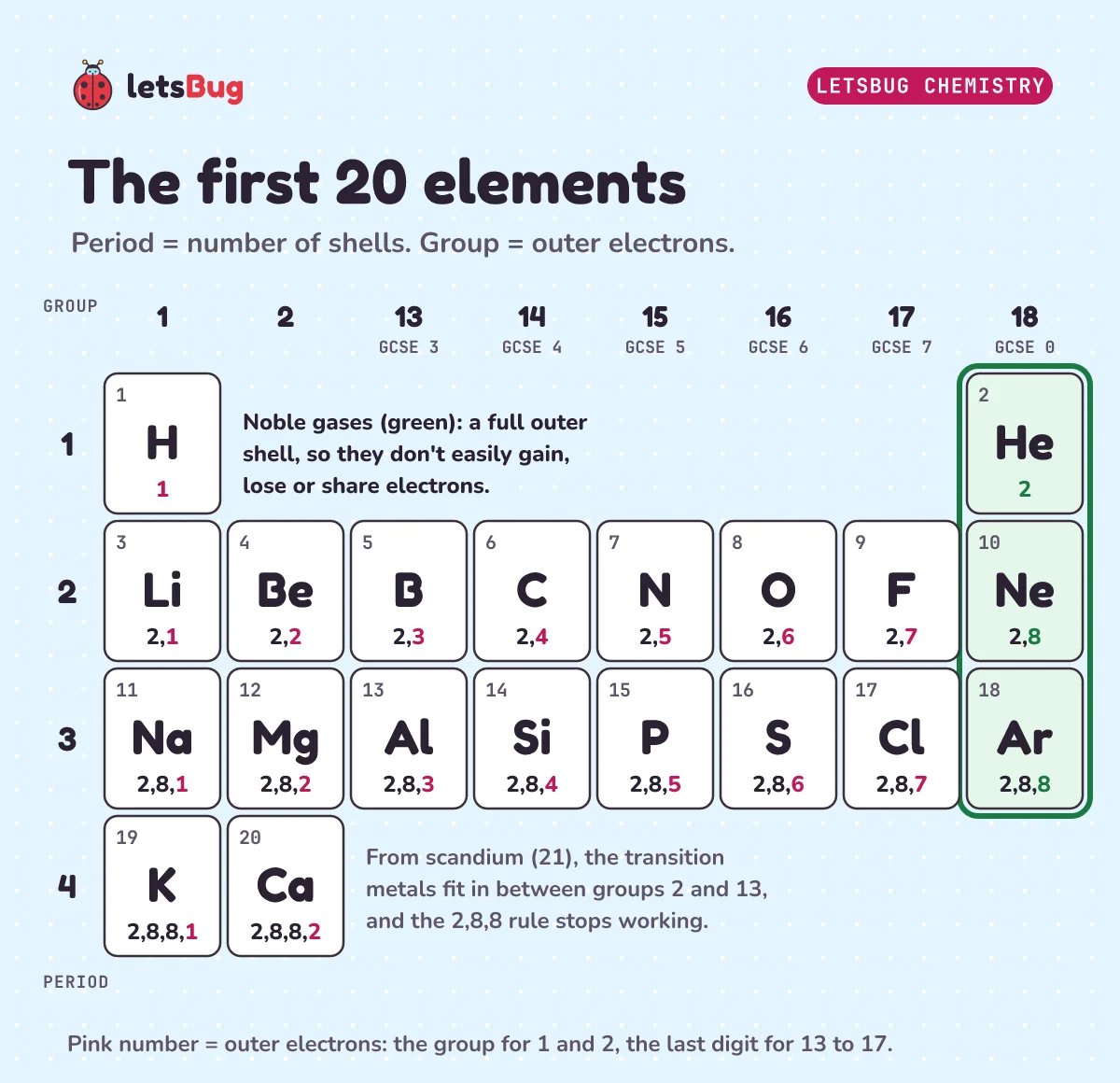
This is the school model. NCERT's Class 9 table, the AQA specification ("the first twenty elements") and the Cambridge IGCSE syllabus (proton number 1 to 20) all stop at calcium, and for these 20 the simple rule gives the same shell counts as the real atoms. From element 21 it breaks. Scandium is really 2,8,9,2, not the 2,8,8,3 the rule would give. Shells are split into subshells called s, p and d, and from scandium to zinc the extra electrons go into the third shell's d subshell (3d), which lets the third shell grow past 8 towards its full 18. Potassium and calcium start the fourth shell first because the 4s subshell fills before 3d. You'll meet subshells in Class 11 or at A level. Until then, 2, 8, 8 is all you need.
What are valence electrons?
NCERT's definition: "The outermost shell containing electrons of an atom is known as its valence shell", and the electrons in it are the valence electrons. Sodium (2,8,1) has 1, oxygen (2,6) has 6, chlorine (2,8,7) has 7. For neon and argon, all 8 outer electrons count, and the shell is full.
Valence electrons are the ones that take part in reactions, which is why the inner shells hardly matter to an element's chemistry. It also explains why isotopes react in the same way. Chlorine-35 has 18 neutrons and chlorine-37 has 20, but both have 17 protons, so both have 17 electrons arranged 2,8,7. The Cambridge syllabus gives that as the reason isotopes have the same chemical properties: the same number of electrons, and so the same electronic configuration.
Why the group number tells you the outer electrons
Line the elements up in order of atomic number and start a new row each time a new shell starts, and you get the periodic table. So the table is a map of electron shells:
- The period (row) is the number of shells in use. The Cambridge syllabus puts it as "the number of occupied electron shells is equal to the period number".
- The group (column) tells you the outer electrons. Cambridge again: "the number of outer shell electrons is equal to the group number in Groups I to VII".
The AQA specification gives the reason this matters: elements in the same group have the same number of outer electrons, "and this gives them similar chemical properties". Lithium, sodium and potassium all end in 1, so they all react in similar ways.
The one thing that confuses people is the numbering. GCSE and IGCSE number the main groups 1 to 7 and call the noble gases group 0 (Cambridge writes I to VII and VIII). Most periodic tables now number all 18 columns, because the ten columns of transition metals (groups 3 to 12, starting at scandium) sit between group 2 and the next main group. So with the 1 to 18 numbers:
- Groups 1 and 2: the group number is the number of outer electrons.
- Groups 13 to 17: the outer electrons are the last digit, so group 13 has 3 and group 17 has 7. That's the GCSE group number.
- Group 18 (group 0): a full outer shell, 8 electrons, or 2 for helium. Helium has only 2 outer electrons but sits with the noble gases because its shell is full and it behaves like them.
Hydrogen is the odd one out at the other end. It has 1 electron and sits at the top of group 1, but it isn't an alkali metal: it isn't a metal at all.
Let's use the map. Chlorine is 2,8,7: 3 shells, so period 3; 7 outer electrons, so group 17 (group 7 at GCSE). It works backwards too. Which element is 2,8,3? Three shells puts it in period 3, three outer electrons in group 13 (group 3). That's aluminium, and the check works: 2 + 8 + 3 = 13, aluminium's atomic number.
Why sodium reacts with water but helium doesn't
Put the two arrangements side by side. Helium is 2: one shell, and it's full. Sodium is 2,8,1: one electron alone in a third shell, a long way from the nucleus and screened from its pull by the 10 electrons in the inner shells. That lone electron is lost easily, and when it goes, what's left is 2,8, the same arrangement as neon.
Drop a small piece of sodium into water and Chemguide describes what you see: it melts "almost at once to form a small silvery ball that dashes around the surface", giving off hydrogen as it goes. The group 1 metals are so reactive that they're stored under oil to keep air and moisture away. Helium, holding its two electrons tightly with no room for a third, just floats your balloon.
Reactivity down groups 1 and 7
Going down group 1, the metals get more reactive. Lithium floats on water, "gently fizzing". Sodium reacts faster. With potassium, "enough heat is given off to set light to the hydrogen", which burns with a lilac flame. The reason is the outer electron. Potassium (2,8,8,1) has one more shell than sodium, so its outer electron is further from the nucleus, with more inner shells shielding it. In Chemguide's words, "The extra protons in the nucleus are screened by additional layers of electrons." The attraction is weaker, so the electron is lost more easily.
Group 7, the halogens, is the same idea in reverse. Fluorine (2,7) and chlorine (2,8,7) are one electron short of a full shell, and they react by gaining one. Going down the group, the outer shell is further from the nucleus, so an incoming electron feels less attraction and reactivity decreases: fluorine is the most reactive, then chlorine, bromine and iodine.
Noble gases at work
Being unreactive makes the noble gases useful, and sometimes lifesaving:
- Balloons and airships. On 6 May 1937 the airship Hindenburg, filled with hydrogen, caught fire while landing at Lakehurst, New Jersey. 36 people died: 35 of the 97 on board and one man on the ground. Today balloons and airships use helium, a non-flammable gas that is still lighter than air. Hydrogen has one electron it can share; helium's full shell gives it nothing to react with, so it can't burn.
- Light bulbs. Argon is the third most common gas in the air, at 0.934%, just under 1%. Old-style filament bulbs were filled with an inert gas such as argon instead of air. Oxygen would attack the white-hot tungsten filament; argon doesn't react with it, and the gas also slows the filament's evaporation.
- Signs. Neon signs have glowed since 1910, when Georges Claude showed neon tube lighting at the Paris Motor Show. The gas glows when electricity passes through it, and being a noble gas it leaves the metal electrodes at each end of the tube alone.
Neon has atomic number 10. Write its electron arrangement, give its group and period, and explain why neon doesn't react with the metal electrodes in a neon sign.
Show the answers
Neon is 2,8 (2 + 8 = 10). It has 2 shells, so it's in period 2. Its outer shell is full, so it's in group 18 (group 0 at GCSE). It has a stable arrangement of electrons, so it does not easily gain, lose or share electrons, and it leaves the electrodes alone.
Mark words vs vague words
Here's a real exam that shows why this matters. On the AQA GCSE Chemistry higher paper in June 2023, question 08.1 was about argon. The examiners' report says nearly all students mentioned the stable outer shell, but "some simply repeated that argon does not form compounds or does not form bonds. This was insufficient as the question required students to answer in terms of electrons."
- Mark words: argon has a full (stable) outer shell of electrons, so it does not easily gain, lose or share electrons.
- Vague words: argon doesn't form bonds, argon is happy, argon wants a full shell.
Exam-style questions with model answers
Q1 (2 marks). Calcium has atomic number 20. Write its electron arrangement and give its group and period.
Model answer
2,8,8,2 [1]. Group 2, period 4 [1]. Check: 2 + 8 + 8 + 2 = 20. Writing 2,8,10 loses the mark.
Q2 (3 marks). An element has the electron arrangement 2,8,6. Identify the element and explain how you used the arrangement.
Model answer
It has 3 shells, so it's in period 3 [1]. It has 6 outer electrons, so it's in group 16 (group 6 at GCSE) [1]. It's sulfur, atomic number 2 + 8 + 6 = 16 [1].
Q3 (2 marks). Explain why argon is unreactive. Answer in terms of electrons.
Model answer
Argon has a full (stable) outer shell of electrons [1], so it does not easily gain, lose or share electrons [1]. "Argon does not form bonds" scores nothing on its own.
Q4 (3 marks). Explain why potassium is more reactive than sodium.
Model answer
Potassium's outer electron is in a shell further from the nucleus, with more shielding by inner shells [1]. So the attraction between the nucleus and the outer electron is weaker [1]. So potassium loses its outer electron more easily [1]. "Potassium is lower in group 1" is true but explains nothing.
Q5 (3 marks). Explain why fluorine is more reactive than chlorine.
Model answer
Fluorine's outer shell is closer to the nucleus, with less shielding [1]. So an incoming electron is attracted more strongly [1]. So fluorine gains an electron more easily [1].
Questions people ask
Why are noble gases unreactive?
Their outer shell is full: 8 electrons, or 2 for helium. This is a stable arrangement, so noble gas atoms do not easily gain, lose or share electrons, and without that there's no reaction.
What is the electronic configuration of the first 20 elements?
Fill shells with up to 2, then 8, then 8 electrons, then start the fourth shell. Hydrogen is 1, helium 2, neon 2,8, sodium 2,8,1, argon 2,8,8, potassium 2,8,8,1 and calcium 2,8,8,2. The table above lists all 20.
What are valence electrons?
The electrons in an atom's outermost shell. Sodium (2,8,1) has 1 valence electron and chlorine (2,8,7) has 7. They decide how the atom reacts.
Why is helium in group 18 if it has only 2 outer electrons?
Because its only shell holds 2, so 2 electrons make it full. A full outer shell is what the noble gases have in common, and helium is just as unreactive as neon and argon.
Why is potassium 2,8,8,1 and not 2,8,9?
For the first 20 elements the outermost shell can hold at most 8, so the 19th electron starts the fourth shell. In more advanced terms, the 4s subshell fills before 3d. From scandium (21) on, the third shell does start to fill beyond 8.
Why does sodium react with water but helium doesn't?
Sodium (2,8,1) has one outer electron far from the nucleus, which it loses easily. Helium (2) has a full shell, so it does not easily gain, lose or share electrons.
Keep going
- Watch the full lesson, Why Are Noble Gases Unreactive? Electron Shells Explained, or the one-minute version: why does sodium react with water but helium doesn't?
- The lesson before this one: what is inside an atom (protons, neutrons, electrons and isotopes).
- Group 1 at work: how GPS works without internet relies on atomic clocks built on caesium or rubidium atoms: two more group 1 metals, with one outer electron each.
- More Class 9 science: animal cell vs plant cell, part by part.
Sources
- NCERT Class 9 Science, Exploration: Chapter 8, Journey Inside the Atom (section 8.7: 2n², outermost shell holds up to 8, Table 8.4, valence shell and valence electrons, "largely unreactive and more stable")
- AQA GCSE Chemistry 8462 specification: Atomic structure and the periodic table (lowest available energy levels, first twenty elements, same group same outer electrons, group 0, group 1, group 7)
- Cambridge IGCSE Chemistry 0620: syllabus for 2026 to 2028 (2.2.5 to 2.2.6: proton number 1 to 20, group and period rules; 2.3.3 isotopes)
- AQA: GCSE Chemistry 8462/1H examiners' report, June 2023 (question 08.1 on argon)
- Royal Society of Chemistry, Education in Chemistry: Avoiding bonding misconceptions
- Chemguide: Reactions of the group 1 elements with water and Atomic and physical properties of the group 7 elements
- Wikipedia element pages for electrons per shell, group and period: Potassium, Calcium, Scandium (2,8,9,2), and the 17 others; Electron configuration (4s before 3d); Group (periodic table) (18 groups, hydrogen)
- Wikipedia: Hindenburg disaster, Helium, Argon (0.934% of air, HArF), Incandescent light bulb, Alkali metal, Neon lighting
Every number in this post was checked against these sources, and the table of the first 20 elements was built and checked in Python before publishing.