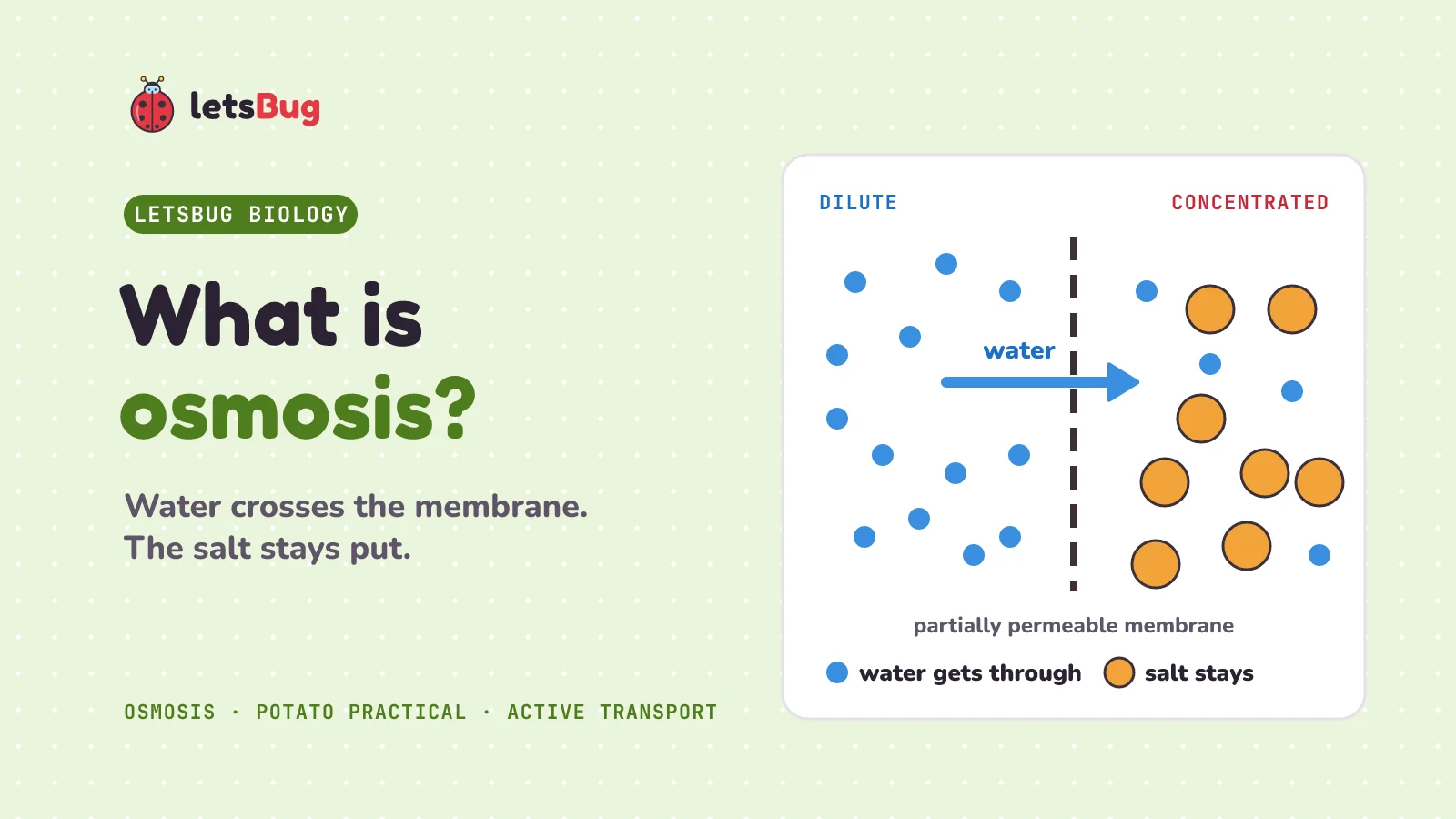
Osmosis is the diffusion of water from a dilute solution to a more concentrated solution through a partially permeable membrane. Only the water moves: the membrane lets small water molecules through but holds back bigger solute particles such as salt and sugar.
In this post we'll start with why water beads up on a salted cucumber (the puddle is water that has left the cucumber's cells, not salt soaking in), pin down the definition in words that score marks, see what pure water and strong salt do to animal and plant cells, work through the potato practical with percentage change in mass, and then meet active transport, which moves things the other way, against the concentration gradient.
Key takeaways
- Osmosis: water moves from a dilute solution to a more concentrated solution through a partially permeable membrane. It needs no energy from the cell.
- In osmosis only the water moves. If a solute such as salt or sugar moves, that's diffusion or active transport.
- In pure water, an animal cell swells and bursts; a plant cell becomes turgid, because its wall stops it bursting. In strong salt solution both lose water, and the plant cell's membrane pulls away from its wall (plasmolysis).
- Percentage change in mass = change in mass ÷ starting mass × 100. A cylinder going from 3.20 g to 2.56 g has changed by -20%, not -25%.
- Active transport moves substances against the concentration gradient, using carrier proteins and energy from respiration. Root hair cells take in mineral ions this way.
This post goes with letsBug Biology, episode 3. Watch it, or read on: the post adds the full working for every calculation, the mark-scoring wording, and exam-style questions with model answers.
Salt on a cucumber: what really moves?
Slice a cucumber, sprinkle some salt on the slices and leave them for a while. Drops of water bead up all over them. Raw cucumber is 95% water, and some of that water has just come out of its cells.
It's tempting to say the salt soaked in. But if the salt had moved into the cucumber, where would the puddle on the plate come from? The puddle is water that has come out of the cells. It's the water that moves, out of the cells and towards the salt. That movement of water is osmosis.
What is osmosis?
In why are cells so small? we met diffusion: the net movement of particles from an area of higher concentration to an area of lower concentration. Osmosis is a special case of it, for water:
Each part of that sentence matters:
- Partially permeable means the membrane lets some particles through but not others. Small water molecules can cross it; bigger solute particles, like sugar or salt, can't. Your Class 9 NCERT textbook calls the same thing a selectively permeable membrane, and the cell membrane is one.
- Dilute means lots of water and little solute. Concentrated means less water and more solute.
- Water molecules move both ways across the membrane all the time. But the dilute side has more free water molecules, so more of them cross from that side than come back. The net movement is from the dilute solution to the concentrated one.
Like all diffusion, osmosis is passive: the cell spends no energy on it.
Say it the way that scores marks
AQA's examiners, reporting on the June 2023 GCSE Biology paper, flagged this answer: "water moves from an area of high concentration to an area of low concentration". It loses the mark. A high concentration of what? In the report's words, "If water concentration is not specified, it is assumed that solute concentration is being described and this often results in an incorrect answer". And a high concentration of solute is exactly where water goes to, not where it comes from.
| Loses the mark | Scores |
|---|---|
| "Water moves from a high concentration to a low concentration." | "Water moves from a dilute solution to a more concentrated solution." |
| "It goes through the membrane." | "Through a partially permeable membrane." |
| "The sugar sucked the water out." | "The solution outside was more concentrated than the solution inside the cells, so water moved out by osmosis." |
The rule: name the water, name the membrane, and compare the two solutions.
Does the salt move in osmosis? The myth
This is the big one. In that same 2023 paper, students had to explain how an antibiotic makes bacteria burst, and "A sizeable minority thought that the antibiotic entered the bacteria by osmosis causing it to burst." Over three quarters of students scored nothing on that question.
The Class 9 NCERT textbook offers the same wrong idea as an option. Its end-of-chapter question puts Cell X in pure water and Cell Y in a concentrated salt solution: X swells and Y shrinks. The first option offered as an explanation is "Salt molecules moved into Cell Y, causing it to shrink." That's the trap. Salt moving in would make the cell more salty, not smaller. Cell Y shrinks because more water leaves it than comes back.
So keep one line in your head: in osmosis, only water moves. A solute that moves is moving by diffusion or by active transport.
What does osmosis do to animal cells? Burst, no change or shrink
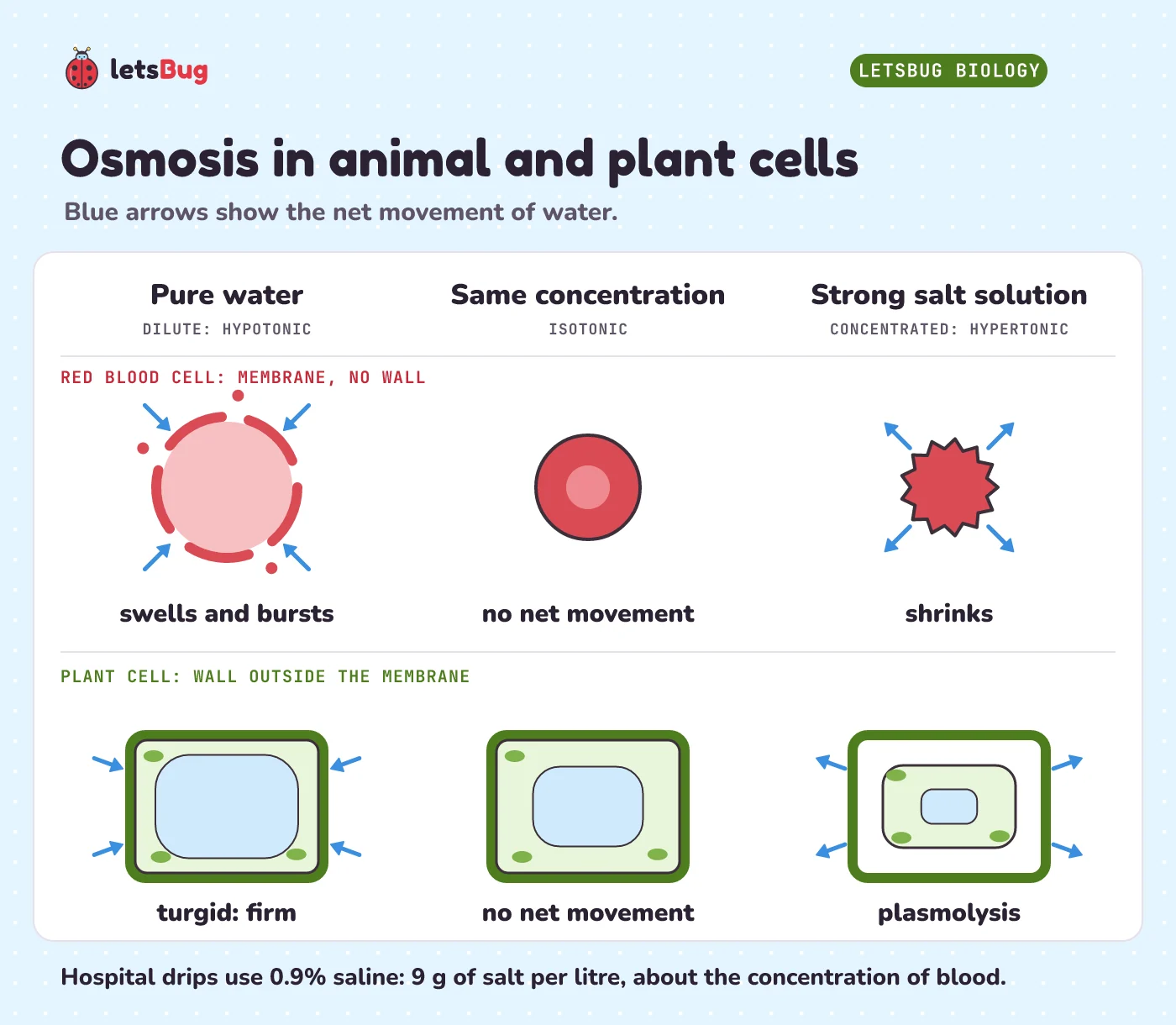
Let's take a red blood cell, which has a membrane but no wall.
- In pure water, the water outside is more dilute than the cell's cytoplasm, so water moves in by osmosis. With no wall to hold it, the cell swells until it bursts (biologists say it lyses).
- In a strong salt solution, the solution outside is more concentrated, so water moves out. The cell shrinks and crinkles (it crenates).
- In a solution at the same concentration as the cell, water still moves in and out, but there's no net movement, so nothing changes.
Your textbook may use three names for these solutions, comparing the solute concentration outside the cell with the inside: hypotonic (outside is more dilute, as in pure water), hypertonic (outside is more concentrated, as in strong salt) and isotonic (the same).
That's why a hospital drip uses 0.9% saline: 9 g of salt in every litre, which is about the same concentration as blood. Blood cells in it neither swell nor shrink. As a check, 9 g in 1000 mL is 0.9 g in every 100 mL, which is what 0.9% means here.
What does osmosis do to plant cells? Turgid or plasmolysed
Plant cells have a strong cell wall outside the membrane, and that changes the story.
- In pure water, water moves in by osmosis. The vacuole swells and pushes the cytoplasm and membrane hard against the wall. The cell becomes turgid: firm, like a pumped-up tyre. The wall stops it bursting.
- In a strong salt or sugar solution, water moves out. The vacuole shrinks and the membrane pulls away from the wall. That's plasmolysis.
Turgid cells are what hold a non-woody plant upright. When a plant doesn't get enough water, its vacuoles lose water, its cells become less firm, and the plant wilts. Water it, and the cells take water back in and the plant firms up again.
How to do the osmosis potato practical: percentage change in mass
You can measure osmosis in the classic potato practical. In AQA GCSE Biology it's Required practical activity 3, and the Class 9 NCERT textbook has a simpler version (Activity 2.2): one potato piece in plain water, one in a 20 per cent salt or sugar solution, left for about an hour.
Method
- Cut potato cylinders of the same size, blot them dry and weigh each one.
- Put one cylinder in each of a range of sugar solutions, for example from 0 (pure water) up to 1.0 mol/dm³: 0, 0.2, 0.4, 0.6, 0.8 and 1.0 mol/dm³.
- Leave them all for the same time, at the same temperature. Repeating each concentration makes the results more reliable.
- Take them out, blot them dry again and reweigh them.
Blotting matters: water clinging to the outside would add mass that never went into the cells.
Why percentage change in mass?
The cylinders never start at exactly the same mass, so comparing the change in grams isn't fair. A 0.3 g gain means more for a small cylinder than for a big one. So we compare the percentage change in mass:
Worked examples
- A cylinder from pure water goes from 2.50 g to 2.85 g. Change = 2.85 - 2.50 = +0.35 g. Percentage change = 0.35 ÷ 2.50 × 100 = +14%.
- A cylinder from the strongest solution goes from 3.20 g to 2.56 g. Change = 2.56 - 3.20 = -0.64 g. Percentage change = -0.64 ÷ 3.20 × 100 = -20%.
The classic slip is to divide by the final mass: 0.64 ÷ 2.56 × 100 = 25%. That's wrong. It's always the starting mass, because you're asking how much the cylinder changed compared with what it was.
Reading the graph
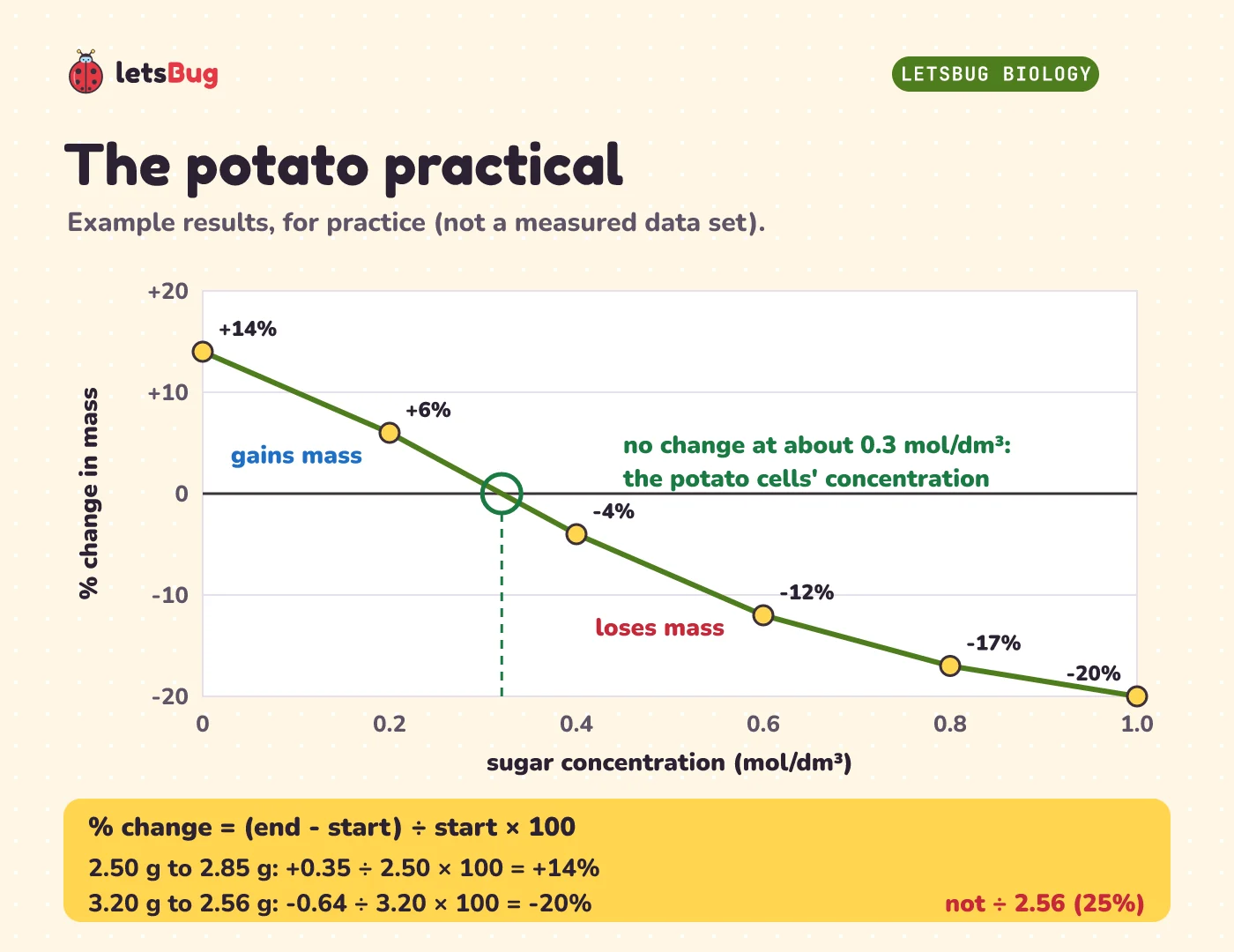
Here's a set of example results with the usual shape (they're for practice, not a real measured data set):
| Sugar (mol/dm³) | 0 | 0.2 | 0.4 | 0.6 | 0.8 | 1.0 |
|---|---|---|---|---|---|---|
| % change in mass | +14 | +6 | -4 | -12 | -17 | -20 |
In weak solutions the potato gains mass: water moves in. In strong solutions it loses mass: water moves out. Where the line crosses zero there's no change, so that solution has the same concentration as the inside of the potato cells.
Here it crosses between 0.2 (+6%) and 0.4 (-4%). The mass change falls by 10 percentage points over those 0.2 mol/dm³, and it has to fall by 6 to reach zero, so the crossing is 6/10 of the way along: 0.2 + 0.2 × 6 ÷ 10 = 0.32. So the potato cells are at about 0.3 mol/dm³ in these example results.
What is active transport? Moving things uphill
Sometimes a cell needs something that's scarcer outside than inside. Diffusion would carry it the wrong way, so the cell has to push it in.
- Root hair cells. Plants need mineral ions for healthy growth, but soil water holds only very dilute solutions of them. Root hair cells take the ions in by active transport, even though the cells already hold more ions than the soil water does.
- The gut. Active transport moves sugar from lower concentrations in the gut into the blood, which already has a higher sugar concentration.
But if the membrane holds back dissolved particles, how do ions get through at all? They can't drift across freely. Carrier proteins in the membrane are their way in: they pick up particular ions or molecules on one side and carry them across. That costs energy, which comes from respiration, usually in the form of a molecule called ATP. A cell that's stopped respiring can't keep up active transport.
Diffusion vs osmosis vs active transport
Three ways across a membrane, side by side:
| Process | What moves | Which way | Energy from the cell? |
|---|---|---|---|
| Diffusion | Any particles that can cross, such as oxygen and carbon dioxide | From higher to lower concentration (down the gradient) | No |
| Osmosis | Water only | From a dilute to a more concentrated solution, through a partially permeable membrane | No |
| Active transport | Ions and molecules such as mineral ions and sugar | Against the concentration gradient | Yes, from respiration |
Examples of osmosis in real life
A drink that saves children's lives
Diarrhoea can leave the body without the water and salts it needs to survive. The WHO says it kills around 443,832 children under 5 every year, more than 1,200 a day. The treatment costs a few cents: oral rehydration solution (ORS), a mixture of clean water, salt and sugar. The WHO's low-osmolarity recipe has 2.6 g of salt and 13.5 g of glucose per litre, plus small amounts of two other salts.
Why sugar as well as salt? The cells lining the gut carry sodium in together with glucose, on a shared carrier protein, a kind of active transport. As sodium and glucose build up inside those cells, the cells become more concentrated than the gut contents, and water follows by osmosis. That's how a cheap drink gets water back into the body even while the diarrhoea goes on.
Salt that keeps food
Salting fish or meat works the other way round. The salt makes the food's surface a very concentrated solution, so bacteria on it lose their water by osmosis and can't grow.
Too much fertiliser
Here's one to try yourself.
A gardener tips a whole bag of fertiliser around some plants and waters it in. The next day the plants have wilted. Explain why, using osmosis.
Show the answer
The dissolved fertiliser makes the soil water more concentrated than the cell sap in the root hair cells. So water moves out of the root cells into the soil by osmosis, from the more dilute cell sap to the more concentrated soil water, through the partially permeable membranes. The cells lose turgor (they become flaccid), and the plant wilts. Gardeners call this fertiliser burn.
Exam-style questions with model answers
These follow the style of GCSE and CBSE Class 9 questions. The number in brackets is the marks.
Q1. A potato cylinder had a mass of 4.00 g. After 30 minutes in a salt solution its mass was 3.70 g. Calculate the percentage change in mass. [2]
Model answer
Change = 3.70 - 4.00 = -0.30 g [1]. Percentage change = -0.30 ÷ 4.00 × 100 = -7.5% [1].
Q2. Explain why the potato cylinder in the strongest sugar solution lost mass. [3]
Model answer
The sugar solution was more concentrated than the solution inside the potato cells [1]. So water moved out of the cells by osmosis [1], through the partially permeable cell membranes [1].
A weak answer, "the sugar sucked the water out", scores 0: it doesn't mention osmosis, the membrane or a comparison of the two solutions.
Q3. Red blood cells are placed in pure water. Describe and explain what happens. [3]
Model answer
Water moves into the cells by osmosis [1], because the water is more dilute than the cytoplasm [1]. Animal cells have no cell wall, so they swell and burst [1].
Q4. Explain why root hair cells need to use active transport to absorb mineral ions. [3]
Model answer
The concentration of mineral ions in the soil water is lower than inside the root hair cells [1]. So the ions must move against the concentration gradient [1]. This needs energy from respiration [1].
Q5. Give two differences between osmosis and active transport. [2]
Model answer
Any two [1 each]: osmosis moves only water, while active transport moves ions or molecules such as sugar; osmosis goes from a dilute to a more concentrated solution, while active transport moves substances against their concentration gradient; osmosis needs no energy from the cell, while active transport needs energy from respiration.
Questions people ask
What is osmosis in simple words?
Osmosis is water moving through a membrane from where there's more water (a dilute solution) to where there's less water (a more concentrated solution). The membrane lets the water through but not the bigger dissolved particles.
Does salt move in osmosis?
No. In osmosis only water moves. The salt stays where it is, and water moves towards it. If salt or sugar crosses a membrane, that's diffusion or active transport, not osmosis.
What is the difference between diffusion and osmosis?
Diffusion is the net movement of any particles from a higher to a lower concentration. Osmosis is the diffusion of water only, from a dilute to a more concentrated solution, through a partially permeable membrane. Neither needs energy from the cell.
What is the difference between osmosis and active transport?
Osmosis moves water from a dilute to a more concentrated solution and needs no energy from the cell. Active transport moves ions or molecules against their concentration gradient, using carrier proteins and energy from respiration.
How do you calculate percentage change in mass?
Subtract the starting mass from the final mass, divide by the starting mass, and multiply by 100. For 2.50 g to 2.85 g: 0.35 ÷ 2.50 × 100 = +14%. Always divide by the starting mass, never the final mass.
Why does a potato gain mass in pure water?
Pure water is more dilute than the solution inside the potato cells, so water moves into the cells by osmosis. The cells become turgid and the cylinder gets heavier.
Why don't plant cells burst in pure water?
They have a strong cell wall. As water moves in, the vacuole pushes the membrane against the wall and the cell becomes turgid, but the wall stops it bursting. Animal cells have no wall, so they can burst.
Keep going
- Watch the full lesson, what is osmosis?, on the letsBug channel.
- The step before osmosis: why are cells so small? Diffusion and the surface area to volume ratio, worked out with cubes.
- Meet the parts that make osmosis work: animal cell vs plant cell, with the membrane, wall and vacuole explained.
Checked on 18 October 2026 against the 11 sources below.
Sources
- AQA: GCSE Biology 8461 specification, cell biology (osmosis 4.1.3.2, Required practical activity 3, active transport 4.1.3.3) and the 8461/1H examiner report, June 2023 (question 03.9)
- NCERT: Grade 9 Science (Exploration), Chapter 2, Cell: The Building Block of Life (osmosis, isotonic solutions, Activity 2.2, end-of-chapter question 2)
- OpenStax Biology 2e: 5.2 Passive transport (osmosis, tonicity, lysis, crenation, turgor, plasmolysis) and 5.3 Active transport (ATP, carrier proteins)
- WHO: Diarrhoeal disease fact sheet
- Wikipedia: Oral rehydration therapy, Saline (medicine), Salting (food), Fertilizer burn and Cucumber
Every number in this post was checked against these sources, and the arithmetic was run in Python before publishing.