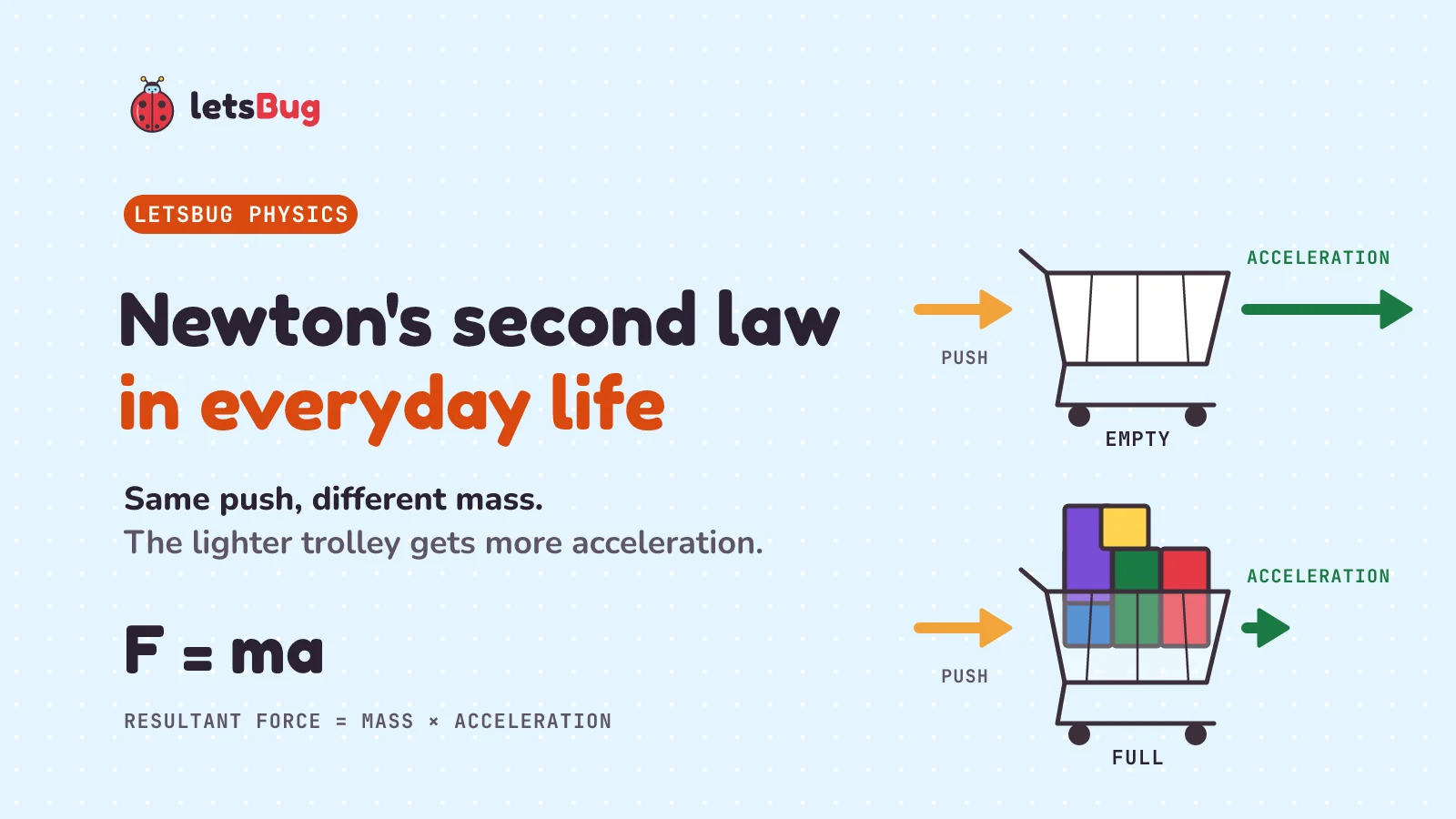
Newton's second law says the resultant force on an object equals its mass times its acceleration: F = ma. You can see it every time you push a shopping trolley. Give an empty trolley and a full one the same push, and the empty one shoots off while the full one barely creeps forward. Same force, more mass, less acceleration. In this post we go through everyday examples of the law, see where the newton comes from, work out a car's acceleration step by step, and clear up a mistake that costs a lot of students marks.
Key takeaways
- F = ma, where F is the resultant force in newtons (N), m is the mass in kilograms (kg) and a is the acceleration in m/s².
- More force, more acceleration: for the same mass, acceleration is directly proportional to the resultant force, so double the force and the acceleration doubles.
- More mass, less acceleration: for the same force, acceleration is inversely proportional to the mass, so double the mass and the acceleration halves.
- Find the resultant force first. A 1200 kg car with 3000 N of driving force and 600 N of resistance accelerates at 2 m/s², not 2.5 m/s².
- Moving things don't need a force to keep moving. A steady speed in a straight line means balanced forces, not no forces.
This post goes with letsBug Physics, episode 1 (Class 9 science in India, GCSE and IGCSE physics). Watch it, or read on: the post adds more everyday examples and exam-style questions with model answers.
What Newton's second law says
A resultant force changes how an object moves: it can speed it up, slow it down or turn it in a new direction. Velocity is speed in a given direction, and acceleration is how quickly velocity changes: the change in velocity each second, measured in metres per second squared (m/s²). The second law tells us how much acceleration a force produces. Isaac Newton published it, in words, in his book the Principia in 1687, more than 300 years ago.
- F is the resultant force, in newtons (N)
- m is the mass, in kilograms (kg)
- a is the acceleration, in metres per second squared (m/s²)
You'll often need it rearranged: a = F / m to find the acceleration, and m = F / a to find the mass. "Resultant force" is the GCSE term. The NCERT Class 9 book calls the same thing the net force. Both mean every push and pull on the object added together, taking their directions into account. Some books, including NCERT's, also state the law using momentum: the resultant force equals the rate of change of momentum. For a fixed mass, that's the same as F = ma.
Newton's second law examples in everyday life
The first two examples show the two ideas packed inside a = F / m: the bigger the force, the bigger the acceleration, and the bigger the mass, the smaller the acceleration. The others show that slowing down and turning are accelerations too, and how F = ma explains a classic catch.
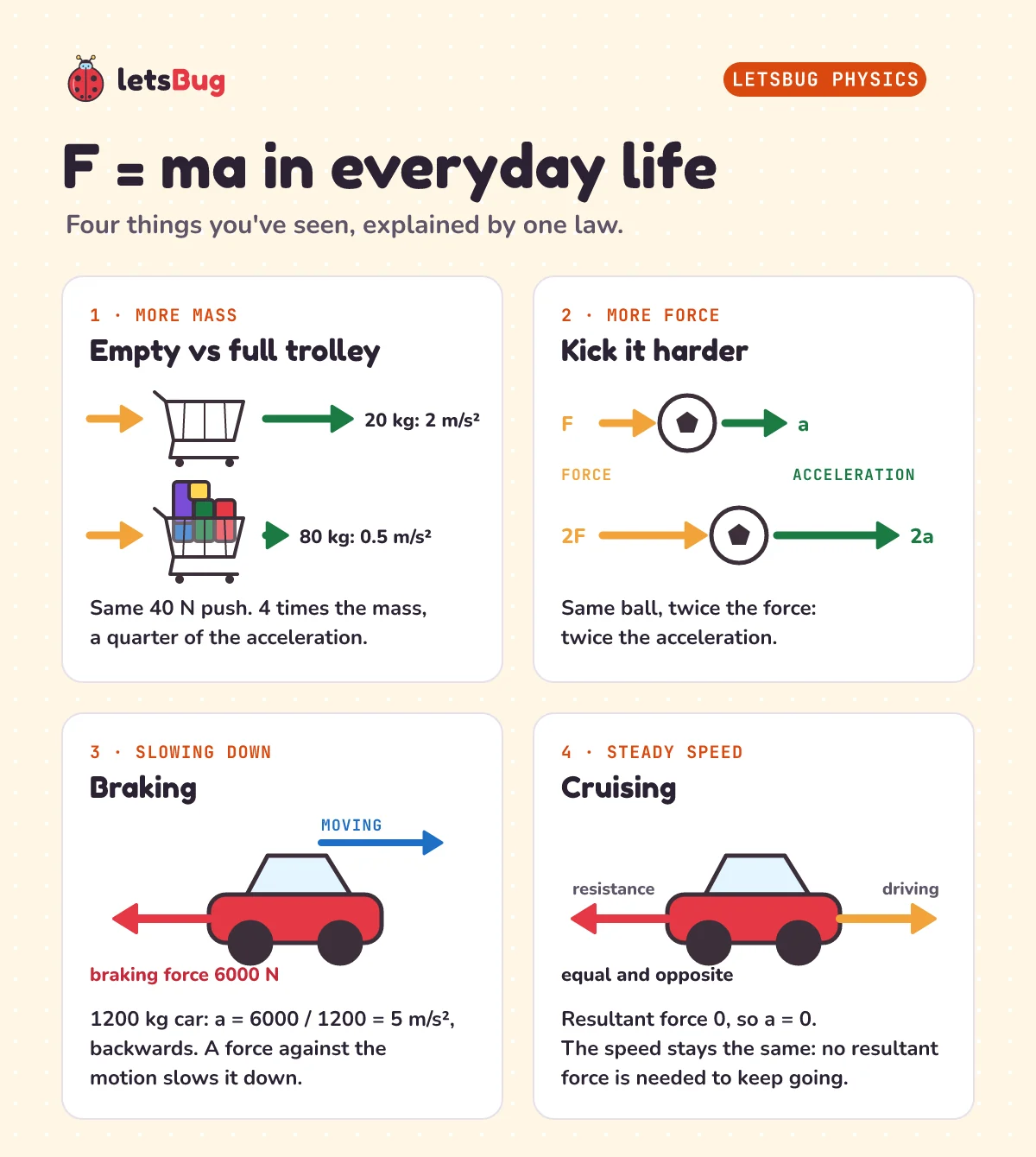
1. Pushing a shopping trolley (more mass, less acceleration)
Say the empty trolley has a mass of 20 kg and the full one 80 kg, and each gets a 40 N push (we'll ignore friction, so 40 N is the resultant force):
- empty trolley: a = 40 / 20 = 2 m/s²
- full trolley: a = 40 / 80 = 0.5 m/s²
Four times the mass gives a quarter of the acceleration. Mass is a measure of inertia: how strongly an object resists a change in its motion. It's the same reason you can pass a basketball with one push, but the same push on a stalled car barely moves it.
2. Kicking a football harder (more force, more acceleration)
Tap a football and it rolls away slowly. Kick it hard and it flies. The ball's mass hasn't changed, but the force from your foot has. For the same ball, double the force gives double the acceleration while your foot is pushing on it. Push the 20 kg trolley with 80 N instead of 40 N and its acceleration doubles from 2 m/s² to 4 m/s².
3. Braking (slowing down is acceleration too)
When a driver brakes, the resultant force on the car points backwards, so the acceleration points backwards and the car slows down. Say a 1200 kg car brakes with a resultant force of 6000 N: a = 6000 / 1200 = 5 m/s² backwards, so it loses 5 m/s of speed every second. Load the same car with passengers and luggage, and the same braking force gives a smaller deceleration (deceleration just means slowing down), so it takes longer to stop.
4. Going round a corner (changing direction)
A car can go round a bend at a steady 30 km/h and still be accelerating, because its direction is changing. The force that does it is friction between the tyres and the road, pushing the car sideways towards the inside of the bend. That's why cars skid on ice: with too little friction, there isn't enough sideways force to turn.
5. Catching a cricket ball (pull your hands back)
A fielder pulls their hands back while catching a fast ball. The ball still has to lose all its speed, but it does so over a longer time, so its deceleration is smaller. By F = ma, a smaller deceleration needs a smaller force, so the catch stings less. Airbags and crash mats work the same way.
Where the newton comes from
The unit of force is defined by this law. One newton is the force that gives a mass of 1 kg an acceleration of 1 m/s². So:
That's also why F = ma has no extra number in it: the newton was chosen to make the numbers line up exactly. To feel what 1 N is like, rest a small apple of about 100 g on your palm. Your hand pushes up on it with about 1 N, enough to balance its weight (W = mg = 0.1 kg × 9.8 N/kg = 0.98 N).
Free-body diagrams: finding the resultant force
Real objects usually have several forces on them at once. To handle that, draw a free-body diagram: the object as a simple box, with an arrow for every force acting on it. Each arrow points the way the force acts, and its length shows how big it is.
- Forces in the same direction add.
- Forces in opposite directions subtract.
- For a car on a flat road, the weight (down) and the road's push (up) cancel, so you only need the forwards and backwards forces.
Whatever is left over is the resultant force. That's the F that goes into F = ma.
Worked example: how fast does a car speed up?
A car has a mass of 1200 kg. Its engine gives a driving force of 3000 N, and friction plus air resistance push back with 600 N. What is its acceleration?
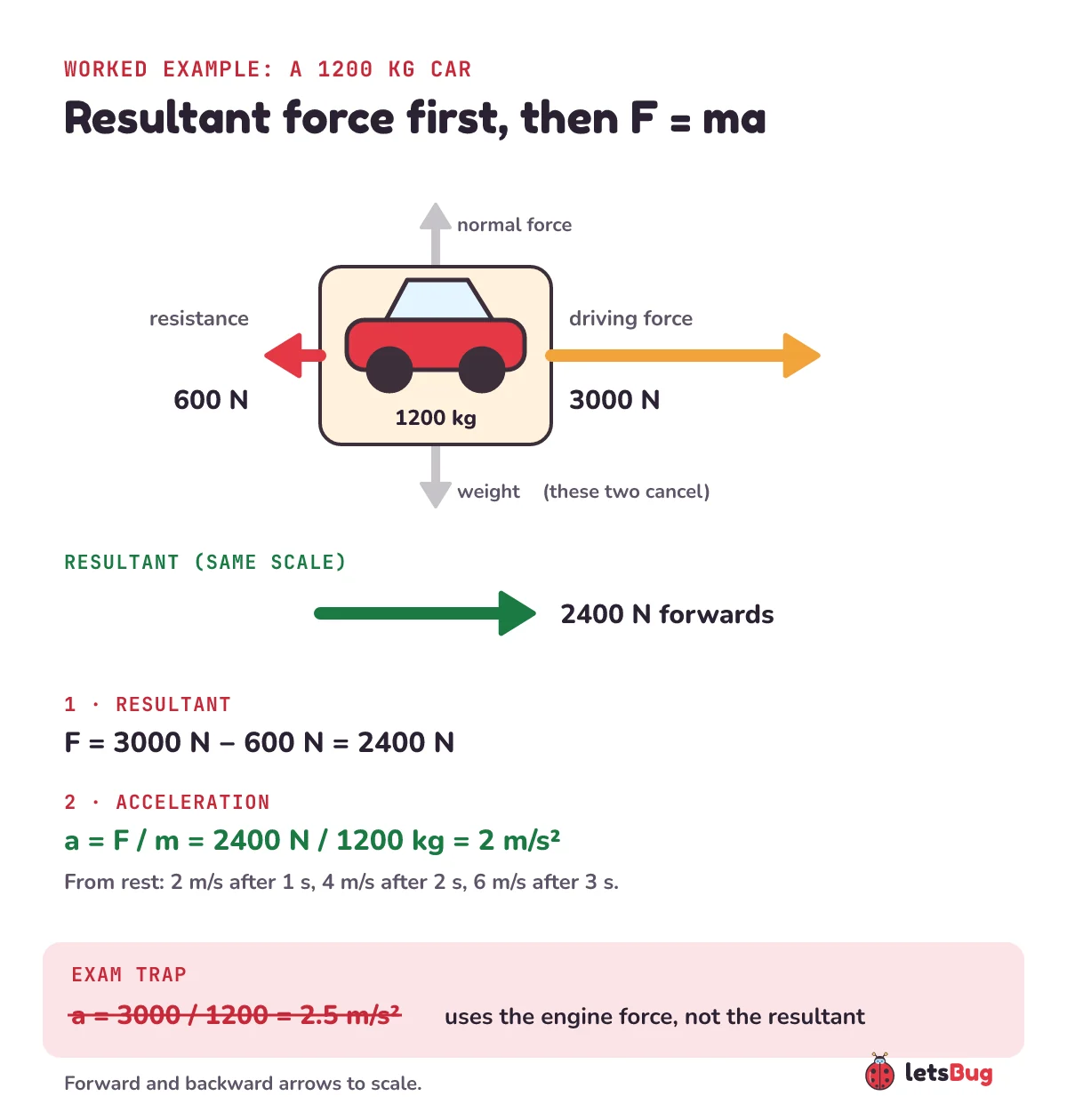
- Resultant force: 3000 N − 600 N = 2400 N forwards.
- Acceleration: a = F / m = 2400 N / 1200 kg = 2 m/s² forwards.
- What it means: every second, the car gains 2 m/s of speed. Starting from rest, it's doing 2 m/s after 1 s, 4 m/s after 2 s and 6 m/s after 3 s, as long as the forces stay the same. In real life air resistance grows as the car speeds up, so the acceleration gets smaller.
Myth: moving things need a force to keep moving
It feels true. Stop pedalling your bike and you slow down. But you slow down because friction and air resistance are still pushing backwards on you, not because a force has been "used up". Take those away and nothing slows you.
An air hockey table shows it. With the air off, the puck slides a short way and stops. With the air on, there's almost no friction, and the puck glides along with hardly any change in speed. A force isn't needed to keep something moving. A resultant force is only needed to change its motion.
Constant velocity means balanced forces
So what about a car cruising along a straight motorway at a steady speed? The engine is still pushing, but as the car sped up, air resistance grew until the resistive forces exactly balanced the driving force. The resultant force is zero, so a = 0 / m = 0, and the velocity stays the same. A skydiver at terminal velocity is the same: air resistance grows as they speed up until it equals their weight, and then they fall at a steady speed.
That's Newton's first law: with no resultant force, an object stays at rest or keeps moving at a constant velocity. You can think of the first law as the second law with F = 0.
A 2 kg trolley is pushed with a force of 10 N, and friction acts against it with 4 N. What is its acceleration?
Show the answer
Resultant force = 10 N − 4 N = 6 N. Then a = F / m = 6 / 2 = 3 m/s², in the direction of the push.
Exam-style questions with model answers
Q1 (2 marks). Calculate the resultant force needed to accelerate a 70 kg sprinter at 3 m/s².
Model answer
F = ma = 70 × 3 [1] = 210 N [1].
Q2 (3 marks). An 800 kg car has a driving force of 2500 N. The resistive forces on it are 500 N. Calculate its acceleration.
Model answer
Resultant force = 2500 − 500 = 2000 N [1]. a = F / m = 2000 / 800 [1] = 2.5 m/s² [1].
Q3 (2 marks). A resultant force of 12 N gives a trolley an acceleration of 4 m/s². Calculate the mass of the trolley.
Model answer
m = F / a = 12 / 4 [1] = 3 kg [1].
Q4 (3 marks). A resultant force of 20 N acts on a 500 g trolley. Calculate its acceleration.
Model answer
500 g = 0.5 kg [1]. a = F / m = 20 / 0.5 [1] = 40 m/s² [1]. Forgetting to convert grams to kilograms gives 0.04 m/s², a very common slip.
Q5 (2 marks). A car moves along a straight, flat road at a constant speed. Its driving force is 1500 N. State the size of the resistive forces on it, and explain your answer.
Model answer
1500 N [1]. The speed is constant, so the acceleration is zero and the resultant force must be zero: the forces are balanced [1].
Questions people ask
What is Newton's second law in simple words?
The bigger the resultant force on something, the faster its velocity changes, and the bigger its mass, the slower its velocity changes. In symbols: F = ma.
What are some examples of Newton's second law in everyday life?
An empty shopping trolley speeds up more than a full one with the same push; a harder kick sends a football away faster; a car slows down when the brakes give it a backward force; a car turns a corner because friction from the road pushes its tyres sideways; a fielder pulls their hands back to make a catch hurt less; and it's easier to push a bicycle than a car.
What is the unit of force?
The newton (N). One newton is the force that gives 1 kg an acceleration of 1 m/s², so 1 N = 1 kg m/s².
Is W = mg the same as F = ma?
Not quite, but it comes from it. Weight is the force that would make an object accelerate at g if it were the only force acting (falling freely), so W = mg. An object still has this weight when it isn't accelerating; the weight is just balanced by other forces. With g = 9.8 N/kg, a 60 kg person weighs 60 × 9.8 = 588 N.
Does a moving object need a force to keep moving?
No. With no resultant force it keeps moving at a constant velocity. Real objects slow down because friction and air resistance act against them.
Keep going
- Watch the full lesson on Newton's second law, F = ma.
- Next in the series: how rockets work in space with no air, which is Newton's third law, with F = ma used on a real Falcon 9.
- Another letsBug physics explainer: how GPS works without internet, and why it needs Einstein.
Sources
- OpenStax Physics: 4.3 Newton's second law of motion (F = ma, a proportional to F and to 1/m, 1 N = 1 kg m/s², the basketball and the stalled car)
- OpenStax Physics: 4.2 Newton's first law of motion: inertia (the air hockey puck, inertia)
- NCERT, Exploration, Science for Grade 9: Chapter 6, How Forces Affect Motion (net force, the definition of the newton, 100 g in your palm is about 1 N, momentum form, catching a cricket ball)
- NASA Glenn Research Center: Newton's laws of motion
- Wikipedia: Newton's laws of motion (the Principia, 1687) and Newton (unit)
- Try it yourself: PhET's free Forces and Motion: Basics simulation
Every fact in this post was checked against these sources. The trolley and braking numbers are made up to keep the arithmetic simple, and all the arithmetic was run in Python before publishing.