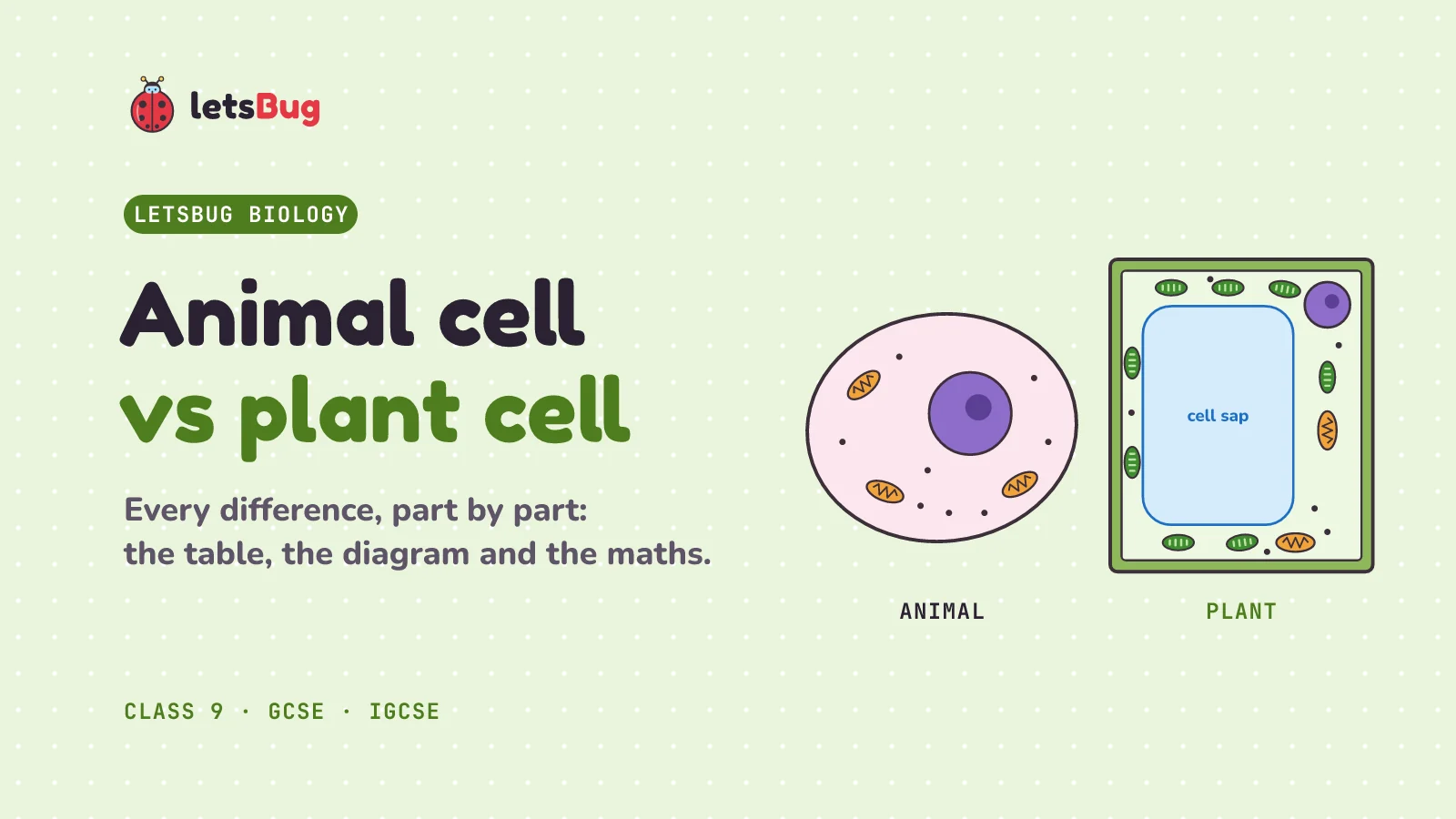
A typical animal cell and a typical plant cell share five parts: a nucleus, a cell membrane, cytoplasm, mitochondria and ribosomes. A plant cell adds three more: a cell wall made of cellulose, chloroplasts, and a large permanent vacuole full of cell sap. That's the core difference in two sentences. In this post we go through every part and its job, put the differences in one table you can revise from, measure cells in micrometres, work out magnification with real numbers, and clear up the exam traps that cost students marks.
Key takeaways
- Both cells have a nucleus, cell membrane, cytoplasm, mitochondria and ribosomes.
- Of the two, only the plant cell has a cell wall (cellulose), chloroplasts and a permanent vacuole. Fungi and bacteria have cell walls too, but not made of cellulose.
- Plant cells have mitochondria as well as chloroplasts. Plants respire all the time, day and night.
- Most animal and plant cells are 10 to 100 µm across, and 1 mm = 1000 µm.
- Magnification = image size / real size, with both sizes in the same unit. A 60 µm cell drawn 30 mm wide is magnified ×500.
This post goes with letsBug Biology, episode 1 (Class 9 science in India, GCSE and IGCSE biology). Watch it, or read on: the post adds a full comparison table and exam-style questions with model answers.
Animal cell vs plant cell: the difference table
Here's every difference you're likely to be asked about, in one place. "Typical" matters: a few special cells break the pattern, and we'll meet some of them below.
| Part or feature | Animal cell | Plant cell |
|---|---|---|
| Cell wall | Absent | Present, made of cellulose |
| Cell membrane | Present, the outer layer | Present, just inside the wall |
| Nucleus | Present | Present |
| Cytoplasm | Present | Present, often a thin layer around the vacuole |
| Mitochondria | Present | Present |
| Ribosomes | Present | Present |
| Chloroplasts (plastids) | Absent | Present in green parts such as leaves; usually absent in roots |
| Permanent vacuole | Absent; small, temporary vacuoles in some cells | Present: one large central vacuole full of cell sap |
| Centrioles (in the centrosome) | Present, a pair near the nucleus | Absent in flowering plants and conifers |
| Shape | Often rounded or irregular; can change shape | Fixed, often box-shaped, because of the wall |
| Food | Can't make its own; the animal must eat | Makes glucose by photosynthesis (cells with chloroplasts) |
For a Class 9 answer, the three plant-only rows (cell wall, chloroplasts or plastids, large permanent vacuole) are the ones examiners expect. NCERT's Class 9 book groups chloroplasts with other plastids: chromoplasts that colour flowers and fruit, and colourless leucoplasts that store food such as starch.
The five parts both cells share
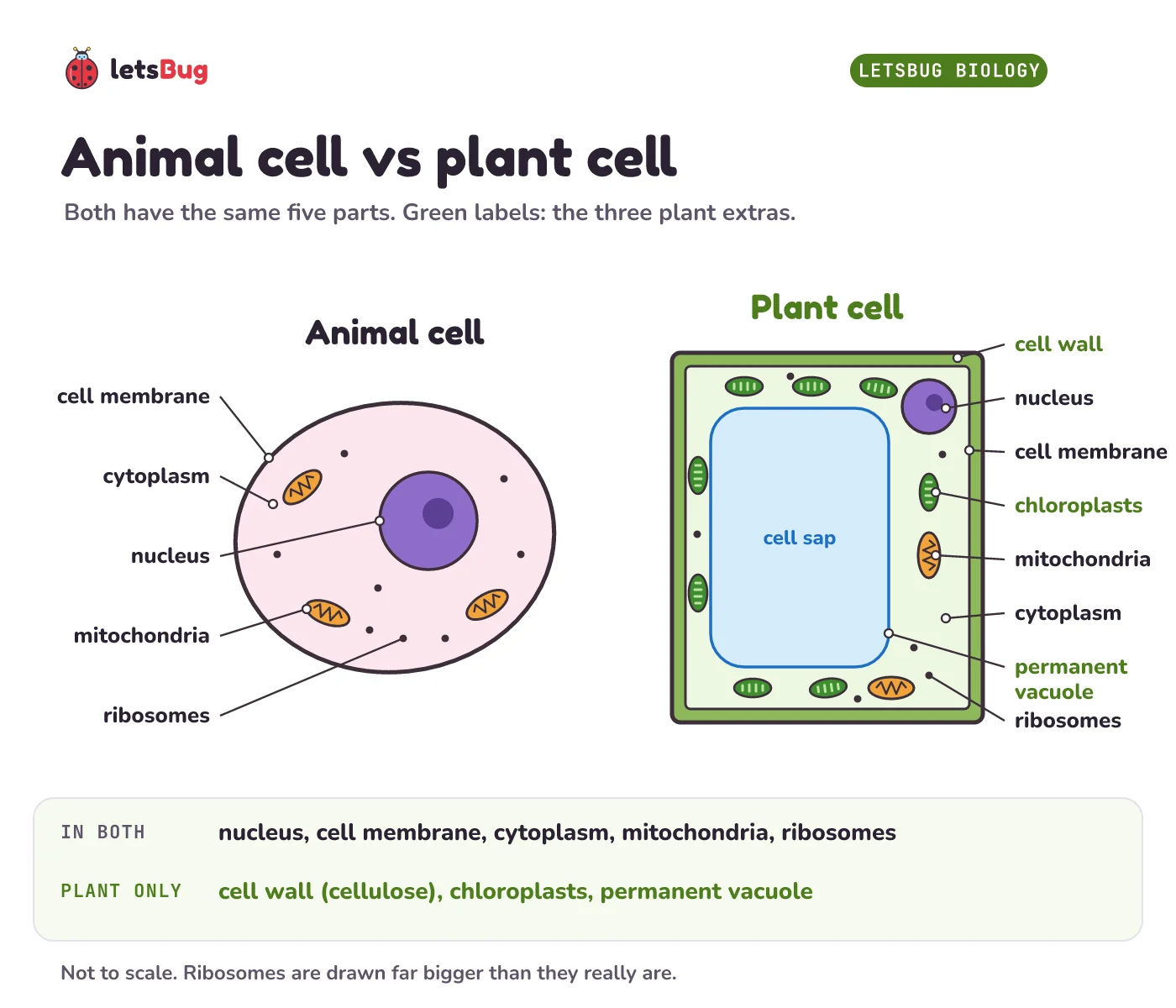
Let's build an animal cell from the outside in. Each part has one main job, and that job is what an exam asks for.
- Cell membrane: controls what enters and leaves the cell. Glucose and oxygen come in; wastes such as carbon dioxide go out.
- Cytoplasm: the watery jelly that fills the cell. Many of the cell's chemical reactions happen here, sped up by enzymes.
- Nucleus: holds the genetic material, DNA, which controls what the cell does. In human cells it's about 6 µm across.
- Mitochondria: where aerobic respiration happens, releasing energy from glucose. A typical one is about 2 µm long and 1 µm wide.
- Ribosomes: where proteins are made. They're tiny, about 25 to 30 nm across, so you need an electron microscope to see them.
"Typical" again: a few cells lose a part as they mature. Your red blood cells, for example, lose their nucleus.
The three extra parts in a plant cell
Cell wall: strength and shape
Outside the membrane, a plant cell has a tough cell wall made of cellulose, a long chain of glucose units. It strengthens the cell and supports it. That's why a stick of celery snaps with a crunch when you bite it: you're tearing rigid cell walls. An animal cell has no wall, so it can be round, flat or long, and it can change shape.
The wall is rigid but fully permeable: water and dissolved minerals pass straight through it. The membrane inside it is the part that's selectively permeable (GCSE courses say partially permeable). NCERT's Class 9 activity shows the difference. Put onion peel or Rhoeo leaf cells in a strong sugar solution and they lose water. The wall keeps its shape, but the membrane and everything inside it shrink away from the wall (this is plasmolysis). Cheek cells in the same solution have no wall, so the whole cell shrinks.
Chloroplasts: where photosynthesis happens
Chloroplasts are green discs, about 4 to 6 µm across. They contain chlorophyll, which absorbs light. The light energy drives photosynthesis:
carbon dioxide + water → glucose + oxygen (using light energy)
A leaf cell from a plant such as wheat can hold about 100 of them. Animal cells don't make chloroplasts. We can't make food from light, so we have to eat. But not every plant cell has chloroplasts either: root hair cells live underground, don't photosynthesise, and have none.
Permanent vacuole: keeping the cell firm
The permanent vacuole is a large sac filled with cell sap, a solution of sugars and salts. In most mature plant cells it takes up more than 30% of the cell's volume, and in some cells as much as 80%. That's why the cytoplasm and chloroplasts end up pushed out to the edges.
When the vacuole is full of water, it presses outwards against the wall and keeps the cell firm, or turgid. Millions of firm cells hold a plant upright. When the soil dries out, water leaves the vacuoles, the walls lose their support, and the plant wilts.
Animal cells don't have a permanent vacuole, but some do have small, temporary vacuoles for storing or moving materials. So "animal cells have no vacuoles" is not quite right.
How small is a cell? Sizes in micrometres
A millimetre is far too big a ruler for cells, so biologists use the micrometre (µm): one thousandth of a millimetre. So 1 mm = 1000 µm, and going smaller, 1 µm = 1000 nm (nanometres).
| Thing | Typical size |
|---|---|
| Most animal and plant cells | 10 to 100 µm across |
| Human cheek cell | about 54 to 77 µm across (averages at different ages) |
| Human cell nucleus | about 6 µm |
| Chloroplast | 4 to 6 µm |
| Mitochondrion | about 2 µm long, 1 µm wide |
| Bacterium | 0.1 to 5 µm |
| Ribosome | 25 to 30 nm (0.025 to 0.03 µm) |
So line up 13 to 18 of your cheek cells and they'd span just one millimetre. A micrometre is 40 times wider than a 25 nm ribosome.
Magnification: image size divided by real size
To measure something this small, we compare its image with the real thing:
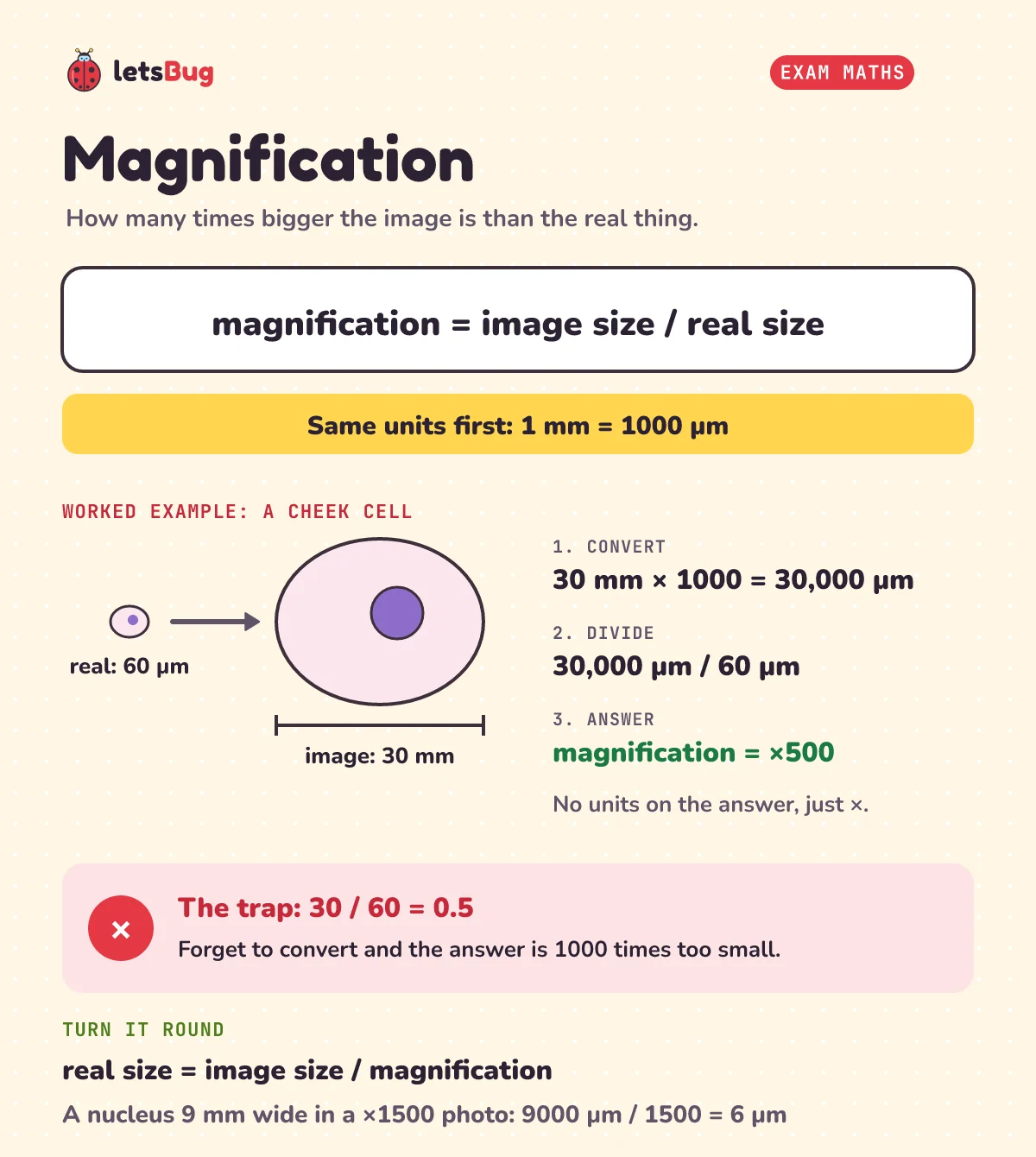
Let's try one. A cheek cell is 60 µm wide. In a textbook drawing it measures 30 mm.
- Convert: 30 mm × 1000 = 30,000 µm.
- Divide: 30,000 µm / 60 µm = 500.
- Answer: the drawing is magnified ×500. Magnification has no units, just the × sign.
The trap: forget to convert and you get 30 / 60 = 0.5, an answer 1000 times too small. A drawing half the size of the real cell should tell you something went wrong.
To find the real size, turn the formula round: real size = image size / magnification. A nucleus measures 9 mm across in a photo magnified ×1500. Convert: 9 mm = 9000 µm. Divide: 9000 / 1500 = 6 µm, the size of a human nucleus.
Class 9 activity: estimating cell size with a ruler
NCERT's Class 9 book has a neat way to measure cells without any formula. Put a clear ruler on the microscope stage and measure the width of the circle you see, say 5 mm. That's 5 × 1000 = 5000 µm. Swap the ruler for an onion peel slide and count the cells across the circle. If 25 cells fit, each one is 5000 / 25 = 200 µm long. Onion cells are big ones, well above the usual range.
A light microscope's total magnification is the eyepiece power times the objective power. A 10× eyepiece with a 10× objective gives 10 × 10 = ×100. Switch to the 40× objective and you get 10 × 40 = ×400, the highest setting on many school microscopes. That's enough to see a cheek cell and its nucleus, but not ribosomes.
Exam traps to avoid
- "Plant cells have chloroplasts instead of mitochondria." Wrong. Plant cells have both. Chloroplasts make glucose; mitochondria release energy from it by respiration, day and night.
- "Every plant cell has chloroplasts." Wrong. Root hair cells, for one, have none.
- "Only plant cells have a cell wall." Wrong. Fungi and most bacteria have walls too. The cellulose wall is the plant feature.
- "Animal cells have no vacuoles." Not quite. They have no permanent vacuole, but some have small, temporary ones.
- "The cell wall controls what enters the cell." No: that's the membrane. The wall is fully permeable.
- Forgetting units in magnification. Convert mm to µm (× 1000) before dividing, and give the answer with × and no units.
A drawing of a cell is 45 mm wide. The real cell is 30 µm wide. (1) What is the magnification? (2) Name the three structures found in plant cells but not animal cells, with one job each.
Show the answers
(1) 45 mm = 45,000 µm, and 45,000 / 30 = ×1500.
(2) Cell wall: made of cellulose, strengthens and supports the cell. Chloroplasts: absorb light for photosynthesis. Permanent vacuole: holds cell sap and keeps the cell turgid.
Exam-style questions with model answers
Q1 (3 marks). Give three differences between a typical plant cell and a typical animal cell.
Model answer
A plant cell has a cell wall made of cellulose; an animal cell has none [1]. A plant cell has chloroplasts; an animal cell has none [1]. A plant cell has a large permanent vacuole containing cell sap; an animal cell has no permanent vacuole [1]. Each point must compare both cells: "plant cells have a cell wall" on its own may not score.
Q2 (2 marks). A student says: "Plant cells don't need mitochondria because they have chloroplasts." Explain why the student is wrong.
Model answer
Plant cells need energy, which is released by respiration in mitochondria [1]. Chloroplasts only make glucose by photosynthesis, in the light; respiration goes on all the time, including at night [1].
Q3 (2 marks). An onion cell is 200 µm long. A student draws it at a magnification of ×100. How long is the drawing in millimetres?
Model answer
image size = magnification × real size = 100 × 200 µm = 20,000 µm [1]. 20,000 µm / 1000 = 20 mm [1].
Q4 (2 marks). Explain why a plant wilts when it is short of water.
Model answer
Water moves out of the cells by osmosis, so the vacuoles shrink [1]. They no longer press outwards on the cell walls, so the cells lose turgor (become flaccid) and can't hold the plant upright [1].
Questions people ask
What is the main difference between a plant cell and an animal cell?
A plant cell has three parts an animal cell lacks: a cellulose cell wall, chloroplasts, and a large permanent vacuole. Both have a nucleus, cell membrane, cytoplasm, mitochondria and ribosomes.
Do plant cells have mitochondria?
Yes. Plant cells respire all the time, day and night, so they need mitochondria as well as chloroplasts.
Do animal cells have a vacuole?
Not a permanent one. Some animal cells have small, temporary vacuoles, but none has the large central vacuole full of cell sap that a plant cell has.
Which cells have a cell wall?
Plant cells (cellulose), fungi (chitin) and most bacteria (peptidoglycan). Animal cells never have a cell wall.
Why do plant cells have a fixed shape?
Because of the rigid cellulose wall around the membrane, helped by the full vacuole pressing outwards on it. Animal cells have no wall, so they can change shape.
Can you see ribosomes with a school microscope?
No. A ribosome is only about 25 to 30 nm across, far too small for a light microscope. You need an electron microscope.
Keep going
- Watch the full lesson, animal cell vs plant cell, on the letsBug channel.
- Where respiration and photosynthesis fit in the bigger picture: Life Processes Class 10 questions and answers.
- Zoom in further: what is inside an atom? Protons, neutrons and electrons, for Class 9 and GCSE.
Sources
- NCERT Class 9 Science (Exploration): Chapter 2, Cell: The Building Block of Life (cell walls in plants, fungi and bacteria; the sugar-solution activity; plastids; vacuoles in animal cells; the ruler activity)
- AQA: GCSE Biology 8461, Cell biology (the parts of animal and plant cells; the magnification formula)
- OpenStax Biology 2e: 4.3 Eukaryotic cells (cellulose walls, chloroplasts, central vacuole and wilting, centrosomes) and 4.2 Prokaryotic cells (cell sizes)
- Milo and Phillips, Cell Biology by the Numbers: chloroplasts (4 to 6 µm, about 100 per leaf cell), mitochondria (2 µm by 1 µm) and human cells
- Journal of Cytology (2013): Hormonal changes in exfoliated normal buccal mucosal cells (cheek cell diameters)
- Wikipedia: Cell nucleus, Ribosome, Vacuole, Cell wall, Centriole and Root hair
Every number in this post was checked against these sources, and the arithmetic was run in Python before publishing.