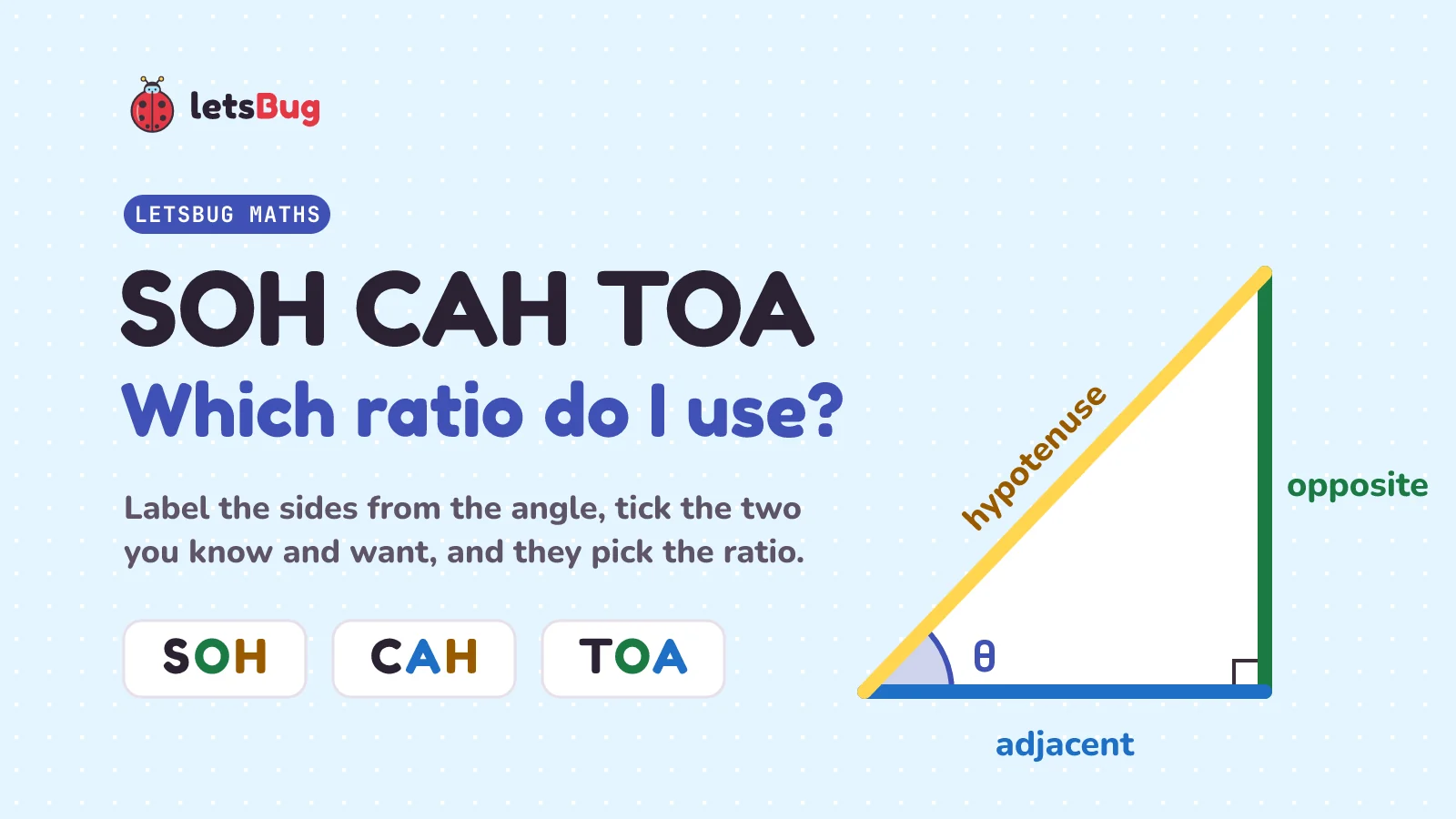
To know which ratio to use, look at the two sides in the question: the one you know and the one you want. Label the sides from the angle first (opposite, adjacent, hypotenuse). If the two sides are the opposite and the hypotenuse, use sin (SOH). Adjacent and hypotenuse: cos (CAH). Opposite and adjacent: tan (TOA). The third side doesn't matter. In this post we see why the ratios work at all, label the sides properly, then use the 3-step method on a roof, a hypotenuse, an angle and a wheelchair ramp, with two mistakes Cambridge examiners flagged in 2024.
Key takeaways
- sin = opposite ÷ hypotenuse, cos = adjacent ÷ hypotenuse, tan = opposite ÷ adjacent: SOH CAH TOA.
- Opposite and adjacent depend on which angle you're using. The opposite side isn't always the upright one.
- Three steps: label the sides from the angle, tick the side you know and the side you want, and the two ticks pick the ratio.
- Unknown on top of the fraction: multiply. Unknown on the bottom: divide. Want an angle: use sin⁻¹, cos⁻¹ or tan⁻¹.
- Check your calculator is in degrees: sin 30 must give 0.5.
This post goes with letsBug Maths, episode 2 (NCERT Class 10, Chapter 8, Introduction to Trigonometry in India; GCSE and IGCSE maths in the UK). Watch it, or read on: the post adds exam-style questions with model answers.
Why sin, cos and tan are fixed numbers
Take a right-angled triangle with a 30° angle and a hypotenuse of 2. The side opposite the 30° angle is exactly 1, half the hypotenuse. Now make the triangle bigger but keep the angle the same: hypotenuse 4, opposite side 2. Bigger again: hypotenuse 6, opposite side 3.
The sides grow, but opposite ÷ hypotenuse stays at 1 ÷ 2 = 0.5 every time. Triangles with the same angles are similar: the same shape at a different size. So the ratio of any two sides depends only on the angle. That fixed number for 30° is the sine of 30°, and your calculator knows it: sin 30° = 0.5.
Label the sides from the angle
Before you choose any ratio, name the three sides. The hypotenuse is the easy one: it's the longest side, across from the right angle, and it stays the same whichever angle you use.
It's tempting to think the opposite side is always the one standing upright. It isn't. Opposite and adjacent depend on which angle you're using:
- Opposite: the side across from the angle. It doesn't touch the angle at all.
- Adjacent: the side next to the angle that isn't the hypotenuse.
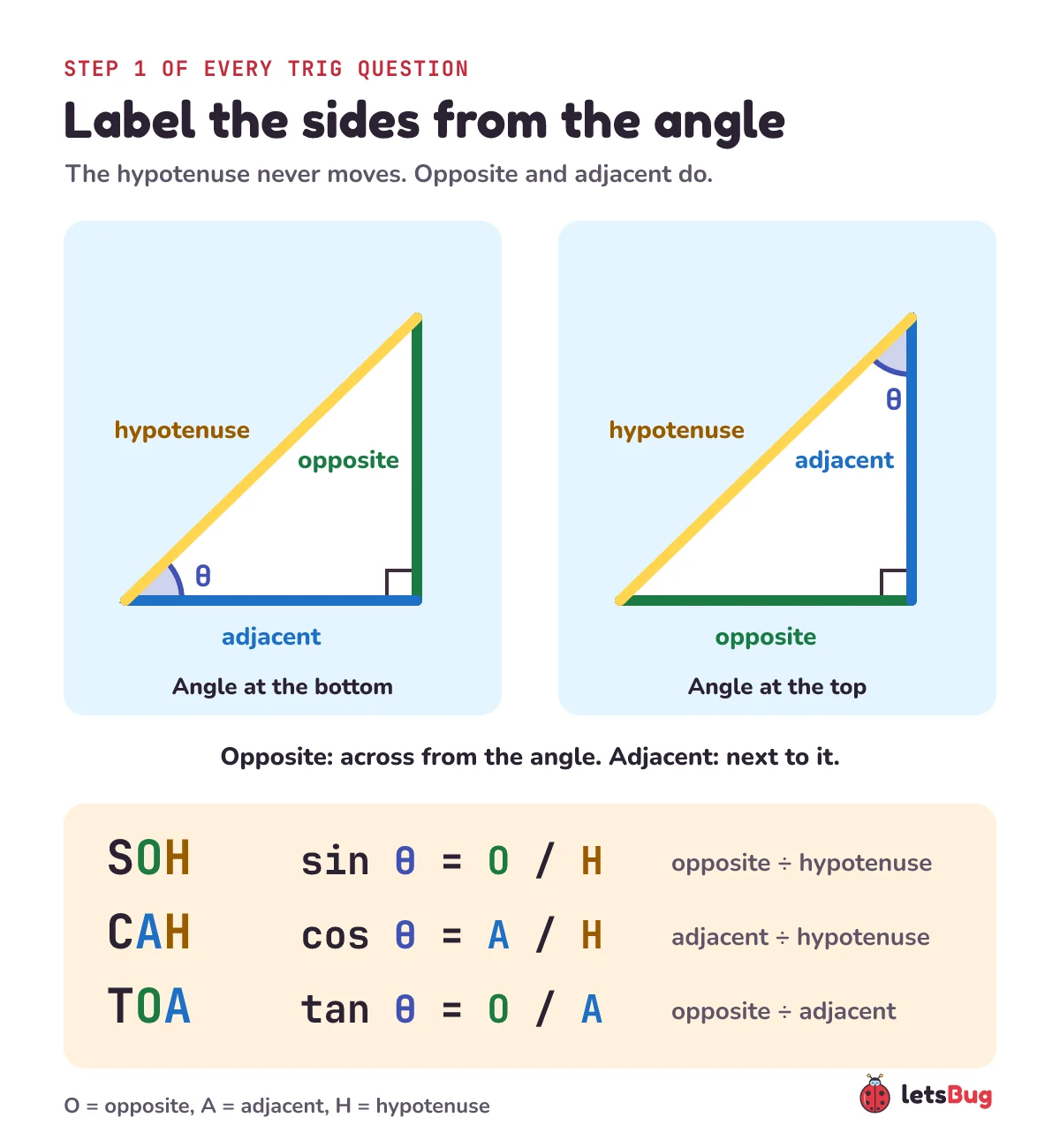
Move to the other acute angle and the two labels swap, even though the triangle hasn't changed. So always mark the angle first and label from it.
SOH CAH TOA: the three ratios
For an angle θ (the Greek letter theta, the usual name for an unknown angle) in a right-angled triangle:
- sin θ = opposite ÷ hypotenuse: S, O, H
- cos θ = adjacent ÷ hypotenuse: C, A, H
- tan θ = opposite ÷ adjacent: T, O, A
Put the letters together and you get SOH CAH TOA, said "soh-kah-toh-ah". Let's test it on the 30° triangle: sin 30° is opposite over hypotenuse, 1 over 2, which is 0.5. It matches the calculator.
Which ratio do I use? The 3-step method
Remembering SOH CAH TOA is easy. Picking the right one is where marks are lost. Cambridge IGCSE examiners noted in 2024 that "some candidates used sin 37 rather than cos 37". This method stops that:
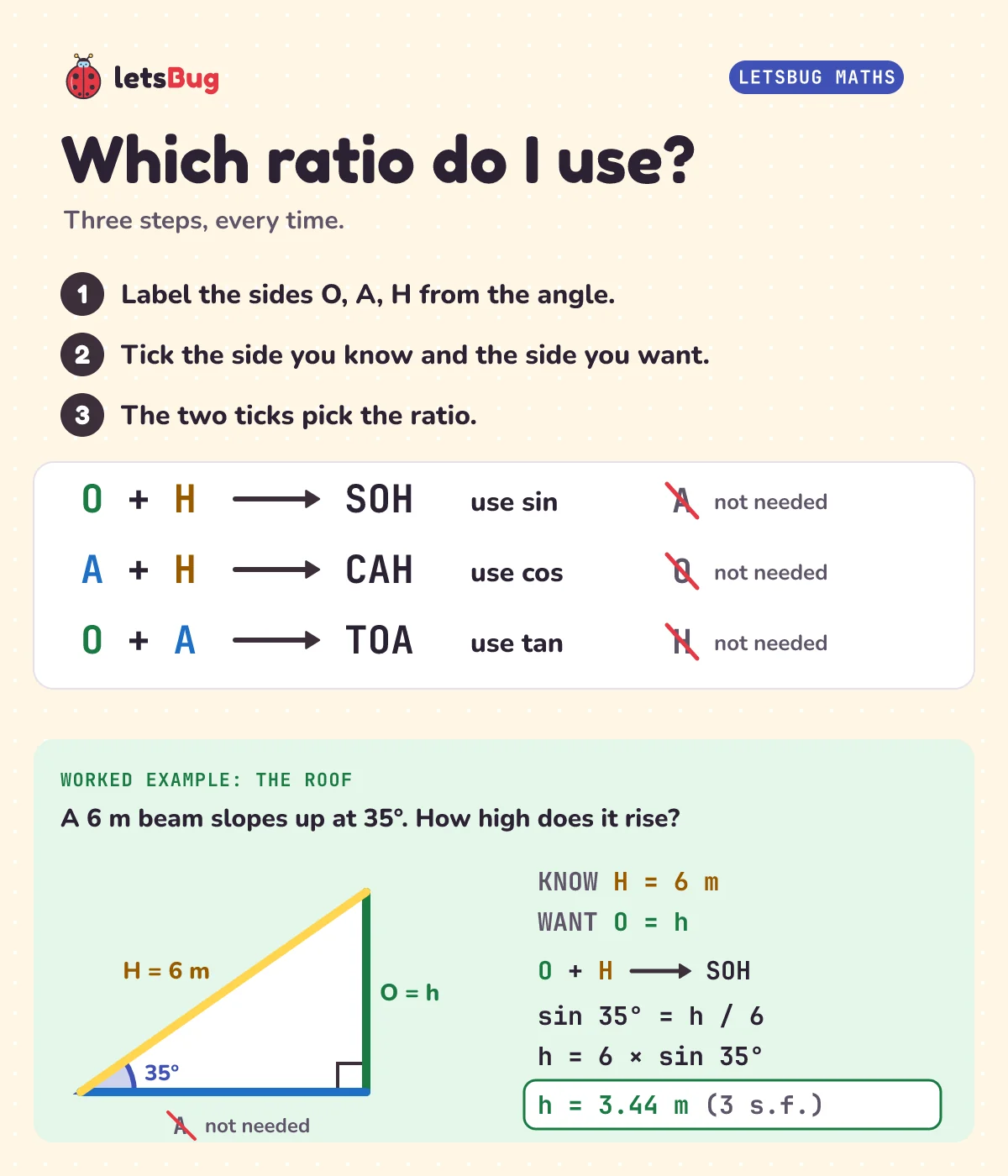
- Label the sides O, A and H from the angle in the question.
- Tick the side you know and the side you want.
- The two ticks pick the ratio. O and H: SOH. A and H: CAH. O and A: TOA. Cross out the third side; you don't need it.
Worked example 1: unknown on top (the roof)
A roof beam is 6 m long and slopes up at 35°. How high does the roof rise?
- Label: the beam is the hypotenuse. The height is opposite the 35° angle.
- Tick: we know H = 6 m; we want O = h.
- Pick: O and H, so SOH: sin 35° = h ÷ 6.
- The unknown is on top, so multiply both sides by 6: h = 6 × sin 35° = 3.44 m (3 s.f.).
Label from the other angle and you'd get the same answer a different way: the angle at the ridge is 90° − 35° = 55°, the height is adjacent to it, and 6 × cos 55° is also 3.44 m. That's the labels swapping, in numbers.
Worked example 2: unknown on the bottom (the classic mistake)
The angle is 40°, the adjacent side is 8 cm, and we want the hypotenuse, x.
- Label and tick: we know A = 8 cm; we want H = x.
- Pick: A and H, so CAH: cos 40° = 8 ÷ x.
Here's where it goes wrong. In the June 2024 Cambridge IGCSE report, examiners described a question where many candidates made "the correct start with sin 48 = 13.3/CD", but then "most often it was CD = 13.3 × sin 48". The same slip here gives x = 8 × cos 40° = 6.13 cm. That can't be right: it's shorter than the adjacent side, and the hypotenuse is always the longest side.
Do it properly. Multiply both sides by x to get x × cos 40° = 8, then divide by cos 40°:
A quick rule: when the unknown is on the top of the fraction, multiply; when it's on the bottom, the answer is the known side divided by the sin, cos or tan.
Worked example 3: finding an angle (the inverse)
A triangle has opposite 5 and adjacent 7. What is the angle?
- Label and tick: we know O = 5 and A = 7; we want the angle.
- Pick: O and A, so TOA: tan θ = 5 ÷ 7.
- Use the inverse button (usually SHIFT then tan): θ = tan⁻¹(5 ÷ 7) = 35.5° (1 d.p.).
Careful with the notation: tan⁻¹ does not mean 1 ÷ tan. The −1 means "the inverse": tan⁻¹ asks which angle has this tangent? (1 ÷ tan is cot, a different thing.)
How steep can a wheelchair ramp be?
In the United States, the ADA accessibility standards say "ramp runs shall have a running slope not steeper than 1:12". That means the ramp rises at most 1 unit for every 12 units along the ground. As an angle, how steep is that?
Label from the angle at the bottom of the ramp. The rise is opposite: O = 1. The ground is adjacent: A = 12. The slope itself is the hypotenuse, which we don't need, so we cross it out. O and A: TOA.
tan θ = 1 ÷ 12, so θ = tan⁻¹(1 ÷ 12) = 4.8°. The steepest ramp allowed is under 5°. Pythagoras can't do this: it finds sides, not angles.
Check your calculator is in degrees
Calculators can measure angles in degrees or in radians (another unit: 360° is 2π radians). Before an exam, type sin 30:
- 0.5: you're in degrees. Good.
- −0.988: you're in radians, and every answer will be wrong. Look for a small D (or DEG) on the screen and change the mode.
When not to use SOH CAH TOA
SOH CAH TOA only works in a right-angled triangle. No right angle? Then you need the sine rule or the cosine rule. But if there is a right angle, don't reach for them. Cambridge examiners warn that "using the sine rule or even the cosine rule in a right-angled triangle can easily lead to errors."
And re-read the last line of the question before you write your answer. Does it want a side or an angle? To how many significant figures or decimal places?
A surveyor stands 40 m from the foot of a building and measures the angle up to the top: 35°. That's called the angle of elevation. How tall is the building? (Ignore the height of her instrument.)
Show the answer
Label from the 35° angle: the height is opposite (want), the 40 m along the ground is adjacent (know). O and A: TOA.
tan 35° = h ÷ 40, so h = 40 × tan 35° = 28.0 m (3 s.f.). Real surveyors then add the height of their instrument.
Exam-style questions with model answers
Q1 (3 marks). A kite string 25 m long makes an angle of 52° with the horizontal ground. How high is the kite above the ground? Give your answer to 3 significant figures.
Model answer
From the 52° angle, the string is the hypotenuse (know) and the height is opposite (want), so use SOH [M1]. sin 52° = h ÷ 25, so h = 25 × sin 52° [M1]. h = 19.7 m [A1].
Q2 (3 marks). A ramp rises 0.6 m over a horizontal distance of 7.5 m. (a) Find the angle of the ramp to 1 decimal place. (b) Is it within the 1:12 limit?
Model answer
(a) Opposite 0.6 and adjacent 7.5, so TOA: tan θ = 0.6 ÷ 7.5 = 0.08 [M1], θ = tan⁻¹(0.08) = 4.6° [A1].
(b) Yes: 0.08 is less than 1 ÷ 12 ≈ 0.0833 (or 4.6° is less than 4.8°), so it's within the limit [B1].
Q3 (3 marks). A 4.2 m ladder leans against a vertical wall. Its foot is 1.1 m from the wall. Find the angle the ladder makes with the ground, to 1 decimal place.
Model answer
From the angle at the ground, the ladder is the hypotenuse and the 1.1 m is adjacent, so CAH [M1]. cos θ = 1.1 ÷ 4.2, θ = cos⁻¹(1.1 ÷ 4.2) [M1]. θ = 74.8° [A1]. An answer of 15.2° comes from using sin⁻¹, treating 1.1 m as the opposite side: that's the angle at the top of the ladder, not at the ground, so it earns no marks.
Questions people ask
How do you know when to use sin, cos or tan?
Label the sides from the angle as opposite, adjacent and hypotenuse. Find the side you know and the side you want. Opposite and hypotenuse means sin, adjacent and hypotenuse means cos, opposite and adjacent means tan.
What does SOH CAH TOA stand for?
Sine is Opposite over Hypotenuse, Cosine is Adjacent over Hypotenuse, Tangent is Opposite over Adjacent. It's a memory aid for the three trigonometric ratios in a right-angled triangle.
Is the opposite side always the vertical side?
No. The opposite side is the one across from the angle you're using. Switch to the triangle's other acute angle and the opposite and adjacent sides swap. Only the hypotenuse stays the same.
Does tan⁻¹ mean 1 divided by tan?
No. tan⁻¹ is the inverse: it takes a ratio and gives back the angle. For example, tan⁻¹(1 ÷ 12) = 4.8°. One divided by tan is a different ratio, called cot.
Does SOH CAH TOA work in any triangle?
No, only in right-angled triangles. For other triangles, use the sine rule or the cosine rule.
Why does my calculator give the wrong answer for sin 30?
It's probably in radians mode, which gives −0.988. Switch it to degrees: sin 30 should give 0.5.
Keep going
- Watch the full lesson, SOH CAH TOA: Which Trig Ratio to Use, and the episode before it, the visual proof of Pythagoras' theorem.
- Another letsBug explainer that measures distances with maths: how GPS works without internet.
- Start here if right triangles are new: Pythagoras theorem visual proof, and how to find the third side when you know two.
Sources
- NCERT Class 10 Mathematics: Chapter 8, Introduction to Trigonometry (the six ratios, reciprocals, Aryabhata) and Chapter 9, Some Applications of Trigonometry (angle of elevation)
- OpenStax Precalculus 2e: 5.4 Right triangle trigonometry (SOH CAH TOA)
- Wikipedia: Trigonometric functions (why the ratios depend only on the angle; the −1 means inverse, not reciprocal), Mnemonics in trigonometry, Grade (slope) (rise over run) and Radian
- US Access Board: 2010 ADA Standards for Accessible Design, 405.2 (ramp slope 1:12)
- Cambridge IGCSE Mathematics 0580: June 2024 principal examiner report (the trigonometry mistakes quoted above)
Every number in this post was checked against these sources, and every calculation was run in Python before publishing.