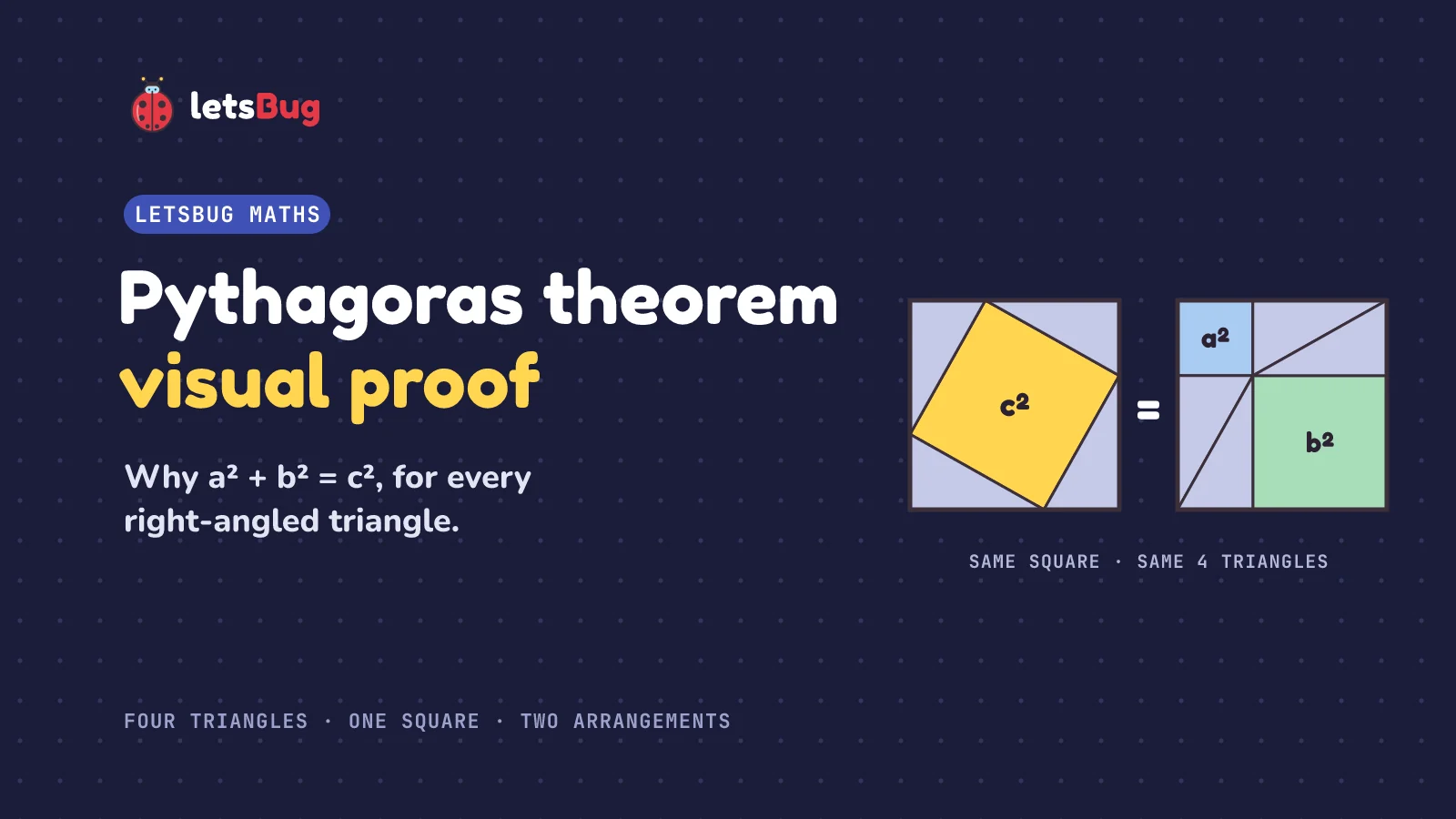
Pythagoras' theorem says that in any right-angled triangle, a² + b² = c², where c is the hypotenuse (the longest side). The visual proof fits four copies of the triangle in a square of side a + b. One way leaves an empty square, c²; another leaves a² and b². That space never changed, so c² = a² + b².
In this post we walk through that proof, then use the theorem to find missing sides, test for a right angle, and steer clear of a common mistake that costs marks.
Key takeaways
- In a right-angled triangle with shorter sides a and b and hypotenuse c: a² + b² = c².
- One example (3, 4, 5) isn't a proof. The rearrangement proof works for every right-angled triangle.
- Hypotenuse missing? Add the squares. Shorter side missing? Subtract the smaller square from the hypotenuse's square. Then square root.
- The hypotenuse is always the longest side. If your "shorter side" comes out longer than the hypotenuse, you added when you should have subtracted.
- The converse: if a² + b² = c², the triangle has a right angle. 7, 24, 25 passes; 6, 7, 9 doesn't.
This post goes with letsBug Maths, episode 1 (Class 9 and 10 maths in India, GCSE and IGCSE). Watch it, or read on: the post adds exam-style questions with model answers.
What is Pythagoras' theorem?
Take a triangle with one angle of exactly 90°, marked with a little square. The two sides that make the right angle we'll call a and b. The side opposite the right angle is the hypotenuse, c. It's always the longest side.
Now build a square on each side. For the triangle with sides 3, 4 and 5:
- the square on the side of 3 has area 3 × 3 = 9,
- the square on the side of 4 has area 4 × 4 = 16,
- the square on the hypotenuse has area 5 × 5 = 25.
And 9 + 16 = 25. The two smaller squares, together, have exactly the area of the big one. That's the theorem: a² + b² = c². It only works for right-angled triangles, and c must be the hypotenuse.
Why is the Pythagorean theorem true? One example isn't enough
Maybe 3, 4, 5 is just lucky. Checking a few more triangles wouldn't settle it either: there are infinitely many right-angled triangles, and we can't measure them all. A proof has to work for any a and b at once. There are hundreds of proofs of this theorem (one book, Elisha Loomis's The Pythagorean Proposition, collects 370). The one below is one of the easiest to see.
How does the visual proof work? Four triangles, one square
Take four identical copies of a right-angled triangle with sides a, b and c. Then take a big square whose side is a + b. We're going to fit the four triangles inside it in two different ways.
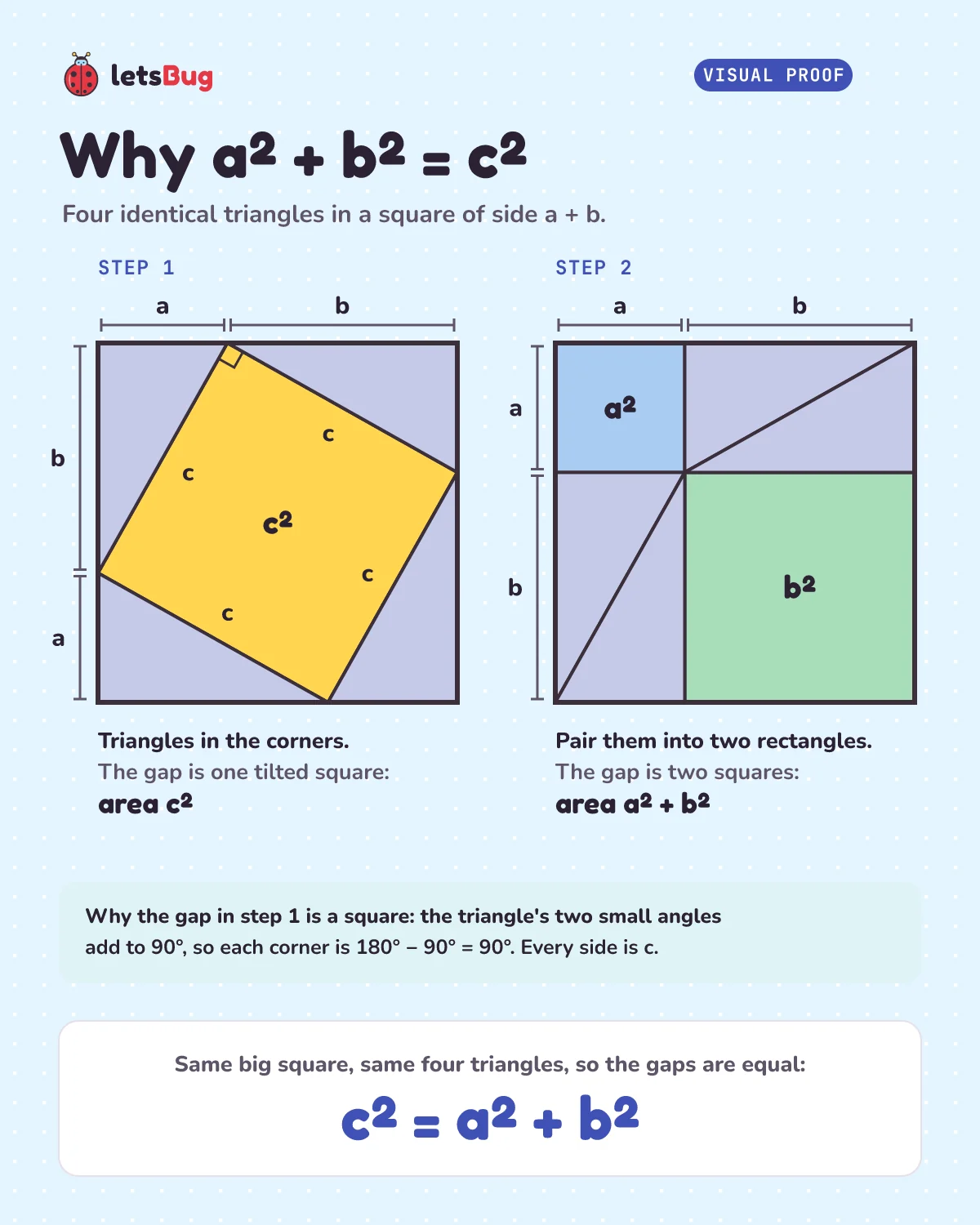
- Arrangement one. Put one triangle in each corner, each turned a quarter turn from the last. Their hypotenuses enclose a tilted shape in the middle, and every side of it is c. Each corner of it is a right angle too (see below). So the gap is a square, with area c².
- Arrangement two. Slide the same four triangles into pairs. Each pair makes an a-by-b rectangle, and the two rectangles go in opposite corners. The empty space is now two squares: one with side a and one with side b. Its area is a² + b².
- Compare the two. The big square is the same size in both pictures, and so are the four triangles. Take the same triangles away from the same square and you must be left with the same area. So c² = a² + b², for every right-angled triangle.
The same proof in algebra
If you like algebra, you can write arrangement one as an equation. The big square's area is (a + b)². It's also the tilted square plus four triangles, each with area ½ab:
- (a + b)² = c² + 4 × ½ab
- a² + 2ab + b² = c² + 2ab
- a² + b² = c² (take 2ab from both sides)
How to find the hypotenuse: add the squares
A right-angled triangle has shorter sides of 5 cm and 12 cm. Find the hypotenuse.
- Write the theorem: c² = 5² + 12²
- Square: c² = 25 + 144
- Add: c² = 169
- Square root: c = √169 = 13 cm
Always write that last step. c² = 169 isn't the answer; c is.
How to find a shorter side: subtract
This time the hypotenuse is 10 cm and one shorter side is 6 cm. Find the other side, a.
- The theorem still says: a² + 6² = 10²
- Take 6² from both sides: a² = 10² − 6²
- a² = 100 − 36 = 64
- a = √64 = 8 cm
So the rule is short: hypotenuse missing, add. Shorter side missing, subtract. Before you start, find the side opposite the right angle and label it c.
Exam trap: adding every time
A very common mistake is to add the squares no matter which side is missing. Try it on the last triangle: 6² + 10² = 36 + 100 = 136, and √136 ≈ 11.7 cm. That would make a shorter side (11.7 cm) longer than the hypotenuse (10 cm), which is impossible. The hypotenuse is always the longest side.
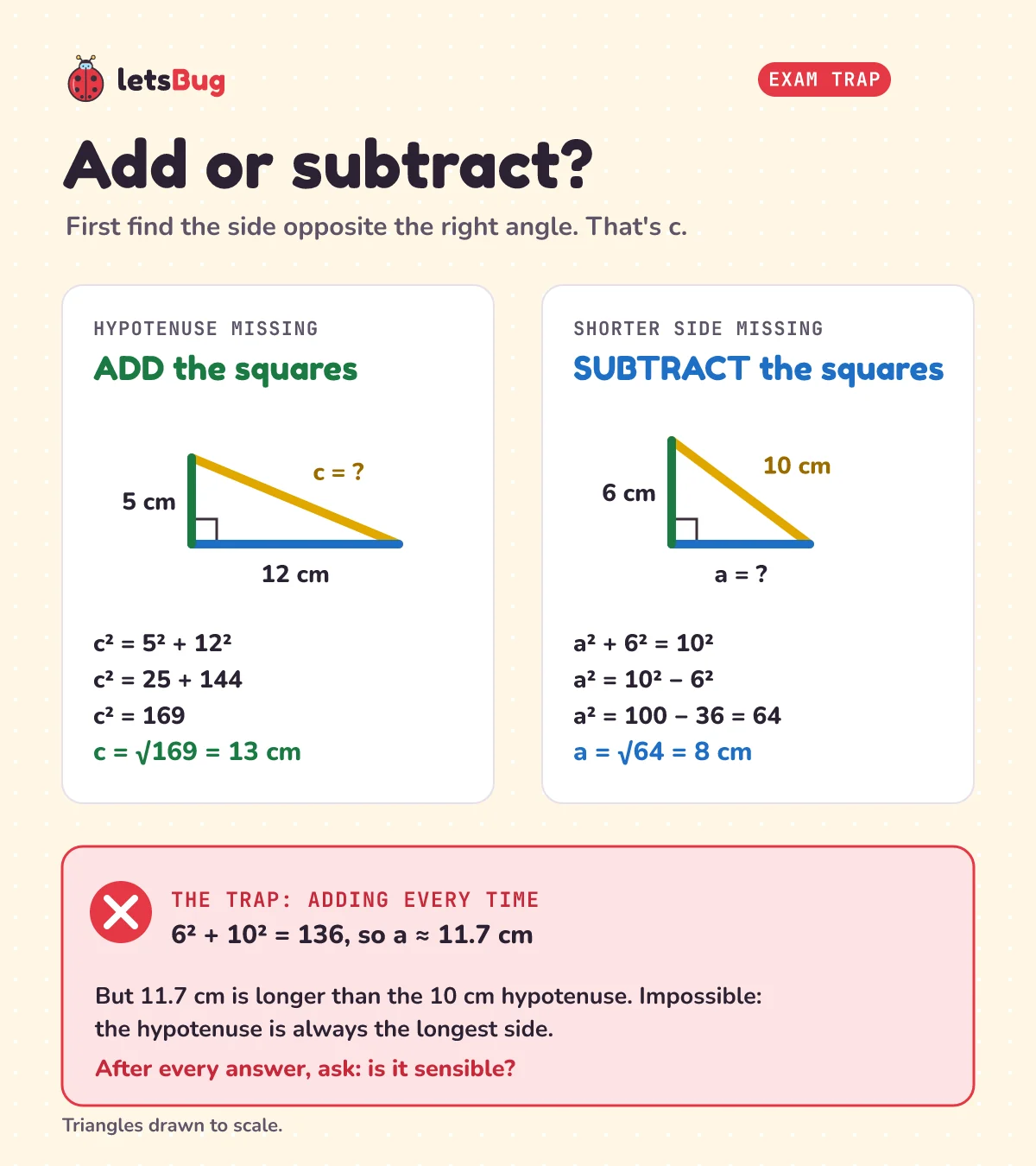
So after every answer, ask one question: is it sensible? A hypotenuse must come out longer than both other sides. A shorter side must come out shorter than the hypotenuse.
How do you test for a right angle? The converse
The theorem also works backwards. If the sides of a triangle fit a² + b² = c², with c the longest side, then the triangle has a right angle. This is called the converse of Pythagoras' theorem.
- 7, 24, 25: 7² + 24² = 49 + 576 = 625, and 25² = 625. Equal, so it's right-angled.
- 6, 7, 9: 6² + 7² = 36 + 49 = 85, but 9² = 81. Not equal, so there's no right angle.
This is how you mark out a square corner with nothing but string. The Shulba Sutras, ancient Indian texts on the geometry of building fire altars, give rules for making right angles with cords whose lengths form triples like 3, 4, 5 and 5, 12, 13. The trick still works on a building site today: mark 3 m along one wall and 4 m along the other, and if the diagonal between the marks is exactly 5 m, the corner is 90°.
Worked example: how high does a ladder reach?
A 5 m ladder leans against a vertical wall on flat ground, with its foot 1.5 m from the wall. How high up the wall does it reach?
The ladder is the hypotenuse (it's opposite the right angle between the wall and the floor). We want a shorter side, so we subtract:
- h² = 5² − 1.5² = 25 − 2.25 = 22.75
- h = √22.75 = 4.769... ≈ 4.77 m (to 2 decimal places)
No calculator? You can still pin it down. 4.7² = 22.09 and 4.8² = 23.04, so h is between 4.7 and 4.8. Halve the gap: 4.75² = 22.5625, which is less than 22.75, so h is between 4.75 and 4.8. Keep halving like that and you get as many decimal places as you like.
TV sizes use it too. A TV's size is the length of its screen's diagonal, the hypotenuse of a right-angled triangle made by the screen's width and height.
How to find the distance between two points
How far is it in a straight line from the point (1, 2) to the point (7, 10)? Draw a right-angled triangle underneath the line, with the right angle at (7, 2).
- Across: 7 − 1 = 6 units. Up: 10 − 2 = 8 units.
- Distance² = 6² + 8² = 36 + 64 = 100, so the distance is √100 = 10 units.
That's all the distance formula is: Pythagoras on a grid. In Class 10 coordinate geometry (NCERT chapter 7), it's written as √((x₂ − x₁)² + (y₂ − y₁)²), and the chapter builds it from exactly this triangle.
Who discovered Pythagoras' theorem? It's older than Pythagoras
The theorem is named after the Greek thinker Pythagoras, born around 570 BC, but he wasn't the first to know it. Babylonian mathematicians were using the rule by about 1800 BC, more than a thousand years earlier: the clay tablet known as Plimpton 322, about 3,800 years old, lists pairs of numbers that can be read as sides of right-angled triangles. In India, the Baudhayana Shulba Sutra, dated to somewhere between the 8th and 5th centuries BC, states the rule too.
Try these. (1) A right-angled triangle has shorter sides 8 cm and 15 cm. Find the hypotenuse. (2) The hypotenuse is 9 cm and one shorter side is 5 cm. Find the other side, to 2 decimal places.
Show the answers
(1) Add: c² = 8² + 15² = 64 + 225 = 289, so c = √289 = 17 cm.
(2) Subtract: a² = 9² − 5² = 81 − 25 = 56, so a = √56 ≈ 7.48 cm (or 2√14 cm in surd form). Sensible: 7.48 is less than 9.
Exam-style questions with model answers
Q1 (3 marks). Town B is 36 km east and 15 km north of town A. Find the straight-line distance from A to B.
Model answer
The distance is the hypotenuse, so add: d² = 36² + 15² = 1296 + 225 = 1521 [1], d = √1521 [1] = 39 km [1].
Q2 (3 marks). A TV screen is 48 cm wide and its diagonal is 60 cm. Calculate its height.
Model answer
The diagonal is the hypotenuse, so subtract: h² = 60² − 48² = 3600 − 2304 = 1296 [1], h = √1296 [1] = 36 cm [1]. Adding (60² + 48²) gives a height longer than the diagonal, which is impossible, and usually scores no marks.
Q3 (2 marks). Show that a triangle with sides 9 cm, 12 cm and 15 cm is right-angled.
Model answer
9² + 12² = 81 + 144 = 225 and 15² = 225 [1]. Since 9² + 12² = 15², by the converse of Pythagoras' theorem the triangle is right-angled [1]. In a "show that" question you must write both totals and the conclusion; "it works" on its own isn't enough.
Q4 (3 marks). Find the distance between the points (1, 1) and (3, 6). Give your answer to 1 decimal place.
Model answer
Across 3 − 1 = 2, up 6 − 1 = 5 [1]. d² = 2² + 5² = 4 + 25 = 29, d = √29 [1] = 5.385... ≈ 5.4 units [1].
Questions people ask
What is the visual proof of Pythagoras' theorem?
Fit four copies of a right-angled triangle inside a square of side a + b. In one arrangement the gap is a square of area c²; in another it's two squares, a² and b². The square and triangles are the same both times, so c² = a² + b².
Why is the Pythagorean theorem true for every right triangle?
Because the proof never uses particular numbers. The rearrangement works for any lengths a and b, so the result holds for every right-angled triangle, not just 3, 4, 5.
Does Pythagoras' theorem work for any triangle?
No, only for right-angled triangles. For example, 6, 7, 9 gives 6² + 7² = 85 but 9² = 81. When the two smaller squares add to more than the biggest one, as here, the triangle is acute; when they add to less, it's obtuse.
How do I know which side is the hypotenuse?
It's the side opposite the right angle, and it's always the longest side. Find the right angle first, then label the side across from it c.
Who discovered Pythagoras' theorem?
It's named after the Greek thinker Pythagoras, but he wasn't the first to know it. Babylonian mathematicians were using it by about 1800 BC, more than a thousand years before he was born, and India's Shulba Sutras state it too.
Keep going
- Watch the full lesson, Pythagoras theorem visual proof, with the two arrangements animated.
- Next in letsBug Maths: SOH CAH TOA, and how to know which trig ratio to use when you have an angle as well as sides.
- Turning a question into a² + b² = c² is a skill of its own: how to write equations from word problems.
- Ratios of lengths come up again in how to share in a ratio, and why 2:3 is not 2/3.
Checked on 10 October 2026 against the 9 sources below.
Sources
- Wikipedia: Pythagorean theorem (rearrangement proof, Loomis's 370 proofs, converse, acute and obtuse test, Babylonian and Indian history, Shulba Sutra cord triples)
- Wikipedia: Shulba Sutras (geometry for fire-altar construction)
- Wikipedia: Pythagorean triple ((3, 4, 5), (5, 12, 13), (7, 24, 25))
- OpenStax Prealgebra 2e: 9.3 Use properties of angles, triangles, and the Pythagorean theorem (hypotenuse, legs)
- OpenStax Elementary Algebra 2e: 3.4 Triangles, rectangles, and the Pythagorean theorem (ladder problems)
- LibreTexts, Elementary College Geometry: 4.4 Pythagorean theorem (the converse)
- NCERT Class 10 Mathematics: Chapter 7, Coordinate geometry (the distance formula from Pythagoras; the towns example)
- Wikipedia: Euclidean distance and Display size (screens are measured along the diagonal)
Every number in this post was checked against these sources, and the arithmetic was run in Python before publishing.