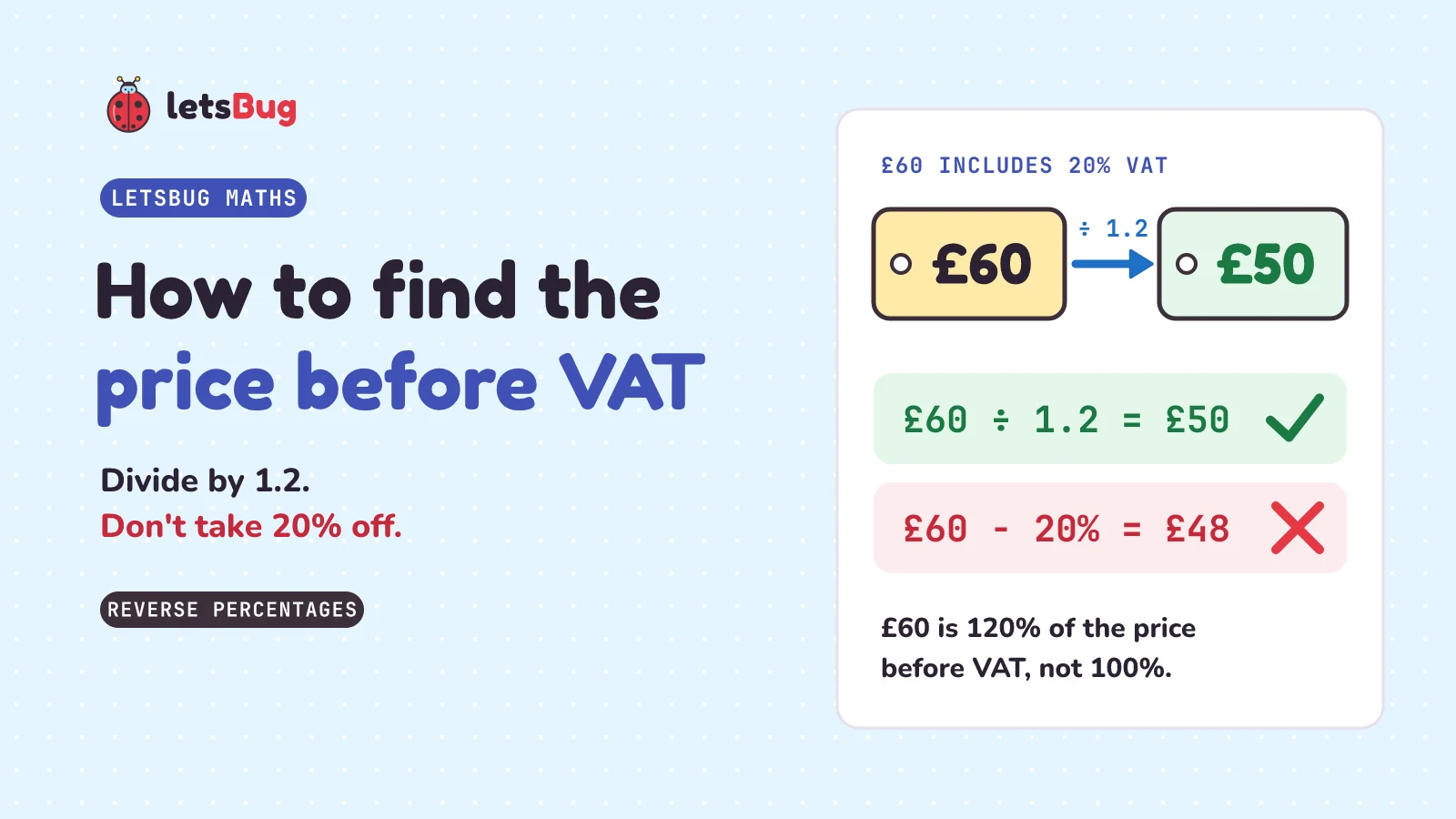
To find the price before VAT, divide the price with VAT by 1.2. Don't take 20% off. VAT (value added tax) is a UK tax added to prices, at 20% on most things. So £60 with VAT is 120% of the old price: £60 ÷ 1.2 = £50. Taking 20% off gives £48, which is wrong.
In this post we test the "take 20% off" idea and see why it fails. Then we turn every percentage change into a multiplier, the single number you multiply by to make the change, and use it to work backwards: to the price before VAT, the price before a sale, and the price of a TV before India cut its GST (goods and services tax). Every hard word is explained the first time it comes up. The practice questions from the video are answered in full, and exam-style questions with model answers are at the end.
Key takeaways
- A percentage is always a percentage OF something. 20% of £50 is £10, but 20% of £60 is £12. So £50 up 20% is £60, and £60 down 20% is £48, not £50.
- A multiplier is the single number you multiply by to make a percentage change. Start from 1 (the whole 100%): up 20% is × 1.2, down 20% is × 0.8, up 12% is × 1.12, down 15% is × 0.85.
- A reverse percentage question gives you the amount after the change. To go back to the original (the amount before the change), divide by the multiplier: £60 with 20% VAT ÷ 1.2 = £50.
- Never add the percentage to, or take it off, the amount after the change. 30% off, now £42: the old price is 42 ÷ 0.7 = £60, not 42 × 1.3 = £54.60.
- Always check forwards: £50 × 1.2 = £60. If you get back to the number in the question, you're right.
This post goes with letsBug Maths, episode 5. Reverse percentages are on the GCSE maths syllabus (the list of what an exam can test), they come up in IGCSE exams, and in ICSE Class 10 they come up as "inverse cases" of GST questions: inverse means the reverse. Watch the lesson, or read on: the post adds a quick way to find the VAT inside a price, the full working for every answer, and model answers that score marks.
Does taking 20% off undo a 20% rise?
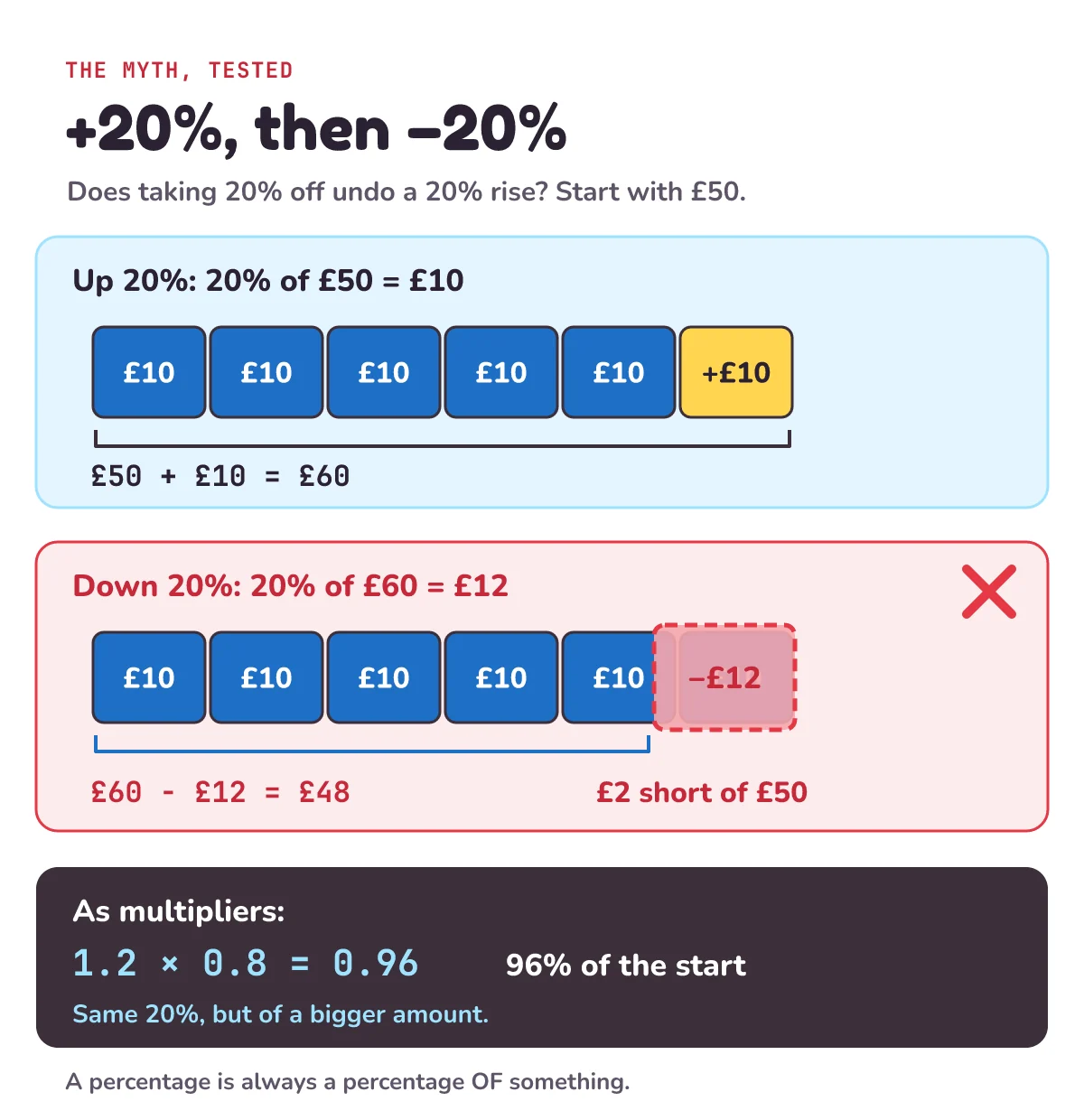
No. Let's test it. A jacket costs £50. The price goes up by 20%. 20% of £50 is £10, so the new price is £60. Now take 20% off £60. 20% of £60 is £12, so you pay £60 − £12 = £48. Not £50: you're £2 short.
Here's why. A percentage means "out of a hundred", and it's always a percentage of something. The rise was 20% of £50. The cut was 20% of £60. Same 20%, but of a bigger amount, so the cut is bigger than the rise. It's like taking one slice from a bigger cake: same share, bigger slice.
This matters every time you shop in the UK. Shop prices already include any VAT. GOV.UK puts it simply: "The standard VAT rate is 20%", and it applies to "most goods and services". Some things have less: GOV.UK lists "most food and children’s clothes" at 0%. So if you want the price before the tax was added, taking 20% off the shop price gives the wrong answer, for the same reason. Working backwards to the amount before a change is called a reverse percentage.
What is a multiplier in percentages?
A multiplier is the single number you multiply by to make a percentage change in one step. You build it from 1, because 1 stands for the whole amount, 100%:
- Up 20%: keep the whole 100% and add 20% more. That's 120%, or × 1.2.
- Down 20%: take 20% from the whole 100%. That's 80%, or × 0.8.
So £50 × 1.2 = £60, and £60 × 0.8 = £48: the same answers as before, in one step each. Now put the two steps together: 1.2 × 0.8 = 0.96. Going up 20% and then down 20% is the same as one change of × 0.96. You end at 96% of where you started, whatever the price was.
| Change | Percentage you end with | Multiplier |
|---|---|---|
| Up 20% (UK VAT) | 100% + 20% = 120% | × 1.2 |
| Up 12% | 100% + 12% = 112% | × 1.12 |
| Up 5% (VAT on home energy) | 100% + 5% = 105% | × 1.05 |
| Down 15% | 100% − 15% = 85% | × 0.85 |
| Down 30% (30% off in a sale) | 100% − 30% = 70% | × 0.7 |
| Down 4% | 100% − 4% = 96% | × 0.96 |
AQA's GCSE maths specification (the exam board's list of what can be tested) asks students to "interpret percentages and percentage changes as a fraction or a decimal, and interpret these multiplicatively". Multiplicatively just means "as a multiplication": exactly what a multiplier is.
What is a reverse percentage?
In most percentage questions you know the starting amount, the 100%, and you find the amount after a change. In a reverse percentage question it's the other way round: you're given the amount after the change, and you have to find the original amount, the one before the change. AQA calls these "original value problems".
So the first rule, before you calculate anything: ask which amount is the original, the 100%. In a reverse percentage, the number you're given is not the 100%. Clue words to look for: "including VAT", "after a 30% discount" (a discount is money taken off the price), "after a 4% fall", "the price before", "the original price".
How do you find the price before VAT?
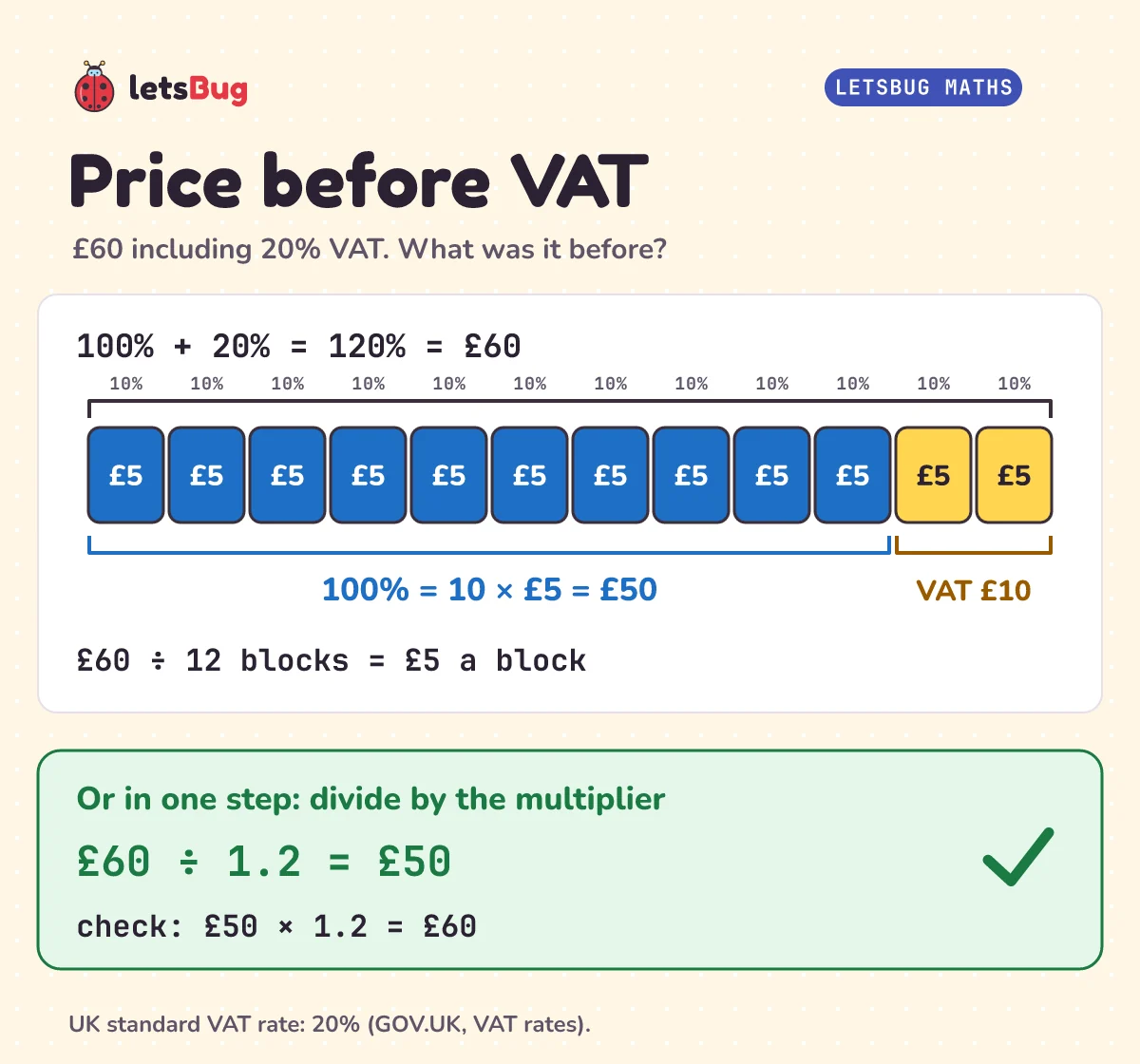
Take a price tag of £60, including 20% VAT. The price before VAT is the 100%. VAT adds 20% on top, so £60 is 100% + 20% = 120% of the price before VAT.
With a bar model. A bar model is a drawing where a long bar stands for an amount, cut into equal blocks. Draw 120% as 12 equal blocks of 10% each. £60 shared into 12 blocks is £60 ÷ 12 = £5 a block. The price before VAT is 100%, which is 10 blocks: 10 × £5 = £50. The other 2 blocks, £10, are the VAT. (This is the unitary method from the ratio lesson: find the value of one part, then multiply.)
In one step. £60 is the price before VAT times 1.2. To undo a multiplication, you divide. So divide by the multiplier: £60 ÷ 1.2 = £50.
Check forwards. £50 + 20% = £50 × 1.2 = £60. That's the price on the tag, so the answer is right.
How do you find the original price after a discount?
Now a sale. A pair of trainers has 30% off, and now costs £42. What was the price before the sale?
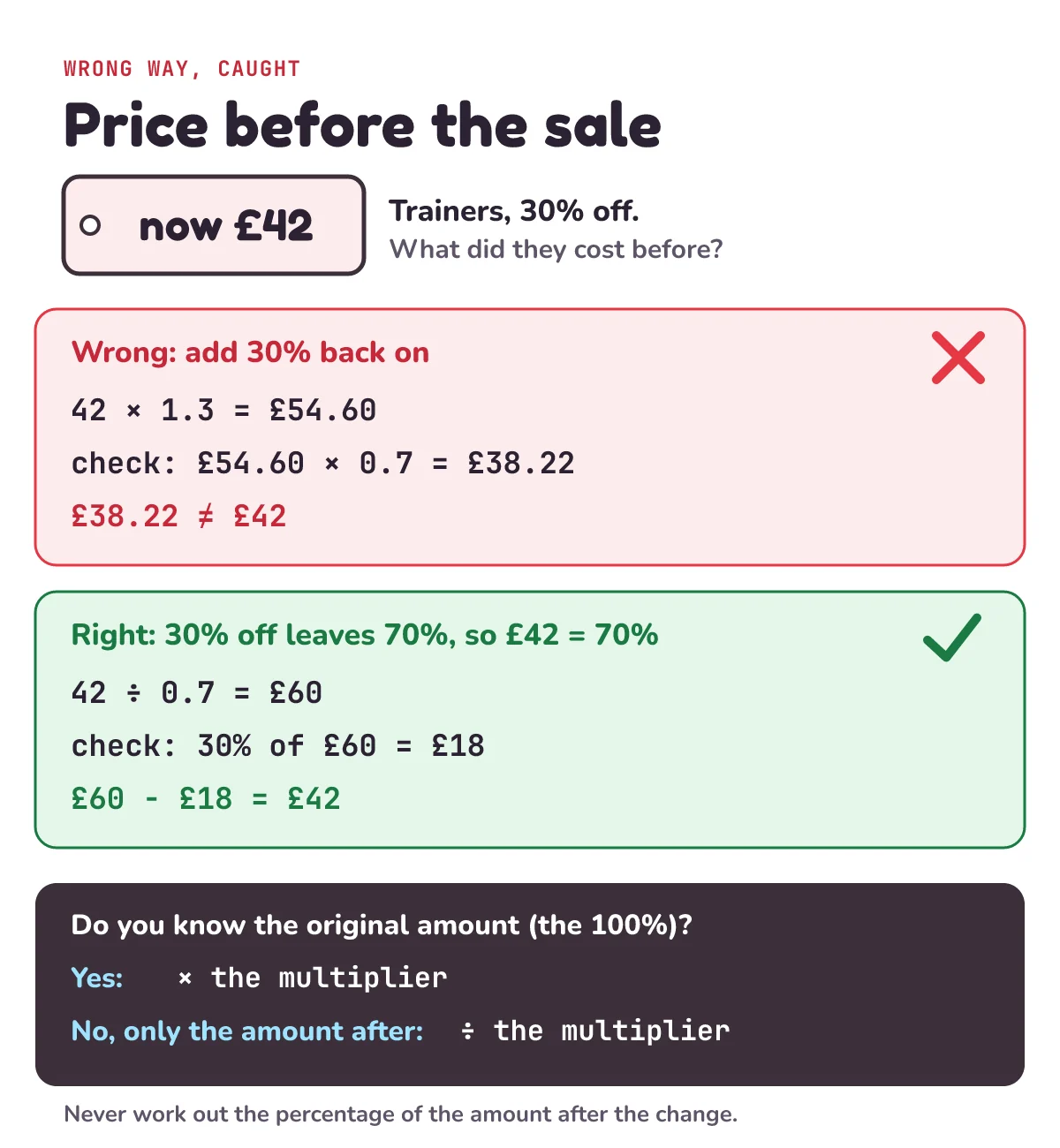
The wrong way: add 30% back on. 42 × 1.3 = £54.60. It looks sensible, so check it forwards. 30% off £54.60 leaves 70% of it: £54.60 × 0.7 = £38.22. That's not £42, so £54.60 is wrong. Caught.
The right way. 30% off leaves 100% − 30% = 70%. So £42 is 70% of the original price, and the multiplier is 0.7. Divide by it: 42 ÷ 0.7 = £60. Check: 30% of £60 is £18, and £60 − £18 = £42. It works.
Multiply or divide: how do you know which to use?
Ask one question: do I know the original amount, the 100%?
- Yes: multiply by the multiplier. £50 plus 20% VAT is £50 × 1.2 = £60.
- No, I only know the amount after the change: divide by the multiplier. £60 including 20% VAT was £60 ÷ 1.2 = £50 before VAT.
And never add the percentage to, or take it off, the amount after the change. That's the mistake in both wrong ways above: taking 20% off £60, and adding 30% back on to £42.
What is the most common mistake with reverse percentages?
Exam boards publish reports on what students got wrong, and this mistake is in them. In a June 2024 Cambridge IGCSE maths paper (0580, Paper 43), students had to use reverse percentages to find the number of members in 2022. The examiners' report says: "The most common error involved increasing 120 by 4 per cent leading to 124.8, which was often rounded to 125, and this earned no marks."
Here's a question built on the report's numbers. (We haven't seen the exam paper itself, so this wording is ours, not Cambridge's.) After a 4% fall, a gym has 120 members. How many members did it have before the fall? Say it clearly, step by step:
- The original is the 100%. After a 4% fall, 100% − 4% = 96%, so 120 members is 96%.
- Divide by the multiplier: 120 ÷ 0.96.
- = 125 members.
Check: 4% of 125 is 5, and 125 − 5 = 120. It works.
Now notice something odd. The wrong method, 120 × 1.04 = 124.8, also rounds to 125. That's luck, not maths, and it earns no marks. Examiners give method marks (marks for correct working, even if the final answer is wrong), and the same report tells students to "show full working with their answers to ensure method marks are considered when final answers are incorrect." So write the three steps every time.
How much cheaper did India's GST cut make a TV?
Now a real example from India. GST, the goods and services tax, is India's tax added on top of most prices, a bit like VAT in the UK. In September 2025 India's government announced "GST simplified to a two-slab structure (5% & 18%)". A slab is one tax rate that a group of goods pays. The government's PIB (Press Information Bureau) note explains the change as "a two-slab system of 5% and 18%, removing the earlier 12% and 28% rates". It says the new rates "will come into effect from 22nd September 2025", and lists "TVs (LCD/LED) (> 32’), ACs, dishwashers: 28% → 18%". So the GST on a TV bigger than 32 inches fell from 28% to 18%.
Say a TV cost ₹64,000 including 28% GST, and the shop keeps its price before tax the same after the cut. (That price is made up for the example; the tax rates are real.)
- Price before tax: the multiplier for 28% GST is 1.28, so ₹64,000 ÷ 1.28 = ₹50,000.
- New price with 18% GST: ₹50,000 × 1.18 = ₹59,000.
- The price fell by ₹64,000 − ₹59,000 = ₹5,000.
The tax rate fell by 10 percentage points, from 28 to 18. Percentage points are what you get when you subtract one percentage from another: 28 − 18 = 10. But the price didn't fall by 10%. It fell by ₹5,000 out of ₹64,000: 5,000 ÷ 64,000 ≈ 0.078 (≈ means "about"), so only about 7.8% cheaper. A fall of 10 points in a tax rate is not a 10% cheaper price, because the tax is a percentage of the price before tax, not of the price you pay.
How do you find a bill before 5% VAT?
Not everything has 20% VAT. GOV.UK lists a reduced rate of 5% for "some goods and services, for example, children’s car seats and home energy". Try this one before you read the answer: an electricity bill comes to £84, including 5% VAT. What was the bill before VAT?
£84 is 100% + 5% = 105% of the bill before VAT, so the multiplier is 1.05. £84 ÷ 1.05 = £80. Check: 5% of £80 is £4, and £80 + £4 = £84. (Taking 5% off £84 would give £79.80, which is wrong again.)
Your turn. These are the three practice questions from the video. Try each one before you open the answers.
1) A coat costs £36 in a sale with 10% off. What was the price before the sale?
2) A town's population grew by 25% to 225,000. What was it before?
3) A selling price is ₹27.60 including 15% tax. Find the price before tax.
Show the answers
1) 10% off leaves 100% − 10% = 90%, so £36 is 90%. Divide by the multiplier: 36 ÷ 0.9 = £40. Check: 10% of £40 is £4, and £40 − £4 = £36. The common wrong answer is 36 × 1.1 = £39.60.
2) A 25% rise makes 125%, so the multiplier is 1.25. 225,000 ÷ 1.25 = 180,000. Check: 25% of 180,000 is 45,000, and 180,000 + 45,000 = 225,000.
3) 15% tax makes 115%, so the multiplier is 1.15. ₹27.60 ÷ 1.15 = ₹24. Check: 15% of ₹24 is ₹3.60, and ₹24 + ₹3.60 = ₹27.60.
Exam-style questions with model answers
The number in brackets is the marks. Each mark is one clear step.
Q1. A laptop costs £540 including VAT at 20%. Work out the price of the laptop before VAT. [2]
Model answer
£540 is 120% of the price before VAT, so divide by 1.2 [1]. 540 ÷ 1.2 = £450 [1]. Check: £450 × 1.2 = £540. (540 × 0.8 = £432 scores nothing.)
Q2. After a 15% pay rise, Sam earns £1,725 a month. How much did Sam earn a month before the rise? [2]
Model answer
100% + 15% = 115%, so £1,725 ÷ 1.15 [1] = £1,500 [1]. Check: 15% of £1,500 is £225, and £1,500 + £225 = £1,725.
Q3. A car has lost 30% of its value since it was new. It is now worth £8,400. What was it worth when new? [2]
Model answer
100% − 30% = 70%, so £8,400 ÷ 0.7 [1] = £12,000 [1]. Check: 30% of £12,000 is £3,600, and £12,000 − £3,600 = £8,400.
Q4. A price goes up by 10%, then down by 10%. Show that the final price is 1% less than the starting price. [2]
Model answer
Up 10% is × 1.1 and down 10% is × 0.9 [1]. 1.1 × 0.9 = 0.99, which is 99% of the starting price, so it is 1% less [1].
Q5. A shopkeeper sells a fan for ₹2,950, including GST at 18%. Find the price of the fan before GST, and the amount of GST. [3]
Model answer
₹2,950 is 118% of the price before GST, so ₹2,950 ÷ 1.18 [1] = ₹2,500 [1]. GST = ₹2,950 − ₹2,500 = ₹450 [1]. Check: 18% of ₹2,500 is ₹450.
Questions people ask
How do you work out the price before VAT?
Divide the price including VAT by 1.2 (for 20% VAT). £60 including VAT ÷ 1.2 = £50 before VAT. Don't take 20% off: that gives £48, which is wrong.
How do you work out how much VAT is in a price?
For 20% VAT, divide the price including VAT by 6. £60 ÷ 6 = £10 of VAT. Or find the price before VAT (£60 ÷ 1.2 = £50) and subtract: £60 − £50 = £10.
Why isn't the price before VAT just the price minus 20%?
Because the 20% was worked out on the price before VAT, which is smaller than the price you pay. £60 is 120% of the price before VAT, so you divide by 1.2. 20% of £60 is £12, more than the £10 of VAT that was added.
What is a reverse percentage?
A question that gives you the amount after a percentage change and asks for the original amount, the one before the change. To solve it, divide by the multiplier: after a 30% discount, £42 ÷ 0.7 = £60.
What is the multiplier for a 20% increase?
1.2, because you keep the whole 100% and add 20%: 120% = 1.2. For a 20% decrease it's 0.8, because 100% − 20% = 80%.
If a price goes up 20% then down 20%, is it back to the start?
No. 1.2 × 0.8 = 0.96, so it ends at 96% of the start. £50 goes up to £60, then down to £48.
How do you find the original price after a percentage decrease?
Take the percentage away from 100% to get the multiplier, then divide by it. After 10% off, £36 is 90% of the original, so £36 ÷ 0.9 = £40.
Keep going
- Watch the full lesson, How to Find the Price Before VAT: Reverse Percentages, or the one-minute Short: If a Price Goes Up 20% Then Down 20%, Is It Back to the Start? More in letsBug Maths on YouTube.
- The episode before this one, with the bar model and the unitary method: how to share in a ratio.
- Turning a wordy question into maths you can solve: how to write equations from word problems.
Checked on 26 October 2026 against the 5 sources below. Every price, multiplier and practice answer in this post was worked out again in a Python script, and every quote was matched word for word with the source text.
Sources
- GOV.UK: VAT rates (20% standard rate on most goods and services, 5% reduced rate on home energy)
- Cambridge International: IGCSE Mathematics 0580, June 2024 principal examiner report (Paper 43, Question 1(a)(iii): the most common reverse-percentage error)
- PIB, Government of India: GST Reforms 2025: Relief for Common Man, Boost for Businesses (4 September 2025: two slabs, 5% and 18%; TVs over 32 inches and ACs 28% to 18% from 22 September 2025)
- AQA: GCSE Mathematics 8300 specification (R9: percentage change and original value problems)
- CISCE: ICSE Mathematics syllabus, Class X, examination year 2027 (a copy hosted by Physics Wallah; Commercial Mathematics, GST including inverse cases)