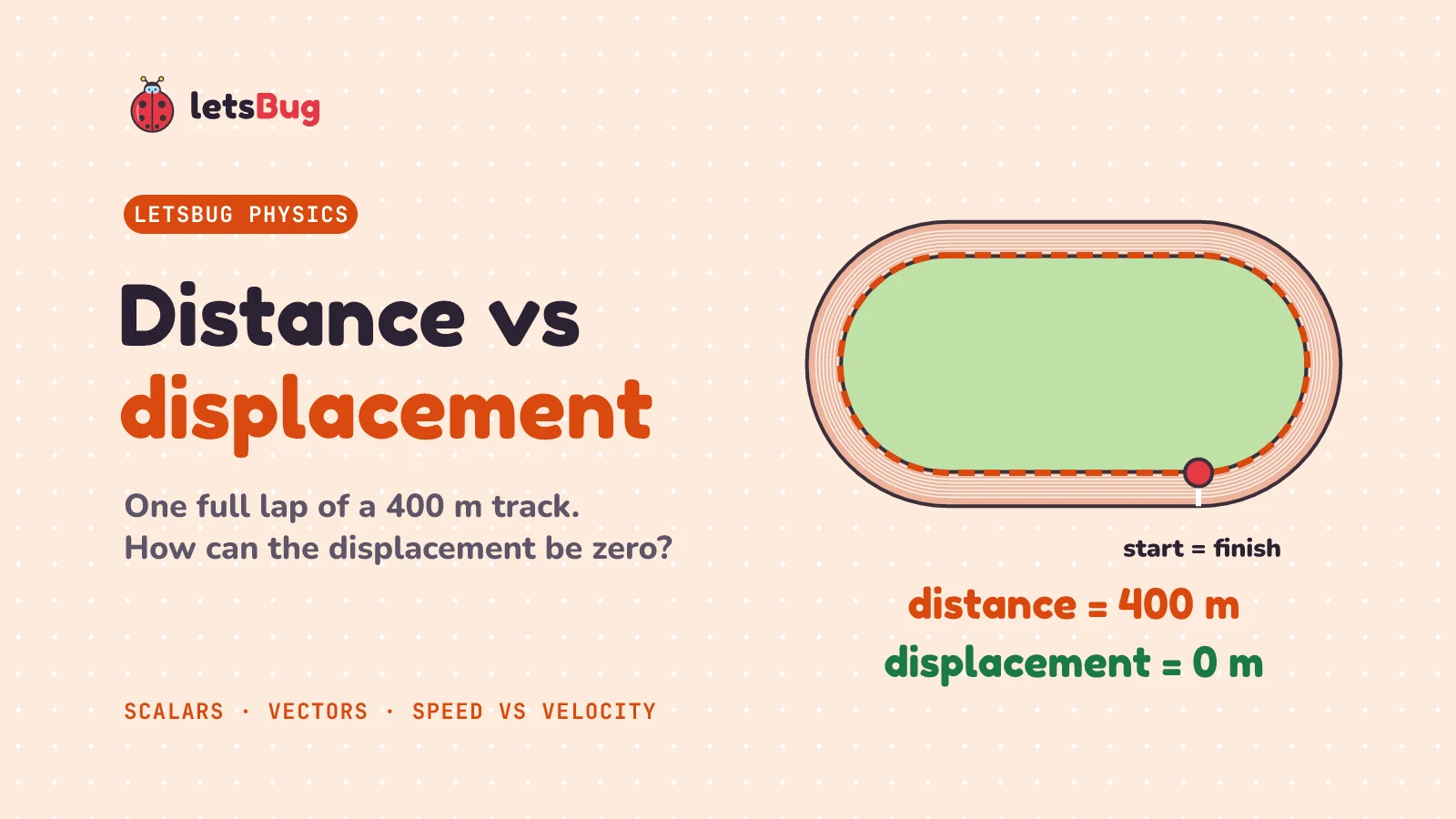
Displacement is zero whenever you finish exactly where you started. Distance is the length of the path you actually travel, so it only has a size (a scalar). Displacement is the straight line from your start to your finish, with a direction (a vector). Run one full lap of a 400 m track and your running app says 400 m: that's your distance. But you end up back on the start line, so your displacement is 0 m. Same run, two different answers, and both are right. In this post we pin down both ideas, use them for speed and velocity, convert a cricket ball's speed to m/s, see why the International Space Station is always accelerating, and finish with exam-style questions and model answers.
Key takeaways
- Distance is the length of the path travelled. It has a size only, so it's a scalar.
- Displacement is the straight line from start to finish, with a direction (north, left, up, or a + / − sign). It's a vector.
- Displacement can never be bigger than distance. They're equal only for motion in one straight line with no turning back.
- Average speed = distance ÷ time. Average velocity = displacement ÷ time, with a direction. One 400 m lap in 80 s: 5 m/s, but 0 m/s.
- A steady speed is not a steady velocity: turning changes your velocity. The ISS moves at an almost steady 7.67 km/s, yet it is accelerating all the time.
This post goes with letsBug Physics, episode 3. Distance, displacement, speed and velocity are in CBSE Class 9 Science (the new Exploration textbook, Chapter 4, Describing Motion Around Us) and in GCSE Physics. Watch the lesson, or read on: the post adds the full working, a taxi problem with Pythagoras and more exam-style questions with answers.
Distance vs displacement: the definitions
Distance is how far you move along your actual path. When you give a distance, you only give its size: "400 m". Anything with a size but no direction is a scalar.
Displacement is your overall change in position: the straight line from where you started to where you finished, and the direction of that line. "3 m forward" or "5 km north-east" are displacements. Anything with a size and a direction is a vector.
Now watch both on the track. As you run the lap, your distance only ever goes up: 100 m, 200 m, 300 m, 400 m. Your displacement is an arrow from the start line to you. It grows as you run away from the start, then shrinks as you come back round, and when you cross the line it's gone. OpenStax gives the same idea with a school run: your parent drives you 5 km to school and drives back home, a total distance of 10 km, "but the total displacement is 0."
| Distance | Displacement | |
|---|---|---|
| What it measures | The length of the path | The straight line from start to finish |
| Direction? | No: a scalar | Yes: a vector |
| Can it be zero after moving? | No | Yes, if you end where you started |
| Can it be negative? | No | Yes: the sign gives the direction |
| One 400 m lap | 400 m | 0 m |
Why the outer lanes start ahead
Real tracks are built around distance. Our lap is run in lane 1: lane 1 of a standard track measures 400 m, but the outer lanes curve round wider bends, so lane 8 is 453.03 m round. In a 400 m race, the runner in lane 8 starts 53.03 m further ahead (453.03 − 400 = 53.03), so every runner covers the same 400 m of distance. You can check that from the bends alone: the measured line in lane 1 has a radius of 36.80 m and in lane 8 it's 45.24 m, so the two bends together add 2π × (45.24 − 36.80) ≈ 53.03 m.
Myth: distance and displacement are the same number
In everyday talk, "how far did you go?" means the length of the path, so it's easy to think distance and displacement are two names for one number. Let's test it. Walk 5 m forward, then 2 m back.
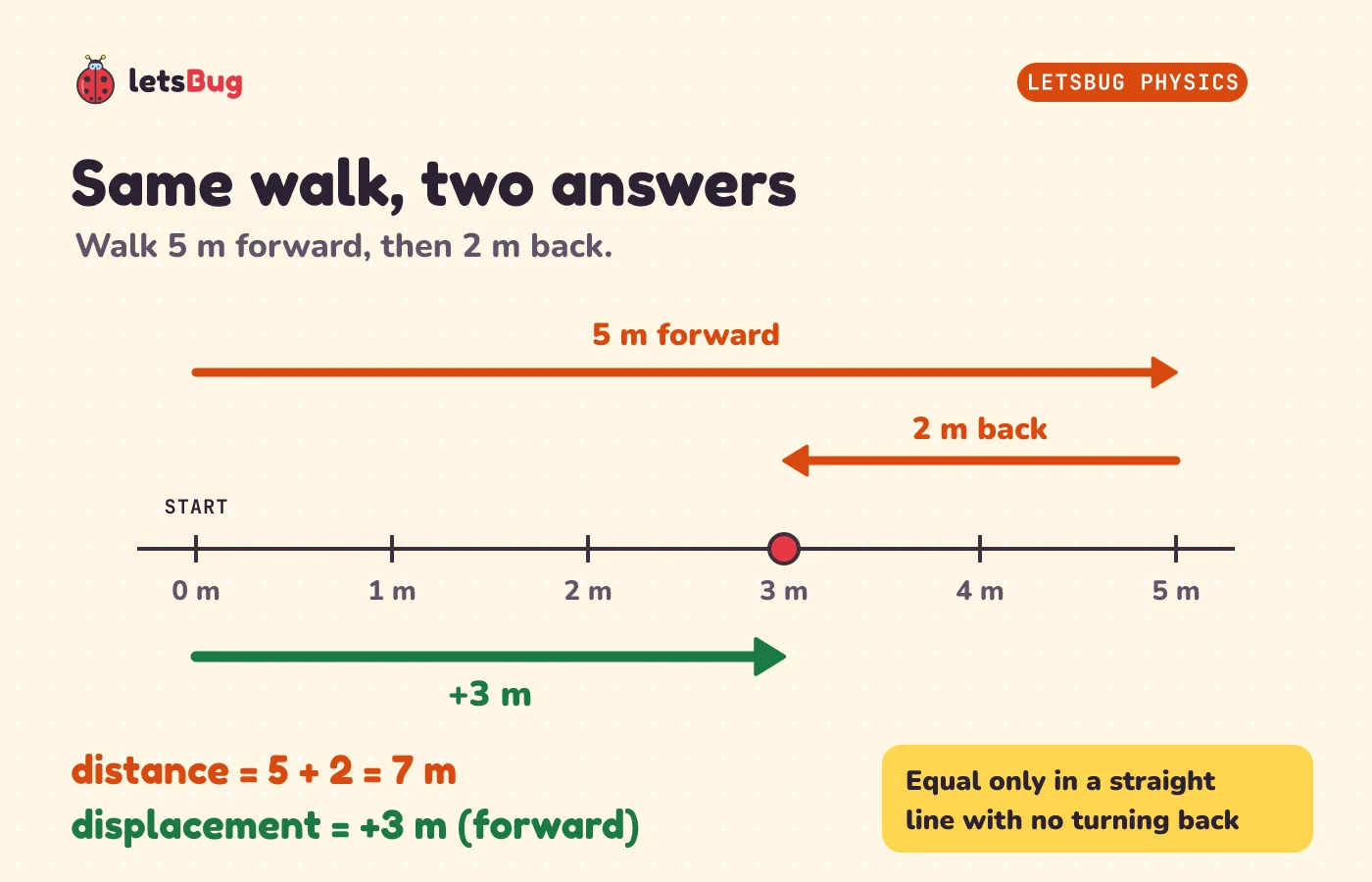
- Distance: add up the whole path. 5 + 2 = 7 m.
- Displacement: where you ended up compared with the start. 5 − 2 = 3, so +3 m, meaning 3 m forward.
The sign is the direction. Pick one direction as positive (here, forward), and the other is negative. If you'd walked 2 m forward and then 5 m back, your displacement would be −3 m: 3 m behind the start.
So the two are not the same. They only match when you move in one straight line and never turn back. Any time you turn, the displacement is smaller than the distance. It can never be bigger, because a straight line is the shortest way between two points.
Average speed vs average velocity
Speed and velocity split in exactly the same way:
average velocity = displacement ÷ time (a vector, so it needs a direction)
Say you run that lap in 80 s.
- Average speed = 400 m ÷ 80 s = 5 m/s.
- Average velocity = 0 m ÷ 80 s = 0 m/s.
You were moving the whole time, but your average velocity for the lap is zero, because you finished where you started. That's not a trick: it's what velocity means. In physics, velocity is speed in a given direction.
Units first: a cricket ball in m/s
Questions love mixed units, so convert first. The fastest bowlers bowl at over 138 km/h, and the record is Shoaib Akhtar's 161.3 km/h. Let's take a fast delivery at 150 km/h. Before you use any equation, change km/h to m/s:
- 1 km = 1000 m and 1 h = 3600 s.
- 150 km/h = 150 000 m ÷ 3600 s ≈ 41.7 m/s.
- Shortcut: km/h ÷ 3.6 = m/s, so 150 ÷ 3.6 ≈ 41.7 m/s.
A cricket pitch is 20.12 m between the wickets, about 20 m. Time = distance ÷ speed = 20 ÷ 41.7 ≈ 0.48 s. That's roughly all the time a batter gets. (It's approximate: the ball slows a little after it leaves the hand, and it's released a little in front of the bowler's wicket.)
Myth: a steady speed means a steady velocity
Here's a second myth: if your speed stays the same, so does your velocity. Look at the International Space Station. It moves at an almost steady 7.67 km/s and goes once around the Earth in about 92.9 minutes.
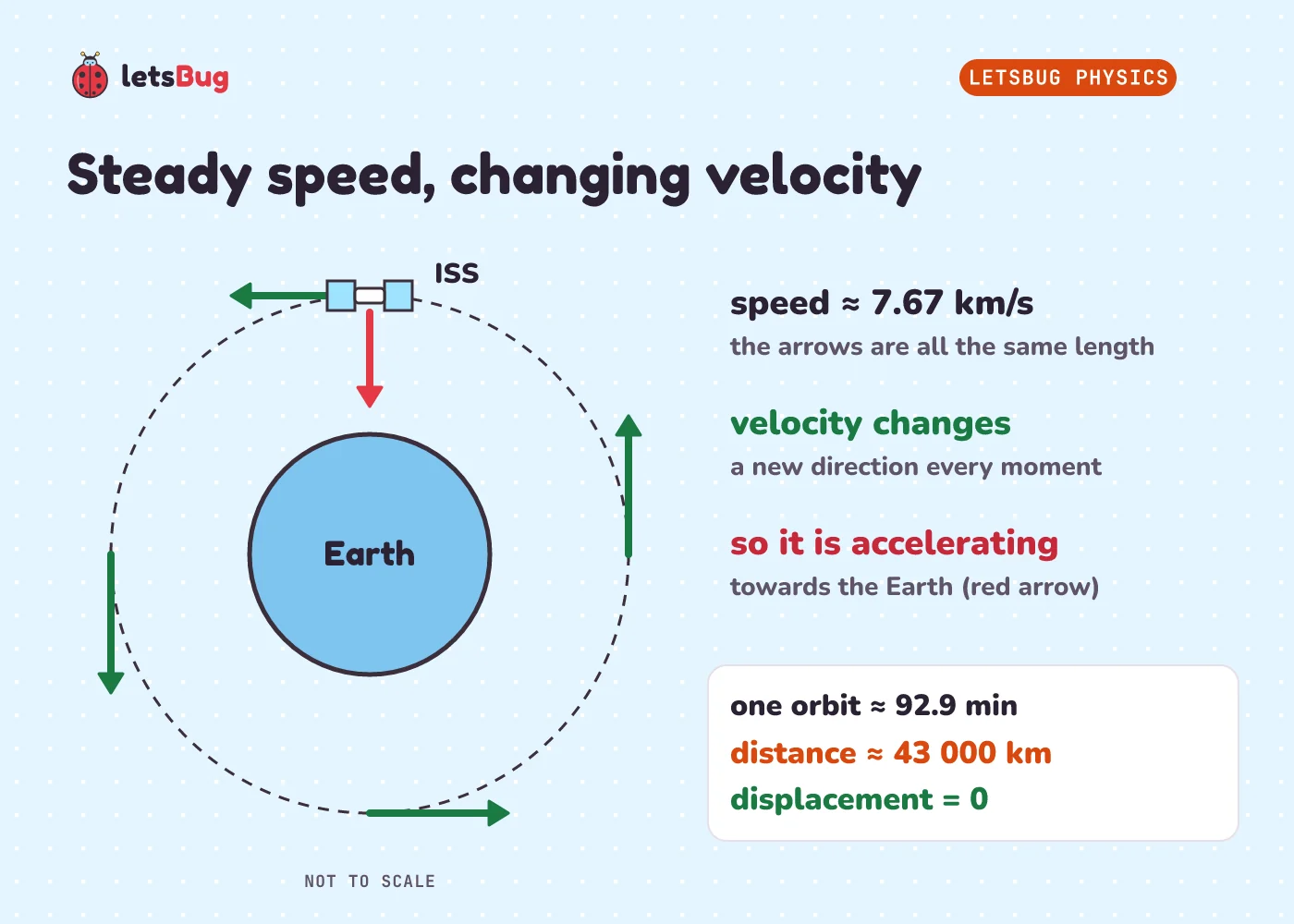
Its speed hardly changes, but its direction changes every moment, so its velocity changes every moment. A changing velocity is an acceleration, and (as Newton's second law says) an acceleration needs a resultant force: here, gravity. The station is accelerating towards the Earth all the time, even at a steady speed. Wikipedia's car example says the same: a car going round a circle at a constant 20 km/h "has a constant speed, but does not have a constant velocity because its direction changes."
And after one orbit, the station is back at the same point in its orbit. Its distance for that orbit is 7.67 km/s × 92.9 × 60 s ≈ 42 753 km, about 43 000 km. Its displacement is 0: the 400 m lap again, on a much bigger track.
Closer to home, a car's speedometer shows speed, never direction. Drive round a roundabout at a steady 30 km/h and your speed doesn't change, but your velocity changes all the way round.
Which one does the question want?
Ask one question: does direction matter?
- If the question says displacement or velocity, give a direction: north, left, up, or a + or − sign.
- If it says distance or speed, add up the whole path. No direction is needed.
Then re-read your answer. Displacement can never be bigger than distance, and average velocity can never be bigger than average speed. If yours is, something has gone wrong.
Model answer: why is average velocity zero on a lap?
A typical 2-mark question: A runner completes one lap of a 400 m track in 80 s. Explain why her average velocity is zero.
A weak answer: "Because she didn't really go anywhere." But she did move, 400 m, and the answer uses no physics words, so it's unlikely to score.
A full-mark answer has two steps:
- She finishes at her starting point, so her displacement is zero. [1]
- Average velocity = displacement ÷ time = 0 ÷ 80 s = 0. [1]
And for "state one difference between speed and velocity": velocity is speed in a given direction. Speed is a scalar; velocity is a vector.
Pause and try. A taxi drives 3 km north, then 4 km east. The trip takes 10 minutes. Find its average speed and its average velocity, in m/s.
Show the answers
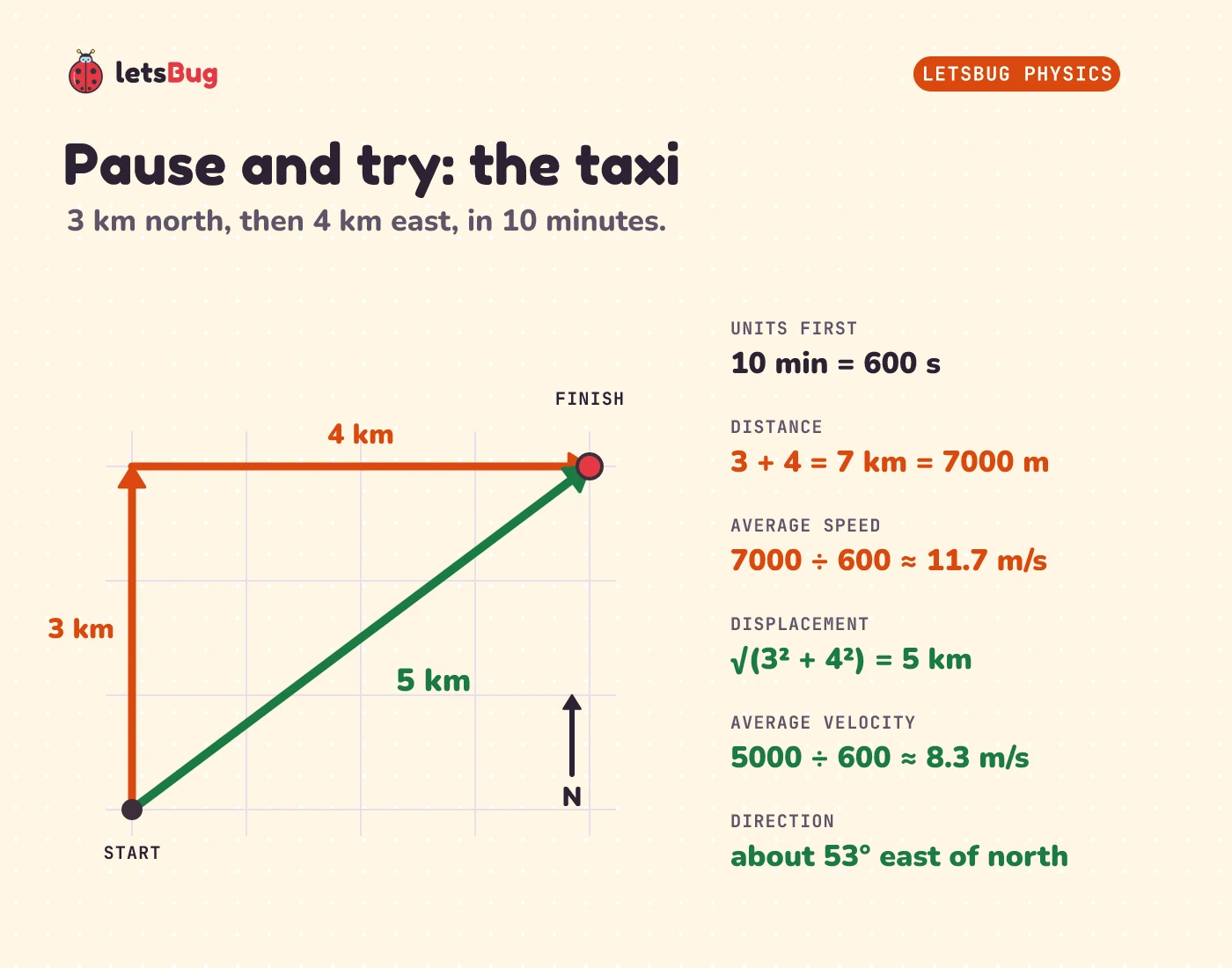
Units first: 10 min = 10 × 60 = 600 s.
Distance = 3 + 4 = 7 km = 7000 m. Average speed = 7000 ÷ 600 ≈ 11.7 m/s.
Displacement: the two legs are at right angles, so use Pythagoras: √(3² + 4²) = √25 = 5 km = 5000 m. Average velocity = 5000 ÷ 600 ≈ 8.3 m/s, in the direction straight from the start to the finish: about 53° east of north.
Re-read: 8.3 m/s is less than 11.7 m/s, as it must be.
Exam-style questions
Q1 (1 mark). State one difference between speed and velocity.
Answer
Velocity has a direction (it's a vector); speed has only a size (it's a scalar).
Q2 (3 marks). A swimmer swims two lengths of a 50 m pool, ending where she started, in 80 s. Calculate (a) her average speed and (b) her average velocity.
Answer
(a) Distance = 2 × 50 = 100 m [1]. Average speed = 100 ÷ 80 = 1.25 m/s [1].
(b) She ends where she started, so her displacement is 0 and her average velocity is 0 m/s [1].
Q3 (4 marks). A lift goes up 30 m, then down 12 m. The whole trip takes 40 s. Find (a) the distance, (b) the displacement, (c) the average speed and (d) the average velocity.
Answer
(a) 30 + 12 = 42 m [1]. (b) 30 − 12 = 18 m up (+18 m) [1]. (c) 42 ÷ 40 = 1.05 m/s [1]. (d) 18 ÷ 40 = 0.45 m/s up [1].
Q4 (2 marks). A car travels at 72 km/h. Convert this to m/s, and find how far it goes in 5 s.
Answer
72 ÷ 3.6 = 20 m/s [1]. Distance = speed × time = 20 × 5 = 100 m [1].
Questions people ask
How can displacement be zero?
Displacement is zero whenever you finish where you started, however far you travelled. One full lap of a 400 m track is 400 m of distance but zero displacement.
What is the difference between distance and displacement?
Distance is the length of the path you travel and has no direction (a scalar). Displacement is the straight line from your start to your finish, with a direction (a vector).
Can displacement be bigger than distance?
No. The straight line from start to finish is the shortest possible path, so displacement is always less than or equal to distance. They're equal only for motion in one straight line with no turning back.
Can displacement be negative?
Yes. The sign shows the direction. If forward is positive, then ending 3 m behind your start is a displacement of −3 m. Distance can never be negative.
What is the difference between speed and velocity?
Velocity is speed in a given direction. Speed is a scalar; velocity is a vector. Average speed uses distance, and average velocity uses displacement.
Can you have a constant speed but a changing velocity?
Yes, whenever you change direction: a car on a roundabout, or the ISS going round the Earth at about 7.67 km/s. A changing velocity is an acceleration.
How do you convert km/h to m/s?
Divide by 3.6, because 1 km/h = 1000 m ÷ 3600 s. So 150 km/h ≈ 41.7 m/s and 72 km/h = 20 m/s.
Keep going
- Watch the full lesson, how can displacement be zero?, on the letsBug channel.
- The taxi's displacement used Pythagoras. See why it works: Pythagoras' theorem, a visual proof.
- What makes velocity change? A resultant force: Newton's second law examples in everyday life.
Sources
- OpenStax Physics: 2.1 Relative motion, distance, and displacement (scalars, vectors, the school-run example) and 2.2 Speed and velocity (average speed and average velocity)
- AQA: GCSE Physics 8463, 4.5 Forces (distance and displacement, speed, velocity, motion in a circle)
- Tiwari Academy: NCERT Class 9 Science Exploration, Chapter 4 (what the 2026-27 chapter covers)
- Wikipedia: Velocity, Running track (lane lengths and the 400 m stagger), Cricket pitch, Fast bowling and International Space Station
Every number in this post was checked against these sources, and the arithmetic was run in Python before publishing.