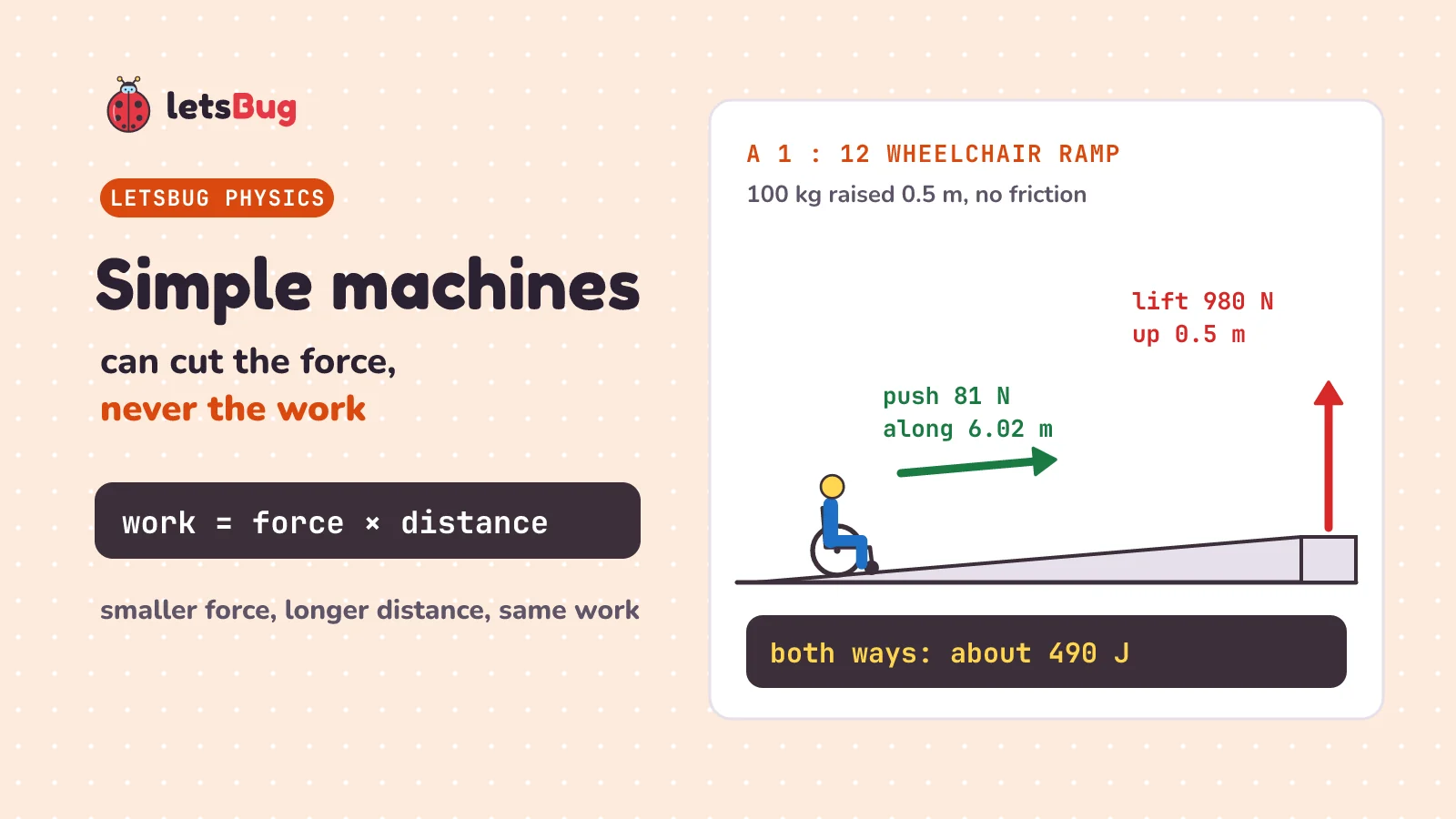
Simple machines make work easier by letting you push with a smaller force over a longer distance. They never reduce the work, which is force × distance. A crowbar that cuts your push to a third makes you push three times as far, and a 1:12 wheelchair ramp turns a 980 N lift into an 81 N push.
In this post we start with the turning effect of a force, called its moment, and the principle of moments that makes a see-saw balance. Then we see how a lever multiplies your force, and why the work stays the same. We work out efficiency, test a real wheelchair ramp, and meet the levers where you push harder than the load, so that the far end moves further and faster. We finish with practice and exam-style questions with model answers.
Key takeaways
- Moment = force × perpendicular distance from the pivot to the line of the force, in newton metres (N m). Perpendicular means at right angles.
- Principle of moments: when something balances, the total clockwise moment equals the total anticlockwise moment.
- Mechanical advantage = load ÷ effort. For a perfect lever (no friction), it also equals effort arm ÷ load arm.
- When the effort is smaller, it moves further by the same factor. So for a perfect machine, work in = work out. A machine never reduces the work.
- Efficiency = useful work out ÷ work in × 100%. Friction transfers some of the energy to the thermal store (it warms the moving parts), so real machines are always below 100%.
- Not every lever needs a smaller effort. With a broom or tweezers you push harder than the load, but the far end moves further and faster.
This post goes with letsBug Physics, episode 10. Moments are in the Cambridge IGCSE Physics syllabus (section 1.5.2), and simple machines are in CBSE Class 9 Science, Chapter 7, Work, Energy, and Simple Machines. Watch the lesson, or read on. The post adds the three classes of lever, a worked efficiency example from OpenStax, the US ramp rules word for word, and exam-style questions with full answers.
What is a simple machine?
A simple machine is a tool that changes the size or the direction of the force you need. Levers, ramps, pulleys, and wheels and axles are all simple machines. The NCERT textbook (the official school book for CBSE) says: "Although the total work required for a task cannot be reduced, it can be made easier by changing the magnitude or direction of the force that needs to be applied." (Magnitude means size.)
Two words are used all the time. NCERT explains them: "The force we apply to a machine is called the effort, and force that needs to be overcome is called the load." Then:
mechanical advantage = load ÷ effort
OpenStax, a free online physics textbook, puts it this way: "The mechanical advantage is a number that tells us how many times a simple machine multiplies the effort force." A mechanical advantage of 3 means the machine lifts a load three times bigger than your push.
What is the moment of a force?
A moment is the turning effect of a force. Push a door and it turns about its hinges. The hinges are the pivot: the fixed point that something turns about. The equation is:
moment = force × perpendicular distance from the pivot to the line of the force
The force is in newtons (N) and the distance is in metres (m), so a moment is in newton metres (N m). The line of the force is the straight line the push acts along, made longer in both directions.
Why is a door handle far from the hinges?
Because the same push, further from the pivot, gives a bigger turning effect. Take a 20 N push at right angles to a door:
- At the handle, 0.8 m from the hinges: moment = 20 × 0.8 = 16 N m.
- Near the hinges, 0.2 m away: moment = 20 × 0.2 = 4 N m. That's a quarter as much, so the door is much harder to open.
Why does the word perpendicular matter?
Perpendicular means at right angles. The distance must be measured at right angles to the line of the force, not just "from the pivot". Here is a test. Push at the handle, but straight towards the hinges. The push is 0.8 m from the hinges, yet the door doesn't turn at all. The line of that force goes right through the pivot, so the perpendicular distance is 0, and the moment is 20 × 0 = 0 N m.
Students lose marks by leaving the word out. Cambridge's June 2025 examiner report for IGCSE Physics (a report by the people who mark the exam) says of Paper 0625/42: "Another common misconception was that the moment of a force was force × distance, i.e. omitting the word ‘perpendicular’." (A misconception is a wrong idea. Omitting means leaving out.) On Paper 0625/41 it warns: "Candidates should be aware of the key term ‘perpendicular’ when they refer to the moment of a force." (A candidate is a student taking the exam.)
What is the principle of moments?
When something balances, the total clockwise moment equals the total anticlockwise moment. Clockwise is the way a clock's hands turn. Anticlockwise is the other way.
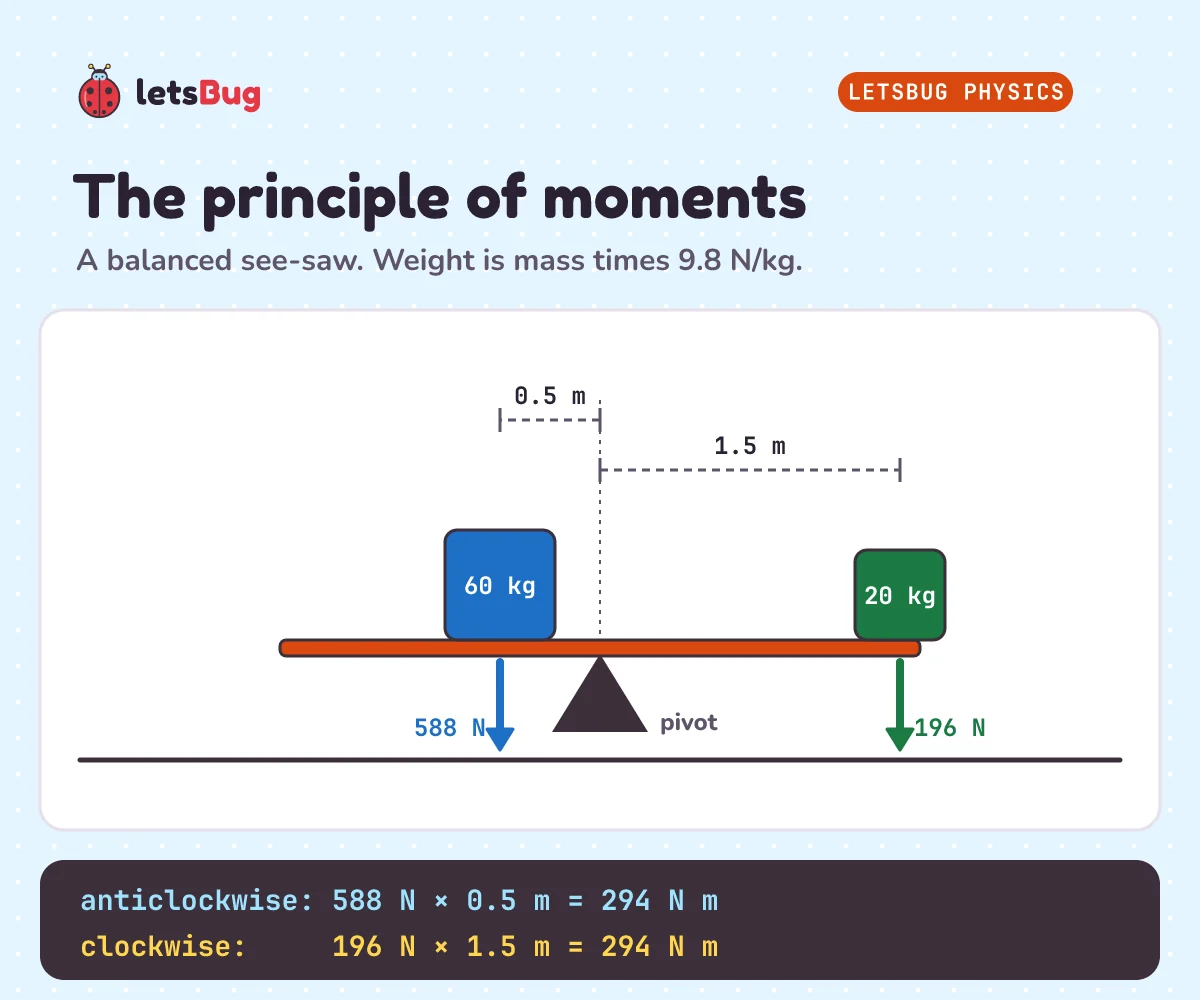
Let's test it on a see-saw. A 20 kg child sits 1.5 m from the pivot on the right. A 60 kg parent sits 0.5 m from the pivot on the left. Weight is mass × 9.8 N/kg (the pull of gravity on each kilogram), as in the post on resultant force.
- Child: weight = 20 × 9.8 = 196 N. Moment = 196 × 1.5 = 294 N m clockwise.
- Parent: weight = 60 × 9.8 = 588 N. Moment = 588 × 0.5 = 294 N m anticlockwise.
The two moments are equal, so the see-saw balances. The parent is three times as heavy, but sits at a third of the distance from the pivot.
Now the parent moves back to 1 m. Their moment doubles: 588 × 1 = 588 N m. That's more than the child's 294 N m, so the parent's side goes down.
The 9.8 cancels when you balance, because it's on both sides. NCERT's Example 7.13 uses this. It asks: "On which seats should children of masses 15 kg and 30 kg sit to make the seesaw balanced?" The seats are 1 m and 2 m from the pivot. Its answer: 15 kg × 2 m = 30 kg × L, so L = 1 m. The heavier child sits closer to the pivot.
In an exam, write down that the two moments are equal. The same examiner report says of Paper 0625/31: "Some candidates separately wrote out the clockwise and anticlockwise moments but made mistakes in equating them, and did not state that they were equal, limiting the credit that could be awarded." (Equating means setting two things equal. Credit means marks.)
How does a lever multiply your force?
A lever is a stiff bar that turns about a pivot. For a lever, the pivot is called the fulcrum. A crowbar is a lever. Put the pivot 0.5 m from a crate that presses down on the bar with 600 N, and push down on the other side, 1.5 m from the pivot. In balance, by the principle of moments:
- effort × 1.5 = 600 × 0.5 = 300
- effort = 300 ÷ 1.5 = 200 N
- mechanical advantage = 600 ÷ 200 = 3
NCERT writes the same rule as effort × effort arm = load × load arm. (The effort arm is the distance from the fulcrum to the effort. The load arm is the distance from the fulcrum to the load.) So, with no friction, a lever's mechanical advantage is also effort arm ÷ load arm: 1.5 ÷ 0.5 = 3. A longer handle means a smaller push.
Does a lever reduce the work you do?
No. Watch the distances. Both ends turn about the pivot together, so each end moves in proportion to its distance from it. (In proportion means that a point twice as far from the pivot moves twice as far.) Your end is three times as far from the pivot, so it moves three times as far.
- The crate rises 10 cm (0.1 m). Your end moves down 30 cm (0.3 m).
- Work out (on the crate) = 600 N × 0.1 m = 60 J.
- Work in (by you) = 200 N × 0.3 m = 60 J.
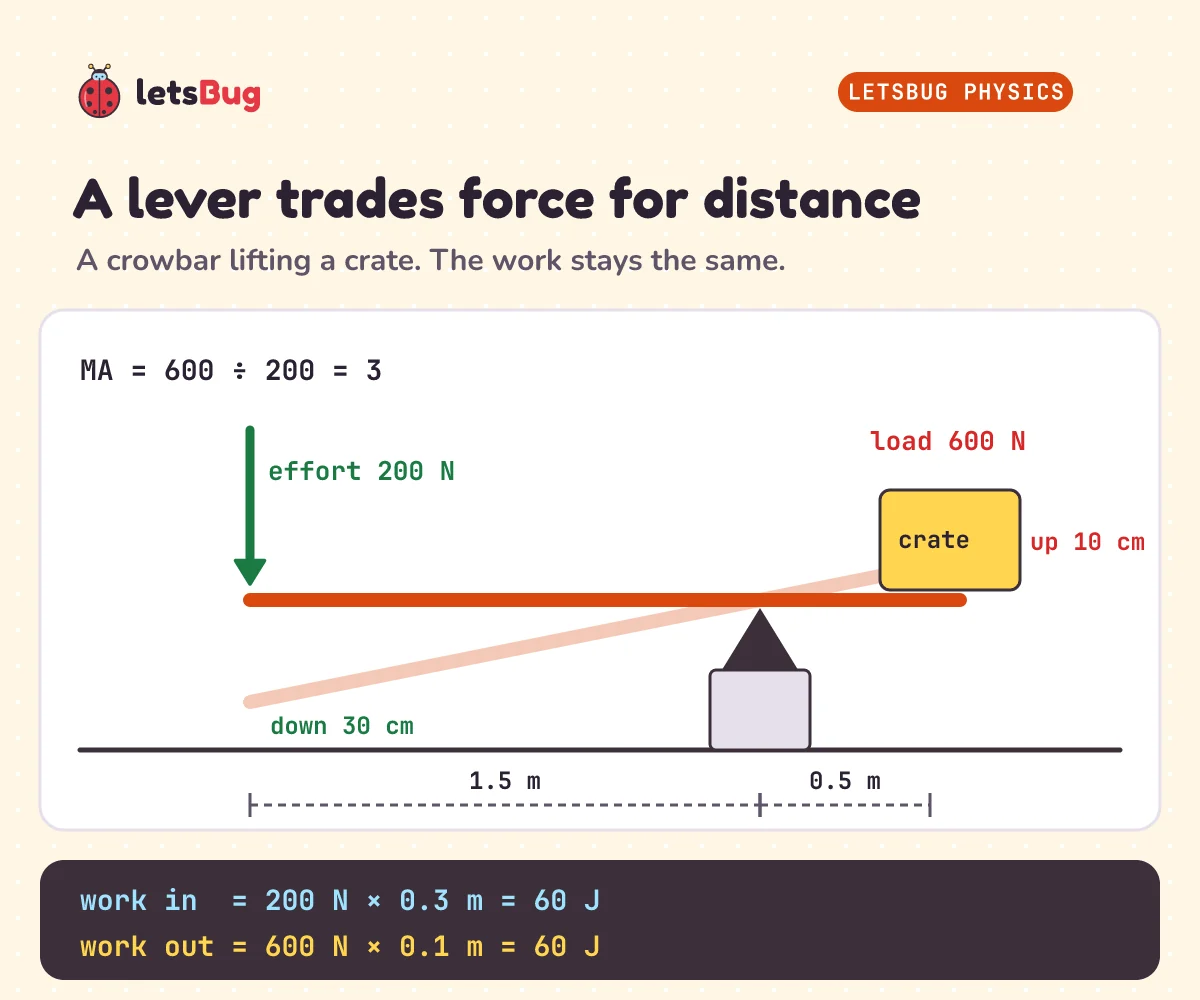
Exactly the same. Work is force × distance, as in the post on work done. The lever makes the force smaller and the distance bigger by the same factor, so the work can't change. NCERT's note says: "A lever reduces the force required to perform a task but not the total work done."
OpenStax says it for every simple machine: "Simple machines make work easier, but they do not decrease the amount of work you have to do." The reason is energy. OpenStax again: "A machine cannot increase the amount of energy you put into it." The work you do is energy you give to the crate. If you got more work out than you put in, the machine would be making energy from nothing. As NCERT puts it: "Machines do not create energy, they only help us use it more effectively." That's the conservation of energy from the last episode.
Why is no machine 100% efficient?
Because of friction. Friction is a force that acts against movement when two surfaces rub or slide over each other. OpenStax explains: "In real life, some of the applied work always ends up as wasted heat due to friction between moving parts." So you always put in a bit more work than you get out:
efficiency = useful work out ÷ work in × 100%
OpenStax has a worked example with a lever: "The input force of 11 N acting on the effort arm of a lever moves 0.4 m, which lifts a 40 N weight resting on the resistance arm a distance of 0.1 m." (The resistance arm is another name for the load arm.)
- Work in = 11 × 0.4 = 4.4 J
- Work out = 40 × 0.1 = 4.0 J
- Efficiency = 4.0 ÷ 4.4 × 100% ≈ 91%
The missing 0.4 J was transferred to the thermal store: friction warms the pivot. Notice what friction does to the mechanical advantage too. The effort moved 4 times as far as the load (0.4 ÷ 0.1 = 4), so a perfect lever would lift 4 times the effort: 44 N. This one lifts 40 N, a mechanical advantage of only 40 ÷ 11 ≈ 3.6.
OpenStax says: "No simple or complex machines have the actual mechanical advantages calculated by the IMA equations." (IMA is the ideal mechanical advantage: the one a perfect machine with no friction would have.) Its conclusion: "Efficiency in real machines will always be less than 100 percent because of work that is converted to unavailable heat by friction and air resistance."
The ideal machine (no friction) is still useful. It tells you the smallest effort you could ever need. Exam questions usually say "ignore friction" when they want you to treat the machine as perfect.
Does a wheelchair ramp save any work?
No, but it cuts the push to about a twelfth of the lift. A ramp is a simple machine too: OpenStax says "All sloping, paved surfaces for walking or driving are inclined planes." (An inclined plane is a slope.)
In the United States, the ADA Standards (the US rules that make buildings usable for disabled people) set the steepest ramp allowed. Rule 405.2 says: "Ramp runs shall have a running slope not steeper than 1:12." (A ramp run is one straight part of a ramp. The running slope is its slope in the direction you move.) A slope of 1:12 means 1 m up for every 12 m along the ground. (The rules measure slope as "the rise over the run": how far up, divided by how far along.) Rule 405.6 adds: "The rise for any ramp run shall be 30 inches (760 mm) maximum."
Let's raise a wheelchair and its user, 100 kg in all, by 0.5 m. That's inside the 760 mm limit.
- Straight up: the force is the weight, 100 × 9.8 = 980 N. Work = 980 × 0.5 = 490 J.
- Up a 1:12 ramp: it runs 0.5 × 12 = 6 m along the ground. Its length along the slope is √(6² + 0.5²) ≈ 6.02 m (by Pythagoras' theorem, the rule for the longest side of a right-angled triangle). With no friction, the push is 490 ÷ 6.02 ≈ 81 N.
- Work up the ramp = 81 N × 6.02 m ≈ 490 J. The same work.
The mechanical advantage is 980 ÷ 81 ≈ 12, and the distance is 6.02 ÷ 0.5 ≈ 12 times as long. NCERT gets the same rule for any ramp with no friction: mechanical advantage = length of the ramp ÷ height. Its Example 7.12 is a ramp over "a step 30 cm high" that is 50 cm long, so 50 ÷ 30 ≈ 1.67.
The ADA rules also point out the downside. The advisory (advice) note under rule 405.2 says: "To accommodate the widest range of users, provide ramps with the least possible running slope and, wherever possible, accompany ramps with stairs for use by those individuals for whom distance presents a greater barrier than steps, e.g., people with heart disease or limited stamina." (Accommodate means suit. Stamina means how long you can keep going.) A gentle ramp needs a smaller push, but over a longer distance. For some people, that extra distance is the harder part.
Do all levers make the force smaller?
No. This is the one place where the video's recap is not quite right. It says levers and ramps make the force smaller. That's true for the crowbar, the wheelbarrow and every ramp. But some levers are built to do the opposite. NCERT says "the effort required is generally smaller", and generally means usually, not always.
NCERT's Table 7.2 sorts levers into three classes "depending upon the relative positions of effort, fulcrum and load":
| Class | What is in the middle | NCERT's examples | Effort smaller than load? |
|---|---|---|---|
| Class I | the fulcrum | scissors, crowbar, pliers, balance scale, seesaw | it depends where the fulcrum is |
| Class II | the load | lemon squeezer, wheel barrow, bottle opener | yes, always |
| Class III | the effort | tweezers, broom, hammer, oar | no, the effort is bigger |
In a class III lever, your hand is closer to the fulcrum than the load is. Say the effort is 0.2 m from the fulcrum and a 10 N load is 1 m from it.
- By the principle of moments, effort × 0.2 = 10 × 1, so the effort is 50 N, five times the load.
- The mechanical advantage is 10 ÷ 50 = 0.2, less than 1.
- What do you get back? The load end moves 5 times as far as your hand, in the same time, so it moves 5 times as fast.
- Move your hand 0.1 m and the load moves 0.5 m: work in = 50 × 0.1 = 5 J, work out = 10 × 0.5 = 5 J. Still the same work.
OpenStax describes these levers: "Some levers exert a large force to a short effort arm." (This means you push hard on a short effort arm.) Its examples: "Examples of this type of lever are baseball bats, hammers, and golf clubs." A bat turns a small movement of your hands into a fast swing at the far end.
Other simple machines don't always make the force smaller either. A fixed pulley, like the one on a flagpole, doesn't change the size of the force at all. NCERT: "A fixed pulley does not reduce the magnitude of the force required, it only changes its direction." Pulling down is just easier than lifting up.
So the rule that is always true is this one: a machine can change the size or the direction of a force, but it never gives out more work than you put in.
How do you answer a lever question clearly?
Here is a typical question. A lever has an effort arm of 1.2 m and a load arm of 0.3 m. What effort lifts a 900 N load, and does the lever reduce the work done?
A common answer says: "The effort is 225 N, so the lever reduces the work." The number is right, but the reason is wrong. A complete answer has three steps:
- By the principle of moments, effort × 1.2 = 900 × 0.3 = 270.
- So the effort = 270 ÷ 1.2 = 225 N.
- The effort moves 4 times as far as the load (1.2 ÷ 0.3 = 4), so the work done is not reduced.
The Cambridge report's general comments for Paper 0625/31 list "applying the principle of moments" among the areas that "were not well understood". The report on Papers 0625/32 and 0625/33 shows what works: "There were many successful answers which usually started with a statement of the principle of moments, and so set the method up for a correct calculation." So write the balance equation first, then put the numbers in.
Your turn. Write the balance equation first, then check the work in and the work out.
1) A wheelbarrow is a lever with its fulcrum at the wheel's axle. A 400 N load sits 0.3 m from the axle, and you lift the handles 1.2 m from it. Find the effort. Then find how far the load rises when you lift the handles by 40 cm.
2) Change one thing: move the load closer to the wheel, just 0.15 m from the axle. Find the new effort and how far the load rises for the same 40 cm lift.
3) A machine does 400 J of useful work when 500 J of work is done on it. Find its efficiency.
Show the answers
1) Effort × 1.2 = 400 × 0.3 = 120, so the effort = 120 ÷ 1.2 = 100 N. The handles are 4 times as far from the axle as the load, so the load rises a quarter as far: 40 cm ÷ 4 = 10 cm. Check: work in = 100 N × 0.4 m = 40 J; work out = 400 N × 0.1 m = 40 J.
2) Effort × 1.2 = 400 × 0.15 = 60, so the effort = 60 ÷ 1.2 = 50 N. The handles are now 8 times as far from the axle (1.2 ÷ 0.15 = 8), so the load rises 40 cm ÷ 8 = 5 cm. Work in = 50 × 0.4 = 20 J; work out = 400 × 0.05 = 20 J. Half the effort, but the load only rises half as far.
3) Efficiency = 400 ÷ 500 × 100% = 80%. The other 100 J was transferred to the thermal store, mostly by friction.
Exam-style questions with model answers
The marks in brackets are our estimate: one mark for each correct step or idea.
Q1 (2 marks). Define the moment of a force, and give its unit.
Model answer
The moment is the force × the perpendicular distance from the pivot to the line of the force [1]. Unit: newton metre, N m [1].
Q2 (2 marks). State the principle of moments.
Model answer
For an object in balance [1], the sum of the clockwise moments about a pivot equals the sum of the anticlockwise moments about the same pivot [1].
Q3 (3 marks). A 30 kg child sits 2 m from the pivot of a see-saw. Where must a 40 kg child sit, on the other side, to balance it?
Model answer
Clockwise moment = anticlockwise moment [1]. 30 × 9.8 × 2 = 40 × 9.8 × d, so 588 = 392 × d [1]. d = 588 ÷ 392 = 1.5 m from the pivot [1].
Q4 (4 marks). A worker pushes a 600 N box up a ramp 3 m long to a platform 0.6 m high. (a) Find the push needed if there is no friction. (b) The real push is 150 N. Find the efficiency of the ramp.
Model answer
(a) Work out = 600 × 0.6 = 360 J [1]. With no friction, push × 3 = 360, so the push = 120 N [1]. (b) Work in = 150 × 3 = 450 J [1]. Efficiency = 360 ÷ 450 × 100% = 80% [1].
Q5 (2 marks). A student says, "A lever with a mechanical advantage of 5 reduces the work I do by 5 times." Explain why the student is wrong.
Model answer
The effort is 5 times smaller, but it moves 5 times as far as the load [1]. Work = force × distance, so the work in is the same as the work out, or a bit more because of friction [1].
Questions people ask
How do simple machines make work easier?
They let you use a smaller force over a longer distance, or change the direction of the force to one that is easier to push or pull. The work, force × distance, stays the same or gets a little bigger because of friction.
Do simple machines reduce the amount of work?
No. A machine can't give out more energy than you put in. If it makes the force smaller, the distance gets bigger by the same factor, so the work is unchanged.
What is the formula for the moment of a force?
Moment = force × perpendicular distance from the pivot to the line of the force. With the force in newtons and the distance in metres, the moment is in newton metres (N m).
What is the principle of moments?
When an object is balanced, the total clockwise moment about any point equals the total anticlockwise moment about that point.
What is mechanical advantage?
Mechanical advantage = load ÷ effort. With no friction, it also equals effort arm ÷ load arm for a lever, and the ramp's length ÷ its height for a ramp.
Why can't a machine be 100% efficient?
Moving parts rub together, and friction transfers some of the energy to the thermal store, warming the parts. So the useful work out is always a little less than the work in.
Keep going
- Watch the full lesson, How Do Simple Machines Make Work Easier? Moments & Levers, and its Short, A Ramp Makes It Easier, but Does It Save Any Work? More in letsBug Physics on YouTube.
- The episode before this one: kinetic energy: double the speed, four times the energy.
- Why work is force × distance: what is work in physics? Carrying a bag does no work on it.
- Why weight is mg: what is a resultant force?
- Coming next in letsBug Physics: density and pressure, and why a steel ship weighing thousands of tonnes floats.
Checked on 22 November 2026 against the 5 sources below. Every force, moment, distance, work and efficiency figure and practice answer in this post was worked out again in a Python script, and every quote was matched word for word with the source text.
Sources
- OpenStax Physics: 9.3 Simple Machines (mechanical advantage, work in = work out, efficiency, the 91% lever, kinds of lever, inclined planes)
- NCERT: Exploration, Science for Grade 9, Chapter 7, Work, Energy, and Simple Machines (PDF) (effort, load, mechanical advantage, pulleys, ramps, levers, Examples 7.12 and 7.13, Table 7.2)
- Cambridge International: IGCSE Physics 0625 syllabus for 2026, 2027 and 2028 (PDF) (section 1.5.2, efficiency)
- Cambridge International, via PapaCambridge: IGCSE Physics 0625, Principal Examiner Report for Teachers, June 2025 (PDF) (the word perpendicular, stating the moments are equal)
- U.S. Access Board: ADA Accessibility Standards (rules 405.2 and 405.6 on ramps, and the advisory on slope)