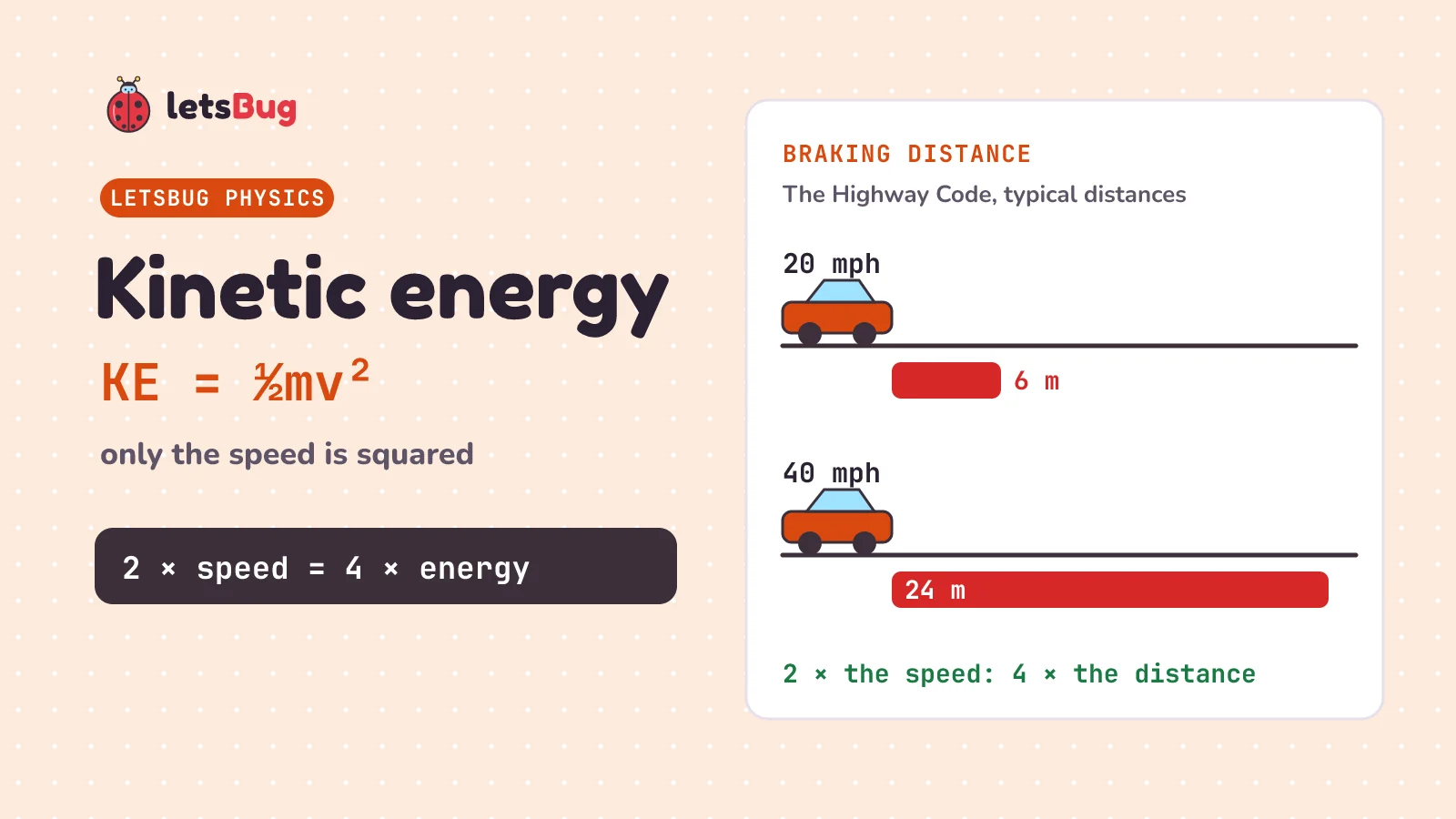
Kinetic energy is the energy something has because it is moving: KE = ½mv², in joules. Only the speed is squared, so doubling the speed makes the kinetic energy four times bigger, not two. That's why a car's braking distance at 40 mph (64 km/h) is 24 m, four times the 6 m it needs at 20 mph (32 km/h).
In this post we work out kinetic energy step by step and see why twice the speed means four times the energy. We check it against real braking distances from the UK Highway Code. Then we add gravitational potential energy and follow the energy as a ball falls. We find the speed of a real roller coaster and a diver, and learn to work out a speed from kinetic energy without the usual mistakes. We finish with practice and exam-style questions with model answers.
Key takeaways
- Kinetic energy KE = ½mv², with the mass m in kilograms, the speed v in metres per second, and KE in joules (J).
- Only the speed is squared. Double the speed: four times the energy. Three times the speed: nine times the energy.
- With the same braking force, four times the energy needs four times the braking distance. The Highway Code shows 6 m at 20 mph and 24 m at 40 mph.
- Gravitational potential energy GPE = mgh, with g = 9.8 N/kg and the height h in metres.
- As something falls with no air resistance, energy moves from the gravitational potential energy store (energy kept because of height) to the kinetic energy store. The total stays the same.
- The mass cancels, so v² = 2gh: a heavy ball and a light ball dropped together land together, at the same speed, if air resistance is small.
- To find a speed from KE: v² = 2KE ÷ m, then take the square root, and check the answer makes sense.
This post goes with letsBug Physics, episode 9. Kinetic and potential energy are in the Cambridge IGCSE Physics syllabus (section 1.7.1) and in CBSE Class 9 Science, Chapter 7, Work, Energy, and Simple Machines. Watch the lesson, or read on. The post adds the whole Highway Code table and where every number comes from. It also has a cricket ball and a landing jet from the NCERT book, and exam-style questions with full answers.
What is kinetic energy?
Kinetic energy is the energy of movement. The NCERT textbook (the official school book for CBSE) says: "The energy possessed by an object due to its motion is called kinetic energy." (Possessed means had. Motion means movement.) OpenStax, a free online physics textbook, says it more simply: "A moving object has kinetic energy." A still object has none.
OpenStax also says: "Kinetic energy depends on the mass of an object and its velocity, v." (Velocity is speed in a given direction. For kinetic energy only the speed matters, not the direction. NCERT says: "The kinetic energy has no direction.") The equation is:
KE = ½ × m × v², where m is the mass in kilograms (kg), v is the speed in metres per second (m/s), and KE is the kinetic energy in joules (J), the unit of energy.
The small 2 means squared: the speed times itself. So v² = v × v. A speed of 10 m/s gives v² = 10 × 10 = 100.
How do you change km/h to m/s?
The answer only comes out in joules if the units are right. OpenStax's tip: "When calculating work or energy, use units of meters for distance, newtons for force, kilograms for mass, and seconds for time."
So a speed in kilometres per hour (km/h) must be changed to m/s first. One kilometre is 1000 m and one hour is 3600 s, so 1 km/h = 1000 ÷ 3600 m/s. So to change km/h to m/s, divide by 3.6 (3600 ÷ 1000 = 3.6). For example, 36 km/h ÷ 3.6 = 10 m/s. A mass in grams must be changed to kilograms too: 200 g = 0.2 kg.
Worked example: a car at 10 m/s
A 1000 kg car moves at 10 m/s. What is its kinetic energy?
- KE = ½ × m × v² = ½ × 1000 × 10²
- 10² = 100, so KE = ½ × 1000 × 100 = 50 000 J
Worked example: a fast cricket ball
NCERT's Example 7.5 takes a fast delivery by an Indian bowler: "a cricket ball with an approximate mass of 0.2 kg at a velocity of about 154.8 km h−1". (km h−1 is another way to write km/h.)
- Speed first: 154.8 ÷ 3.6 = 43 m/s
- KE = ½ × 0.2 × 43² = 0.1 × 1849 = 184.9 J
That matches NCERT's answer. The ball is very light, but it is fast, and the speed is the part that gets squared.
What happens to kinetic energy when you double the speed?
It goes up four times. Let's take the same 1000 kg car and double its speed, from 10 m/s to 20 m/s.
- KE = ½ × 1000 × 20² = ½ × 1000 × 400 = 200 000 J
- 200 000 ÷ 50 000 = 4. Four times as much energy.
A common mistake is to double the energy too, and write 2 × 50 000 = 100 000 J. That's wrong, because the speed is squared: twice the speed gives 2 × 2 = 4 times the energy. NCERT's Example 7.4 asks this exact question: "If the velocity of a vehicle doubles in magnitude, what will its kinetic energy be compared to its original value?" (Magnitude means size.) Its answer is 4 times.
A second mistake is to square the whole answer, as if KE were (½ × 1000 × 20)². That gives 100 000 000 J, which is far too big. Only the v is squared.
| Speed | Speed squared | Kinetic energy |
|---|---|---|
| 1 × the speed | 1 × 1 = 1 | 1 × the energy |
| 2 × the speed | 2 × 2 = 4 | 4 × the energy |
| 3 × the speed | 3 × 3 = 9 | 9 × the energy |
| 10 × the speed | 10 × 10 = 100 | 100 × the energy |
The mass isn't squared. Double the mass at the same speed, and the kinetic energy only doubles. Compare this with momentum, mass × velocity: double the speed and the momentum only doubles, but the kinetic energy goes up four times.
Students make the same mistake in other topics too. Cambridge's June 2025 examiner report for IGCSE Physics (a report by the people who mark the exam) describes a question on Paper 0625/23 about electrical resistance: how hard it is for electric current to flow through a wire. The second wire's diameter (its width) was twice as big. A wire twice as wide has 2 × 2 = 4 times the area for the current to flow through, so it has a quarter of the resistance. To keep the resistance the same, it must be four times as long. The report says: "Therefore, because the diameter doubled, candidates only doubled the length of the wire instead of multiplying it by 4." (A candidate is a student taking the exam.) Whenever something is squared, doubling it gives four times.
Why does braking distance go up four times when speed doubles?
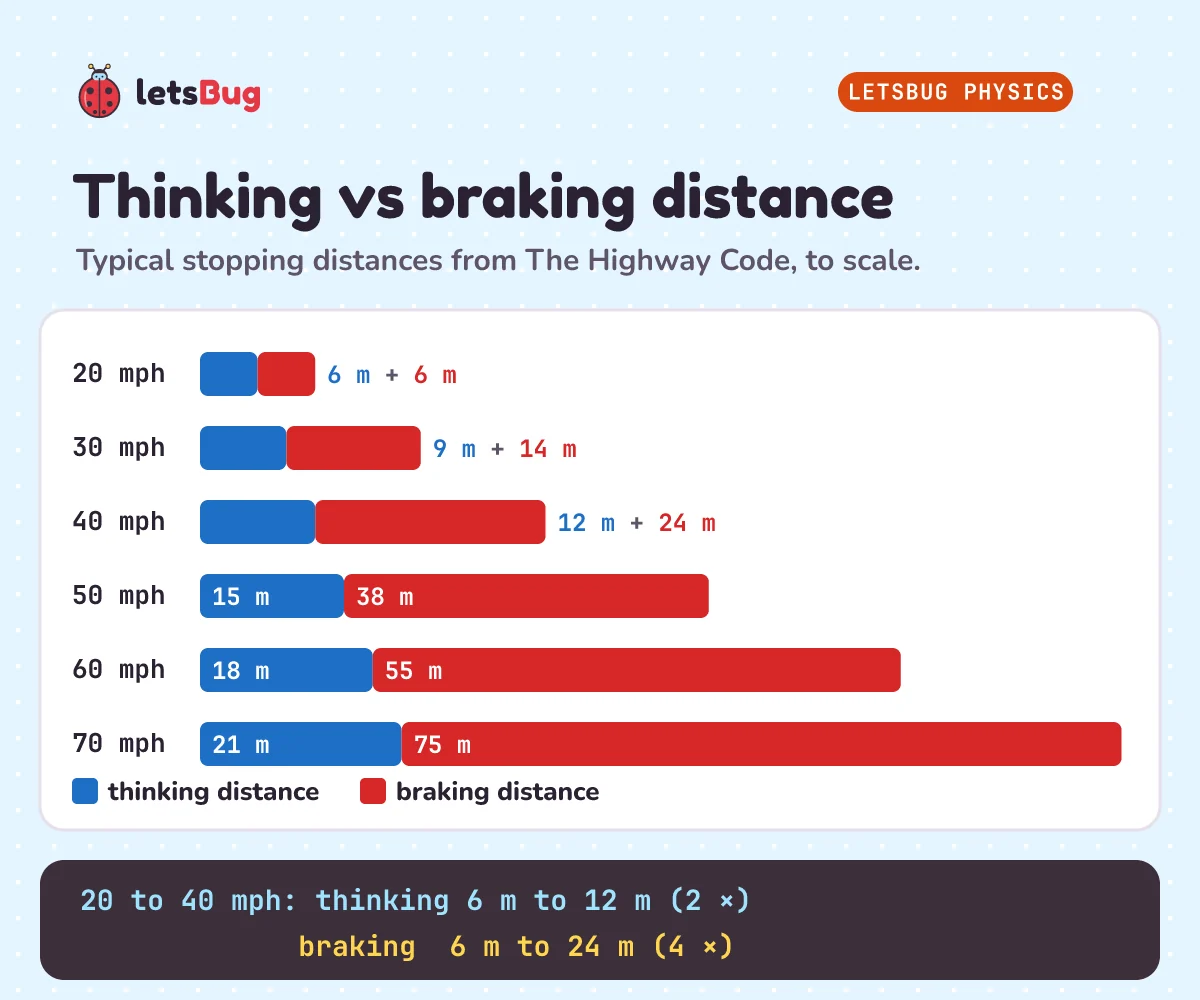
The UK Highway Code (the UK government's rule book for road users) prints a chart of typical stopping distances, with speeds in mph (miles per hour). Its rule 126 says: "Drive at a speed that will allow you to stop well within the distance you can see to be clear." The chart splits the stopping distance into two parts:
- Thinking distance: how far the car goes while the driver notices the danger and moves a foot to the brake.
- Braking distance: how far the car goes once the brakes are on.
| Speed | Thinking distance | Braking distance | Total stopping distance |
|---|---|---|---|
| 20 mph (32 km/h) | 6 m | 6 m | 12 m |
| 30 mph (48 km/h) | 9 m | 14 m | 23 m |
| 40 mph (64 km/h) | 12 m | 24 m | 36 m |
| 50 mph (80 km/h) | 15 m | 38 m | 53 m |
| 60 mph (96 km/h) | 18 m | 55 m | 73 m |
| 70 mph (112 km/h) | 21 m | 75 m | 96 m |
Look at 20 mph and 40 mph. The thinking distance doubles, from 6 m to 12 m. The braking distance goes up four times, from 6 m to 24 m (24 ÷ 6 = 4). Why are they different?
Thinking distance is the car moving at a steady speed during the driver's reaction time (the time it takes to see the danger and react). Twice the speed covers twice the distance in the same time. So it grows in proportion to the speed: twice the speed, twice the distance.
Braking distance depends on the kinetic energy. In a simple model, the brakes push back on the car with about the same force at any speed. As the car slows, the brakes do work on it: force × distance, as in the post on work done. That work has to take away all of the car's kinetic energy:
braking force × braking distance = kinetic energy
With the same force, four times the kinetic energy needs four times the distance.
Does the whole table follow the squared rule?
Let's test it. If braking distance grows with the speed squared, then from the 6 m at 20 mph, the braking distance at any speed should be 6 × (speed ÷ 20)².
| Speed | Our prediction | The Highway Code |
|---|---|---|
| 30 mph | 6 × 1.5² = 13.5 m | 14 m |
| 40 mph | 6 × 2² = 24 m | 24 m |
| 50 mph | 6 × 2.5² = 37.5 m | 38 m |
| 60 mph | 6 × 3² = 54 m | 55 m |
| 70 mph | 6 × 3.5² = 73.5 m | 75 m |
Every prediction is within 1.5 m of the chart. At 60 mph, three times 20 mph, the car needs about nine times the braking distance. The Highway Code warns that its numbers are "a general guide". Real braking also depends on the road surface, the weather and the state of the car.
How hard do the brakes push?
Take a 1000 kg car. The chart gives 20 mph as 32 km/h, which is 32 ÷ 3.6 ≈ 8.9 m/s.
- At 32 km/h: KE = ½ × 1000 × (32 ÷ 3.6)² ≈ 39 500 J, about 40 000 J. It stops in 6 m, so the braking force is about 39 500 ÷ 6 ≈ 6600 N.
- At 64 km/h (64 ÷ 3.6 ≈ 17.8 m/s): KE = ½ × 1000 × (64 ÷ 3.6)² ≈ 158 000 J, about 160 000 J, four times as much. It stops in 24 m: 158 000 ÷ 24 ≈ 6600 N.
The same force, four times the energy, four times the distance. Even a smaller rise matters: from 30 to 40 mph, a third faster, the braking distance goes from 14 m to 24 m.
NCERT uses the same idea for a jet landing on an aircraft carrier (a ship that planes take off from and land on). In Example 7.6, a 15 000 kg jet is caught by a wire that "exerts an approximately constant backward force of 367500 N and stops the jet within 100 m." The wire's work removes all the kinetic energy: ½ × 15 000 × v² = 367 500 × 100. So v² = 36 750 000 ÷ 7500 = 4900, and v = √4900 = 70 m/s, about 252 km/h.
What is gravitational potential energy?
Gravitational potential energy (GPE) is the energy of height. OpenStax says: "Gravitational potential energy is the stored energy an object has as a result of its position above Earth’s surface (or another object in space)." It comes from the work you do to lift something, as in the last episode: NCERT explains that the work you do to lift an object is stored in it as potential energy. The equation is:
GPE = m × g × h, where m is the mass in kg, g is 9.8 N/kg (the pull of gravity on each kilogram near Earth's surface), and h is the height in metres.
Lift a 2 kg ball 5 m up. Its GPE is 2 × 9.8 × 5 = 98 J.
Hydroelectric dams use the same idea
A hydroelectric dam makes electricity from moving water. It holds water high up, so the water has GPE. As it falls, the GPE becomes kinetic energy. The U.S. Energy Information Administration explains: "At hydropower plants water flows through a pipe, or penstock, then pushes against and turns blades in a turbine that spin to power a generator to produce electricity." (A turbine is a wheel with blades. A generator turns that spinning into electricity.)
The height matters, just as h matters in mgh. The EIA says: "In general, the greater the water flow and the higher the head, the more electricity a hydropower plant can produce." (The head is how far the water falls.) Each kilogram of water that falls 100 m gives up 1 × 9.8 × 100 = 980 J.
What happens to the energy when something falls?
It moves from one store to another. An energy store is a way something holds energy: kinetic because it moves, gravitational potential because it is high up, and thermal because it is warm.
OpenStax says: "For example, when an object that has gravitational potential energy falls, its energy is converted to kinetic energy." (Converted means changed.) None of it is used up. OpenStax calls this "the law of conservation of energy, which says that, in a closed system, total energy is conserved—that is, it is constant." (Conserved means kept the same.) It explains: "The phrase in a closed system means we are assuming no energy is lost to the surroundings due to friction and air resistance."
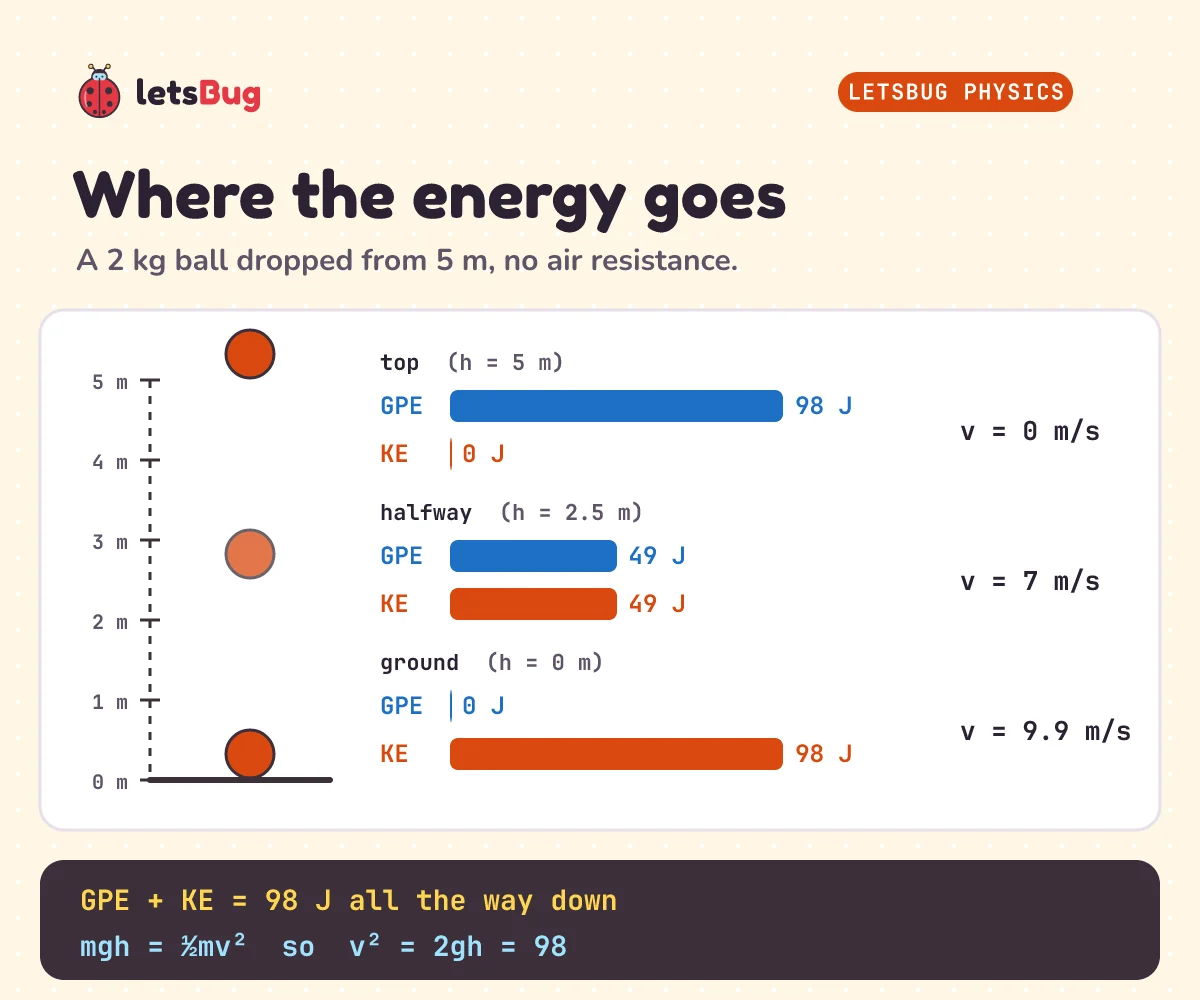
Let's follow the 2 kg ball, dropped from 5 m, with no air resistance.
- At the top: GPE = 98 J, KE = 0 J. It isn't moving yet.
- Halfway down, at 2.5 m: GPE = 2 × 9.8 × 2.5 = 49 J. The other 49 J is now kinetic energy (98 − 49 = 49). Its speed: ½ × 2 × v² = 49, so v² = 49 and v = 7 m/s.
- At the ground: GPE = 0 J, KE = 98 J. ½ × 2 × v² = 98, so v² = 98 and v = √98 ≈ 9.9 m/s.
Why does the mass cancel?
At the top it's all GPE. At the bottom it's all KE. So:
mgh = ½mv²
There's an m on both sides, so we can divide both sides by m. That leaves gh = ½v², or v² = 2gh. OpenStax says: "Note that we can solve many problems involving conversion between KE and PE without knowing the mass of the object in question." It gives the reason: "This is because kinetic and potential energy are both proportional to the mass of the object." (Proportional means that twice the mass gives twice the energy.)
So a 6 kg ball dropped from 5 m has three times the energy, 6 × 9.8 × 5 = 294 J. But it also has three times the mass to speed up: v² = 2 × 294 ÷ 6 = 98. It lands at the same 9.9 m/s. Dropped together, the heavy ball and the light ball land together.
In real air, a feather falls slowly, because air resistance matters for it. OpenStax says ignoring air resistance is "a good assumption" for "dense falling objects". Dense means heavy for its size.
If you've met the suvat equations, you get the same answer from v² = u² + 2as. A dropped ball starts from rest (u = 0), speeds up at g (so the acceleration a = g), and falls a distance h (so s = h). That gives v² = 2gh. Two different routes, one answer.
How do you describe the energy transfer?
Many students lose marks here because they don't say it clearly. Cambridge's June 2025 examiner report for Papers 0625/32 and 0625/33 says of a falling hammer: "Only a minority clearly described the transfer between GPE and KE." (A minority means fewer than half.) On Paper 0625/41, about a skateboarder, most candidates understood the energy transfers, but some stopped halfway: "Only the strongest candidates gave a coherent description of all the energy transfers." (Coherent means clear and joined up.) So describe every stage, all the way to the end.
A clear way to say it: "As the ball falls, energy is transferred from the gravitational potential energy store to the kinetic energy store. The total energy stays the same." If there is air resistance, add: "Some energy is transferred to the thermal store of the air and the ball." (More energy in the thermal store means it gets warmer.) The same report notes that "A few candidates noted that there is also an energy transfer to the thermal/internal store."
How fast does a roller coaster go at the bottom of a drop?
We can use v² = 2gh to estimate this. Wikipedia says Millennium Force, a roller coaster at Cedar Point in Ohio, USA, "drops 300 feet (91 m) at an 80-degree angle and reaches a maximum speed of 93 mph (150 km/h) at the bottom of the hill."
Let's predict it with no friction and no air resistance:
- v² = 2 × 9.8 × 91 ≈ 1784
- v = √1784 ≈ 42.2 m/s
- 42.2 × 3.6 ≈ 152 km/h
The real top speed is 150 km/h, very close. Most of the small gap is energy transferred to the thermal store by friction and air resistance, warming the track, the wheels and the air. OpenStax says: "Friction causes the loss of some useful energy."
Also, the lift pulls the train up "at 15 mph (24 km/h)", so the train isn't quite still at the top. That would add a little speed, so friction and air resistance must take away a little more than the 2 km/h gap suggests. OpenStax says that for roller coasters, ignoring friction "introduces some inaccuracy to the calculation".
How do you find the speed from kinetic energy?
This question tests rearranging: moving the parts of an equation around.
A 1200 kg car has 60 000 J of kinetic energy. How fast is it going?
Two wrong answers are common:
- Dividing the energy by the mass: 60 000 ÷ 1200 = 50 m/s. This forgets the ½ and the square.
- Forgetting the square root: v² = 100, so "v = 100 m/s". Check that: 100 × 3.6 = 360 km/h. That's far too fast for a family car, so something is wrong.
Here is the model answer:
- KE = ½mv², so v² = 2 × KE ÷ m.
- v² = 2 × 60 000 ÷ 1200 = 100.
- v = √100 = 10 m/s. That's 10 × 3.6 = 36 km/h, a sensible town speed.
Always read your last line again and ask: is this speed sensible for this object?
Your turn. Write the equation first, put the units in, and check the answer is sensible.
1) A 0.5 kg ball moves at 6 m/s. Find its kinetic energy.
2) A 60 kg diver drops from the 10 m platform, the height used at the Olympic Games. Ignore air resistance. Find the GPE she loses and her speed as she reaches the water.
3) Change one thing: how high would the platform need to be for her to reach the water at twice the speed, 28 m/s?
Show the answers
1) KE = ½ × 0.5 × 6² = 0.25 × 36 = 9 J.
2) GPE = 60 × 9.8 × 10 = 5880 J. All of it becomes KE, so v² = 2 × 5880 ÷ 60 = 196 and v = √196 = 14 m/s, about 50 km/h (14 × 3.6 = 50.4). Wikipedia gives the real speed at the water from a 10 m platform as "around 55 km/h", a little faster. That is about 15.3 m/s (55 ÷ 3.6), and our equation needs a fall of about 12 m for it: 15.3² ÷ 19.6 ≈ 11.9. So a real dive seems to start about 2 m higher than the platform, for example because the diver jumps up first.
3) h = v² ÷ 2g = 28² ÷ 19.6 = 784 ÷ 19.6 = 40 m. Twice the speed needs four times the height, because v² = 2gh.
Exam-style questions with model answers
The marks in brackets are our estimate: one mark for each correct step or idea.
Q1 (2 marks). State the equation for kinetic energy, and give the unit of each quantity.
Model answer
KE = ½mv² [1]. KE in joules (J), m in kilograms (kg), v in metres per second (m/s) [1].
Q2 (2 marks). A ball is dropped from a window. Describe the energy transfers as it falls. Ignore air resistance.
Model answer
Energy is transferred from the gravitational potential energy store [1] to the kinetic energy store, and the total energy stays the same [1].
Q3 (2 marks). A car speeds up from 10 m/s to 30 m/s. How many times greater is its kinetic energy? Explain your answer.
Model answer
9 times [1]. The speed is 3 times greater, and KE depends on the speed squared: 3² = 9 [1].
Q4 (3 marks). A 0.2 kg apple falls from a branch 5 m above the ground. Take g = 9.8 N/kg and ignore air resistance. Find its GPE at the start and its speed just before it hits the ground.
Model answer
GPE = 0.2 × 9.8 × 5 = 9.8 J [1]. All of it becomes KE: v² = 2 × 9.8 ÷ 0.2 = 98 [1]. v = √98 ≈ 9.9 m/s [1]. It's the same speed as the 2 kg ball, because the mass cancels.
Q5 (3 marks). A 1000 kg car brakes with a steady force of 8000 N. Find its braking distance from 20 m/s, and from 10 m/s.
Model answer
At 20 m/s, KE = ½ × 1000 × 20² = 200 000 J [1]. Force × distance = KE, so distance = 200 000 ÷ 8000 = 25 m [1]. At 10 m/s, KE = 50 000 J, so distance = 50 000 ÷ 8000 = 6.25 m [1]. Twice the speed, four times the braking distance.
Questions people ask
What is the formula for kinetic energy?
Kinetic energy = ½ × mass × speed², KE = ½mv². With the mass in kilograms and the speed in metres per second, the energy comes out in joules.
What is the unit of kinetic energy?
The joule, J, the same unit as work done. A 2 kg mass moving at 1 m/s has 1 J of kinetic energy (½ × 2 × 1² = 1).
What happens to kinetic energy if the mass is doubled?
It doubles. The mass isn't squared, so twice the mass at the same speed gives twice the kinetic energy.
Why does braking distance increase with the square of speed?
The brakes push with about the same force at any speed, and the work they do (force × distance) has to remove all the kinetic energy. Kinetic energy grows with the speed squared, so the braking distance does too.
What is the difference between kinetic and potential energy?
Kinetic energy is the energy of movement, ½mv². Gravitational potential energy is energy stored because of height, mgh. As something falls, its potential energy turns into kinetic energy.
Do heavy objects fall faster than light ones?
Not when air resistance is small. The mass cancels out of mgh = ½mv², so v² = 2gh for any mass. A heavy ball and a light ball dropped together land together.
Keep going
- Watch the full lesson, Kinetic Energy Explained: Double the Speed, 4× the Energy, and its Short, Double Your Speed: Double the Kinetic Energy? More in letsBug Physics on YouTube.
- The episode before this one: what is work in physics? Carrying a bag does no work on it.
- Where v² = u² + 2as comes from: which suvat equation to use.
- Why weight is mg: what is a resultant force?
- Coming next in letsBug Physics: levers and simple machines, and why a machine never reduces the work you do.
Checked on 15 November 2026 against the 10 sources below. Every energy, speed and distance figure and practice answer in this post was worked out again in a Python script, and every quote was matched word for word with the source text.
Sources
- OpenStax Physics: 9.1 Work, Power, and the Work–Energy Theorem (kinetic energy, KE = ½mv², gravitational potential energy)
- OpenStax Physics: 9.2 Mechanical Energy and Conservation of Energy (conservation of energy, the mass cancels, v² = 2gh, friction, roller coasters)
- GOV.UK: The Highway Code, rules 103 to 158 (rule 126, stopping distances)
- GOV.UK: The Highway Code, Typical stopping distances (PDF) (thinking and braking distances, 20 to 70 mph)
- Cambridge International, via PapaCambridge: IGCSE Physics 0625, Principal Examiner Report for Teachers, June 2025 (PDF) (describing energy transfers, the doubling trap)
- Cambridge International: IGCSE Physics 0625 syllabus for 2026, 2027 and 2028 (PDF) (section 1.7.1; g)
- NCERT: Exploration, Science for Grade 9, Chapter 7, Work, Energy, and Simple Machines (PDF) (kinetic energy, Examples 7.4 to 7.7, mgh)
- Wikipedia: Millennium Force (drop, top speed, lift speed)
- Wikipedia: Diving (sport) (the 10 m platform, entry speed)
- U.S. Energy Information Administration: Hydropower explained (turbines, head)