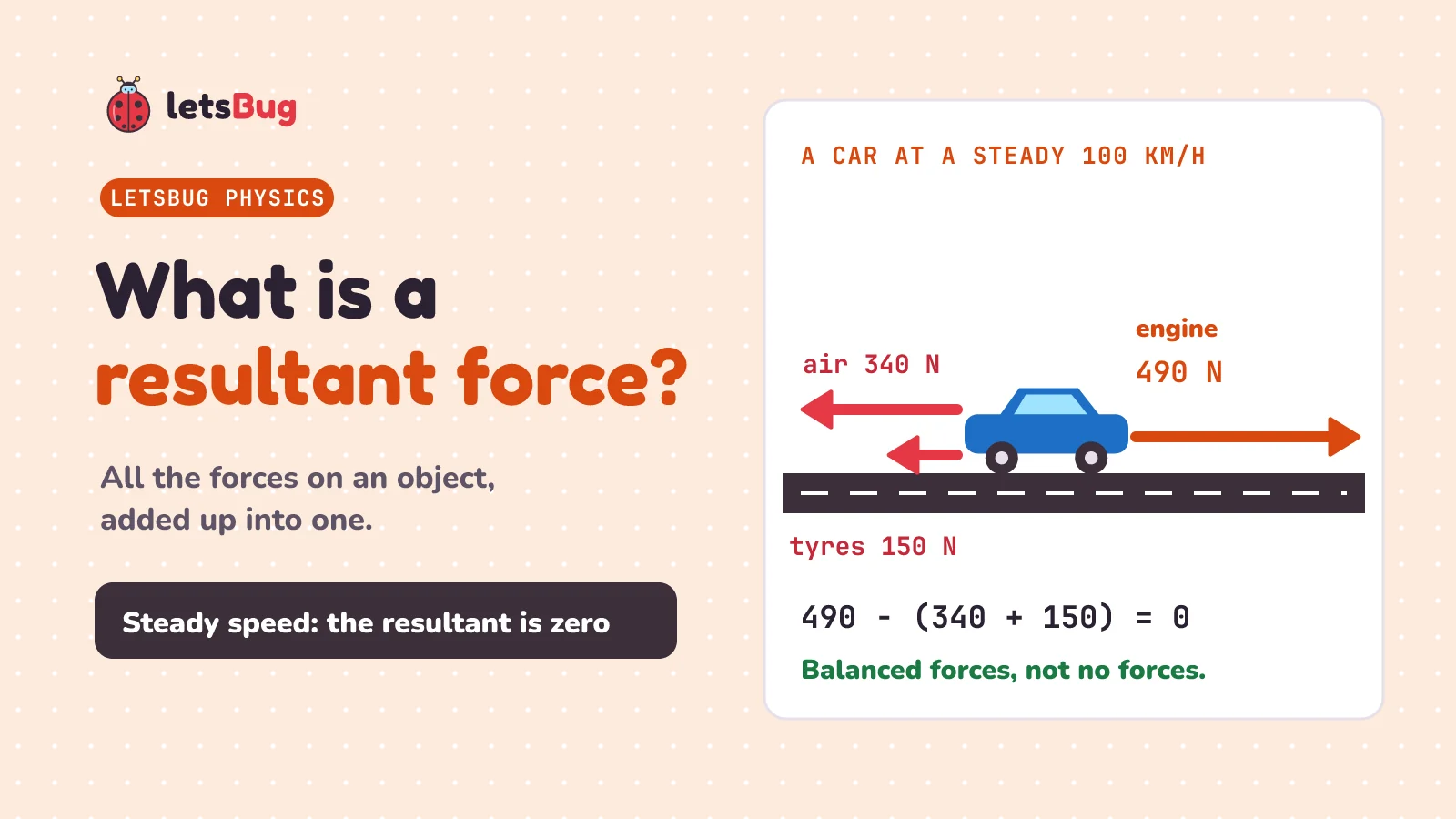
A resultant force is the one force that has the same effect as all the forces on an object together. Along a straight line, add the forces that point the same way and subtract the ones that point the opposite way. When something moves at a constant speed in a straight line, the resultant force on it is zero.
In this post we find the resultant force in a tug of war, then add up the real forces on a car at a steady 100 km/h and see why they come to zero. We work out what a forward resultant force would actually do, draw a free-body diagram, and then explain the difference between mass and weight with a trip to the Moon. We finish with practice and exam-style questions with model answers.
Key takeaways
- The resultant force (also called the net force) is all the forces on an object added up, with their directions. Same direction: add. Opposite directions: subtract.
- Constant velocity (a steady speed in a straight line) means a zero resultant force. That means balanced forces, not no forces. A car at a steady 100 km/h has about 490 N pushing it forwards and about 490 N pushing it back.
- A forward resultant force doesn't keep a car at a steady speed. It makes the car speed up: a = F ÷ m.
- Mass is the amount of matter in something. It's measured in kilograms (kg) and it's the same everywhere.
- Weight is a force: the pull of gravity on that mass. It's measured in newtons (N). W = mg, with g = 9.8 N/kg on Earth and 1.62 N/kg on the Moon.
This post goes with letsBug Physics, episode 6. Resultant force, balanced forces and weight are in CBSE Class 9 Science (the new Exploration textbook, Chapter 6, How Forces Affect Motion) and in Cambridge IGCSE Physics. Watch the lesson, or read on: the post adds where the car's numbers come from, why bathroom scales would get your mass wrong on the Moon, and more questions with full answers.
What is a resultant force?
An object almost never has just one force on it. A rolling ball is pulled down by gravity, pushed up by the ground and slowed by the air, all at once. You can swap all of those forces for one single force that would have the same effect. That single force is the resultant force. Many books call it the net force. It means the same thing.
When all the forces act along one straight line, finding it is simple:
- Forces in the same direction add up. The NCERT textbook's example is two people pushing a car that won't start: "the magnitude of the net force applied by them on the car is the sum of the magnitudes of two forces." (Magnitude means size.)
- Forces in opposite directions subtract. The resultant points the way of the bigger force.
A tug of war
One team pulls the rope to the left with 300 N. The other team pulls to the right with 250 N. The resultant force is 300 − 250 = 50 N to the left, towards the stronger team. So the rope starts to move that way.
Now both teams pull with 300 N. The resultant is 300 − 300 = 0, and the rope doesn't speed up at all. NCERT calls these balanced forces: "Such two forces, which are equal in magnitude but opposite in direction are called balanced forces." And when they aren't equal: "If the forces applied on an object are not balanced, a non-zero net force acts on the object."
Is there a resultant force on a car at constant speed on a straight road?
Picture a car on a straight motorway at a steady 100 km/h. The engine is working hard. Surely there's a forward force winning? No. The resultant force on the car is zero. Let's add up the forces and see why.
That's true on a straight road. Going round a bend changes the car's direction, and a change of direction needs a resultant force too. Physics uses the word velocity for speed in a set direction. NCERT says: "Remember that constant velocity means that there is no change in the magnitude or the direction of velocity."
Units first
Physics formulas need metres and seconds. One kilometre is 1000 m and one hour is 3600 s, so divide by 3.6: 100 km/h = 100 ÷ 3.6 ≈ 27.8 m/s.
The forces pushing back
- Air resistance (also called drag): the air pushes back on the car as it moves through it. Wikipedia gives the drag force as ½ × air density × drag area × speed². Air density is how many kilograms one cubic metre of air has: about 1.2 kg/m³ (dry air at 20 °C is 1.2041 kg/m³). The drag area is one number for how big the front of the car is and how smooth its shape is. Wikipedia says: "Average full-size passenger cars have a drag area of roughly 8 sq ft (0.74 m²)". So the drag is ½ × 1.2 × 0.74 × 27.8² ≈ 340 N.
- Rolling resistance: the tyres squash a little where they touch the road, and squashing them takes energy. Wikipedia says it's "often expressed as a coefficient times the normal force". (A coefficient is just a fixed number you multiply by. The normal force is the road pushing up on the car; more on that below.) For ordinary car tyres on concrete, the coefficient is 0.010 to 0.015. Take a car with a round, typical mass of 1500 kg: 0.010 × 1500 × 9.8 = 147 N, so about 150 N.
Together: 340 + 150 ≈ 490 N pushing the car backwards.
The force pushing forwards
The engine turns the wheels. The tyres push back on the road, and the road pushes the car forwards. That forward push is called the driving force. To hold a steady 100 km/h, it has to be about 490 N too.
Forwards minus backwards: 490 − 490 = 0. A zero resultant force means zero acceleration (no change in speed or direction), so the speed stays at 100 km/h. That's Newton's first law. In NCERT's words: "An object at rest remains at rest, and an object in motion continues to move with a constant velocity, unless a net force acts upon the object."
What would a forward resultant force do?
So why does the engine keep pushing at all? Because the resistance never stops. Let's see what happens when the forces are not balanced, using a = F ÷ m (Newton's second law: acceleration = resultant force ÷ mass).
- Engine off. Now only the 490 N backwards is left. On the 1500 kg car, a = −490 ÷ 1500 ≈ −0.33 m/s². The minus sign means it slows down by about a third of a metre per second, every second (like any braking car, it has a negative acceleration). (The drag gets smaller as the car slows, so this is the slowing at the start.)
- Push 300 N harder than the resistance. Now the resultant is 300 N forwards: a = 300 ÷ 1500 = 0.2 m/s². Keep that up for one minute (60 s) and the car gains 0.2 × 60 = 12 m/s. That's 12 × 3.6 ≈ 43 km/h faster. (Drag grows with the speed squared, so the driver would have to press harder and harder to keep the extra push at 300 N.)
A forward resultant force doesn't hold a steady speed. It speeds you up. People used to get this wrong for a very long time. NCERT says: "For ages, it was mistakenly thought that a force was indeed required to maintain an object in such a motion." OpenStax gives the correct rule: "Newton’s first law says that only a nonzero net external force can cause a change in motion, so a net external force must cause an acceleration." (An external force comes from outside the object.)
What does a free-body diagram of a moving car look like?
A free-body diagram shows every force on one object, as arrows. Each arrow points the way the force acts. A car moving at a steady speed has forces up and down too, not just forwards and backwards:
- Weight: the Earth pulls the car down. For the 1500 kg car, that's 1500 × 9.8 = 14 700 N (we'll see where that comes from in the next section).
- Normal force: the road pushes up on the tyres. "Normal" here means at right angles to the surface. The car doesn't sink into the road or float off it, so on a flat road the normal force is also 14 700 N.
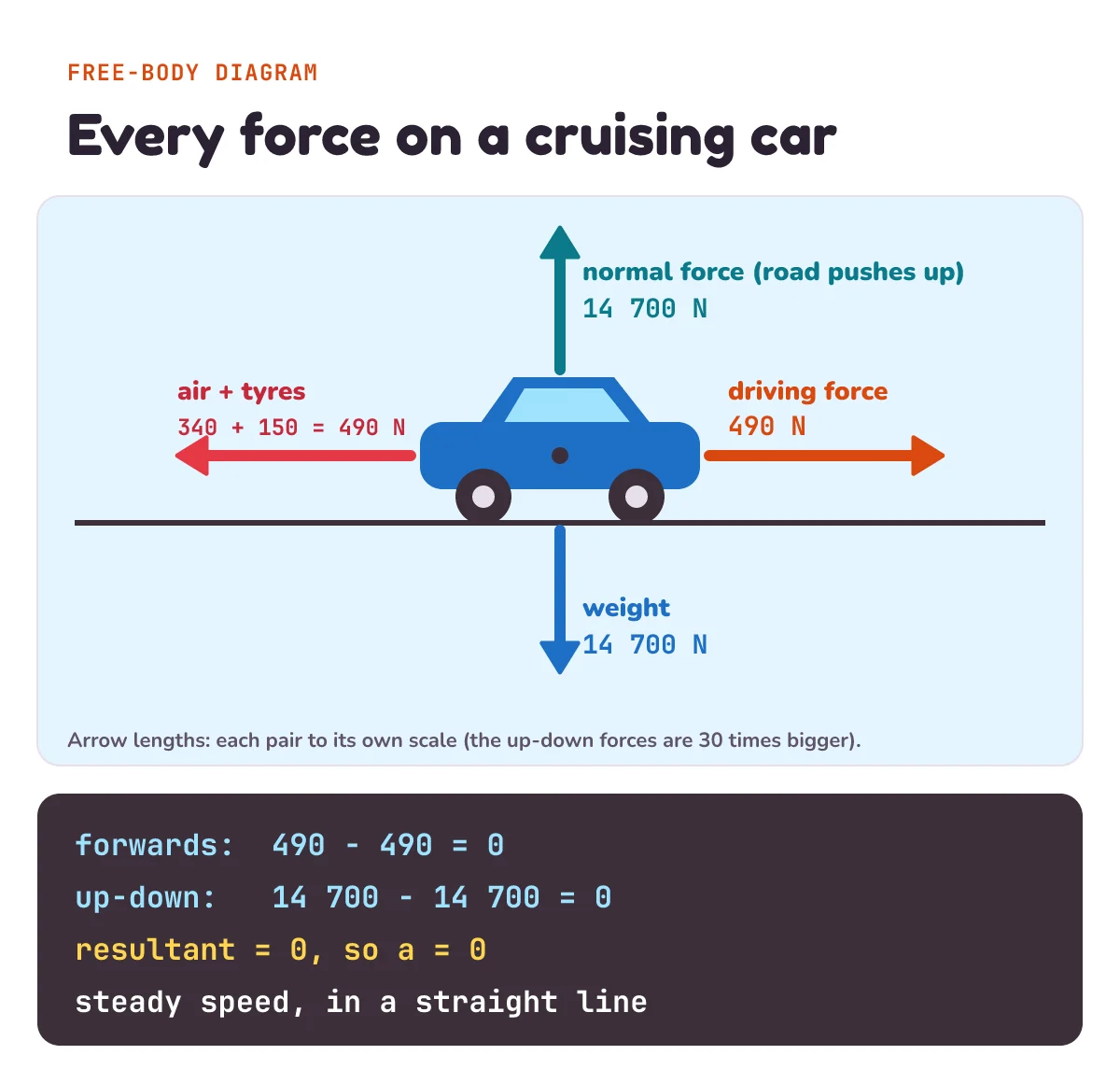
Four forces, two balanced pairs, so the resultant is zero. Remember: a zero resultant means the forces balance. It doesn't mean there are no forces.
One thing to watch: weight and the normal force are equal and opposite here, but they are not a Newton's third law pair. Both act on the same object, the car. A third law pair always acts on two different objects (see Newton's third law and how rockets work in space).
What is the difference between mass and weight?
In everyday life we say "my weight is 60 kg". In physics, that's a mix-up. Mass and weight are two different things:
| Property | Mass | Weight |
|---|---|---|
| What it is | How much matter (stuff) an object has, and how hard it is to speed up or slow down | A force: the pull of gravity on the object |
| Unit | kilogram (kg) | newton (N) |
| Does it change from place to place? | No, it's the same everywhere | Yes, it depends on how strong gravity is there |
OpenStax says it clearly: "Mass is the quantity of matter in an object (how much stuff there is, or how hard it is to accelerate it) and does not vary, but weight is the gravitational force on an object and is proportional to the force of gravity." (Proportional means that if gravity doubles, the weight doubles too.)
W = mg
Weight = mass × gravitational field strength: W = mg. The gravitational field strength, g, is how many newtons of pull gravity puts on each kilogram. On Earth, g is about 9.8 N/kg. (It's the same number as the acceleration of something falling freely, with no air resistance: 9.8 m/s², because 1 N/kg = 1 m/s². NCERT writes it as "the gravitational force acting on an object of mass m is F = mg".)
So the 1500 kg car has a weight of 1500 × 9.8 = 14 700 N.
This mistake appears in real exams. Cambridge's June 2025 examiner report for IGCSE Physics says that "many weaker candidates had the misconception that weight of an object is the quantity of matter in the object rather than the force of attraction between the object and the Earth." (A misconception is a wrong idea that many people share.)
How much would you weigh on the Moon?
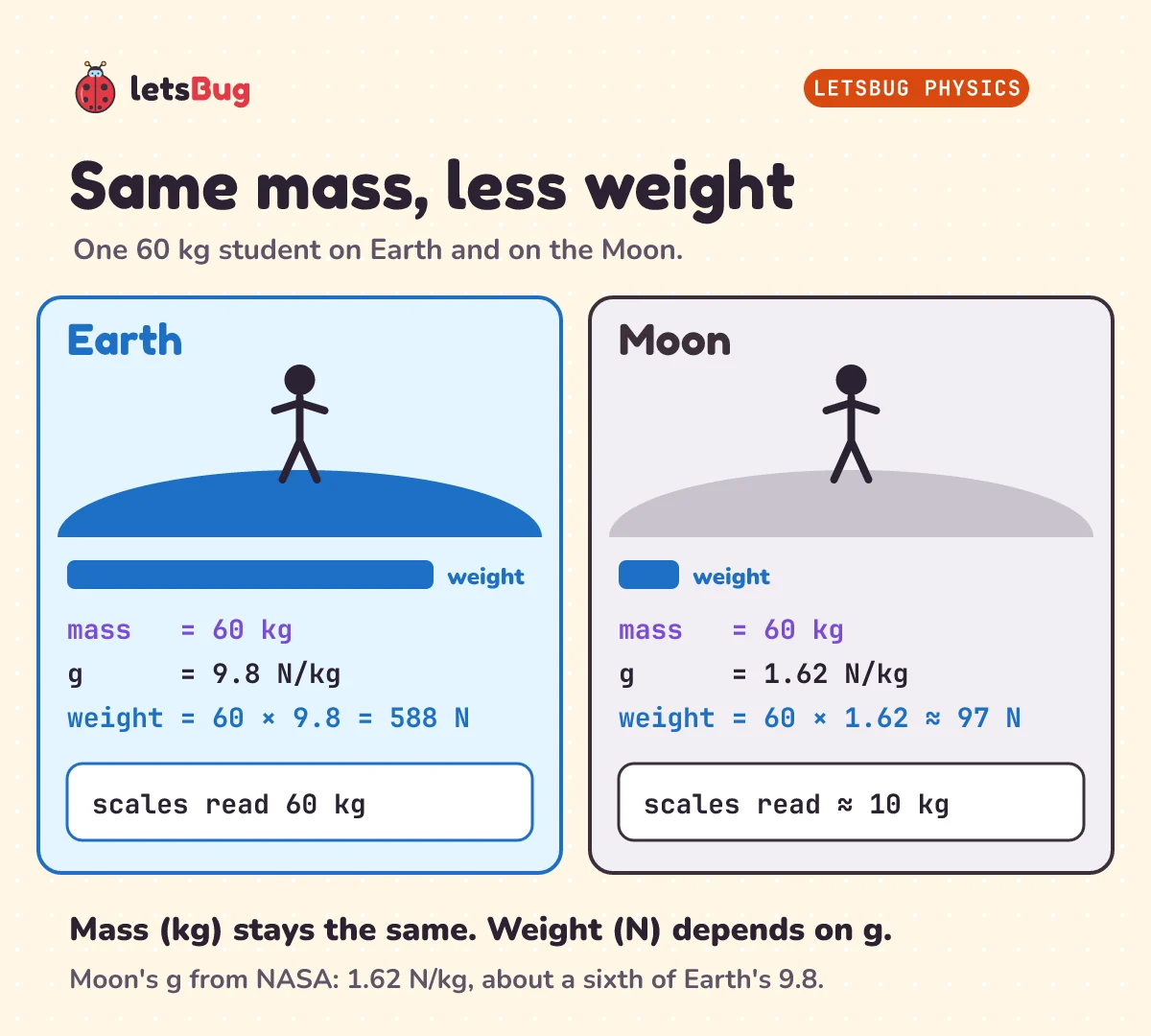
Take a 60 kg student. On Earth: W = 60 × 9.8 = 588 N.
On the Moon, NASA's Moon Fact Sheet gives the surface gravity as 1.62 m/s², so g = 1.62 N/kg. Same student, same 60 kg of mass, but a weight of only 60 × 1.62 ≈ 97 N. That's about a sixth of the student's weight on Earth (NASA lists the ratio as 0.165).
What do bathroom scales really measure?
Scales measure how hard you push down on them. That's a force, in newtons. Then they divide by Earth's g and show the answer in kilograms. OpenStax says: "In most countries, the measurement is now divided by 9.80 to give a reading in kilograms", and "The scale detects weight but is calibrated to display mass." (Calibrated means set up to show a certain kind of reading.)
So on the Moon, the same scales would feel a push of about 97 N and show 97 ÷ 9.8 ≈ 10 kg. Your mass would still be 60 kg. The scales would just be using the wrong g.
Why is there no resultant force on a car going downhill at a constant speed?
In June 2025, a Cambridge IGCSE multiple-choice question (Paper 0625/11) asked about a car going down a hill at a constant speed. Here is the same idea as a written question: A car travels down a hill at a constant speed. What is the size of the resultant force on the car, and why?
Cambridge's examiner report says of that question: "The majority of candidates had the misconception that there was a resultant force on the car because it was going downhill, even though it was travelling at constant speed."
Our model answer has three parts:
- The resultant force is zero.
- The car's speed and direction aren't changing, so its acceleration is zero (and F = ma gives F = 0).
- The pull of gravity down the slope is balanced by friction and air resistance.
Use clear words: "the resultant force is zero", "the acceleration is zero", "balanced by". Avoid vague ones like "the forces cancel out a bit" or "the car has momentum, so it keeps going".
Your turn. Draw the forces as arrows first, then add them up.
1) In a tug of war, one team pulls left with 400 N and the other pulls right with 380 N. Find the resultant force.
2) A lift and its passengers have a mass of 800 kg. The lift rises at a steady 2 m/s. Find the weight, and the force in the cable pulling it up.
3) A cyclist rides along a flat road at a steady 5 m/s. Her pedalling gives a driving force of 30 N. What is the total resistance (air and tyres) on her and the bike?
Show the answers
1) Opposite directions, so subtract: 400 − 380 = 20 N to the left, towards the stronger team.
2) W = mg = 800 × 9.8 = 7840 N. The speed is steady, so the resultant force is zero, and the cable pulls up with 7840 N too. Not more, even though the lift is going up.
3) Steady speed, so the forces balance: the resistance is 30 N, backwards.
Exam-style questions with model answers
The marks in brackets are our estimate: one mark for each correct step or idea.
Q1 (1 mark). What is the unit of weight?
Model answer
The newton, N [1]. (Not the kilogram: that's the unit of mass.)
Q2 (2 marks). A skydiver falls at a constant speed. Explain why there is no resultant force on her.
Model answer
Her velocity is constant (a steady speed, straight down), so her acceleration is zero [1]. So the air resistance pushing up on her equals her weight pulling down: the forces are balanced and the resultant is zero [1].
Q3 (3 marks). A 2 kg box is pulled to the right with a force of 10 N. Friction on it is 6 N to the left. Find the resultant force and the box's acceleration.
Model answer
Opposite directions, so subtract: 10 − 6 = 4 N [1], to the right [1]. a = F ÷ m = 4 ÷ 2 = 2 m/s², to the right [1].
Q4 (3 marks). An astronaut has a mass of 75 kg. Calculate her weight on Earth (g = 9.8 N/kg) and on the Moon (g = 1.62 N/kg). What is her mass on the Moon?
Model answer
On Earth: W = 75 × 9.8 = 735 N [1]. On the Moon: W = 75 × 1.62 = 121.5 N [1]. Her mass is still 75 kg: mass doesn't change from place to place [1].
Questions people ask
Is resultant force the same as net force?
Yes. Both mean the single force that has the same effect as all the forces on an object together. Cambridge IGCSE papers say resultant force; the NCERT textbook says net force.
Can an object move if the resultant force on it is zero?
Yes. With a zero resultant force, an object at rest stays at rest, and a moving object keeps moving at a constant speed in a straight line. A car at a steady 100 km/h has a zero resultant force.
Why does a car need its engine to keep a steady speed?
Because air resistance and rolling resistance never stop. The engine's driving force has to balance them (about 490 N each for a typical car at 100 km/h). Turn the engine off and the resistance becomes a backward resultant force, so the car slows down.
Is weight measured in kg or N?
In newtons (N), because weight is a force. Mass is measured in kilograms. W = mg links them: a 60 kg person weighs 60 × 9.8 = 588 N on Earth.
Does your mass change on the Moon?
No. Your mass is the same everywhere. Your weight changes: on the Moon, g is 1.62 N/kg, so a 60 kg person weighs about 97 N instead of 588 N, about a sixth.
What do bathroom scales actually measure?
A force: how hard you push down on them. They divide it by Earth's g and show kilograms. On the Moon, the same scales would show about 10 kg for a 60 kg person.
Keep going
- Watch the full lesson, What Is a Resultant Force? Constant Speed Means Zero, and its Short, Car at a Steady 100 km/h: Is There a Net Force on It? More in letsBug Physics on YouTube.
- What a resultant force does once it isn't zero, with 10 everyday examples: Newton's second law examples in everyday life.
- The episode before this one, where a braking car has a negative acceleration: which SUVAT equation to use.
- Why the road pushes the car forwards: Newton's third law and how rockets work in space.
Checked on 31 October 2026 against the 7 sources below. Every force, acceleration, weight and practice answer in this post was worked out again in a Python script, and every quote was matched word for word with the source text.
Sources
- NCERT: Exploration, Science for Grade 9, Chapter 6, How Forces Affect Motion (PDF) (net force, balanced forces, Newton's first law, F = mg, g = 9.8)
- Cambridge International, via PapaCambridge: IGCSE Physics 0625, Principal Examiner Report for Teachers, June 2025 (PDF) (the downhill car and weight misconceptions)
- OpenStax Physics: 4.3 Newton's Second Law of Motion (mass vs weight, W = mg, scales)
- NASA NSSDCA: Moon Fact Sheet (surface gravity 1.62 m/s², 0.165 of Earth's)
- Wikipedia: Automobile drag coefficient (the drag equation, average car drag area 0.74 m²)
- Wikipedia: Rolling resistance (coefficient times the normal force, 0.010 to 0.015 for car tyres on concrete)
- Wikipedia: Density of air (1.2041 kg/m³ at 20 °C)