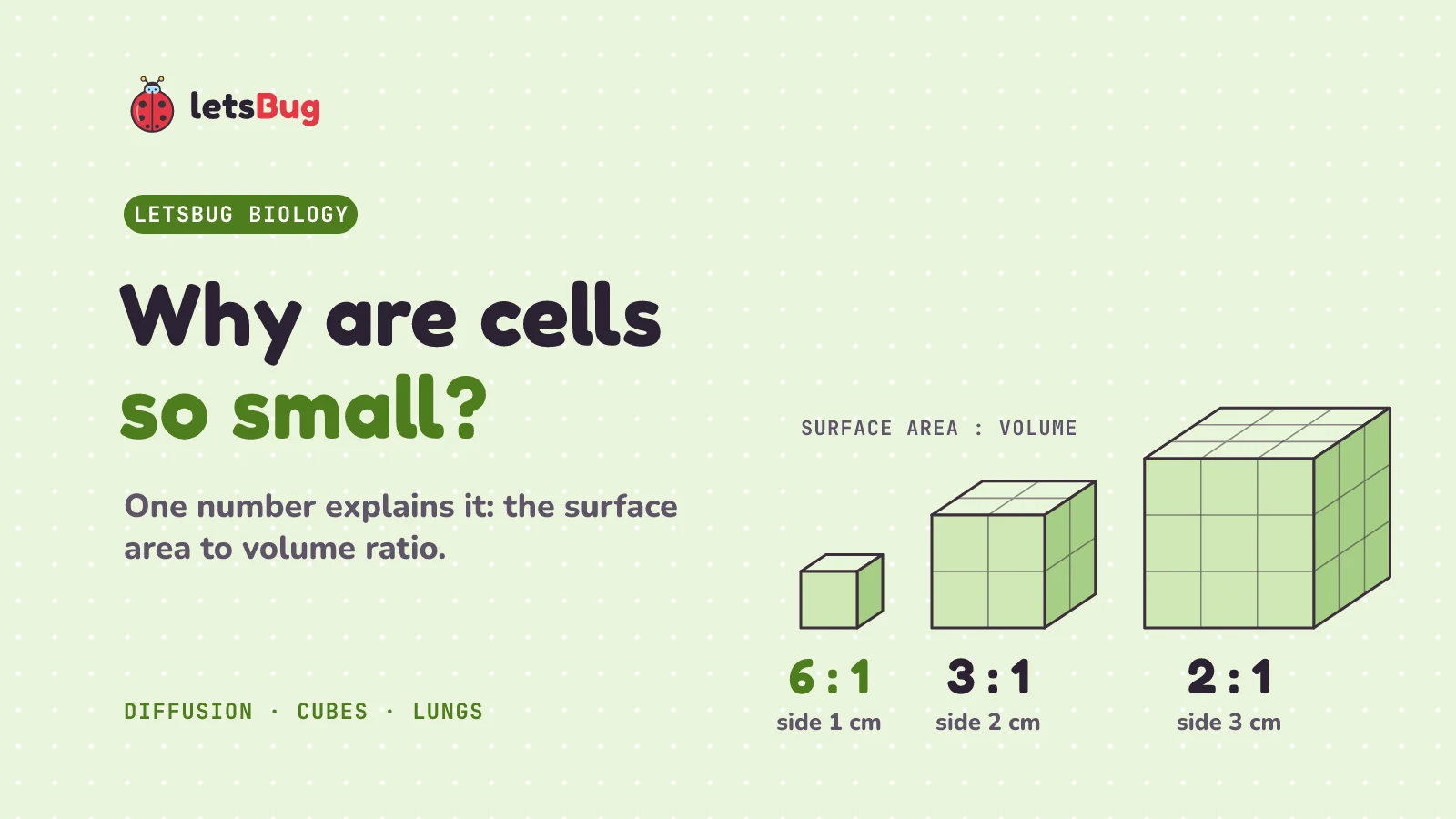
Cells are small because everything they need gets in through their surface, but every part of the inside uses it. As a cell grows, its volume grows faster than its surface area, so its surface area to volume ratio falls and the middle can't be supplied fast enough.
In this post we see exactly how diffusion works, then work out the ratio step by step: cubes with sides of 1, 2 and 3 cm give 6 : 1, 3 : 1 and 2 : 1, and a 2 × 2 × 4 cm cuboid gives 2.5 : 1. Then we meet the biggest cells, see how your lungs, your gut and an elephant's ears get round the problem, and open up a bacterium.
Key takeaways
- Diffusion is the net movement of particles from an area of higher concentration to an area of lower concentration. It needs no energy from the cell.
- Diffusion is faster with a steeper concentration gradient, a higher temperature, a larger surface area and a shorter distance.
- Surface area to volume ratio = surface area / volume. For a cube it works out as 6 / side: 6 : 1 for a 1 cm cube, 3 : 1 for 2 cm, 2 : 1 for 3 cm.
- Double the side of a cube and the surface area goes up 4 times, but the volume goes up 8 times, so the ratio halves.
- For a cuboid, surface area = 2(lw + lh + wh). A 2 × 2 × 4 cm cuboid has 40 cm² of surface and a volume of 16 cm³: 2.5 : 1.
- The biggest cells get away with it. A nerve cell's axon can be a metre long but is only about 1 µm thick, and most of an ostrich egg yolk is stored food.
- Big living things solve this with exchange surfaces: your lungs pack 70 to 80 m² of surface into your chest, behind a barrier less than 1 µm thick.
This post goes with letsBug Biology, episode 2. Watch it, or read on: the post adds the full working for every cube, a classic lab experiment and practice questions with answers.
Trillions of tiny cells, each fed through its surface
Let's start with the smallest cells around you. A 2016 study estimated that a 70 kg adult man carries about 38 trillion bacteria, most of them in the colon, the last part of the gut. That's of the same order as the number of his own cells, about 30 trillion, yet all those bacteria together weigh only about 0.2 kg, roughly 200 g.
One of them, E. coli, lives in your lower intestine. It's a rod about 2 µm long and 0.25 to 1 µm wide. Line up 50 of them nose to tail and they'd just cross a large plant cell 100 µm wide, since 50 × 2 µm = 100 µm.
A bacterium has no lungs and no mouth. So how does oxygen get in and waste get out?
What is diffusion? How things get in and out
Through its surface, by diffusion: the net movement of particles from an area of higher concentration to an area of lower concentration.
"Net" is the important word. Particles move about randomly all the time, in every direction. But where they're crowded, more of them happen to wander towards the empty side than wander back. Overall, the substance spreads from where there's a lot of it to where there's less. The difference in concentration between the two places is the concentration gradient, and particles move down it.
Diffusion is passive: it needs no energy from the cell. And it keeps going for a living cell because the cell keeps the gradient there. Oxygen keeps diffusing in because the cell uses it up inside. Carbon dioxide keeps diffusing out because the cell keeps making it. Water crosses the membrane by a special kind of diffusion, osmosis.
Say it precisely
Three small slips make an explanation of diffusion vague. Here's the precise version of each:
| Vague | Precise |
|---|---|
| "It increases diffusion." | "It increases the rate of diffusion." |
| "The gradient is high." | "There is a steep concentration gradient." |
| "The particles spread out." | "There is a net movement of particles from higher to lower concentration." |
What affects the rate of diffusion?
Four things speed diffusion up:
- A steeper concentration gradient. The bigger the difference in concentration, the faster the diffusion.
- A higher temperature. Particles have more energy and move faster.
- A larger surface area. More surface means more places for particles to cross at the same time.
- A shorter distance, such as a thinner membrane. The further particles have to travel, the slower the rate.
How do you calculate surface area to volume ratio? Start with cubes
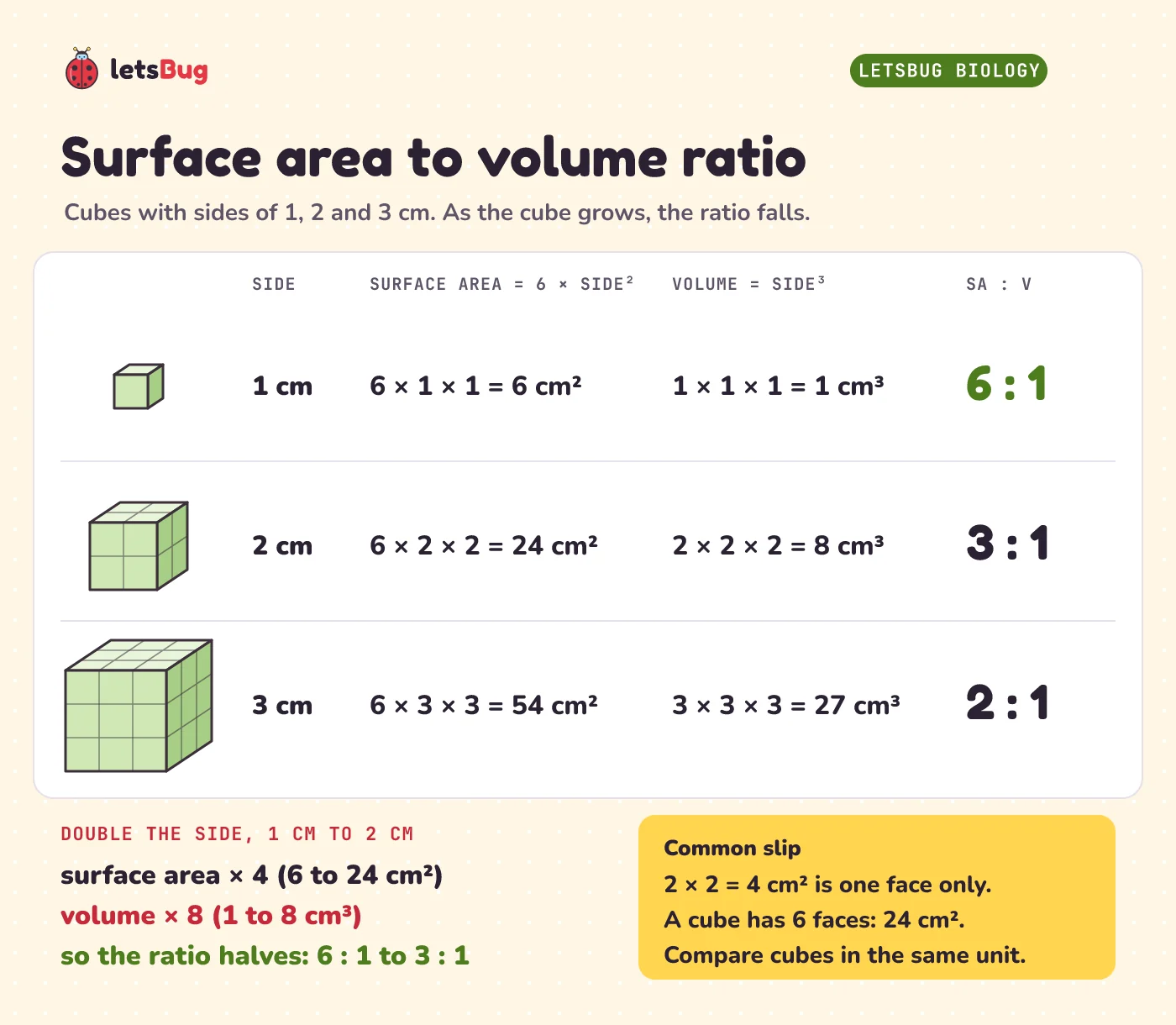
To compare cells of different sizes, biologists use the surface area to volume ratio (SA : V). Real cells are round or oddly shaped, so let's use cubes, which keep the maths simple. A cube has 6 faces, and each face is a square, so:
Let's work through all three.
- 1 cm cube. Each face is 1 × 1 = 1 cm², and 6 faces make 6 cm². The volume is 1 × 1 × 1 = 1 cm³. So SA : V = 6 / 1 = 6 : 1.
- 2 cm cube. Each face is 2 × 2 = 4 cm², and 6 faces make 6 × 4 = 24 cm². The volume is 2 × 2 × 2 = 8 cm³. So SA : V = 24 / 8 = 3 : 1.
- 3 cm cube. Each face is 3 × 3 = 9 cm², and 6 faces make 6 × 9 = 54 cm². The volume is 3 × 3 × 3 = 27 cm³. So SA : V = 54 / 27 = 2 : 1.
The easy slip is to stop at one face: "2 × 2 = 4 cm²" is the area of one face, not the whole cube. Always multiply by 6.
| Side | Surface area | Volume | SA : V |
|---|---|---|---|
| 1 cm | 6 cm² | 1 cm³ | 6 : 1 |
| 2 cm | 24 cm² | 8 cm³ | 3 : 1 |
| 3 cm | 54 cm² | 27 cm³ | 2 : 1 |
Look at the last column: 6, 3, 2. That's 6 divided by the side each time, so a 6 cm cube would be 1 : 1, and a 12 cm cube only 0.5 : 1. As the cube grows, the ratio falls.
Why the ratio falls: double the side
Go from a 1 cm cube to a 2 cm cube. The surface area goes from 6 to 24 cm², which is 4 times bigger (2 × 2). The volume goes from 1 to 8 cm³, which is 8 times bigger (2 × 2 × 2). Volume races ahead of surface, so the ratio halves, from 6 : 1 to 3 : 1.
The same happens with round cells. A sphere's surface area grows with the square of its radius, but its volume grows with the cube of its radius, much faster. For any shape, making it bigger in every direction leaves less surface for every cubic micrometre of inside. That's why stretching thin or going flat helps.
How to calculate SA : V for a cuboid
Not every block is a cube. A cuboid is a box whose sides aren't all the same length. It still has 6 faces, but they come in 3 matching pairs: top and bottom, front and back, left and right. So:
Let's work one out: a cuboid 2 cm wide, 2 cm high and 4 cm long.
- The three different faces. 2 × 2 = 4 cm² for each end, and 2 × 4 = 8 cm² for each of the long sides.
- Surface area. Each face has a twin on the opposite side, so surface area = 2(4 + 8 + 8) = 2 × 20 = 40 cm².
- Volume. 2 × 2 × 4 = 16 cm³.
- Ratio. SA : V = 40 : 16. Divide both sides by 16 to get it "to 1": 40 / 16 = 2.5, so the ratio is 2.5 : 1.
This cuboid is just two 2 cm cubes stuck end to end. Apart, the two cubes have 2 × 24 = 48 cm² of surface and a ratio of 3 : 1 each. Stick them together and the two touching faces, 4 cm² each, are hidden: 48 − 8 = 40 cm². Same volume, less surface, so a lower ratio.
AQA's GCSE Biology specification says students should be able to "calculate and compare surface area to volume ratios". Comparing is easiest when every ratio is written "to 1", so divide the surface area by the volume: 2.5 : 1 against 3 : 1 is easier to compare than 40 : 16 against 24 : 8. If ratios are new to you, start with how to share in a ratio: it covers what a ratio means and the unitary method (finding the value for one), which is what writing a ratio "to 1" does.
And one line for round cells: a sphere of radius r has a surface area of 4πr² and a volume of 4/3 πr³, so SA : V = 3 / r. Double the radius and the ratio halves, just like the cube.
Why are cells so small?
Now put the two ideas together. Every bit of a cell's volume uses oxygen and glucose and makes waste. That's the demand. All of it has to cross the surface. That's the supply.
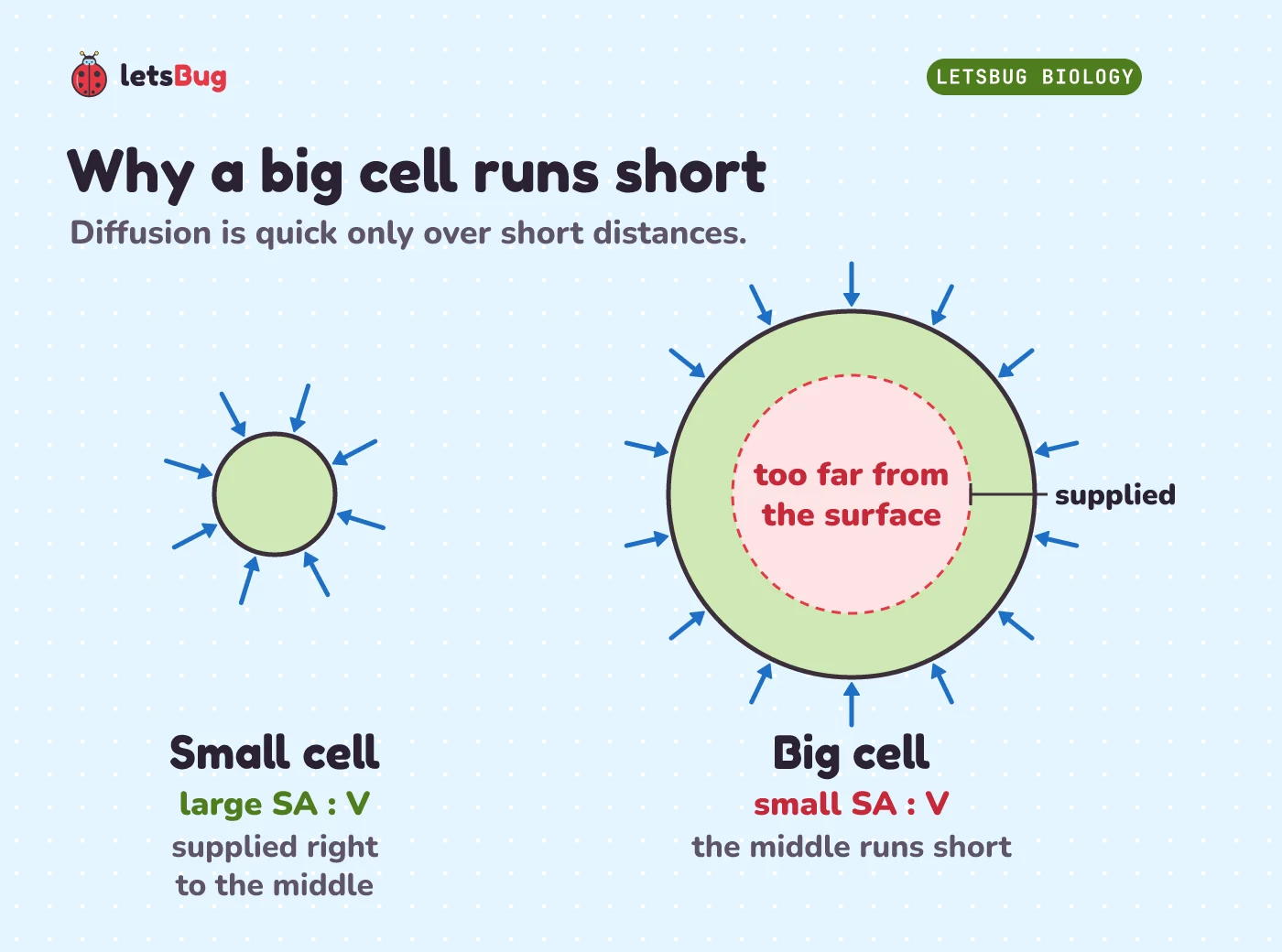
In a small cell, the ratio is large: there's plenty of surface for its volume, and nothing inside is far from the edge, so diffusion keeps up. That's why a bacterium needs no lungs or blood. In a bigger cell, demand grows faster than the surface that supplies it, and the middle ends up far from the surface. Diffusion over a longer distance is slower, so nutrients can't reach the centre fast enough and waste can't leave it. The membrane simply doesn't have enough surface area to keep up with the volume.
So when a cell grows too large for its surface, it has two choices: divide or die. Most animal and plant cells stay between 10 and 100 µm across, and bacteria are smaller still, about 0.1 to 5 µm.
Are there big cells?
Yes, a few. They don't break the rule. They find a way round it.
Nerve cells: long but very thin
Your longest cells are nerve cells. Each one has an axon, a long thin fibre that carries its signals. The longest axons in your body are in the sciatic nerve: they run from the base of your spine to your big toe. Some axons can be up to a metre or more long, yet most are only about 1 µm across.
That thinness is the trick. In a fibre 1 µm across, no part of the inside is more than about 0.5 µm from the membrane, about as close as in E. coli. A long thin tube has an SA : V of about 2 / r (ignoring its ends). Measured in micrometres, a 1 µm axon has a radius of 0.5 µm, so its ratio is about 2 / 0.5 = 4 : 1. A round cell 10 µm across (radius 5 µm) has only 3 / 5 = 0.6 : 1. The thin fibre has more than six times as much surface for its size.
The ostrich egg yolk: big but mostly food
The cell most often named as the largest is the yolk of an unfertilised ostrich egg. BioNumbers, a database of biology numbers from Harvard, calls the unfertilised ostrich egg "the largest known cell", and adds that strictly speaking only the yolk is the single cell. The egg white and shell around it aren't part of the cell. Not every source counts it this way: Wikipedia's yolk article says that in all birds the yolk is "a special storage organ" made in the mother's body. And some slime moulds, single cells with many nuclei, can spread over 30 cm across. So the record depends on what you count.
Either way, the yolk gets away with its size because most of it isn't busy, living cell material. Its job is to supply food for a growing chick, and the same article calls yolk "largely passive material": a store, not working cytoplasm. So most of that huge volume isn't the kind of demand that has to be fed through the surface.
How big animals solve it: lungs and villi
You're far too big to live on diffusion through your skin. A large animal has a small surface area to volume ratio, and most of its cells are a long way from the outside. So the body packs huge surfaces into small spaces, and a blood system carries things the rest of the way.
Your lungs
A typical pair of human lungs holds about 480 million alveoli, tiny air sacs that give a total gas-exchange surface of 70 to 80 m². An adult's whole body surface is only about 1.8 to 2.1 m², so your lungs have roughly 40 times the area of your skin. The barrier between the air and your blood is only 0.2 to 0.6 µm thick, less than a micrometre, and a fine mesh of capillaries covers about 70% of each alveolus.
Your small intestine
Your small intestine is lined with villi, small finger-like projections, each about 0.5 to 1.6 mm long, that give it a large surface. Each villus has a wall one cell thick, for a short diffusion path, and a rich blood supply: its capillaries carry sugars and amino acids away into the blood, which keeps the concentration gradient steep.
Lungs and villi share the three features of a good exchange surface in an animal: a large surface area, a thin wall, and a good blood supply to keep the gradient steep.
Elephant ears: the same idea, for heat
Surface area matters for heat, too, because an animal loses heat through its surface. An African elephant is so big that it has a small surface area for its volume, so it has relatively little skin to lose heat through.
Its answer is its ears. They're huge and thin, with large blood vessels on their inner sides. Flapping them creates air currents over those blood vessels, which increases heat loss in hot weather. A big surface with very little volume: the same trick as your lungs.
Inside a bacterium: a cell with no nucleus
Let's go back to the smallest cells and open one up. In animal and plant cells, the DNA sits inside a nucleus. Those are eukaryotic cells. Bacteria are prokaryotic: they have no nucleus, and no other parts wrapped in their own membrane either. Here's what a bacterium does have:
- Cell wall: the outer layer that protects the cell, helps it keep its shape and stops it drying out.
- Cell membrane: just inside the wall; it separates the inside of the cell from the outside, and everything that enters or leaves crosses it.
- Cytoplasm packed with ribosomes, which make proteins. Bacterial ribosomes are about 20 nm across, smaller than ours, which are 25 to 30 nm.
- One big loop of DNA, loose in the cytoplasm. In E. coli it's a single circular molecule 4.6 million base pairs long.
- Plasmids in many bacteria: small extra rings of DNA, often carrying useful genes such as those for antibiotic resistance.
- A flagellum in some bacteria: a tail the cell uses to swim.
And what a bacterium never has: mitochondria or chloroplasts. It doesn't need lungs either: as we saw, its surface is enough.
What does the agar cube experiment show?
You can watch the ratio at work. In a classic lab experiment, cubes of agar jelly are coloured with universal indicator, or made slightly alkaline and coloured pink with phenolphthalein, and dropped into dilute acid (0.1 M hydrochloric acid). As the acid diffuses in, the indicator changes colour (phenolphthalein turns from pink to colourless), so you can see how far the acid has got. The Practical Biology version uses cubes with sides of 2 cm, 1 cm and 0.5 cm and checks how far the acid has gone after five minutes. Wear eye protection: it uses acid.
Work out the ratios first. The 0.5 cm cube has a surface area of 6 × 0.5 × 0.5 = 1.5 cm² and a volume of 0.5 × 0.5 × 0.5 = 0.125 cm³, so its ratio is 1.5 / 0.125 = 12 : 1, against 6 : 1 and 3 : 1 for the bigger cubes. The smallest cube has the largest ratio and the shortest distance to its middle, so it changes colour all the way through first.
A cube of agar with sides of 4 cm is cut into eight cubes with sides of 2 cm. (1) What is the surface area to volume ratio before and after? (2) Which pieces change colour all the way through first, and why?
Show the answers
(1) Before: surface area = 6 × 4 × 4 = 96 cm², volume = 4 × 4 × 4 = 64 cm³, so the ratio is 96 / 64 = 1.5 : 1. After: each 2 cm cube is 24 / 8 = 3 : 1. The total volume is the same (8 × 8 = 64 cm³), but the total surface has doubled to 8 × 24 = 192 cm².
(2) The small cubes. Their ratio is twice as big, and the middle of each is only 1 cm from the surface instead of 2 cm, so the acid reaches it sooner.
Why do big organisms need exchange surfaces?
Here's a question that pulls the whole idea together: why does a large multicellular organism need a specialised exchange surface, when a single-celled organism doesn't?
"Because it's bigger" is true, but it explains nothing. Here's the complete explanation, step by step:
- A single-celled organism has a large surface area to volume ratio, so diffusion through its surface can supply its whole volume.
- A large organism has a small surface area to volume ratio.
- Its inner cells are far from the surface, so diffusion alone would be far too slow to supply them.
- So it needs exchange surfaces with a large area and thin walls, such as alveoli and villi, plus a transport system, the blood, to carry substances to every cell.
Practice questions
Q1. A sugar cube has sides of 1 cm. A block of 125 of them, stacked 5 by 5 by 5, has sides of 5 cm. Work out the surface area to volume ratio of the block.
Answer
Surface area = 6 × 5 × 5 = 150 cm². Volume = 5 × 5 × 5 = 125 cm³. Ratio = 150 / 125 = 1.2 : 1.
Q2. Break the block from Q1 into its 125 separate cubes. How much surface is there now, and how many times more is that?
Answer
Each 1 cm cube has 6 cm² of surface, so 125 × 6 = 750 cm². That's 750 / 150 = 5 times more surface for the same volume.
Q3. Give three ways your alveoli are suited to gas exchange.
Answer
A very large surface area (about 480 million alveoli, 70 to 80 m²); a very thin barrier between air and blood (0.2 to 0.6 µm), so the diffusion distance is short; and a rich blood supply from the capillaries, which keeps the concentration gradient steep.
Q4. Agar cubes with sides of 1 cm, 2 cm and 3 cm, coloured with an indicator, are put in acid. Which one changes colour all the way through first, and why?
Answer
The 1 cm cube. It has the largest surface area to volume ratio (6 : 1, against 3 : 1 and 2 : 1), and its middle is only 0.5 cm from the surface, so the acid has the shortest distance to diffuse.
Q5. Give two differences between a bacterial cell and one of your own cells.
Answer
Any two: a bacterial cell has no nucleus (its DNA is a single loop, loose in the cytoplasm); it has a cell wall; it may have plasmids; it has no mitochondria; its ribosomes are smaller.
Questions people ask
Why are cells so small?
Because a cell takes in everything it needs, and gets rid of its waste, through its surface. As a cell gets bigger, its volume grows faster than its surface area, so its surface area to volume ratio falls and the middle ends up too far from the surface to be supplied in time.
What is the surface area to volume ratio?
It's the surface area of an object divided by its volume. A large ratio means lots of surface for every bit of inside. Small objects have large ratios: a 1 cm cube is 6 : 1, a 3 cm cube only 2 : 1.
How do you work out the surface area to volume ratio of a cube?
Surface area = 6 × side × side. Volume = side × side × side. Divide the surface area by the volume and write the answer "to 1". For a 2 cm cube: 24 cm² / 8 cm³ = 3 : 1.
How do you work out the surface area to volume ratio of a cuboid?
Surface area = 2(lw + lh + wh). Volume = l × w × h. Divide the surface area by the volume and write the answer "to 1". For a 2 × 2 × 4 cm cuboid: 40 cm² / 16 cm³ = 2.5 : 1.
What is the largest cell?
The yolk of an unfertilised ostrich egg is the cell most often named, though not every source counts a bird's yolk as one cell. Your own longest cells are nerve cells: axons in the sciatic nerve run from the base of your spine to your big toe, but they're only about 1 µm thick.
Does a larger surface area make diffusion faster?
Yes. More surface means more places for particles to cross at once, so the rate of diffusion goes up. A shorter distance also speeds it up, which is why exchange surfaces are both large and thin.
What happens if a cell gets too big?
Its surface can no longer supply its volume fast enough, so it either divides into two smaller cells or dies.
Why don't bacteria need lungs?
A bacterium is only a few micrometres long, so it has a very large surface area to volume ratio and nothing inside is far from the surface. Its surface alone can take in enough oxygen and food and get rid of its waste.
Why do elephants have such big ears?
To lose heat. An elephant is so large that it has a small surface area for its volume. Its huge, thin ears have large blood vessels, and flapping them creates air currents that increase heat loss in hot weather.
Keep going
- Watch the full lesson, why are cells so small?, on the letsBug channel.
- The cells before bacteria: animal cell vs plant cell, every part explained, with cell sizes in micrometres.
- How water actually crosses that membrane: what is osmosis? The potato practical, and active transport.
- Zoom in much further: what is inside an atom? Protons, neutrons and electrons.
Checked on 20 October 2026 against the 17 sources below.
Sources
- OpenStax Biology 2e: 4.2 Prokaryotic cells (parts of a prokaryote, flagella, cell sizes, surface area to volume ratio, "divide or die") and 5.2 Passive transport (diffusion, no energy, what affects the rate)
- Sender, Fuchs and Milo (2016), PLOS Biology: Revised estimates for the number of human and bacteria cells in the body
- AQA: GCSE Biology (8461) specification, cell biology (4.1.3.1 Diffusion: "calculate and compare surface area to volume ratios")
- BioNumbers (Harvard Medical School): Volume of egg, ostrich (BNID 105104) (the unfertilised ostrich egg as the largest known cell)
- Practical Biology (Royal Society of Biology): Effect of size on uptake by diffusion (the agar cube experiment)
- Wikipedia: Escherichia coli, Plasmid, Ribosome, Pulmonary alveolus, Body surface area, Intestinal villus, African elephant, Phenolphthalein, Axon, Yolk and Largest organisms
Every number in this post was checked against these sources, and the arithmetic was run in Python before publishing.