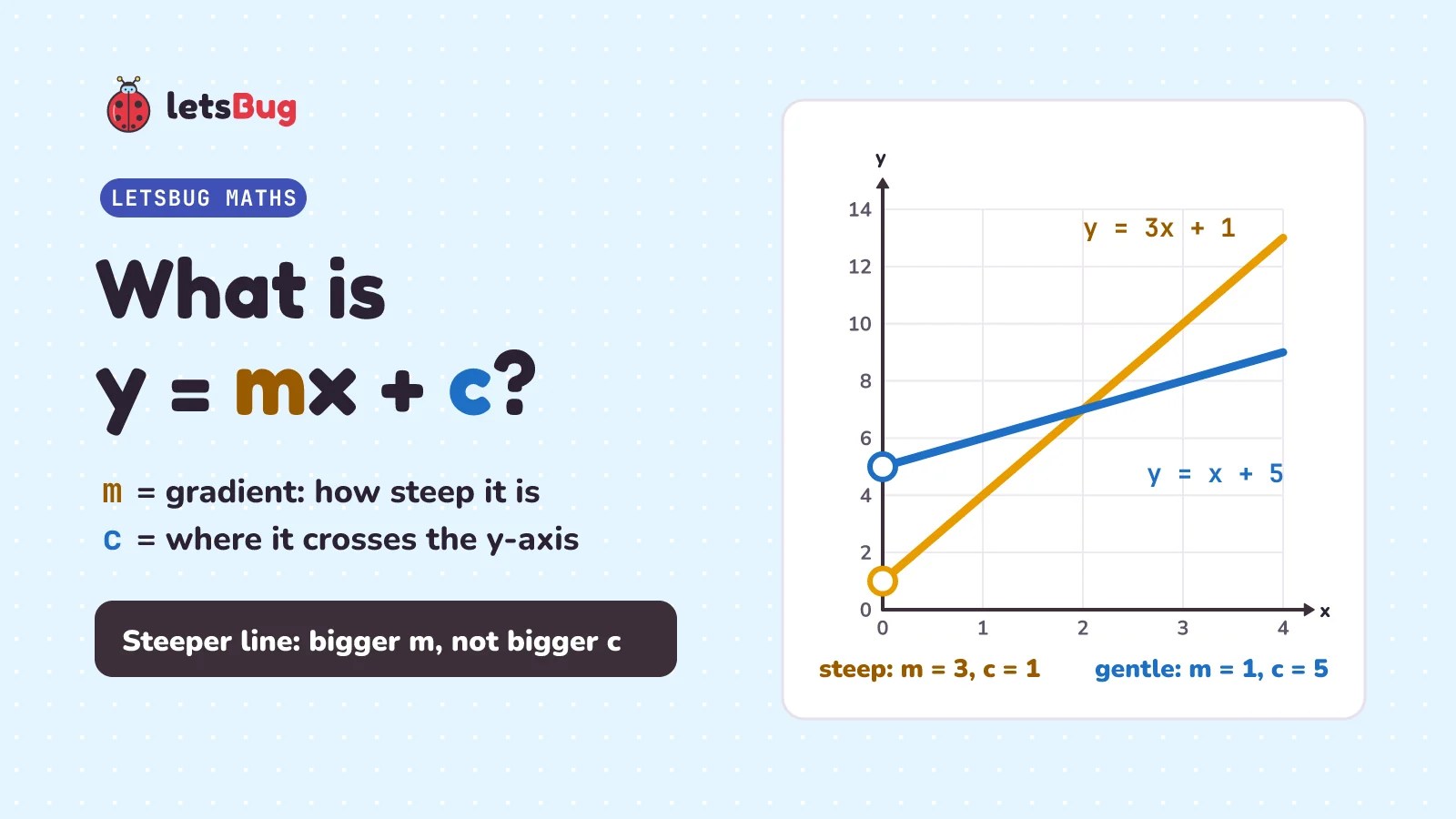
y = mx + c is the equation of a straight line. m is the gradient, the steepness: how much y changes for each 1 across. c is the y-intercept: where the line crosses the y-axis (the up axis), when x is 0. A steeper line has a bigger m, not a bigger c.
In this post we read m and c off a real electricity bill, then test the idea that a steeper line has a bigger c. We find a gradient from two points and catch a mistake examiners often see, read downhill lines and road signs, rearrange equations before reading m, and find the equation of a line step by step. Every hard word is explained where it first comes up. The practice questions from the video are answered in full, and exam-style questions with model answers are at the end.
Key takeaways
- In y = mx + c, m is the gradient (the change in y for each 1 across) and c is the y-intercept (the value of y when x = 0).
- Steepness comes only from m. y = 3x + 1 is steeper than y = x + 5, but it has the smaller c. Change c and the line slides up or down; change m and it turns.
- Gradient from two points = change in y ÷ change in x. Through (1, 4) and (3, 10) it's 6 ÷ 2 = 3, not 2 ÷ 6. Check: if the line climbs more than it runs, the gradient is bigger than 1.
- Get y on its own first. 2y = 6x + 8 is y = 3x + 4, so the gradient is 3, not 6.
- A negative gradient goes downhill. A 10% hill sign means 10 m up for every 100 m across: a gradient of 0.1.
This post goes with letsBug Maths, episode 6. y = mx + c is on the GCSE and IGCSE maths syllabus (the list of what an exam can test), in ICSE Class 10 under "equation of a line", and in Chapter 13 of NCERT's Class 9 book, Ganita Manjari. Watch the lesson, or read on: the post adds what the gradient's units mean, a test for direct proportion (where zero gives zero and double gives double), the full working for every answer, and model answers that score marks.
What do m and c mean in y = mx + c?
Let's start with something you pay for every day: electricity. Two words from the bill first:
- A kWh (kilowatt-hour) is the energy a one-kilowatt heater uses in one hour. It's the "unit" on an electricity bill.
- A standing charge is a fixed amount you pay every day, even if you use no electricity at all.
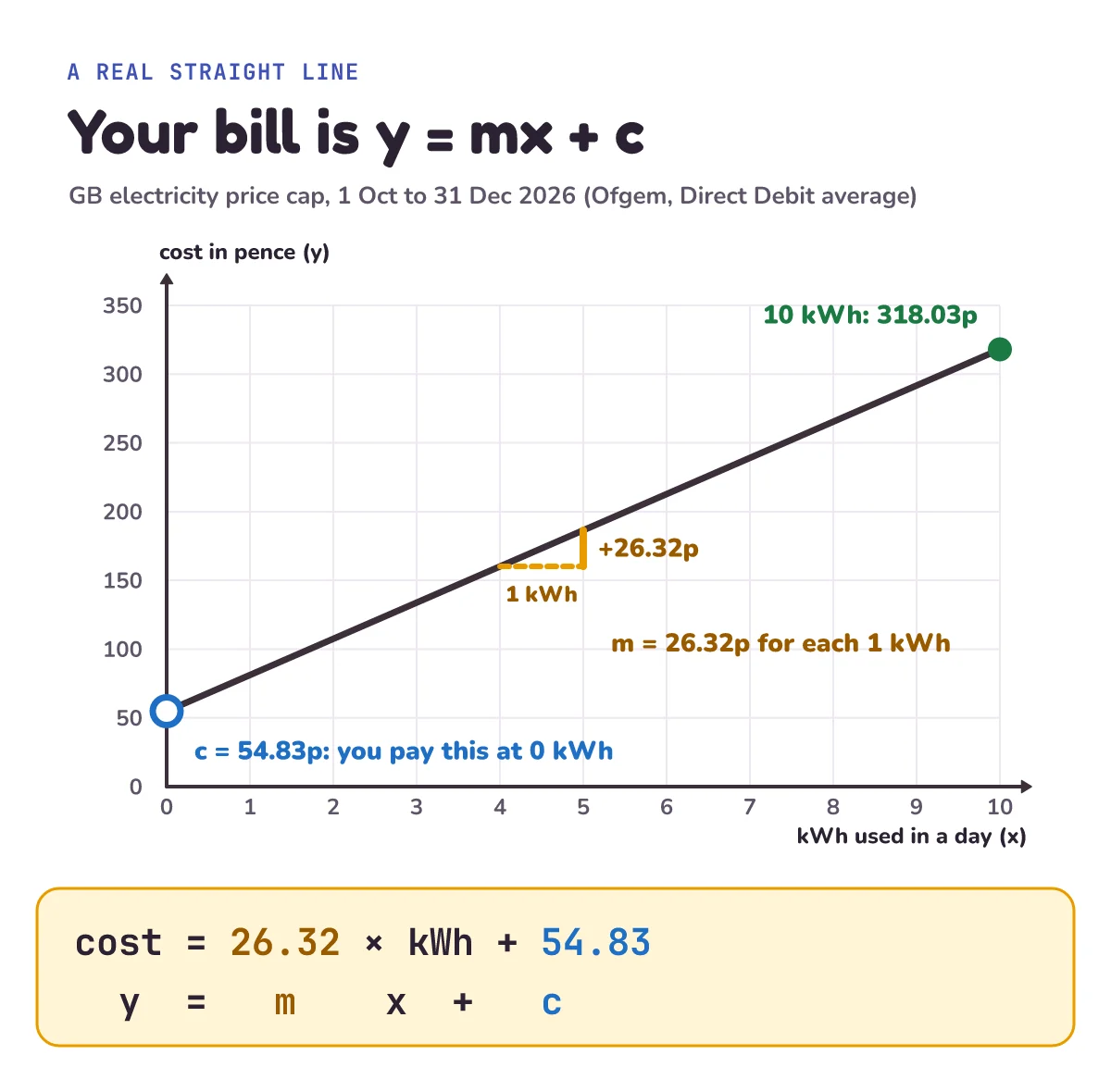
In Britain, electricity has a price cap, set by an office called Ofgem. In Ofgem's words: "This is the maximum amount your supplier can charge for a unit of energy and standing charge together." For 1 October to 31 December 2026, Ofgem lists electricity at "26.32 pence per kWh" with a "54.83 pence daily standing charge". These are averages for England, Scotland and Wales, for people who pay by Direct Debit (an automatic payment from a bank account).
So at these prices, one day's electricity costs 26.32 pence for each kWh, plus 54.83 pence:
cost = 26.32 × kWh + 54.83
That's y = mx + c. Draw it with the kWh you use across the bottom (x) and the cost in pence up the side (y):
- c = 54.83 is where the line crosses the y-axis (the up-and-down axis). Use nothing, x = 0, and you still pay 54.83p. That's the y-intercept: the value of y when x is zero. Intercept means the point where the line cuts the axis.
- m = 26.32 is the gradient: how much y changes for each 1 across. Each extra kWh adds 26.32p, so go 1 across and the line goes 26.32 up.
Use 10 kWh in a day and you pay 26.32 × 10 + 54.83 = 318.03p, about £3.18. (10 kWh is just an example number.)
Does a steeper line have a bigger c?
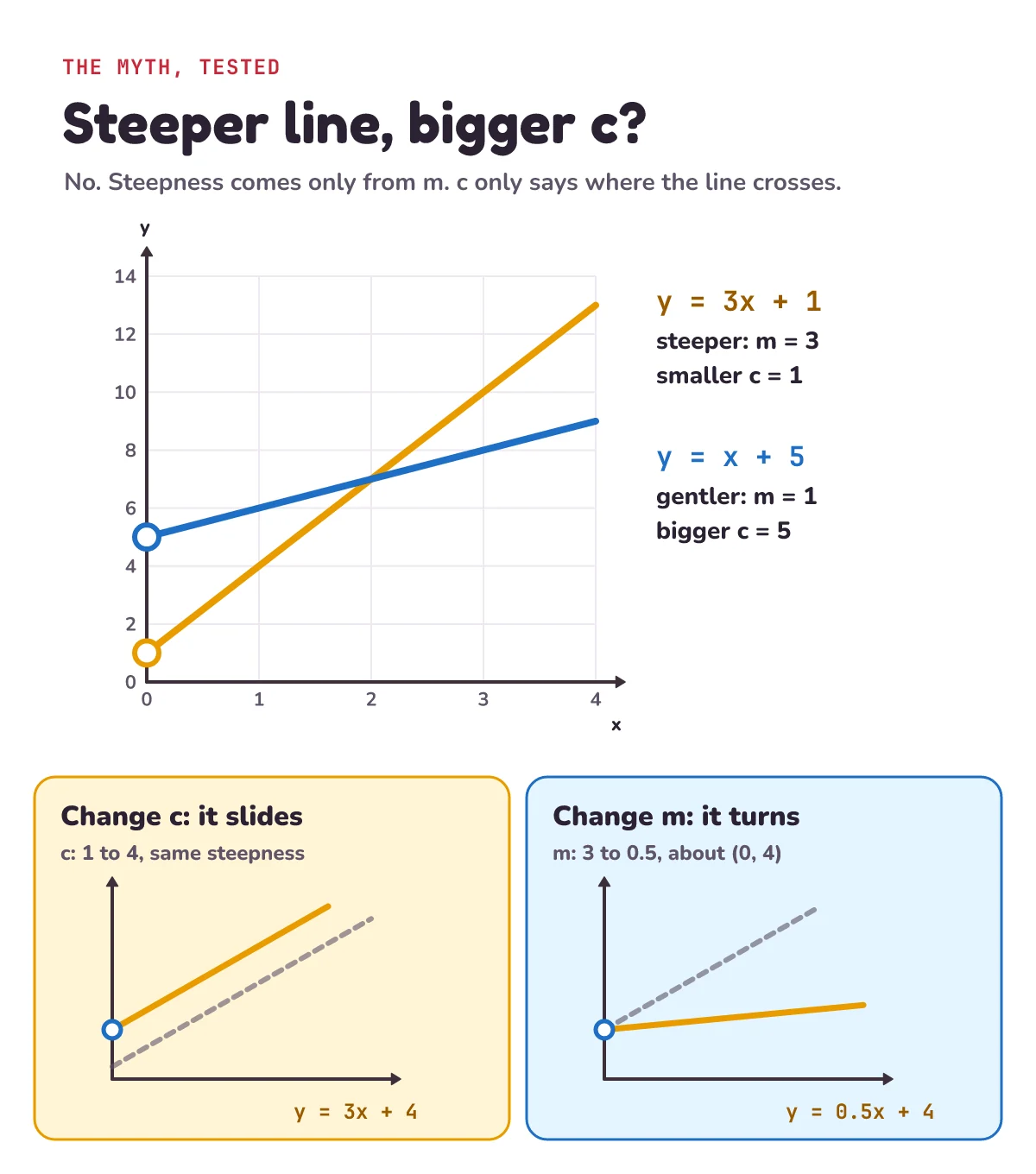
No. Let's test it with two lines:
- y = 3x + 1: the gradient is 3, so it climbs 3 for every 1 across. It crosses the y-axis at 1.
- y = x + 5: this is y = 1x + 5, so the gradient is 1. It crosses the y-axis at 5.
The first line is much steeper. But the second one has the bigger c. So steepness comes only from m, and c only says where the line crosses the y-axis.
Think of m and c as two separate dials. Turn the c dial from 1 to 4 and y = 3x + 1 becomes y = 3x + 4: the whole line slides up 3, just as steep as before. Turn the m dial from 3 to 0.5 and y = 3x + 4 becomes y = 0.5x + 4: the line turns about the point (0, 4), where it crosses the y-axis, like a door on its hinge. It gets less steep. Two different lines with the same m never meet. They are parallel, like the two lines in the first dial.
How do you find the gradient from two points?
Take the points (1, 4) and (3, 10). A point (x, y) is a pair of coordinates: how far across, then how far up. The gradient is the change in y divided by the change in x. People call it rise over run: rise is how far the line goes up, run is how far it goes across.
- Rise: 10 − 4 = 6 up.
- Run: 3 − 1 = 2 across.
- Gradient: m = 6 ÷ 2 = 3.
Here's a common mistake: dividing the wrong way round, change in x ÷ change in y. That gives 2 ÷ 6 = 1/3. Exam boards publish examiner reports on what students got wrong, and this one is in them. In the June 2024 Cambridge IGCSE maths exam (0580, Paper 23, Question 10), the report says: "The biggest error was having their working the wrong way round, that is change in x divided by change in y, or not dealing with the double negatives correctly." In Paper 22, "A gradient of 2 was seen from dividing change in x by change in y".
Catch it with a picture. From (1, 4) to (3, 10), the line goes 6 up but only 2 across. It climbs more than it runs, so its gradient must be bigger than 1. A third can't be right.
You can finish the job too. Put the point (1, 4) into y = 3x + c: 4 = 3 × 1 + c, so c = 1. The line is y = 3x + 1, the steep line from the last section.
What does a negative gradient mean?
A negative gradient means y goes down as you move right: the line goes downhill. Take y = 8 − 2x. The gradient is −2, so the line drops 2 for every 1 across. It crosses the y-axis at 8, so c = 8.
Check with two points on the line. When x = 0, y = 8. When x = 4, y = 8 − 8 = 0. Rise over run: (0 − 8) ÷ (4 − 0) = −8 ÷ 4 = −2. The minus sign is the downhill.
Keep the order the same on the top and the bottom: if you start the top from the second point (0 − 8), start the bottom from the second point too (4 − 0). Mixing them up flips the sign. The Cambridge report also warns about "double negatives": when a coordinate is negative, you subtract a negative number, and 4 − (−2) = 4 + 2 = 6. Exam question 2 below has one.
What does a 10% hill sign mean?
Gradient is how roads are signed. Wikipedia's article on grade (another word for slope) says: "In Europe, road gradients are expressed in signage as percentage." The percentage is the rise over the run, times 100. On a 10% hill, the road climbs 10 m for every 100 m across.
As a gradient: 10 ÷ 100 = 0.1. And 0.1 × 100 = 10%. So a road sign's percentage is just the gradient, written as a percentage.
One detail: the run is measured flat, across the map. The article says "run is the horizontal distance (not the distance along the slope)". Horizontal means flat, level with the ground. And the percentage is not an angle. A 100% slope is not straight up: it's 45°, where the run equals the rise.
How do you find m and c when y isn't on its own?
An equation isn't always written as "y = ...". Look at 2y = 6x + 8. It's tempting to say the gradient is 6. It isn't.
Rule: get y on its own first. Divide everything by 2: y = 3x + 4. Now read it: m = 3 and c = 4.
Students really do miss this. The Eduqas GCSE maths examiners' report for Summer 2025 (Higher tier, the harder paper, Component 2, Question 5(b)) says that "only a minority were able to realise that 2y = 6x + 8 can be written as y = 3x + 4 and thus has a gradient of 3." A minority means fewer than half.
The order of the terms doesn't matter either. In y = 5 − 2x, the number with x is −2, so m = −2, and the number on its own is 5, so c = 5. m is the number in front of x, including its minus sign.
How do you find the equation of a line through two points?
Find the equation of the line through (2, 7) and (5, 13). Say it clearly, step by step:
- Find the gradient. m = (13 − 7) ÷ (5 − 2) = 6 ÷ 3 = 2.
- Find c. Put one point into y = 2x + c. Using (2, 7): 7 = 2 × 2 + c, so 7 = 4 + c, and c = 3. (That's a one-step equation, like the ones in writing equations from word problems.)
- Write the full equation. y = 2x + 3.
Check with the other point. 2 × 5 + 3 = 13. It works.
Don't stop at m = 2. That's only the steepness, not the line. Examiners see this too. In the June 2024 Cambridge report for Paper 32, writing down the equation of a line "was not generally well answered", and "Stating the correct gradient was more successful than stating the correct intercept."
Why is Celsius to Fahrenheit a straight line?
Try this one before you read the answer. Water freezes at 0 °C, which is 32 °F. It boils at about 100 °C, which is 212 °F. Find the equation for Fahrenheit, F, in terms of Celsius, C.
The two points are (0, 32) and (100, 212), with C across and F up.
- Gradient: (212 − 32) ÷ (100 − 0) = 180 ÷ 100 = 1.8.
- The line crosses the F axis at 32, so c = 32.
- So F = 1.8C + 32.
(Careful: capital C here means Celsius. It isn't the c in y = mx + c.)
That's the formula NIST, the US government's measurement lab, gives: "(°C * 1.8) + 32", where * means ×. NIST also says "An interval of one Celsius degree corresponds to an interval of 1.8 Fahrenheit degrees". An interval is the gap between two temperatures. That sentence is the gradient in words: each 1 across in °C is 1.8 up in °F. Every Celsius degree is the same size, so each one is always 1.8 Fahrenheit degrees. A rate that never changes gives a straight line. Check it with a room at 20 °C: 1.8 × 20 + 32 = 68 °F, the same as NIST's table.
Why is the gradient a rate of change?
The gradient has units: the units of y per unit of x. On the electricity line, m = 26.32 pence per kWh. A rate of change is how fast one thing changes as another changes, and that's exactly what a gradient is. AQA's GCSE maths specification (the exam board's list of what can be tested) asks students to "interpret the gradient of a straight-line graph as a rate of change".
You've met this in physics: on a distance-time graph, the gradient is metres per second, which is the speed. See how to read distance-time and velocity-time graphs.
What does it mean when c = 0?
When c = 0, the line goes through (0, 0), the origin, where both axes start. Then y = mx is direct proportion: zero gives zero, and double gives double. The electricity bill isn't, because of the standing charge. 10 kWh costs 318.03p, but 20 kWh costs 26.32 × 20 + 54.83 = 581.23p, not double (636.06p). The ratio and proportion lesson has the full test.
Your turn. These are the practice questions from the video, plus a bonus. Try each one before you open the answers.
1) Find the equation of the line through (0, 3) and (4, 11).
2) Find the equation of the line through (2, 7) with gradient −2.
3) Write down the gradient and y-intercept of 3y = 12 − 6x.
4) Bonus: at what temperature are °C and °F the same number?
Show the answers
1) m = (11 − 3) ÷ (4 − 0) = 8 ÷ 4 = 2. The line passes through (0, 3), so c = 3. y = 2x + 3. Check: 2 × 4 + 3 = 11.
2) Put (2, 7) into y = −2x + c: 7 = −2 × 2 + c, so 7 = −4 + c, and c = 11. y = −2x + 11. Check with another point: at x = 3, y = −6 + 11 = 5. That's 1 across and 2 down from (2, 7), a gradient of −2.
3) Get y on its own: divide everything by 3, so y = 4 − 2x. The gradient is m = −2 and the y-intercept is c = 4. The common wrong answer is m = −6.
4) Set F = C in F = 1.8C + 32: C = 1.8C + 32, so −0.8C = 32, and C = 32 ÷ −0.8 = −40. Check: 1.8 × −40 + 32 = −72 + 32 = −40. So −40 °C is −40 °F.
Exam-style questions with model answers
The number in brackets is the marks. Each mark is one clear step.
Q1. Write down the gradient and the y-intercept of the line y = 4x − 7. [2]
Model answer
Gradient = 4 [1]. y-intercept = −7 [1]. (The minus sign belongs to c.)
Q2. Find the gradient of the line through (−2, 5) and (4, −7). [2]
Model answer
m = (−7 − 5) ÷ (4 − (−2)) [1] = −12 ÷ 6 = −2 [1]. Check: the line goes down as x goes up, so the gradient should be negative. (4 − (−2) is 4 + 2 = 6: that's the double negative.)
Q3. Find the equation of the line through (1, 9) and (3, 15). [3]
Model answer
m = (15 − 9) ÷ (3 − 1) = 6 ÷ 2 = 3 [1]. Using (1, 9): 9 = 3 × 1 + c, so c = 6 [1]. y = 3x + 6 [1]. Check: 3 × 3 + 6 = 15.
Q4. A line has equation 4y = 2x − 12. Find its gradient and its y-intercept. [2]
Model answer
Divide by 4: y = 0.5x − 3 [1]. Gradient = 0.5, y-intercept = −3 [1]. (2 is the common wrong answer for the gradient.)
Q5. A plumber charges a £40 call-out fee (a fixed charge just for coming to the job) plus £30 for each hour. (a) Write a formula for the total cost, £T, of a job that takes h hours. (b) What do the 30 and the 40 mean on a graph of T against h? [3]
Model answer
(a) T = 30h + 40 [1]. (b) 30 is the gradient: the cost goes up £30 for each hour [1]. 40 is the T-intercept: the cost for 0 hours, the call-out fee [1].
Q6. Which of these lines is parallel to y = 2x + 3? y = 3x + 2, y = 2x − 5, y = −2x + 3. [1]
Model answer
y = 2x − 5 [1], because parallel lines have the same gradient, 2.
Questions people ask
What is y = mx + c?
The equation of a straight line. m is the gradient (how steep the line is) and c is the y-intercept (where the line crosses the y-axis). For example, y = 2x + 3 has gradient 2 and crosses the y-axis at 3.
What does m stand for in y = mx + c?
m is the gradient: how much y changes for each 1 you move across. A bigger m means a steeper line. A negative m means the line goes downhill.
What does c stand for in y = mx + c?
c is the y-intercept: the value of y when x = 0, where the line crosses the y-axis. Changing c slides the line up or down without changing how steep it is.
How do you find the gradient of a line?
Pick two points on it and divide the change in y by the change in x. Through (1, 4) and (3, 10): (10 − 4) ÷ (3 − 1) = 6 ÷ 2 = 3.
How do you find c in y = mx + c?
Put the gradient and one point on the line into y = mx + c, then solve. For m = 2 and the point (2, 7): 7 = 2 × 2 + c, so c = 3.
Does a steeper line have a bigger y-intercept?
No. Steepness comes only from m. y = 3x + 1 is steeper than y = x + 5, but its y-intercept (1) is smaller than 5.
Do parallel lines have the same gradient?
Yes. Two different lines with the same m climb at the same rate, so they never meet. y = 2x + 3 and y = 2x − 5 are parallel; only their c is different.
Keep going
- Watch the full lesson, What Is y = mx + c? Gradient and y-Intercept, and its Short, Steeper Line, Bigger c? Gradient vs y-Intercept. More in letsBug Maths on YouTube. Next in the series: distance and the section formula.
- The episode before this one: how to find the price before VAT, with reverse percentages.
- When c = 0 the line is direct proportion: how to share in a ratio, and the test for direct proportion.
- Gradient as speed: how to read distance-time and velocity-time graphs.
Checked on 31 October 2026 against the 9 sources below. Every gradient, intercept, cost and practice answer in this post was worked out again in a Python script, and every quote was matched word for word with the source text.
Sources
- Ofgem: Get energy price cap standing charges and unit rates by region (1 October to 31 December 2026: electricity 26.32p per kWh and a 54.83p daily standing charge, Direct Debit average)
- Ofgem: Energy price cap and standing charges explained (what the cap limits, and what a standing charge is)
- Wikipedia: Grade (slope) (percentage grade = 100 × rise ÷ run; road signs in Europe)
- NIST: SI units: temperature (°F = (°C × 1.8) + 32; water freezes at 0 °C and boils at about 100 °C)
- Cambridge International: IGCSE Mathematics 0580, June 2024 principal examiner report (Papers 22, 23 and 32: gradients the wrong way round, and equations of lines)
- Eduqas: GCSE Mathematics examiners' report, Summer 2025 (Higher tier, Component 2, Question 5: 2y = 6x + 8)
- AQA: GCSE Mathematics 8300 specification (A9, A10: equations, gradients and intercepts of straight lines; the gradient as a rate of change)
- CISCE: ICSE Mathematics syllabus, Class X, examination year 2027 (a copy hosted by Physics Wallah; Co-ordinate Geometry, equation of a line)
- Tiwari Academy: NCERT Solutions for Class 9 Maths, Ganita Manjari Chapter 13, Two Variables, One Line (a solutions site, not NCERT itself; slopes and intercepts)