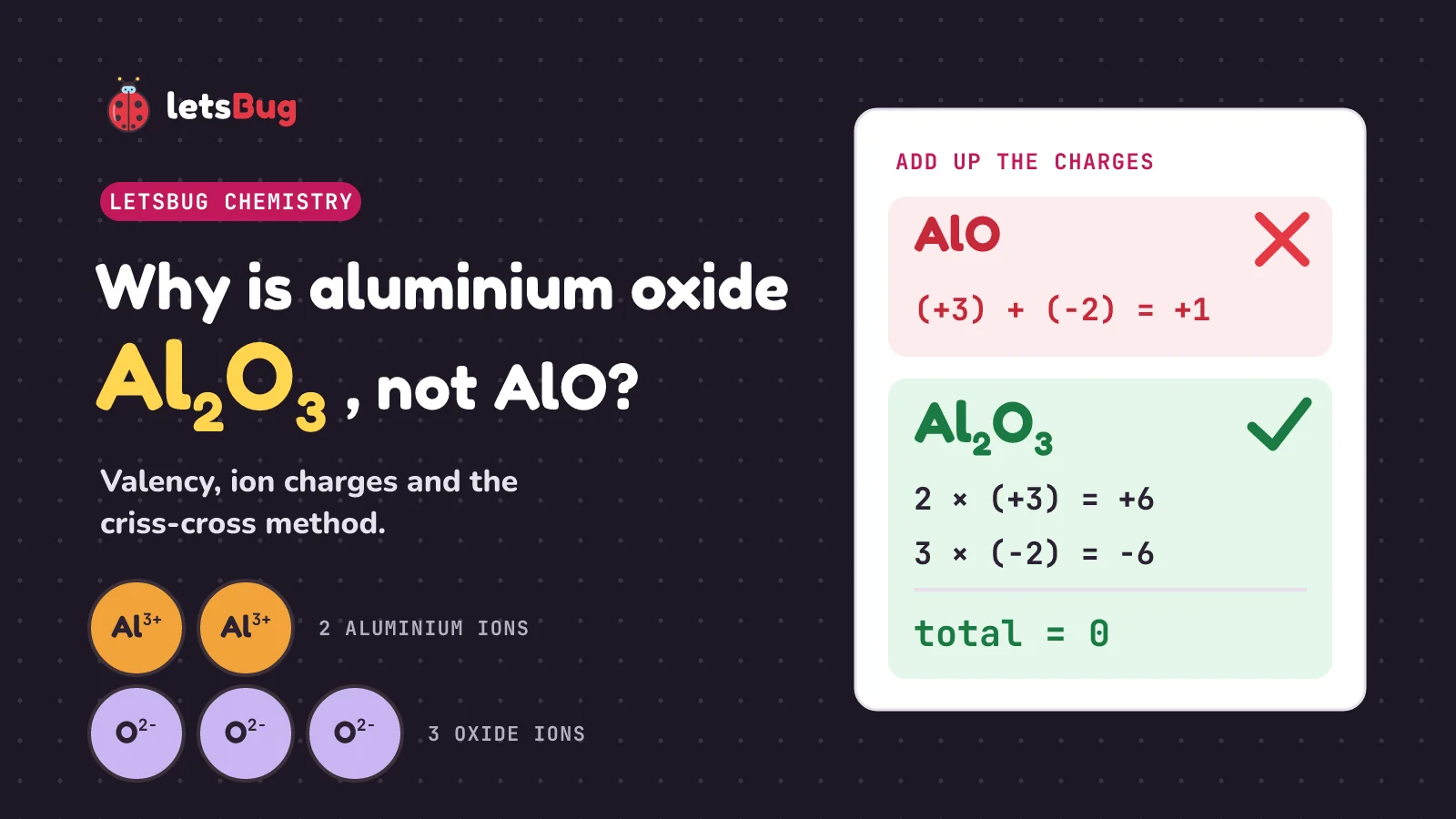
Aluminium oxide is Al2O3 because an aluminium ion has a charge of 3+, an oxide ion has a charge of 2−, and a compound has no overall charge. One of each, AlO, would leave +1. Two aluminium ions give +6 and three oxide ions give −6, which add up to zero. So the formula is Al2O3.
In this post we work out valency from the electron arrangement, turn it into the charge on an ion, and use one rule to write formulae: the charges must add up to zero. Then we learn the criss-cross shortcut and its two extra rules, and put groups like hydroxide and sulfate in brackets. Last, we use valency for molecules (and see why PH2 is wrong) and finish with exam-style questions and model answers.
Key takeaways
- Valency is an atom's combining power: how many electrons it loses, gains or shares to get a full outer shell. Sodium 1, magnesium 2, aluminium 3, oxygen 2, chlorine 1.
- Quick pattern: for groups 1 to 3, valency = the group number. For groups 5 to 7, valency = 8 − the group number.
- Metal atoms lose electrons and become positive ions (Al3+). Non-metal atoms gain electrons and become negative ions (O2−).
- The rule behind every formula made of ions: total positive charge + total negative charge = 0.
- Criss-cross: write the charges under the symbols, swap only the numbers and drop them down as subscripts. Don't write a 1, and divide out a common factor (Mg2O2 becomes MgO).
- Put a group of atoms like OH− in brackets when you need more than one of it: Al(OH)3, not AlOH3.
- Always check: add up the charges. If they don't make zero, the formula is wrong.
This post goes with letsBug Chemistry, episode 5. It covers section 9.5, Writing Chemical Formulae, in Chapter 9 of the new NCERT Class 9 science book, Exploration ("Atomic Foundations of Matter"), and writing the formulae of ionic compounds in GCSE and IGCSE chemistry. Watch the lesson, or read on: the post adds a table of common ions, more worked examples, and exam-style questions with model answers.
Why is aluminium oxide not AlO?
The scratch-resistant glass on some watches isn't ordinary glass. It's sapphire, made in a factory. Wikipedia's sapphire article says: "Synthetic sapphire—also referred to as sapphire glass—is commonly used for small windows", including crystals for watches (a watch crystal is the clear cover over the face). Sapphire is a form of the mineral corundum, and Wikipedia's corundum article says corundum is a crystal (its particles are packed in a regular, repeating pattern) of aluminium oxide, Al2O3.
It's used because it's so hard. "Sapphire has a remarkable hardness, with a score of 9 on the Mohs scale". The Mohs scale ranks minerals from 1 (talc) to 10 (diamond). Of the ten minerals that set the scale, only diamond sits above corundum.
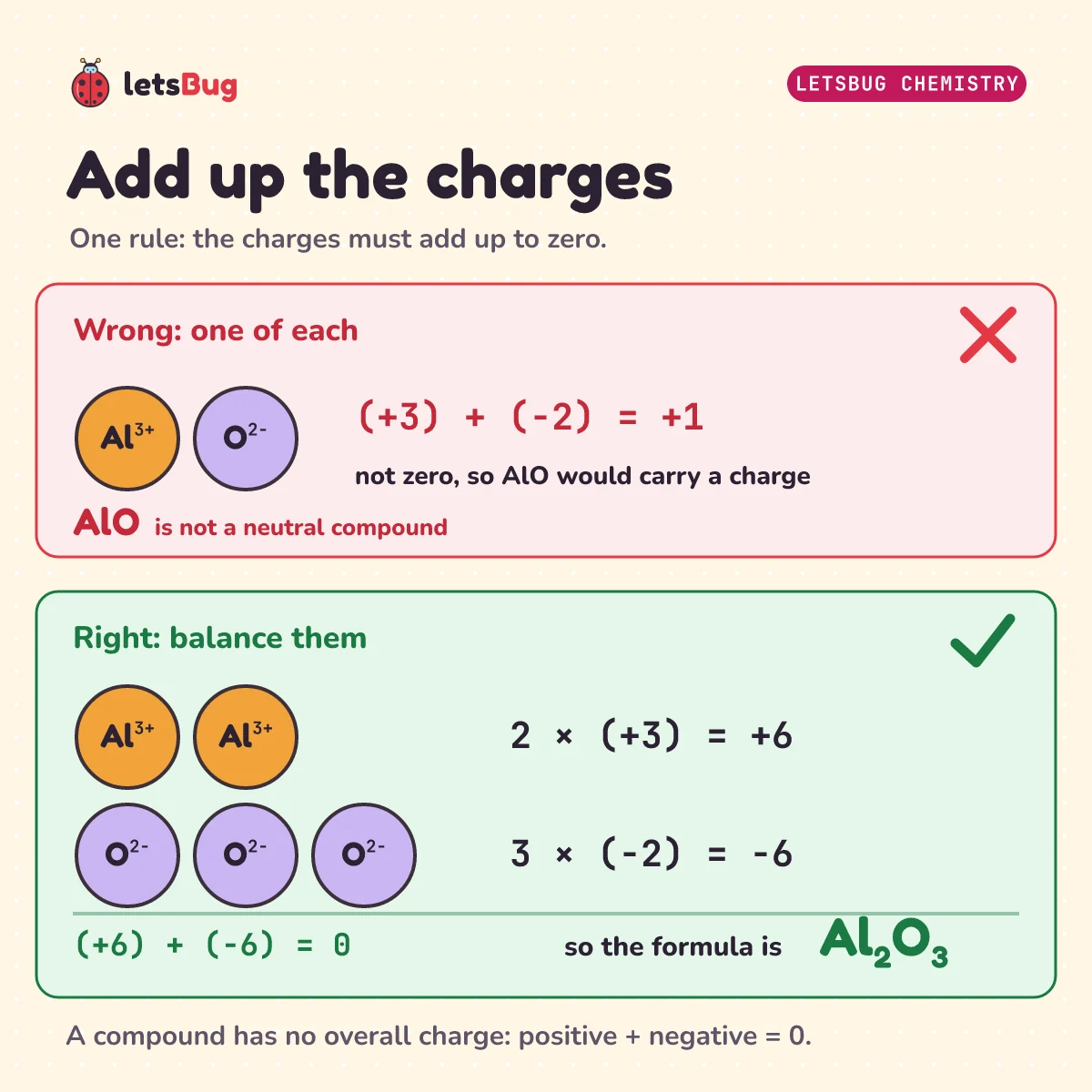
Now write its formula. A tempting answer is AlO: one aluminium, one oxygen. It looks tidy, and it's wrong. Here's how to catch it. An aluminium ion has a charge of 3+ and an oxide ion has a charge of 2−. (On an ion we write the number first, 3+. When we add charges, we write it like any other number, +3.) One of each gives:
A compound has no overall charge. NCERT says it plainly: "The positive and negative charges must balance each other, and the overall structure must be neutral." Neutral means a total charge of zero. AlO would carry a charge of +1, so it can't be a compound. That's the five-second check: add up the charges before you move on.
What is valency?
Valency is an atom's combining power: the number of electrons it loses, gains or shares to get a full outer shell. NCERT puts the idea in one line: "Atoms can lose, gain or share electrons to achieve an octet of valence electrons." The valence shell is the outer shell, and an octet is a set of eight electrons in it. A full outer shell is stable (it doesn't easily change or react), which is why the noble gases are unreactive.
You read valency from the electron arrangement (how many electrons sit in each shell). A metal atom with 1, 2 or 3 outer electrons loses them, because that's fewer electrons to move than gaining 7, 6 or 5. A non-metal atom with 5, 6 or 7 outer electrons gains the 3, 2 or 1 it needs to reach eight (or gets them by sharing, as we'll see below). NCERT does this for oxygen: "the number of electrons present in its valence shell is six, and it requires two more electrons to complete its octet."
| Element | Shells | Outer | To fill | Valency |
|---|---|---|---|---|
| Na | 2,8,1 | 1 | loses 1 | 1 |
| Mg | 2,8,2 | 2 | loses 2 | 2 |
| Al | 2,8,3 | 3 | loses 3 | 3 |
| O | 2,6 | 6 | gains 2 | 2 |
| Cl | 2,8,7 | 7 | gains 1 | 1 |
The number of outer electrons matches the group number (the column of the periodic table) in the 1 to 7 numbering used in GCSE books. That gives a quick pattern:
- Groups 1 to 3 (metals like sodium, magnesium, aluminium): valency = the group number.
- Groups 5 to 7 (non-metals like nitrogen, oxygen, chlorine): valency = 8 − the group number. Oxygen is in group 6, so 8 − 6 = 2.
On a periodic table numbered 1 to 18, aluminium is in group 13 and oxygen in group 16: use the last digit. (Our table of the first 20 elements gives both numbers.) AQA's specification (the exam board's list of what you must learn) makes the same link for groups 1, 2, 6 and 7: "The charge on the ions produced by metals in Groups 1 and 2 and by non-metals in Groups 6 and 7 relates to the group number of the element in the periodic table."
The pattern only works for groups 1 to 3 and 5 to 7. Group 4 atoms, like carbon, usually share their four outer electrons (more on that below). The noble gases already have a full outer shell, so they don't need to lose, gain or share electrons. And the metals in the wide middle block of the periodic table, like zinc, silver, iron and copper, don't follow it: learn their ions from the table below. Some of them have more than one valency: NCERT's table lists iron as Fe2+ (ferrous) and Fe3+ (ferric), and copper as Cu+ and Cu2+. The Roman numeral in a name tells you which one: iron(III) oxide contains Fe3+ ions, and iron(II) means Fe2+.
How do atoms become ions?
An atom has equal numbers of protons (positive) and electrons (negative), so it has no overall charge. An ion is an atom, or a group of atoms, that has lost or gained electrons, so the numbers no longer match. (We met protons and electrons in what is inside an atom.)
- Metal atoms lose electrons. Aluminium has 13 protons and 13 electrons (2,8,3). It loses its 3 outer electrons. Now it has 13 protons and 10 electrons: 3 more positive charges than negative. That's the aluminium ion, Al3+. A positive ion is also called a cation.
- Non-metal atoms gain electrons. Oxygen has 8 protons and 8 electrons (2,6). It gains 2 electrons. Now it has 8 protons and 10 electrons: 2 more negative charges. That's the oxide ion, O2−. A negative ion is also called an anion.
A compound made of positive and negative ions held together is called an ionic compound. Aluminium oxide is one.
NCERT counts the same way for sodium. Its ion is Na+: "It is so because it would have 11 protons and 10 electrons." Notice the ion of a valency-3 atom has a charge of 3. For ions, the charge number is the valency.
Here are common ions from NCERT's Table 9.1. You'll use these again and again.
| Valency | Positive ions | Negative ions |
|---|---|---|
| 1 | sodium Na+, potassium K+, lithium Li+, silver Ag+, ammonium NH4+ | chloride Cl−, bromide Br−, iodide I−, fluoride F−, hydroxide OH−, nitrate NO3− |
| 2 | magnesium Mg2+, calcium Ca2+, zinc Zn2+, iron(II) Fe2+, copper(II) Cu2+ | oxide O2−, sulfide S2−, carbonate CO32−, sulfate SO42− |
| 3 | aluminium Al3+, iron(III) Fe3+ | none in this table |
How do you write a chemical formula using valency?
Back to aluminium oxide. Turn each valency into an ion charge, then balance the charges. We need enough aluminium ions and oxide ions for the charges to cancel. Find the smallest number both charges go into (the lowest common multiple). 3 and 2 both go into 6.
6 ÷ 2 = 3 oxide ions: 3 × (−2) = −6
(+6) + (−6) = 0, so the formula is Al2O3
The small numbers written low down are called subscripts. They count the ions: 2 aluminium ions for every 3 oxide ions. That's also the formula NCERT gives for aluminium oxide. The charges themselves don't appear in the finished formula: "The charges on the ions are not indicated in the formula of the compound."
How does the criss-cross method work?
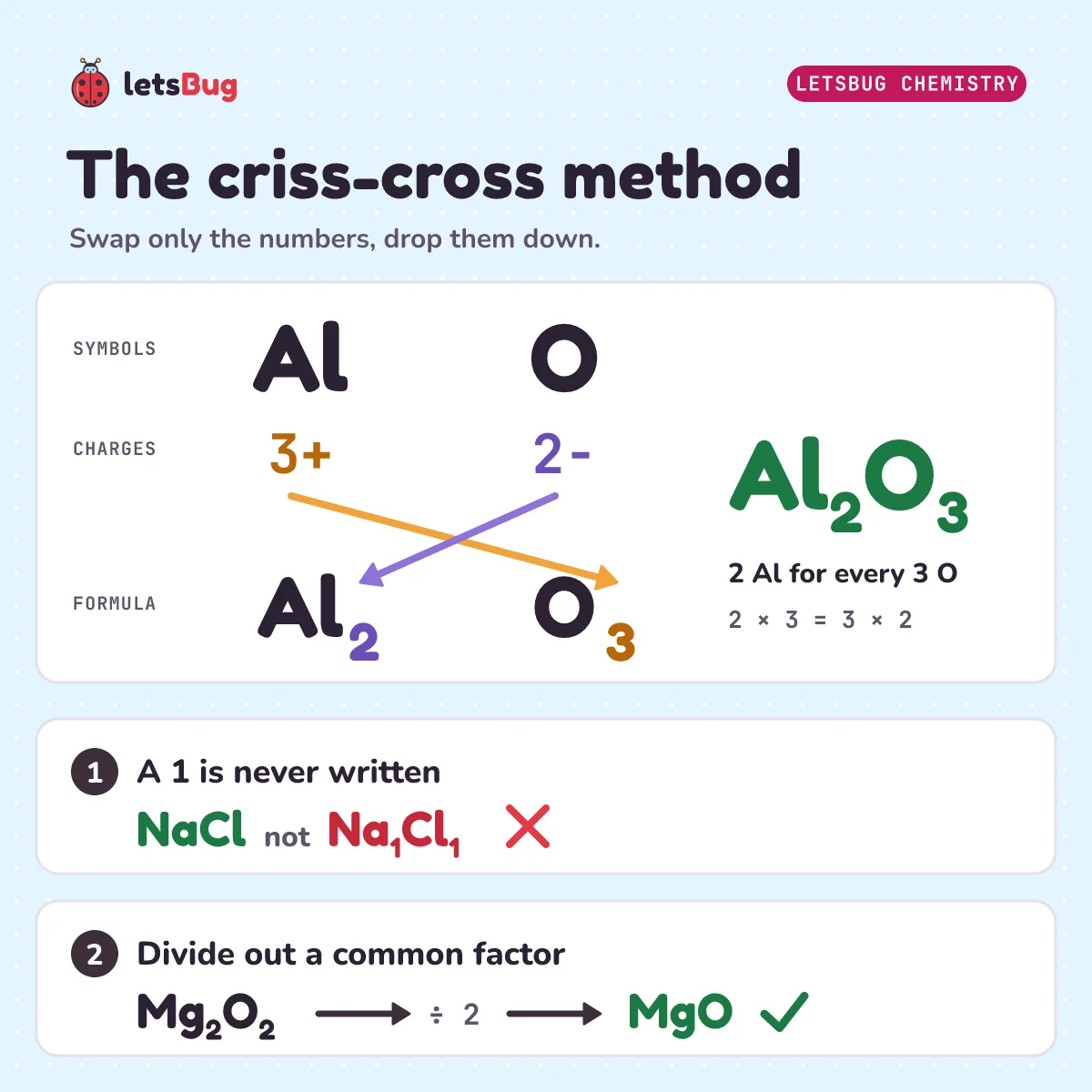
There's a faster way, the one NCERT teaches. NCERT's steps for an ionic compound are:
- "Write the symbol of the cation first, followed by the symbol of the anion." The positive ion goes first: Al, then O.
- "Write the charges under the symbols rather than as superscripts." (Superscripts are small raised numbers, like the 3+ in Al3+.) Under Al write 3+; under O write 2−.
- "Crossover the charges (only the numbers) as shown below to obtain the formula." Aluminium's 3 drops down after O. Oxygen's 2 drops down after Al. You get Al2O3.
Then two extra rules:
- A 1 is never written. NCERT: "If the valency is one after criss-crossing, it is not written." Sodium chloride is NaCl, not Na1Cl1. Calcium chloride (Ca2+, Cl−) crosses to Ca1Cl2, written CaCl2.
- Divide out a common factor. "The chemical formula gives the simplest ratio of the elements in a compound. Therefore, after criss-crossing, the subscripts are divided by a common factor, if any." Magnesium oxide (Mg2+, O2−) crosses to Mg2O2. Both numbers divide by 2, so it's written MgO.
Why does crossing work? Each ion gets the other ion's charge as its count. So aluminium's total is 2 × 3 = 6 and oxygen's total is 3 × 2 = 6. The two totals are always the same number, one positive and one negative, so they always cancel. It's the charge-balance rule with the sum done for you.
When do you need brackets in a chemical formula?
Some ions are groups of atoms that stay together and carry one charge between them. NCERT: "Some ions are formed by the combination of atoms of two or more elements, and are called polyatomic ions." (Poly means many.) Hydroxide, OH−, is one oxygen and one hydrogen with a charge of 1− shared by the pair. Sulfate, SO42−, is one sulfur and four oxygens with a charge of 2−.
Treat the whole group as one unit, and criss-cross as before. Aluminium hydroxide: Al3+ and OH− cross to one aluminium and three hydroxides. Because there's more than one hydroxide, the group goes in brackets: Al(OH)3. NCERT's rule: "We use brackets ( ) when we have two or more polyatomic ions of the same type in a formula." And its warning: "Formula of aluminium hydroxide is Al(OH)3, not AlOH3."
The brackets change what the formula means. Al(OH)3 has 1 aluminium, 3 oxygens and 3 hydrogens: three whole hydroxide groups. AlOH3 would mean 1 aluminium, 1 oxygen and 3 hydrogens, which isn't the same thing at all.
Aluminium hydroxide is in some medicines. Wikipedia's article says it's used as an antacid, under the name algeldrate. An antacid cancels out some stomach acid: "It reacts with excess acid in the stomach, reducing the acidity of the stomach content", which can ease heartburn.
Two more things to know about brackets:
- Only one group? No brackets. NCERT: "Brackets are not required when only one polyatomic anion is present." Calcium carbonate (Ca2+, CO32−) crosses to Ca2(CO3)2, divides by 2, and becomes CaCO3. Sodium hydroxide is NaOH.
- Positive groups get brackets too. Ammonium, NH4+, with sulfate, SO42−, needs two ammoniums: (NH4)2SO4.
Does valency work for covalent molecules?
Yes. In a molecule, atoms share electrons instead of passing them from one atom to another. AQA: "When atoms share pairs of electrons, they form covalent bonds." Here, valency is the number of covalent bonds an atom makes, which is the number of extra electrons it needs to fill its outer shell, which it gets by sharing:
- hydrogen and chlorine: 1
- oxygen and sulfur: 2
- nitrogen: 3
- carbon: 4
Cross them over the same way (no charges this time, just the valencies). NCERT's step: "Crossover the valencies of the combining atoms and write them as subscripts after the symbols of elements". Its examples are hydrogen chloride, HCl; hydrogen sulfide, H2S; and carbon tetrachloride, CCl4. In the same way, hydrogen (1) and oxygen (2) give H2O, water. Carbon (4) and hydrogen (1) give CH4, methane, which Wikipedia calls "the main constituent of natural gas" (constituent means part). Nitrogen (3) and hydrogen (1) give NH3, ammonia.
Now the trap. AQA's report on a June 2023 GCSE paper says this about question 08.2, where students had to write a formula by comparing with ammonia: "About three fifths of students were able to give a correct formula by analogy with ammonia. PH2 was a common incorrect response." By analogy means by comparing it with something you already know. Phosphorus (2,8,5) is in the same group as nitrogen (2,5): both have 5 outer electrons and need 3 more. So phosphorus has a valency of 3, like nitrogen, and the formula is PH3, just like NH3.
How do you explain a formula in an exam?
Writing the formula is one skill. Explaining it in words is another. On the same AQA paper, the answer to question 09.5 depended on the formulae of some metal nitrates. The report says: "The key to answering the question was in the formulae of the nitrates; aluminium forms an ion of charge 3+, so each ion requires three nitrate ions to balance the charge." Only "just over one in ten" students scored all three marks.
The common mistake was the wording: "Even when students got the basic idea, they often did not express themselves clearly enough, using phrases such as ‘aluminium has a 3+ charge’ rather than referring to an aluminium ion." An aluminium atom has no charge. It's the aluminium ion that has the charge.
So, to explain why aluminium nitrate is Al(NO3)3, say it in three steps:
- An aluminium ion has a charge of 3+.
- Each nitrate ion, NO3−, has a charge of 1−.
- So three nitrate ions are needed to balance the charge, and the compound has no overall charge.
Your turn. Work each one out before you open the answers.
1) Water treatment plants use aluminium sulfate to clean water before it reaches our taps. Wikipedia: "It causes suspended impurities to coagulate into larger particles and then settle to the bottom of the container (or be filtered out) more easily." (Suspended impurities are tiny bits of dirt floating in the water. Coagulate means clump together.) Aluminium ions are Al3+ and sulfate ions are SO42−. Write the formula of aluminium sulfate.
2) Write the formula of calcium chloride (Ca2+, Cl−).
3) Sodium forms Na+ and sulfur forms S2−. Write the formula of sodium sulfide and show that the charges balance.
Show the answers
1) Cross over: 2 aluminium ions, 3 sulfate ions. Sulfate is a group and there's more than one, so it needs brackets: Al2(SO4)3. Check: 2 × (+3) = +6 and 3 × (−2) = −6, total 0.
2) Ca2+ and Cl− cross to Ca1Cl2. Don't write the 1: CaCl2. Check: +2 + 2 × (−1) = 0.
3) Na2S. Check: 2 × (+1) + (−2) = 0.
Exam-style questions with model answers
The marks in brackets are our own guide, set out the way GCSE mark schemes split marks: B1 means one mark for that point. They aren't from a published mark scheme.
Q1 (1 mark). Write the formula of magnesium hydroxide. Magnesium ions are Mg2+ and hydroxide ions are OH−.
Model answer
Mg(OH)2 [B1]. The brackets are needed because there are two hydroxide ions. Check: +2 + 2 × (−1) = 0.
Q2 (1 mark). Iron(III) ions are Fe3+. Write the formula of iron(III) oxide.
Model answer
Fe2O3 [B1]. It's the same pattern as aluminium oxide: 2 × (+3) = +6 and 3 × (−2) = −6. NCERT calls the Fe3+ ion ferric, so this is also called ferric oxide.
Q3 (2 marks). A student writes the formula of calcium carbonate as Ca2(CO3)2. Explain what is wrong, and give the correct formula.
Model answer
A formula gives the simplest ratio of the ions, and both subscripts share a common factor of 2 [B1]. Divide by 2: CaCO3 [B1]. (No brackets: there's only one carbonate ion.)
Q4 (2 marks). Element X is in group 3 and element Y is in group 6. Predict the formula of the compound X forms with Y.
Model answer
X forms X3+ ions and Y forms Y2− ions (8 − 6 = 2) [B1]. Cross over: X2Y3 [B1]. Check: 2 × (+3) + 3 × (−2) = 0.
Q5 (1 mark). Phosphorus is in the same group as nitrogen. Ammonia is NH3. Write the formula of the compound of phosphorus and hydrogen.
Model answer
PH3 [B1]. Phosphorus has 5 outer electrons, like nitrogen, so it shares 3 to fill its outer shell. PH2 is wrong.
Q6 (3 marks). Aluminium nitrate is Al(NO3)3. Explain why it has three nitrate ions.
Model answer
(Our own question, built from the examiners' comment.) An aluminium ion has a charge of 3+ [B1]. Each nitrate ion has a charge of 1− [B1]. So three nitrate ions are needed to balance the charge, and the compound has no overall charge [B1]. Say "aluminium ion", not "aluminium has a 3+ charge".
Questions people ask
What is the formula of aluminium oxide?
Al2O3. Aluminium ions are Al3+ and oxide ions are O2−. Two aluminium ions (+6) and three oxide ions (−6) add up to zero.
Why is aluminium oxide not AlO?
One Al3+ and one O2− give (+3) + (−2) = +1. A compound has no overall charge, so AlO can't be right. You need 2 aluminium ions and 3 oxide ions.
What is valency in simple words?
Valency is an atom's combining power: how many electrons it loses, gains or shares to get a full outer shell. Sodium loses 1, so its valency is 1. Oxygen gains 2, so its valency is 2.
What is the valency of aluminium?
3. Aluminium is 2,8,3: it loses its 3 outer electrons to form the Al3+ ion.
What is the criss-cross method?
A shortcut for writing formulae. Write the symbols with their charges or valencies underneath, then swap only the numbers and write them as subscripts. Don't write a 1, and divide out any common factor.
When do you use brackets in a chemical formula?
When there are two or more of the same polyatomic ion, such as hydroxide or sulfate: Al(OH)3, Al2(SO4)3. With only one, no brackets: NaOH, CaCO3.
Is it MgO or Mg2O2?
MgO. Criss-crossing Mg2+ and O2− gives Mg2O2, but a formula shows the simplest ratio, so you divide both numbers by 2.
Keep going
- Watch the full lesson, Aluminium Oxide Formula: Why Al2O3, Not AlO? Valency Explained, or the Short: Criss-Cross Method: Why Aluminium Oxide Is Al2O3, Not AlO. More in letsBug Chemistry on YouTube.
- Where electron arrangements and groups come from: why are noble gases unreactive? (episode 2).
- Protons, electrons and charge: what is inside an atom? (episode 1).
- The episode before this one: why is chlorine's atomic mass 35.5? (episode 4, isotopes).
- Next episode, why those ions hold together so hard: why do ionic compounds have high melting points? (episode 6).
Checked on 31 October 2026 against the 10 sources below. Every charge sum, valency and practice answer in this post was worked out again in a Python script, and every quote was matched word for word with the source text.
Sources
- NCERT Class 9 Science, Exploration: Chapter 9, Atomic Foundations of Matter (9.4 how atoms combine, Table 9.1 common ions and valencies, 9.5 writing chemical formulae)
- AQA: GCSE Chemistry 8462 specification, bonding, structure and the properties of matter (4.2.1.2 ionic bonding, 4.2.1.4 covalent bonding)
- AQA: GCSE Chemistry 8462/1H, report on the examination, June 2023 (questions 08.2 and 09.5)
- Cambridge International: IGCSE Chemistry 0620 syllabus for 2026 to 2028 (3.1 Formulae)
- Wikipedia: Corundum (aluminium oxide, the Mohs scale minerals, watch crystals)
- Wikipedia: Sapphire (Mohs 9, sapphire glass for watches)
- Wikipedia: Aluminium oxide (corundum, just below diamond)
- Wikipedia: Aluminium hydroxide (algeldrate, antacid)
- Wikipedia: Aluminium sulfate (drinking water treatment)
- Wikipedia: Methane (natural gas)