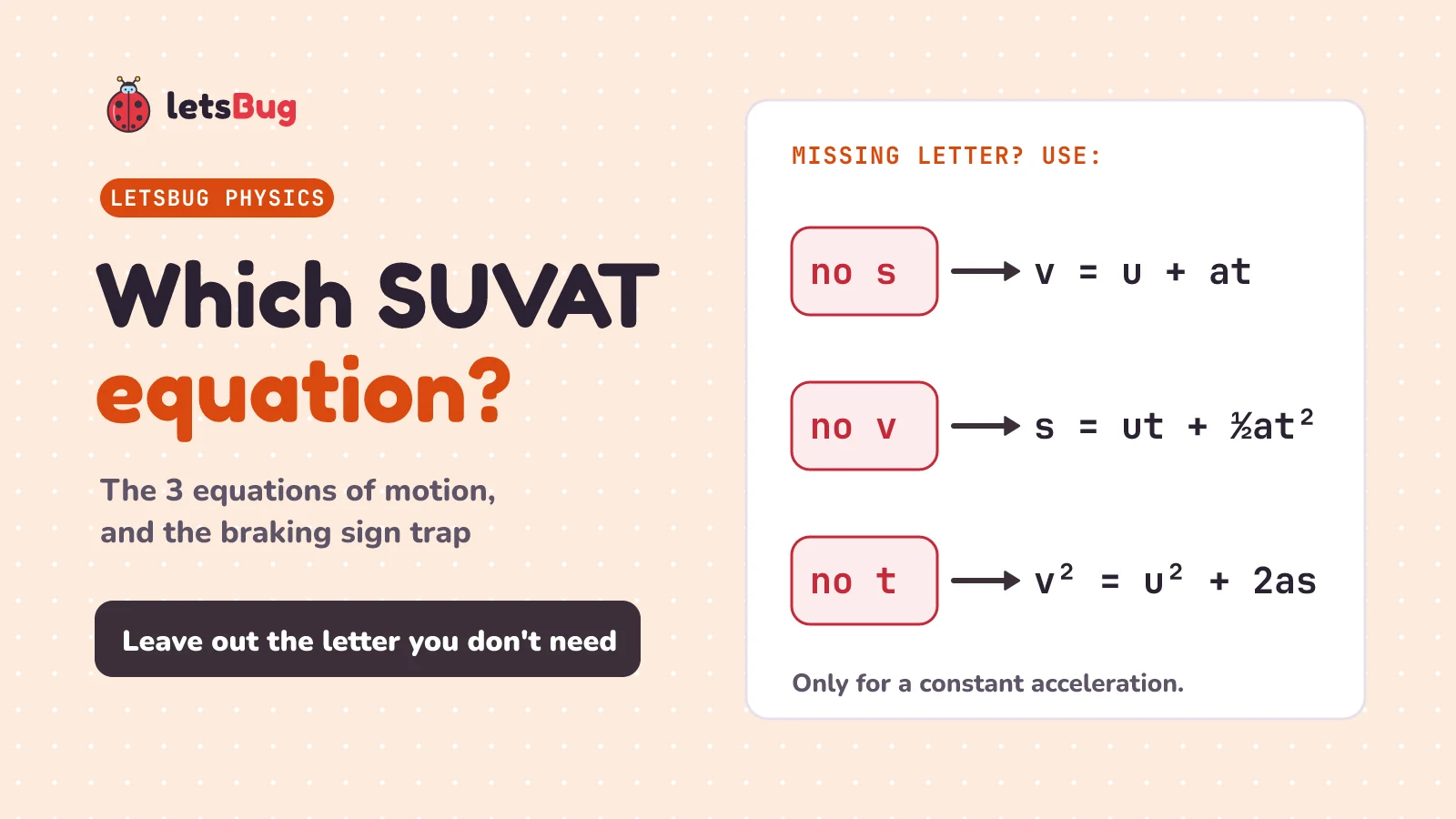
To pick a SUVAT equation, list s, u, v, a and t and fill in the three you know. The letter you don't know and don't need picks it: no s, use v = u + at; no v, use s = ut + ½at²; no t, use v² = u² + 2as. They only work for a constant acceleration.
In this post we name the five SUVAT letters in plain words, see where two of the equations come from on a velocity-time graph, and learn the one-step way to pick the right equation. Then we catch a very common mistake: a braking car put in with the wrong sign, which makes the maths say the car speeds up. We use real braking distances from the UK Highway Code, and finish with practice and exam-style questions with model answers.
Key takeaways
- s, u, v, a, t are displacement, starting velocity, final velocity, acceleration and time. Put everything in metres and seconds before you use them.
- The three equations: v = u + at, s = ut + ½at² and v² = u² + 2as. They only work when the acceleration is constant.
- Pick by the missing letter. Three letters you know, one you want, one left out. Use the equation that leaves that one out (it's usually s, v or t).
- Braking means a negative acceleration. Choose the direction of motion as positive. "A deceleration (slowing down) of 6.4 m/s²" goes in as a = −6.4 m/s².
- Re-read your answer. Braking must make the speed go down, and a braking distance can't come out negative. If it does, check the sign.
This post goes with letsBug Physics, episode 5. The equations of motion are in CBSE Class 9 Science (the new Exploration textbook, Chapter 4, Describing Motion Around Us) and ICSE Class 9 Physics (Chapter 2, Motion in One Dimension). They're also called the SUVAT equations, after their five letters. Watch the lesson, or read on: the post adds where v² = u² + 2as comes from, what the Highway Code's numbers tell us, and more questions with full answers.
What do s, u, v, a and t stand for?
Every equation of motion uses the same five quantities. Their letters give the equations their nickname: SUVAT.
| Letter | What it means | Unit |
|---|---|---|
| s | Displacement: how far the object ends up from where it started, in a set direction | m |
| u | Initial velocity: the velocity at the start | m/s |
| v | Final velocity: the velocity at the end | m/s |
| a | Acceleration: how much the velocity changes every second | m/s² |
| t | Time | s |
Velocity is speed in a set direction. That's why displacement and velocity can be negative: a minus sign means "the other way". (For more on this, see distance vs displacement.) For a car that goes one way and never turns back, the displacement is the same as the distance.
The unit m/s² reads "metres per second, every second". An acceleration of 2 m/s² means the velocity goes up by 2 m/s each second.
Units first
Put every value in metres and seconds before you substitute (put the numbers into the equation). Speeds often come in miles per hour. One mile is 1609.344 m and one hour is 3600 s, so 30 mph = 30 × 1609.344 ÷ 3600 ≈ 13.4 m/s.
One rule: the acceleration must be constant
Constant means the acceleration doesn't change: the velocity goes up (or down) by the same amount every second. OpenStax says it plainly: "The kinematic equations are applicable when you have constant acceleration." (Kinematic means "about motion".) A sprinter who speeds up fast at the start and then holds a steady speed doesn't have a constant acceleration, so the equations don't fit the whole race.
What are the three equations of motion?
Here they are, with when each one is useful:
- v = u + at: the final velocity after time t. It has no s.
- s = ut + ½at²: the displacement after time t. It has no v.
- v² = u² + 2as: links the speeds and the displacement. It has no t.
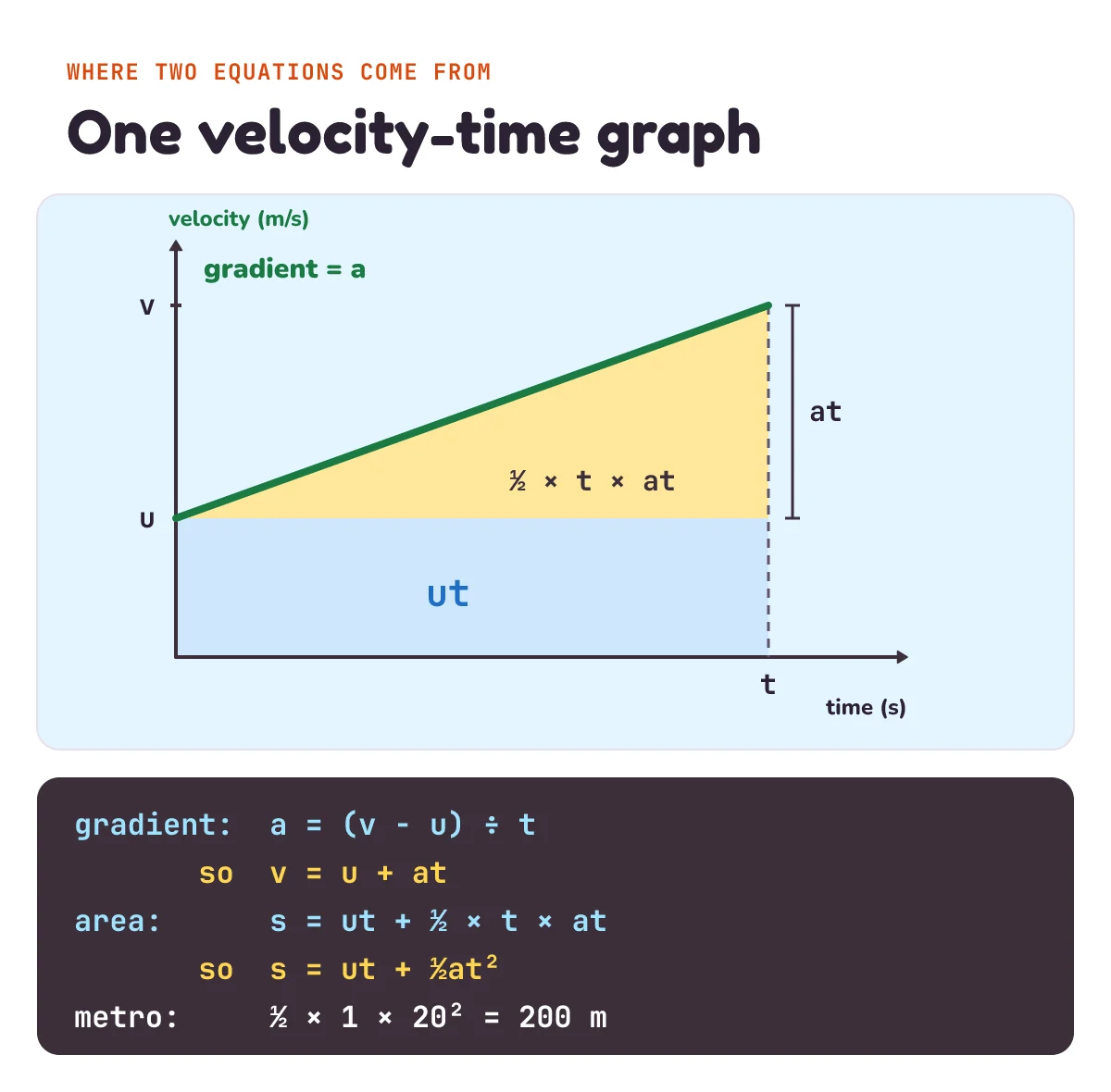
You don't have to learn them as three random lines. Two of them come straight from a velocity-time graph, which we met in how to read distance-time and velocity-time graphs.
Where does v = u + at come from?
The gradient (how steep the line is) of a velocity-time graph is the acceleration: the change in velocity divided by the time. So a = (v − u) ÷ t. Multiply both sides by t and add u: v = u + at. In words, OpenStax says the "velocity at any point equals initial velocity plus acceleration multiplied by time".
Example: a metro train starts from rest (u = 0) and speeds up at 1 m/s² for 20 s. Then v = 0 + 1 × 20 = 20 m/s.
Where does s = ut + ½at² come from?
The area under a velocity-time graph is the displacement. Split it into two shapes:
- A rectangle under the starting velocity: u × t = ut.
- A triangle on top. Its height is the velocity gained, at, so its area is ½ × t × at = ½at².
Add them: s = ut + ½at². For the metro train: s = 0 × 20 + ½ × 1 × 20² = 200 m. That's exactly the triangle under its graph.
Where does v² = u² + 2as come from?
It comes from the other two, with t taken out. The time is t = (v − u) ÷ a. With a constant acceleration, the average velocity is halfway between u and v, so s = (u + v) ÷ 2 × t. Put the time in: s = (u + v)(v − u) ÷ (2a). Multiply both sides by 2a: 2as = (u + v)(v − u) = v² − u², so v² = u² + 2as.
That's why it's the one to use when a question never mentions time. OpenStax picks it for that reason: "it gives the velocity from acceleration and displacement, without involving the time."
Which SUVAT equation should you use?
Don't guess. Do this instead:
- Write s, u, v, a, t down the side of your page.
- Fill in the three values the question gives you.
- Mark the one you're asked for with a question mark.
- One letter is left: the one you don't know and don't need. Use the equation without it.
| Letter you don't need | Equation to use |
|---|---|
| s | v = u + at |
| v | s = ut + ½at² |
| t | v² = u² + 2as |
Three letters you know, one you want, one left out. One catch: u and a are in all three equations. If the letter you don't need is a, find a first with one equation and then use another, or use s = (u + v) ÷ 2 × t from the working above.
Why is braking a negative acceleration?
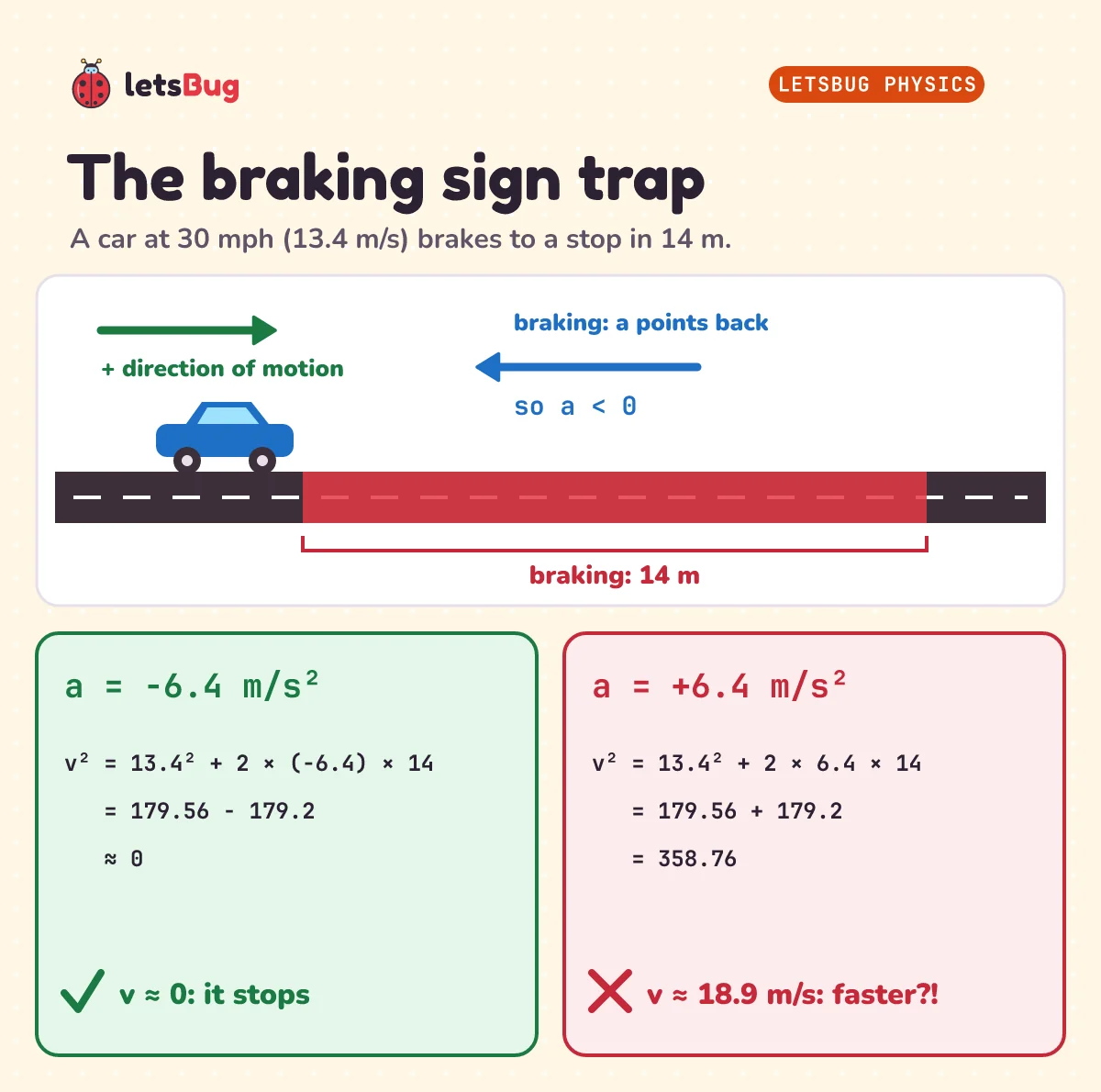
Let's start with a mistake. The UK Highway Code says a car at 30 mph needs about 14 m of braking distance to stop (the distance it travels after the brakes go on). From that, a student works out the car's deceleration (how fast it slows down): about 6.4 m/s². Then they put it into v² = u² + 2as as plus 6.4:
v² = 13.4² + 2 × 6.4 × 14 = 179.56 + 179.2 = 358.76, so v ≈ 18.9 m/s.
The car comes out of the braking zone at 18.9 m/s, faster than the 13.4 m/s it went in. Braking doesn't do that. The sign is wrong.
Here's how to get the sign right every time:
- Choose a positive direction. Use the way the car is moving.
- The car is slowing down, so its acceleration points the other way: backwards. That makes a negative.
- List the values: u = 13.4 m/s, v = 0 (it stops), s = 14 m. There's no t, so use v² = u² + 2as.
- 0 = 13.4² + 2 × a × 14, so a = −179.56 ÷ 28 ≈ −6.4 m/s².
So "a deceleration of 6.4 m/s²" means a = −6.4 m/s². ICSE Physics calls it retardation. The Selina solutions on IndCareer say "Retardation is the decrease in velocity per second", and "Thus, retardation is negative acceleration". OpenStax uses the same sign idea for gravity: when up is positive, gravity's acceleration is negative, and "it is usually given a negative sign because the acceleration due to gravity is downward."
(With a = −6.4 exactly, v² = 179.56 − 179.2 = 0.36, not quite 0, only because −6.41 was rounded to −6.4. The Highway Code doesn't give a deceleration. The 6.4 m/s² is worked out from its figures, which it calls "a general guide". Real braking isn't perfectly steady, so treat 6.4 m/s² as a typical value.)
How do you work out braking distance?
An exam-style question (3 marks, our estimate): A car travelling at 20 m/s brakes with a deceleration of 5 m/s². Calculate its braking distance.
A common wrong answer puts a = +5: 0 = 20² + 2 × 5 × s, so s = −400 ÷ 10 = −40 m. A negative distance, going backwards while braking forwards? That's the sign mistake showing itself. If you see it, go back and check the sign of a.
A full-mark answer has three steps:
- List the values: u = 20 m/s, v = 0, a = −5 m/s² (braking, so negative). [1]
- There's no t, so use v² = u² + 2as: 0 = 20² + 2 × (−5) × s. [1]
- Solve: 10s = 400, so s = 400 ÷ 10 = 40 m. [1]
Why does double the speed mean four times the braking distance?
Look at v² = u² + 2as for a car braking to a stop. With v = 0, the braking distance is s = u² ÷ (2 × the size of the deceleration). The speed is squared. So if the braking stays the same, double the speed gives 2² = 4 times the braking distance.
The Highway Code's chart shows it. At 30 mph the braking distance is 14 m. At 60 mph, double the speed, it's 55 m, not 28 m. The v² rule predicts 4 × 14 = 56 m: very close to the Highway Code's 55 m (and 55 ÷ 14 ≈ 3.9).
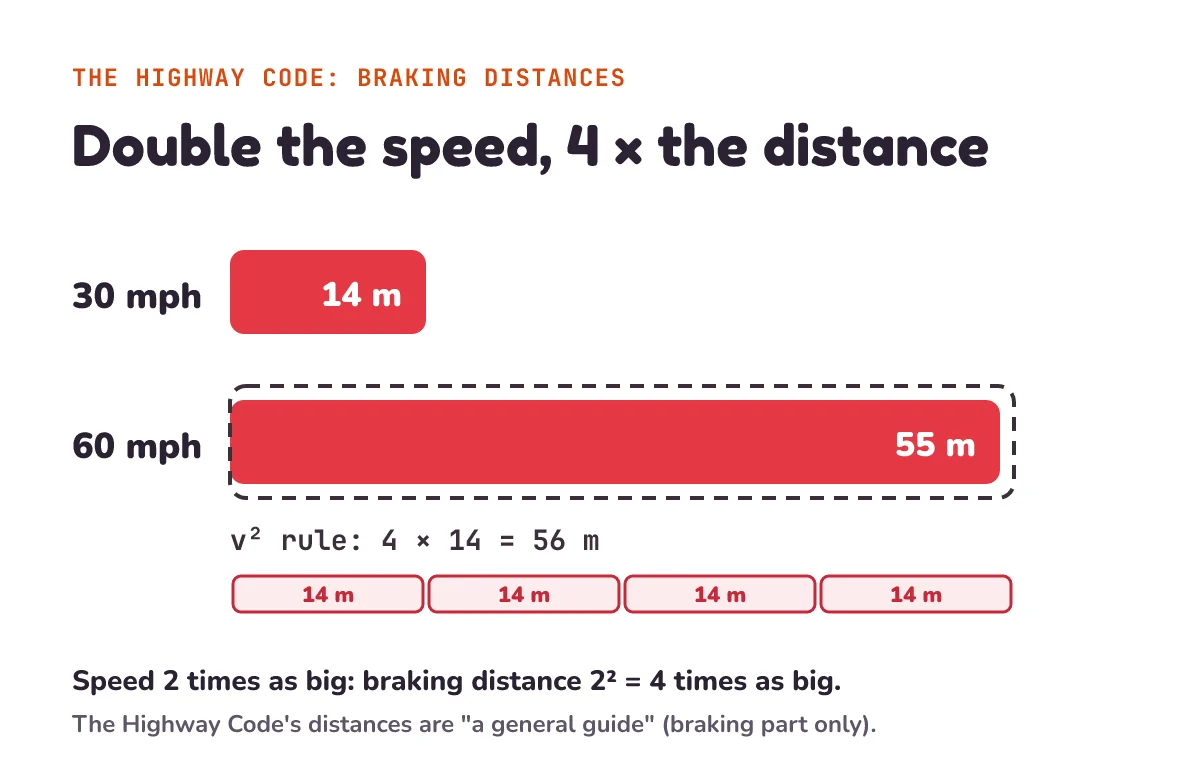
That's why speed matters so much on the road. Rule 126 of the Highway Code says: "Drive at a speed that will allow you to stop well within the distance you can see to be clear." A small rise in speed makes a much bigger rise in the distance you need to stop.
Your turn. Write s, u, v, a, t down the side first, then pick the equation.
1) A cyclist at 8 m/s brakes steadily and stops in 4 s. Find her acceleration and her stopping distance.
2) A train speeds up steadily from 5 m/s to 25 m/s over 300 m. Find its acceleration.
3) A bus at 15 m/s brakes with a deceleration of 3 m/s². How long does it take to stop, and how far does it travel while braking?
Show the answers
1) u = 8, v = 0, t = 4, no s. v = u + at: 0 = 8 + 4a, so a = −2 m/s² (negative, because she's braking). Now the distance, with no v: s = ut + ½at² = 8 × 4 + ½ × (−2) × 4² = 32 − 16 = 16 m. If you got 48 m, you dropped the minus sign.
2) u = 5, v = 25, s = 300, no t. v² = u² + 2as: 25² = 5² + 2 × a × 300, so 625 − 25 = 600a and a = 1 m/s².
3) u = 15, v = 0, a = −3. Time, with no s: 0 = 15 − 3t, so t = 5 s. Distance, with no t: 0 = 15² + 2 × (−3) × s, so s = 225 ÷ 6 = 37.5 m. Check with s = ut + ½at²: 15 × 5 − ½ × 3 × 5² = 75 − 37.5 = 37.5 m.
Exam-style questions with model answers
The marks in brackets are our estimate: one mark for each correct step or idea.
Q1 (1 mark). Which equation of motion does not involve time?
Model answer
v² = u² + 2as [1].
Q2 (2 marks). A car at 13.4 m/s brakes to rest in 14 m. A student uses a = +6.4 m/s² and finds the car leaves the braking zone at 18.9 m/s. Explain the mistake.
Model answer
Taking the direction of motion as positive, the braking acceleration points backwards, so it must be negative: a = −6.4 m/s² [1]. With the right sign, v² = 179.56 − 179.2 ≈ 0 (not exactly 0 only because a was rounded), so the car stops; a final speed bigger than the starting speed can't be right for braking [1].
Q3 (3 marks). A ball rolls from rest down a slope with a constant acceleration of 0.5 m/s² for 6 s. Calculate (a) its final velocity and (b) the distance it rolls.
Model answer
(a) v = u + at = 0 + 0.5 × 6 = 3 m/s [1].
(b) s = ut + ½at² = 0 + ½ × 0.5 × 6² [1] = 9 m [1].
Q4 (4 marks). A train travelling at 25 m/s brakes steadily and stops in 500 m. Calculate (a) its deceleration and (b) the time it takes to stop.
Model answer
(a) No t, so v² = u² + 2as: 0 = 25² + 2 × a × 500 [1], so a = −625 ÷ 1000 = −0.625 m/s², a deceleration of 0.625 m/s² [1].
(b) v = u + at: 0 = 25 − 0.625t [1], so t = 25 ÷ 0.625 = 40 s [1].
Questions people ask
What does SUVAT stand for?
The five quantities in the equations of motion: s = displacement (m), u = initial velocity (m/s), v = final velocity (m/s), a = acceleration (m/s²) and t = time (s).
How do you know which SUVAT equation to use?
Write down the five letters and fill in the three you know. The letter you don't know and don't need picks the equation: no s, use v = u + at; no v, use s = ut + ½at²; no t, use v² = u² + 2as. If it's a, use s = (u + v) ÷ 2 × t.
Is deceleration negative in SUVAT?
Yes, if you take the direction of motion as positive. A deceleration of 5 m/s² goes into the equations as a = −5 m/s². Using +5 gives answers like a car speeding up while braking, or a negative braking distance.
Which SUVAT equation has no time in it?
v² = u² + 2as. Use it when the question gives speeds and a distance but never mentions time, such as a braking distance.
When can't you use the SUVAT equations?
When the acceleration changes. The equations only work for a constant acceleration. For a changing one, use the gradient and the area of a velocity-time graph instead.
Why does doubling the speed quadruple the braking distance?
For a car braking to a stop, v² = u² + 2as gives a braking distance that grows with the speed squared. Double the speed and the distance goes up 2² = 4 times. The Highway Code gives 14 m at 30 mph and 55 m at 60 mph.
Keep going
- Watch the full lesson, Which SUVAT Equation to Use? 3 Equations of Motion, and its Short, Braking Distance: How a Plus Sign Makes the Car Speed Up. More in letsBug Physics on YouTube.
- The episode before this one, where the gradient and the area come from: how to read distance-time and velocity-time graphs.
- Why displacement and velocity have a direction (and a sign): distance vs displacement, and how displacement can be zero.
- What makes an object accelerate in the first place: Newton's second law examples in everyday life.
Checked on 27 October 2026 against the 5 sources below. Every speed, acceleration, distance and practice answer in this post was worked out again in a Python script, and every quote was matched word for word with the source text.
Sources
- GOV.UK, The Highway Code: Typical stopping distances (PDF) (braking distances 14 m at 30 mph and 55 m at 60 mph, "a general guide")
- GOV.UK, The Highway Code: rules 103 to 158 (rule 126, stopping distances)
- OpenStax Physics: 3.2 Representing acceleration with equations and graphs (the kinematic equations, constant acceleration, signs)
- Tiwari Academy: NCERT Class 9 Science Exploration, Chapter 4 (what the chapter covers: the three kinematic equations)
- IndCareer: Selina Class 9 ICSE Physics, Chapter 2, Motion in One Dimension (the three equations, retardation)