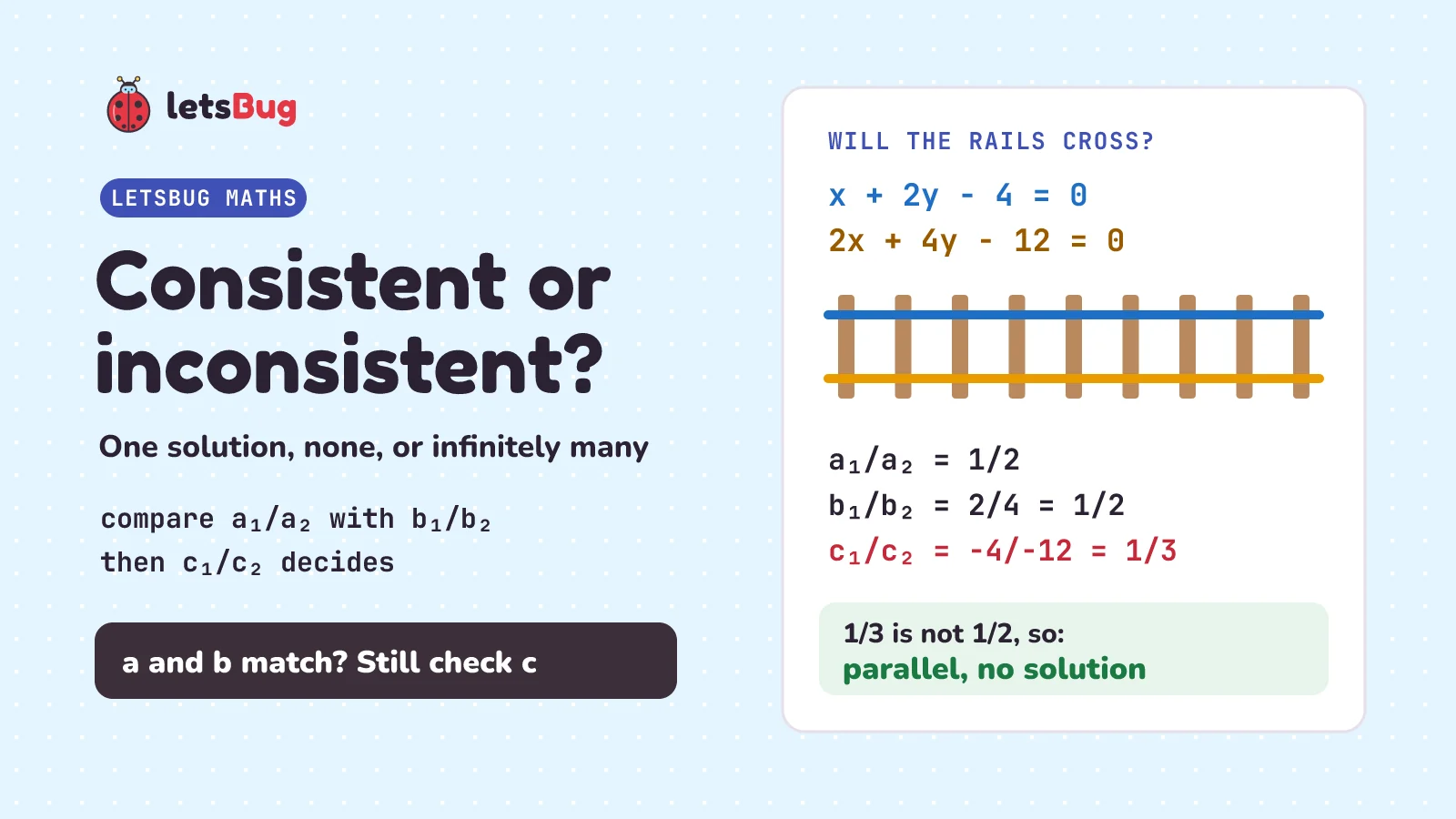
A pair of linear (straight-line) equations is consistent if it has at least one solution, and inconsistent if it has none. Compare a₁/a₂ with b₁/b₂. If they differ, the lines cross: one solution. If equal, compare c₁/c₂. Equal again: the same line, infinitely many (endless) solutions. Different: parallel lines that never meet, no solution.
In this post we answer the pencils-and-erasers question from episode 8, then see why railway rails are a picture of "no solution". We learn the ratio test (a quick check with three fractions) and catch a common slip: calling parallel lines the same line because a and b match. Then we see why the test works, find a missing number k step by step, and compare two phone plans. Every hard word is explained where it first comes up. The video's practice questions are answered in full, and exam-style questions with model answers are at the end.
Key takeaways
- Two straight lines can do only three things. Cross at one point (one solution), be parallel (no solution), or lie on top of each other (infinitely many solutions).
- Consistent means at least one solution. Inconsistent means no solution at all. Lines on top of each other are still consistent.
- Compare a₁/a₂ with b₁/b₂ first. Different: the lines cross. Only if they are equal do you look at c₁/c₂.
- Matching a and b is not enough. For x + 2y − 4 = 0 and 2x + 4y − 12 = 0, a and b give 1/2 but c gives 1/3. Parallel: no solution.
- Substitution agrees. (That's putting one equation into the other.) A false statement like −4 = 0 means no solution. An always-true statement like 18 = 18 means infinitely many.
- For "find k" questions, check the third ratio. Infinitely many solutions need all three ratios equal.
This post goes with letsBug Maths, episode 9. In episode 8, simultaneous equations, every pair had exactly one answer. This time we look at the pairs that don't. The topic is on the CBSE Class 10 syllabus (the list of what an exam can test) as "consistency/inconsistency", along with "Algebraic conditions for number of solutions". NCERT's Class 10 book covers it in Chapter 3, Pair of Linear Equations in Two Variables. Variables are letters, like x and y, that stand for numbers. Watch the lesson, or read on. The post adds a shortcut for lines with a zero in them, why no k can give "no solution" in the k example, and full working for every answer.
How many answers can two equations have?
One, none, or infinitely many. Infinitely many means there is no end to them: however many you list, there are always more.
Episode 8 ended with a question from NCERT: 2 pencils and 3 erasers cost ₹9, and 4 pencils and 6 erasers cost ₹18. How much is each? Let x be the price of a pencil and y the price of an eraser, in rupees:
- (1) 2x + 3y = 9
- (2) 4x + 6y = 18
Look closely. Double every term (every part) of (1) and you get 4x + 6y = 18, which is exactly (2). The second equation tells us nothing new. So lots of prices fit. A pencil at ₹3 and an eraser at ₹1 works: 6 + 3 = 9. So does a pencil at ₹1.50 and an eraser at ₹2: 3 + 6 = 9. NCERT says: "We cannot find a unique cost of a pencil and an eraser, because there are many common solutions". Unique means only one.
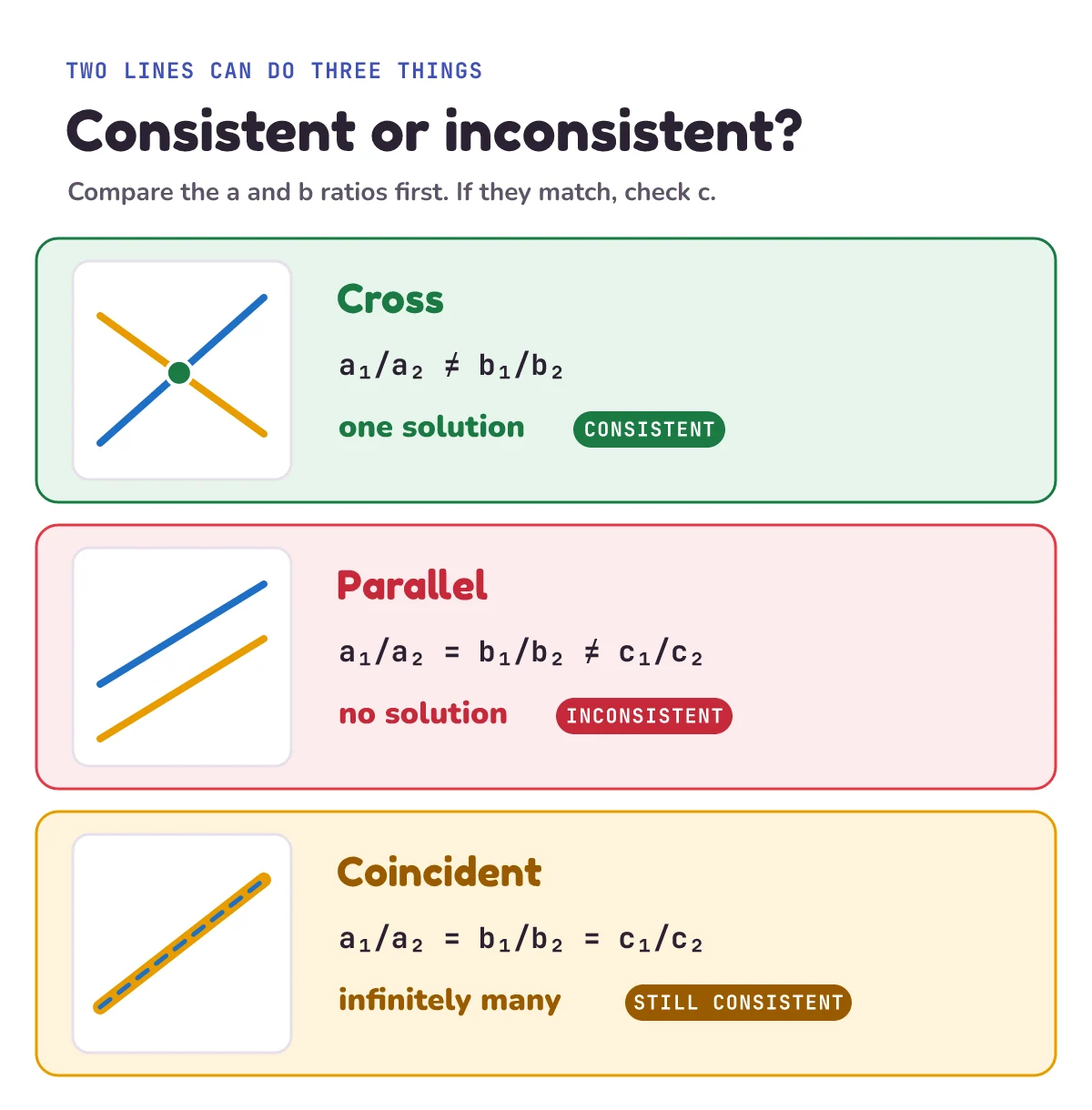
So two equations don't always give just one answer. On a graph, each linear equation is a straight line (that's what linear means). A solution of the pair is a point that is on both lines. Two straight lines can only do three things:
- Cross at one point: exactly one solution.
- Be parallel: always the same distance apart, never closer, so they never meet. No point is on both lines: no solution.
- Be coincident: lying exactly on top of each other, like the pencils. Every point on one line is on the other: infinitely many solutions.
What do consistent and inconsistent mean?
These are the words NCERT uses for has an answer and has no answer:
- Consistent means the pair has at least one solution. In NCERT's words: "A pair of linear equations in two variables, which has a solution, is called a consistent pair of linear equations."
- Inconsistent means the pair has no solution: "A pair of linear equations which has no solution, is called an inconsistent pair of linear equations."
Here is the word trap. Coincident lines have infinitely many solutions, so they are consistent, not inconsistent. NCERT calls such a pair dependent: one equation is just the other one multiplied by a number. It adds: "Note that a dependent pair of linear equations is always consistent." So crossing lines and coincident lines are both consistent. Only parallel lines are inconsistent.
| Lines | Solutions | Name |
|---|---|---|
| Cross | Exactly one | Consistent |
| Coincident | Infinitely many | Consistent (dependent) |
| Parallel | None | Inconsistent |
What is the a₁/a₂, b₁/b₂, c₁/c₂ ratio test?
Drawing two graphs takes time. The ratio test tells you which of the three cases you have, with no graph. A ratio here is one number over another, written as a fraction.
First write both equations in the form ax + by + c = 0, with everything on the left. The numbers a and b in front of x and y are called coefficients, and c is the number on its own. Number them 1 and 2 for the first and second equation:
- a₁x + b₁y + c₁ = 0
- a₂x + b₂y + c₂ = 0
Then compare three ratios: a₁/a₂, b₁/b₂ and c₁/c₂. NCERT's Table 3.1 gives the rule:
| The ratios | The lines | Solutions |
|---|---|---|
| a₁/a₂ ≠ b₁/b₂ | Cross | Exactly one |
| a₁/a₂ = b₁/b₂ = c₁/c₂ | Coincident | Infinitely many |
| a₁/a₂ = b₁/b₂ ≠ c₁/c₂ | Parallel | None |
The sign ≠ means is not equal to. NCERT notes the rule works both ways: "In fact, the converse is also true for any pair of lines." The converse is the rule turned around, so if you know the lines are parallel, you also know the ratios follow the third row.
Try it on the pencils. Written as ax + by + c = 0 they are 2x + 3y − 9 = 0 and 4x + 6y − 18 = 0. So a₁/a₂ = 2/4 = 1/2, b₁/b₂ = 3/6 = 1/2 and c₁/c₂ = −9/−18 = 1/2. All three are equal: coincident, infinitely many solutions.
Why do parallel lines have no solution?
Because a solution is a point on both lines, and parallel lines share no point. Railway track is the everyday picture. Wikipedia's page on 5 ft 6 in gauge railways says: "Indian Railways today predominantly operates on 1,676 mm (5 ft 6 in) broad gauge." The gauge is the gap between the two rails, and predominantly means mostly. On a straight stretch, that gap stays the same, so the rails never get closer and never meet. They are a picture of parallel lines.
NCERT turns this into an example: "Two rails are represented by the equations x + 2y − 4 = 0 and 2x + 4y − 12 = 0. Will the rails cross each other?" This is where people slip.
- a₁/a₂ = 1/2.
- b₁/b₂ = 2/4 = 1/2. The first two match.
- It is tempting to stop here and say coincident, infinitely many. That's the mix-up. You haven't looked at c yet.
- c₁/c₂ = −4/−12 = 1/3. That is not 1/2.
- So a₁/a₂ = b₁/b₂ ≠ c₁/c₂. The lines are parallel: no solution. The pair is inconsistent.
Check it by substitution (putting one equation into the other), as in episode 8. From the first equation, x = 4 − 2y. Put that in place of x in the second: 2(4 − 2y) + 4y − 12 = 0. Multiply out: 8 − 4y + 4y − 12 = 0. The y terms cancel and you are left with −4 = 0. That is false. No values of x and y can make it true, so no point fits both equations. NCERT's answer: "So, the two rails will not cross each other."
When the letters vanish and only numbers are left, substitution did not go wrong. It is telling you something. NCERT puts it like this: "If this statement is true, you can conclude that the pair of linear equations has infinitely many solutions. If the statement is false, then the pair of linear equations is inconsistent." For the pencils, x = (9 − 3y)/2 put into 4x + 6y = 18 gives 2(9 − 3y) + 6y = 18, so 18 − 6y + 6y = 18, and 18 = 18: always true, infinitely many.
Why does the ratio test work?
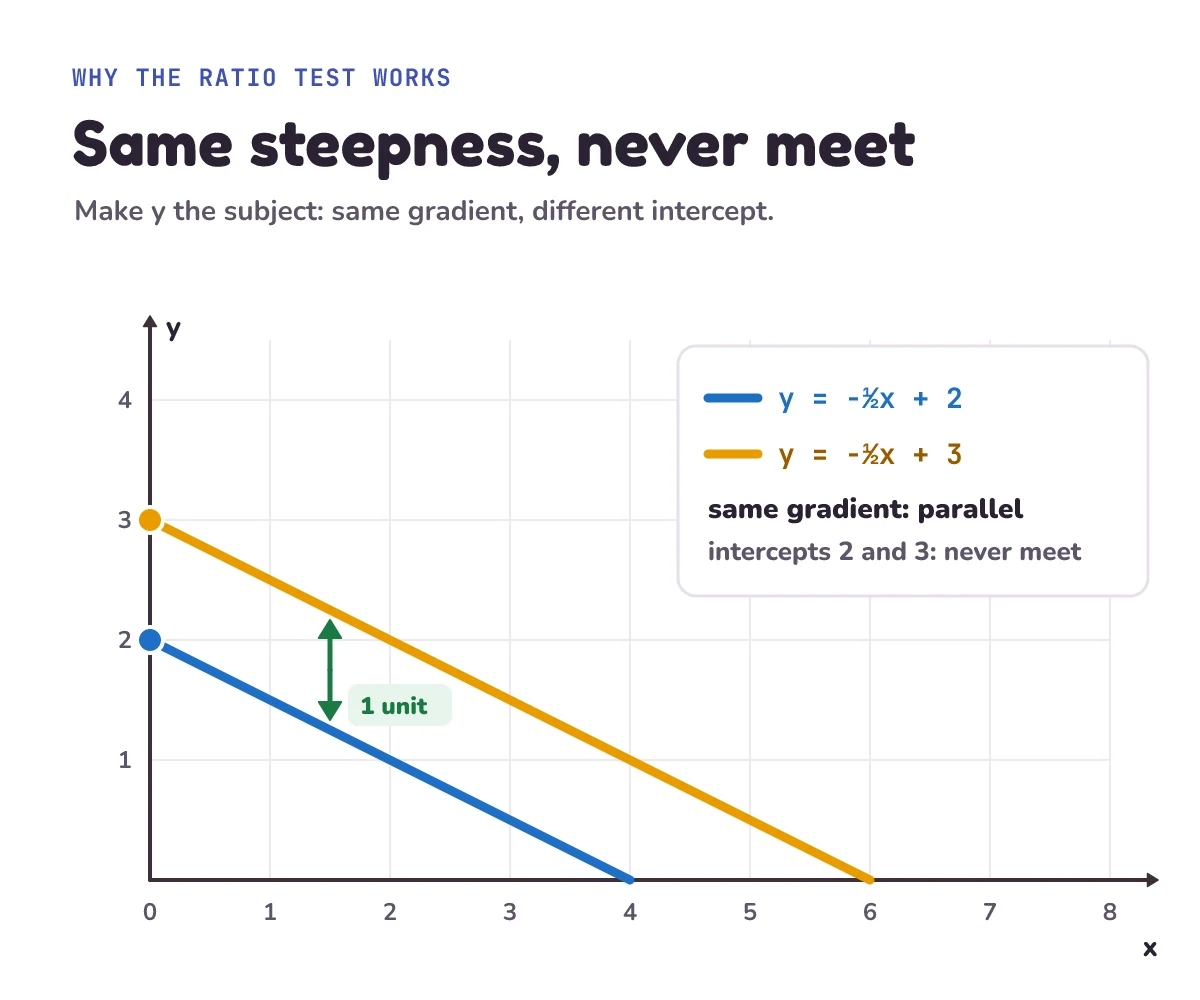
Rearrange each equation to make y the subject (y on its own on the left), as in y = mx + c. The gradient m is how steep the line is. The intercept is where the line crosses the y-axis, the up-and-down axis.
- Rail 1: x + 2y − 4 = 0 gives 2y = −x + 4, so y = −½x + 2.
- Rail 2: 2x + 4y − 12 = 0 gives 4y = −2x + 12, so y = −½x + 3.
Same gradient, −½, so the lines are equally steep: parallel. Different intercepts, 2 and 3, so they are not the same line. At every x, rail 2 is exactly 1 unit higher than rail 1, so they never meet.
This works for any pair. Rearranging a₁x + b₁y + c₁ = 0 gives a gradient of −a₁/b₁. When a₁/a₂ = b₁/b₂, it is also true that a₁/b₁ = a₂/b₂, so the gradients −a₁/b₁ and −a₂/b₂ are equal and the lines are equally steep. Then c decides. If c₁/c₂ is the same ratio too, the whole second equation is the first one multiplied by a number, so it is the same line. If c₁/c₂ is different, the intercepts are different, and the lines are parallel. For the pencils, both equations become y = −(2/3)x + 3: same gradient, same intercept, one line drawn twice.
One small note on the picture. The 1 unit is the gap measured straight up. Measured the shortest way, at right angles to the rails, the gap is a little less, about 0.89 units. Either way, it never changes.
How do you find the number of solutions without a graph?
Put it together as two steps. The video calls this the ten-second test:
- Compare a₁/a₂ with b₁/b₂. If they are different, stop. The lines cross, there is exactly one solution, and the pair is consistent.
- If they are equal, compare c₁/c₂. Equal again: coincident lines, infinitely many solutions, consistent (dependent). Different: parallel lines, no solution, inconsistent.
Two tips. First, it doesn't matter whether you write ax + by + c = 0 or ax + by = c, as long as you write both equations the same way. Moving c to the other side changes the sign of both c₁ and c₂, and the ratio stays the same: −4/−12 and 4/12 are both 1/3.
Second, the ratios break when a₂, b₂ or c₂ is zero, because you can't divide by zero. Take y = 2 and y = 5 (no x at all, so a₁ = a₂ = 0, and a₁/a₂ would be 0/0). Instead, use the cross-multiplied form. Multiplying both sides of a₁/a₂ = b₁/b₂ by a₂b₂ gives a₁b₂ = a₂b₁, which has no division. The lines are equally steep when it is true. Here 0 × 1 = 0 × 1, so they are equally steep. Flat lines at heights 2 and 5 are parallel: no solution. If a₁b₂ ≠ a₂b₁, the lines cross.
How do you find k for infinitely many solutions?
For what value of k does the pair 2x + 3y = 7 and (k − 1)x + (k + 2)y = 3k have infinitely many solutions? Let's say it clearly, step by step.
- Infinitely many means coincident, so all three ratios are equal.
- Write them: 2/(k − 1) = 3/(k + 2) = 7/(3k).
- Take the first two and cross-multiply (multiply each top number by the other bottom number): 2(k + 2) = 3(k − 1), so 2k + 4 = 3k − 3, and k = 7.
- Check the third ratio with k = 7: 2/6 = 1/3, 3/9 = 1/3, and 7/21 = 1/3. All equal.
- Answer: k = 7. The second equation becomes 6x + 9y = 21, which is the first one times 3.
Step 4 is the easy one to skip. Without it, you have only shown the lines are equally steep. That fits parallel lines too.
What about no solution for this pair? You would need the first two ratios equal and the third different. But the first two are equal only when k = 7, and then the third matches too. So no value of k gives no solution here. There is a neat reason. Put x = 2 and y = 1 into the second equation: (k − 1) × 2 + (k + 2) × 1 = 2k − 2 + k + 2 = 3k. That is true for every k. The first equation also fits, since 2 × 2 + 3 × 1 = 7. So every line you get from a value of k passes through the point (2, 1), and two lines through the same point can never be parallel.
When do two phone plans cost the same?
Here is a made-up example with simple prices. Say plan P costs ₹100 a month plus ₹10 per gigabyte (GB) of data, and plan Q costs ₹150 a month plus ₹10 per GB. Let x be the GB used and y the cost in rupees:
- P: y = 10x + 100, or 10x − y + 100 = 0
- Q: y = 10x + 150, or 10x − y + 150 = 0
The ratios: a₁/a₂ = 10/10 = 1, b₁/b₂ = −1/−1 = 1, and c₁/c₂ = 100/150 = 2/3. The first two match and the third doesn't: parallel. The plans never cost the same. Plan Q is always ₹50 more, whatever you use: ₹150 against ₹200 at 5 GB, ₹200 against ₹250 at 10 GB. The price per GB is the gradient, and both plans have the same one.
Now a friend writes plan P as 2y = 20x + 200. As ax + by + c = 0, that's 20x − 2y + 200 = 0. Compare it with 10x − y + 100 = 0: 10/20 = 1/2, −1/−2 = 1/2 and 100/200 = 1/2. All three match: coincident. It isn't a new plan, just plan P doubled. Price plans like these work like the taxi meter in equations from word problems: a fixed charge plus a price per unit. Write each one as an equation first.
Your turn. These are the practice questions from the video, plus its change-one-thing challenge and its pause-and-try question. Try each one before you open the answers.
1) For what value of k do x + 2y = 4 and 3x + ky = 12 have infinitely many solutions?
2) Are 3x − y = 5 and 6x − 2y = 7 consistent or inconsistent?
3) Change one thing: in x + 2y − 4 = 0 and 2x + 4y − 12 = 0, change ONE number so the two rails become one line. Which number, and what does it become?
4) Plan P costs ₹100 plus ₹10 per GB, and plan Q costs ₹150 plus ₹10 per GB. When do they cost the same?
Show the answers
1) Infinitely many means all three ratios are equal: 1/3 = 2/k = 4/12. Since 4/12 = 1/3, we need 2/k = 1/3, so k = 6. Check: 3x + 6y = 12 is x + 2y = 4 times 3.
2) a₁/a₂ = 3/6 = 1/2 and b₁/b₂ = −1/−2 = 1/2: equal. Then c₁/c₂ = 5/7, which is not 1/2. Parallel lines, no solution: inconsistent.
3) There are two ways. Change −12 to −8: 2x + 4y − 8 = 0 is the first equation doubled. Or change −4 to −6: x + 2y − 6 = 0 doubled is 2x + 4y − 12 = 0. Either way all three ratios are 1/2, so the lines are coincident. Changing an a or a b can't work, because then a₁/a₂ and b₁/b₂ would no longer match.
4) Never. The ratios are 1, 1 and 2/3: parallel lines. Plan Q is always ₹50 more.
Exam-style questions with model answers
The number in brackets is the marks. Each mark is one clear step.
Q1. Are 2x − 3y = 8 and 4x − 6y = 9 consistent or inconsistent? [2]
Model answer
a₁/a₂ = 2/4 = 1/2 and b₁/b₂ = −3/−6 = 1/2, so they are equal [1]. c₁/c₂ = 8/9, which is not 1/2, so the lines are parallel: no solution, inconsistent [1]. (This is NCERT Exercise 3.1, Question 3 (ii).)
Q2. Are 5x − 3y = 11 and −10x + 6y = −22 consistent or inconsistent? [2]
Model answer
a₁/a₂ = 5/−10 = −1/2 and b₁/b₂ = −3/6 = −1/2, so they are equal [1]. c₁/c₂ = 11/−22 = −1/2 as well. All three are equal: coincident lines, infinitely many solutions, so the pair is consistent (dependent) [1]. The second equation is the first times −2. (This is NCERT Exercise 3.1, Question 3 (iv).)
Q3. Given 2x + 3y − 8 = 0, write another linear equation so that the pair is (i) intersecting lines, (ii) parallel lines, (iii) coincident lines. [3]
Model answer
Many answers are right. (i) 3x − 2y − 1 = 0: 2/3 ≠ 3/−2, so the lines cross [1]. (ii) 4x + 6y − 5 = 0: 2/4 = 3/6 = 1/2, but −8/−5 = 8/5 ≠ 1/2, so parallel [1]. (iii) 4x + 6y − 16 = 0: 2/4 = 3/6 = −8/−16 = 1/2, so coincident [1]. (This is NCERT Exercise 3.1, Question 6.)
Q4. Find k so that kx + 2y = 5 and 3x + y = 1 have no solution. [3]
Model answer
No solution means a₁/a₂ = b₁/b₂ ≠ c₁/c₂. So k/3 = 2/1 [1], which gives k = 6 [1]. Check the third ratio: c₁/c₂ = 5/1 = 5, which is not 2, so the lines are parallel [1]. The pair becomes 6x + 2y = 5 and 6x + 2y = 2 (the second times 2): the same left side can't equal both 5 and 2.
Q5. A student says 2x + 4y = 6 and x + 2y = 5 have infinitely many solutions, because 2/1 = 4/2. Find the mistake and give the right answer. [2]
Model answer
They did not check c. c₁/c₂ = 6/5, which is not 2, so the lines are parallel and there is no solution [1]. Substitution agrees: x = 5 − 2y gives 2(5 − 2y) + 4y = 6, so 10 = 6, which is false [1].
Questions people ask
What is a consistent pair of linear equations?
A pair with at least one solution. That covers lines that cross (exactly one solution) and coincident lines (infinitely many). For example, 2x + 3y = 9 and 4x + 6y = 18 are consistent, because they are the same line.
What is an inconsistent pair of linear equations?
A pair with no solution. Their lines are parallel, so no point is on both. For example, x + 2y − 4 = 0 and 2x + 4y − 12 = 0: a₁/a₂ = b₁/b₂ = 1/2, but c₁/c₂ = 1/3.
Are coincident lines consistent or inconsistent?
Consistent. They have infinitely many solutions, and consistent means at least one. NCERT calls such a pair dependent, and says a dependent pair "is always consistent".
Can two linear equations have no solution?
Yes, when their lines are parallel. A solution is a point on both lines. Parallel lines stay the same distance apart and never meet, so there is no such point. Substitution shows it as a false statement, like −4 = 0.
Does it matter if I write ax + by = c or ax + by + c = 0?
No, as long as both equations are written the same way. Moving c across changes the sign of both c₁ and c₂, so c₁/c₂ stays the same.
What if one of the coefficients is zero?
You can't divide by zero, so use the cross-multiplied form instead. If a₁b₂ ≠ a₂b₁, the lines cross. If a₁b₂ = a₂b₁, they are equally steep: parallel or the same line. Then check whether one equation is a multiple of the other.
Keep going
- Watch the full lesson, Parallel Lines, No Solution: Consistent or Inconsistent?, and its Short, Parallel Lines, No Solution: Can Two Equations Have No Answer? More in letsBug Maths on YouTube. Next in the series: zeroes and coefficients of a polynomial.
- The episode before this one: how to solve simultaneous equations.
- Gradients and intercepts: what y = mx + c means.
Checked on 14 November 2026 against the 4 sources below. Every ratio, value of k and substitution in this post was worked out again in a Python script, with exact fractions. Every quote was matched word for word with the source text.
Sources
- NCERT: Class 10 Mathematics, Chapter 3, Pair of Linear Equations in Two Variables (Reprint 2026-27: consistent, inconsistent and dependent pairs, Table 3.1, Examples 6 and 7, Exercise 3.1)
- CBSE: Mathematics curriculum, Class X, 2026-27 (Unit II Algebra: consistency/inconsistency and algebraic conditions for number of solutions)
- AQA: GCSE Mathematics 8300 specification (A9: using y = mx + c to identify parallel lines)
- Wikipedia: 5 ft 6 in gauge railway (Indian Railways' 1,676 mm broad gauge)