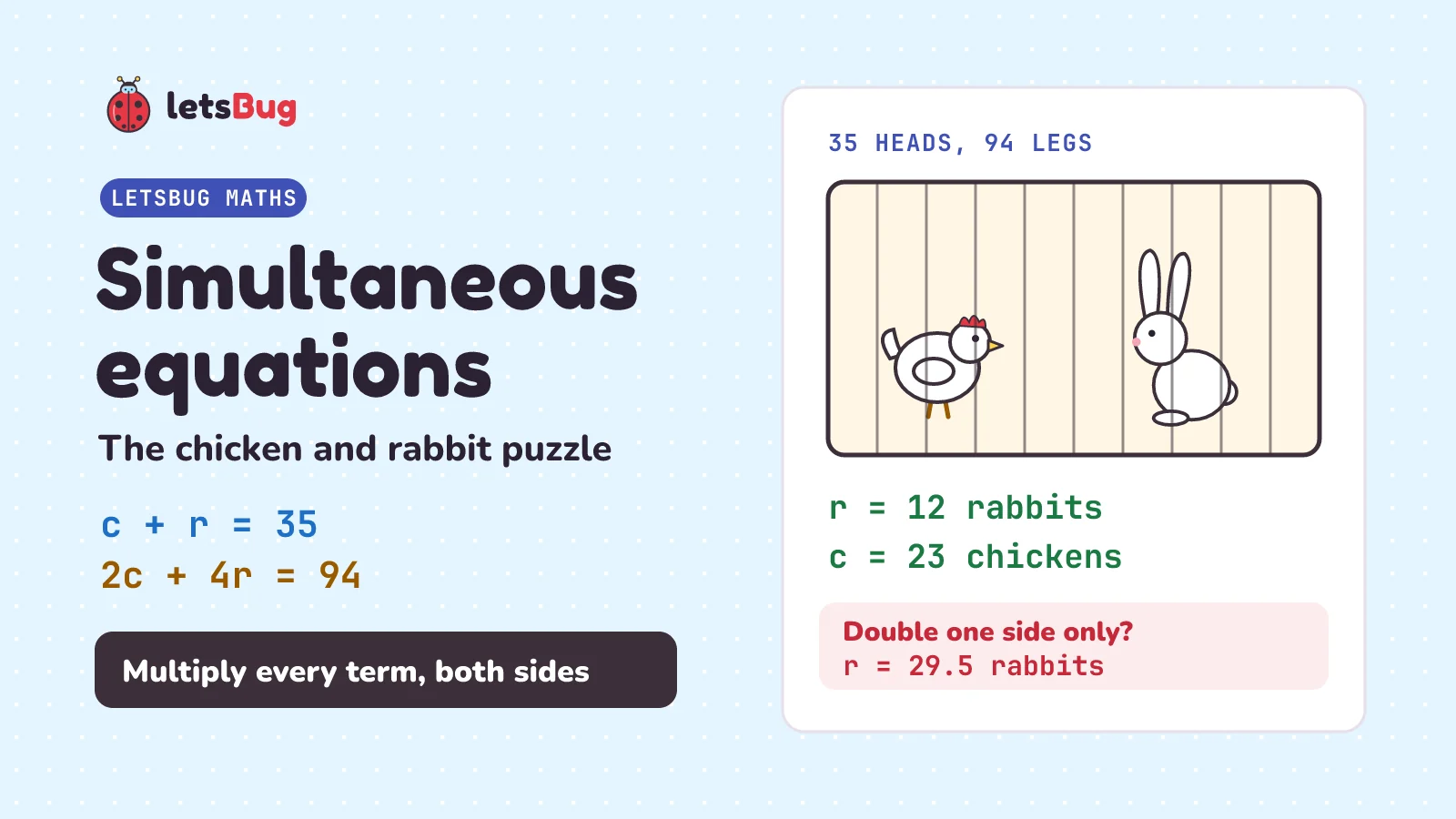
Simultaneous equations are two equations that are true at the same time. To solve them by elimination, make the number in front of one letter match by multiplying every term (every part) on both sides. Then add or subtract the equations so that letter disappears. A cage with 35 heads and 94 legs holds 12 rabbits and 23 chickens.
In this post we solve a puzzle that is more than 1,500 years old, step by step. Then we see how one small slip gives half a rabbit, and how to know when to add and when to subtract. We also use substitution (putting one equation into the other), write a full answer with a check, and find when two gym plans cost the same. Every hard word is explained where it first comes up. The practice questions from the video are answered in full, and exam-style questions with model answers are at the end.
Key takeaways
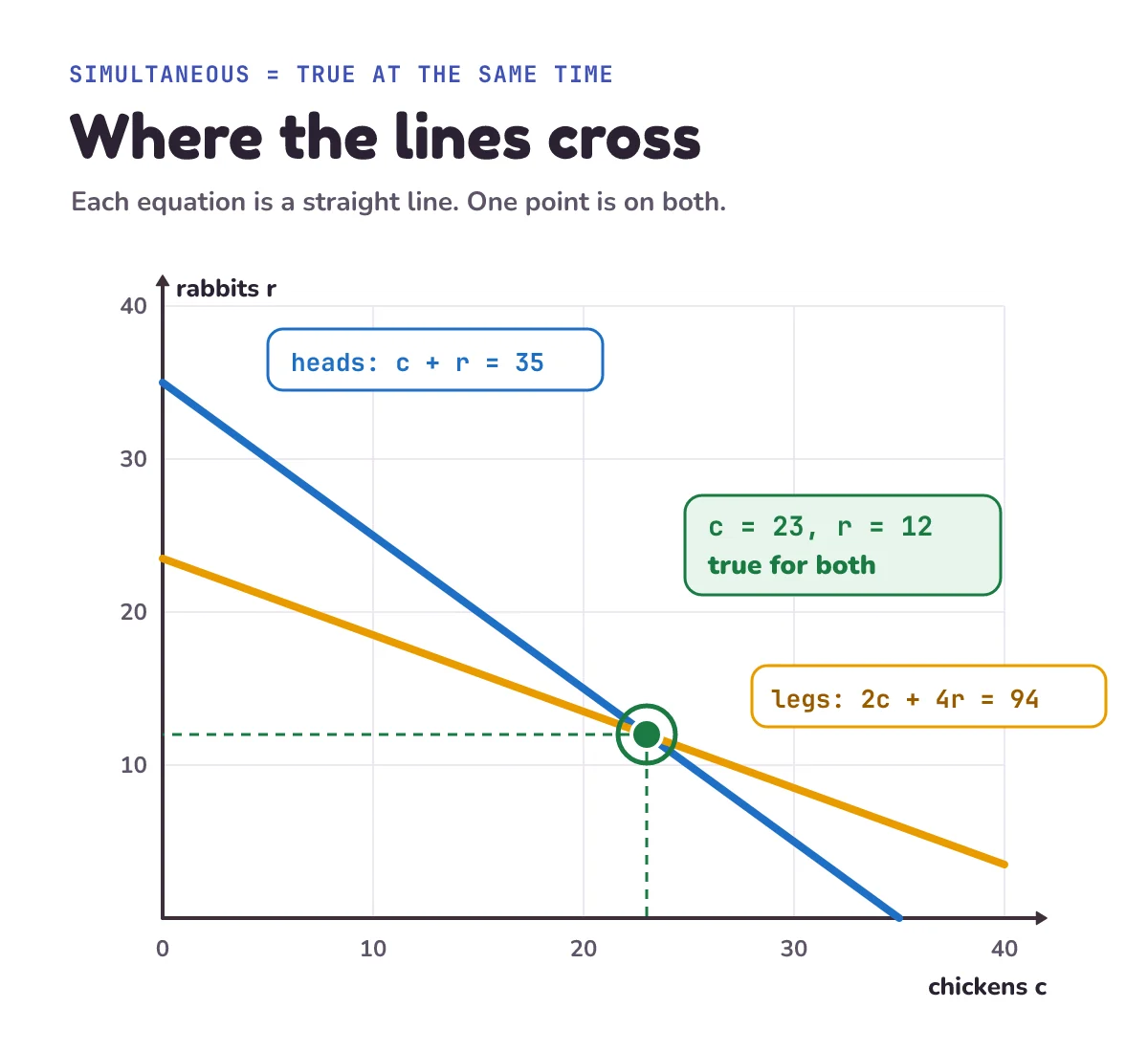
- Simultaneous means true at the same time. When both equations are linear (no squared letters), each is a straight line on a graph, and the answer is the point where the two lines cross.
- Elimination: make one letter's coefficient (the number in front of it) match, then add or subtract the equations so that letter disappears.
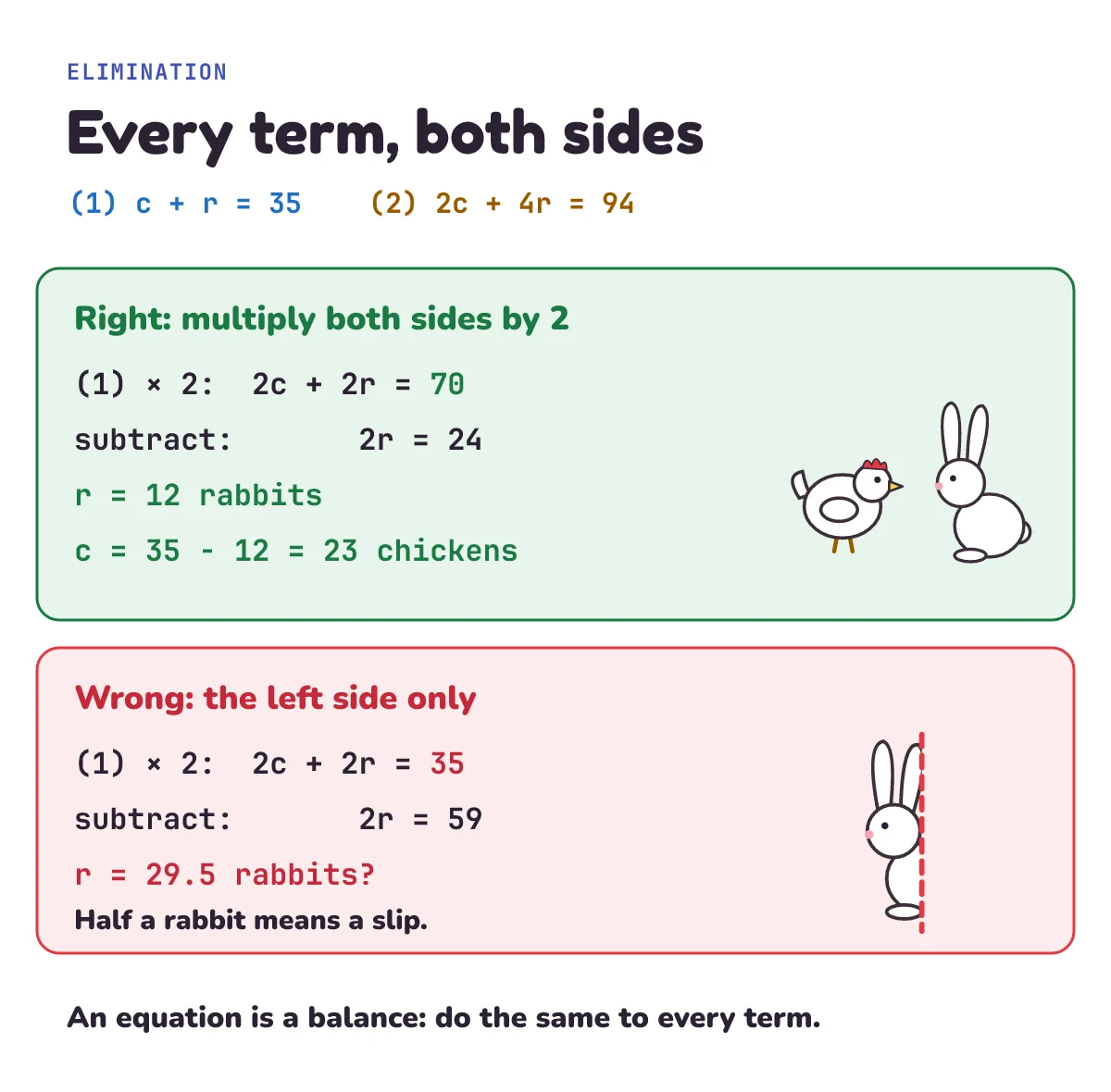
- Multiply every term, on both sides. Doubling only the left side of c + r = 35 gives 29.5 rabbits: a sign of a slip.
- Same signs, subtract. Different signs, add. +2y and −2y have different signs, so you add.
- Substitution is quicker when one letter is on its own or easy to get on its own, like c = 35 − r. Both methods give the same answer.
- Check your answer in both equations. A pair that fits only one of them is wrong.
This post goes with letsBug Maths, episode 8. Simultaneous equations are on the CBSE Class 10 syllabus (the list of what an exam can test). NCERT's Class 10 book covers them in Chapter 3, where they're called a "pair of linear equations in two variables". That means two equations whose graphs are straight lines, with two letters that stand for numbers. GCSE and IGCSE students meet them as simultaneous equations. Watch the lesson, or read on. The post adds why elimination works and how an old Chinese book solved the same puzzle. It also gives the full working for every answer, and model answers with a suggested mark for each step.
What are simultaneous equations?
Simultaneous equations are two equations that are true at the same time. Simultaneous just means at the same time. You need two of them when there are two numbers you don't know yet.
Here is a puzzle from an old Chinese maths book, the Sunzi Suanjing. A 2026 article in the Thang Long Journal of Science tells its story. The book was written some time between the years 200 and 500 CE (AD), so it is more than 1,500 years old. In English it reads: "Now there are chickens and rabbits in the same cage. There are 35 heads above and 94 feet below. How many chickens and rabbits are there?" Here "feet" means legs.
Let's write it as maths. Let c be the number of chickens and r the number of rabbits. Each letter stands for a number we don't know yet.
- Heads. Every animal has one head, so c + r = 35.
- Legs. A chicken has 2 legs and a rabbit has 4, so 2c + 4r = 94.
Turning words into equations like this is a skill of its own. If it's new to you, see how to write equations from word problems.
Each equation on its own has lots of answers. c + r = 35 works for 30 chickens and 5 rabbits, or 20 and 15, and many more. We want the one pair that makes both equations true.
On a graph, each of these equations is a straight line. That's why they are called linear equations: their graphs are straight lines (see what y = mx + c means). Every point on a line makes that equation true. So the point where the two lines cross is the only point that makes both true (when they cross at one point, as here). Here they cross at c = 23, r = 12. A graph gives you a good estimate. Algebra gives the exact answer.
How do you solve simultaneous equations by elimination?
To eliminate means to remove. NCERT calls it a way "of eliminating (i.e., removing) one variable". A variable is a letter that stands for a number, like c or r. The plan is to get rid of one letter, so only one is left.
First, two more words. A term is one piece of an equation, between the plus, minus and equals signs: 2c, 4r and 94 are the terms of 2c + 4r = 94. A coefficient is the number in front of a letter: in 2c, the coefficient is 2.
- Number the equations. (1) c + r = 35 and (2) 2c + 4r = 94.
- Make one coefficient match. Equation (2) has 2c. Multiply equation (1) by 2, every term on both sides: 2c + 2r = 70. Call it (3).
- Subtract. Take (3) away from (2): (2c + 4r) − (2c + 2r) = 94 − 70. The 2c terms cancel, and 4r − 2r = 2r. So 2r = 24.
- Solve. r = 24 ÷ 2 = 12 rabbits.
- Put it back. c + 12 = 35, so c = 35 − 12 = 23 chickens.
- Check both equations. Heads: 23 + 12 = 35. Legs: 2 × 23 + 4 × 12 = 46 + 48 = 94. Both work.
The Thang Long article gives the same answer: "23 chickens and 12 rabbits." It also looks at a later, longer version of a Chinese maths book by Trình Đại Vị that was "first printed in 1592". (The article says the later book is "supplemented from" the first one, which means things were added to it.) A copy of the later book is kept in Vietnam, and it solves the puzzle with exactly our steps: "Double the total number of heads to obtain 70. Subtract 70 from the total number of legs; the remainder is 24. Divide this by 2 to obtain 12, the number of rabbits."
The Sunzi Suanjing's own shortcut is elimination too. It halves the legs: 94 ÷ 2 = 47. In algebra, that's dividing every term of (2) by 2: c + 2r = 47. Now subtract (1), c + r = 35, and you get r = 47 − 35 = 12. Same answer, same idea.
Why does multiplying only one side give half a rabbit?
Because the equation stops being true. Here is the slip. Someone doubles only the left side of c + r = 35 and writes 2c + 2r = 35. Then they subtract as before:
- (2c + 4r) − (2c + 2r) = 94 − 35, so 2r = 59.
- r = 59 ÷ 2 = 29.5 rabbits.
Half a rabbit. Real animals come in whole numbers, so the half is a warning sign. The check catches it too: c would be 35 − 29.5 = 5.5, and the legs would be 2 × 5.5 + 4 × 29.5 = 11 + 118 = 129, not 94.
Examiners see this slip in real exams. Exam boards publish examiner reports, which say what students got wrong. Cambridge's June 2024 IGCSE maths report (0580, Paper 21, Question 12) lists "not multiplying all terms when attempting to equate coefficients". "Equate coefficients" means make the coefficients match, our step 2.
Why are you allowed to add or subtract two equations?
Because equal amounts taken from equal amounts leave equal amounts. In (2), the left side 2c + 4r is the same number as 94. In (3), the left side 2c + 2r is the same number as 70. Take the second pair from the first, and the two results must still be equal: 2r = 24.
Think of a balance again. Both pans weigh the same. Take 70 grams from each pan, and it stays level. Equation (3) tells us that 2c + 2r is 70, so taking 2c + 2r from one side and 70 from the other is taking the same amount from both. Adding works the same way.
When do you add and when do you subtract?
Look at the two terms you made to match, and look at their signs (plus or minus):
- Same signs, subtract. +2c and +2c: subtracting makes 2c − 2c = 0.
- Different signs, add. +2y and −2y: adding makes 2y + (−2y) = 0.
Try it on (1) 3x + 2y = 16 and (2) 5x − 2y = 16. The y terms are +2y and −2y: different signs, so add.
- Add. (3x + 5x) + (2y − 2y) = 16 + 16, so 8x = 32 and x = 4.
- Put it back in (1). 12 + 2y = 16, so 2y = 4 and y = 2.
- Check in (2). 5 × 4 − 2 × 2 = 20 − 4 = 16. It works.
What if you subtract instead? (3x + 2y) − (5x − 2y) = 3x − 5x + 2y + 2y = −2x + 4y, and 16 − 16 = 0. You get −2x + 4y = 0. Both letters are still there, so nothing was eliminated. Taking away −2y is the same as adding 2y, which is why the y terms grew instead of cancelling.
Examiners see this too. In the same Cambridge report, Paper 13, Question 19, the common wrong answers came "from subtracting rather than adding the pair of simultaneous equations". The Eduqas GCSE report for Summer 2025 (Higher tier, Component 1, Question 9) found "many numerical slips with multiplication and mishandling negatives as part of the elimination process". Write each step out, and take extra care with minus signs.
When should you use substitution instead?
Use substitution when one letter is already on its own, or is easy to get on its own. To substitute means to put something in place of something else. NCERT's first step is to "Find the value of one variable, say y in terms of the other variable". "In terms of the other variable" means written using the other letter, like c = 35 − r.
For the cage, c + r = 35 gives c = 35 − r. Put that in place of c in the legs equation:
- 2(35 − r) + 4r = 94.
- Multiply out the bracket, every term inside it: 70 − 2r + 4r = 94.
- Collect the r terms: 70 + 2r = 94, so 2r = 24 and r = 12.
- Then c = 35 − 12 = 23. The same answer as elimination.
So which should you use? If a letter is on its own (like y = 2x + 1), or has no number in front of it (like c in c + r = 35), substitution is quick. Otherwise, eliminate. Both are worth knowing.
Try a pair where y is already on its own: y = 2x + 1 and 3x + y = 11. Put 2x + 1 in place of y: 3x + (2x + 1) = 11. So 5x + 1 = 11, 5x = 10 and x = 2. Then y = 2 × 2 + 1 = 5. Check: 3 × 2 + 5 = 11. It works.
How do you write a full answer step by step?
Solve 2x + 3y = 13 and 5x − 2y = 4. Here neither coefficient matches, so you multiply both equations. Say it clearly, one step at a time:
- Number them. (1) 2x + 3y = 13 and (2) 5x − 2y = 4.
- Match the y terms. 6 is a multiple of both 3 and 2. (1) × 2: 4x + 6y = 26. (2) × 3: 15x − 6y = 12. Every term, both sides.
- Add or subtract? +6y and −6y have different signs, so add: 19x = 38, and x = 2.
- Put it back in (1). 2 × 2 + 3y = 13, so 4 + 3y = 13, 3y = 9 and y = 3.
- Check in (2). 5 × 2 − 2 × 3 = 10 − 6 = 4. It works.
The answer is x = 2, y = 3. Check in both equations. The one you didn't use to find the second letter is the real test. "Candidates" are the students who sat the exam, and the Cambridge report (Paper 21, Question 12) noticed that "few candidates using either method seemed to check their answers to ensure that they had a solution that worked for both equations". It adds that checking "would have highlighted when errors had been made". A check takes only a few seconds.
When do two price plans cost the same?
Here is a made-up example with simple prices. Say a gym offers two plans. Plan A: £30 to join, then £10 a month. Plan B: nothing to join, but £15 a month. After m months, the cost in pounds is:
- Plan A: cost = 30 + 10m
- Plan B: cost = 15m
That's a pair of simultaneous equations, and both already say what the cost is. So substitute: when the costs are the same, 30 + 10m = 15m. Take 10m from both sides: 30 = 5m, so m = 6. After 6 months, both plans cost 15 × 6 = £90. On a graph, that's where the two lines cross, just as two moving things meet where their lines cross on a distance-time graph.
| Months | Plan A: 30 + 10m | Plan B: 15m | Cheaper |
|---|---|---|---|
| 0 | £30 | £0 | B |
| 3 | £60 | £45 | B |
| 6 | £90 | £90 | the same |
| 12 | £150 | £180 | A |
Which is cheaper for a year? Plan A: 30 + 10 × 12 = £150. Plan B: 15 × 12 = £180. So plan A is cheaper if you stay longer than 6 months. For a shorter time, plan B is cheaper: after 3 months, A costs £60 and B costs £45, because B has no joining fee. Phone contracts, taxi fares and electricity tariffs (price plans) can be compared the same way.
Your turn. These are the practice questions from the video, plus the question it ends on. Try each one before you open the answers.
1) Solve x + y = 7 and x − y = 3.
2) Solve 2x + 5y = 11 and 3x − 4y = 5.
3) Two adult tickets and four child tickets cost £44. One adult ticket and one child ticket cost £17. Find the price of each.
4) The question the video ends on, from NCERT: 2 pencils and 3 erasers cost ₹9, and 4 pencils and 6 erasers cost ₹18. How many answers are there?
Show the answers
1) +y and −y have different signs, so add: 2x = 10, and x = 5. Then 5 + y = 7, so y = 2. Check in the second equation: 5 − 2 = 3. It works.
2) Match the x terms. (1) × 3: 6x + 15y = 33. (2) × 2: 6x − 8y = 10. Same signs (+6x and +6x), so subtract: 15y − (−8y) = 23y and 33 − 10 = 23, so 23y = 23 and y = 1. Then 2x + 5 = 11, so 2x = 6 and x = 3. Check in (2): 3 × 3 − 4 × 1 = 9 − 4 = 5. It works. Watch the minus sign: taking away −8y adds 8y.
3) Let a be the adult price and k the child (kid) price, in pounds. (1) 2a + 4k = 44 and (2) a + k = 17. (2) × 2: 2a + 2k = 34. Subtract from (1): 2k = 10, so k = £5. Then a = 17 − 5 = £12. Check in (1): 2 × 12 + 4 × 5 = 24 + 20 = 44. It works.
4) Let x be the price of a pencil and y the price of an eraser, in rupees. (1) 2x + 3y = 9 and (2) 4x + 6y = 18. (1) × 2: 4x + 6y = 18, which is exactly (2). Subtract: 0 = 0. Both letters vanish, and what is left is always true. The two equations are really the same equation, so their lines sit on top of each other, and every point on the line is an answer to the equations (for the shop, any pair of positive prices on it). A pencil at ₹3 and an eraser at ₹1 works (6 + 3 = 9), and so does a pencil at ₹1.50 and an eraser at ₹2 (3 + 6 = 9). NCERT's answer: "Therefore, Equations (1) and (2) have infinitely many solutions." Infinitely many means there is no end to them. That's the next episode's topic.
Exam-style questions with model answers
The number in brackets is the marks. Each mark is one clear step.
Q1. Solve (1) 3x + 4y = 10 and (2) 2x − 2y = 2. [3]
Model answer
(2) × 2: 4x − 4y = 4 [1]. +4y and −4y have different signs, so add: 7x = 14, x = 2 [1]. Then 6 + 4y = 10, so 4y = 4 and y = 1 [1]. Check in (2): 4 − 2 = 2. (This is NCERT Exercise 3.3, Question 1 (ii).)
Q2. A later version of the puzzle has 36 heads and 100 legs. How many chickens and how many rabbits are there? [3]
Model answer
c + r = 36 and 2c + 4r = 100 [1]. Double the first: 2c + 2r = 72. Subtract: 2r = 28, so r = 14 rabbits [1]. c = 36 − 14 = 22 chickens [1]. Check: 2 × 22 + 4 × 14 = 44 + 56 = 100. This version appears in a book by Nguyễn Hữu Thận from 1829, and the Thang Long article gives the same answer: "There are 22 chickens and 14 rabbits."
Q3. A student solves x + y = 10 and 3x + 2y = 24. They write 2x + 2y = 10, subtract it from 3x + 2y = 24, and get x = 14 and y = −4. Find the mistake and the correct answer. [3]
Model answer
They doubled only the left side. It should be 2x + 2y = 20 [1]. Subtract: x = 24 − 20 = 4 [1]. Then y = 10 − 4 = 6 [1]. Check: 3 × 4 + 2 × 6 = 12 + 12 = 24. The student's pair fits the first equation, since 14 + (−4) = 10. But in the second, 3 × 14 + 2 × (−4) = 42 − 8 = 34, not 24. That's why you check in both.
Q4. Five years ago, Nuri was three times as old as Sonu. Ten years from now, Nuri will be twice as old as Sonu. How old are they now? [4]
Model answer
Let Nuri be N years old and Sonu S years old. Five years ago: N − 5 = 3(S − 5), so N − 3S = −10 [1]. In ten years: N + 10 = 2(S + 10), so N − 2S = 10 [1]. Same signs (+N and +N), so subtract the first from the second: −2S − (−3S) = S and 10 − (−10) = 20, so S = 20 [1]. Then N = 10 + 2 × 20 = 50 [1]. Check: five years ago they were 45 and 15, and 45 = 3 × 15. In ten years they'll be 60 and 30, and 60 = 2 × 30. (This is NCERT Exercise 3.3, Question 2 (ii).)
Q5. Solve (1) x + y = 5 and (2) 2x − 3y = 4. [3]
Model answer
(1) × 2: 2x + 2y = 10 [1]. Same signs (+2x and +2x), so subtract (1) × 2 from (2): −3y − 2y = −5y and 4 − 10 = −6, so −5y = −6 and y = 6/5 [1]. Then x = 5 − 6/5 = 19/5 [1]. Check in (2): 38/5 − 18/5 = 20/5 = 4. Fractions are fine here. A fraction is only a warning sign when the answer must be a whole number, like a count of animals. (This is NCERT Exercise 3.3, Question 1 (i).)
Questions people ask
What are simultaneous equations?
Two equations with the same two unknown letters that are both true at the same time. When both are linear, they are two straight lines on a graph, and the answer is the point where they cross. For c + r = 35 and 2c + 4r = 94, that point is c = 23, r = 12.
What is the elimination method?
Multiply one or both equations, every term on both sides, so one letter's coefficient is the same size in both (the sign can differ, like +6y and −6y). Then add or subtract the equations so that letter disappears. Solve for the other letter, put it back, and check.
How do I know whether to add or subtract?
Look at the signs of the terms you matched. Same signs (+2c and +2c), subtract. Different signs (+2y and −2y), add. If both letters are still there afterwards, you picked the wrong one.
Is substitution or elimination better?
Neither is better: both give the same answer. Use substitution when one letter is on its own or has no number in front of it, like y = 2x + 1 or c in c + r = 35. Otherwise elimination is usually quicker.
Why did I get half a rabbit?
You probably multiplied only one side of an equation. Doubling c + r = 35 must give 2c + 2r = 70, not 35. With 35 you get 2r = 59 and 29.5 rabbits.
How do I check my answer?
Put both numbers into both original equations. For 23 chickens and 12 rabbits: 23 + 12 = 35 heads and 46 + 48 = 94 legs. If either equation fails, look for a slip.
Keep going
- Watch the full lesson, Chicken and Rabbit Problem: Simultaneous Equations, and its Short, Simultaneous Equations by Elimination: How You Get Half a Rabbit. More in letsBug Maths on YouTube. Next in the series: consistent, inconsistent or coincident lines. What if the lines never cross, or sit on top of each other? A consistent pair has at least one answer; an inconsistent pair has none. Coincident lines are the same line, one on top of the other.
- The episode before this one: the section formula and the distance formula.
- Why each equation is a straight line: what y = mx + c means.
- Turning a story into equations: how to write equations from word problems.
Checked on 5 November 2026 against the 6 sources below. Every answer in this post was worked out again in a Python script, with exact fractions, and checked in both equations. Every quote was matched word for word with the source text.
Sources
- NCERT: Class 10 Mathematics, Chapter 3, Pair of Linear Equations in Two Variables (Reprint 2026-27: the substitution and elimination methods, Example 6 and Exercise 3.3)
- CBSE: Mathematics curriculum, Class X, 2026-27 (Unit II Algebra: solving a pair of linear equations by substitution and by elimination)
- AQA: GCSE Mathematics 8300 specification (A19 and A21: simultaneous equations)
- Cambridge International: IGCSE Mathematics 0580, June 2024 principal examiner report (Paper 13, Question 19 and Paper 21, Question 12: one-side multiplying, adding or subtracting, checking)
- Eduqas: GCSE Mathematics examiners' report, Summer 2025 (Higher tier, Component 1, Question 9: slips with negatives)
- Thang Long Journal of Science: The Chicken and Dog Poem Problem in Folk Activities (2026: the Sunzi Suanjing puzzle, its answer, its date, the method in a later book based on one first printed in 1592, and the 36-head version. Its title names a chicken-and-dog version of the puzzle)