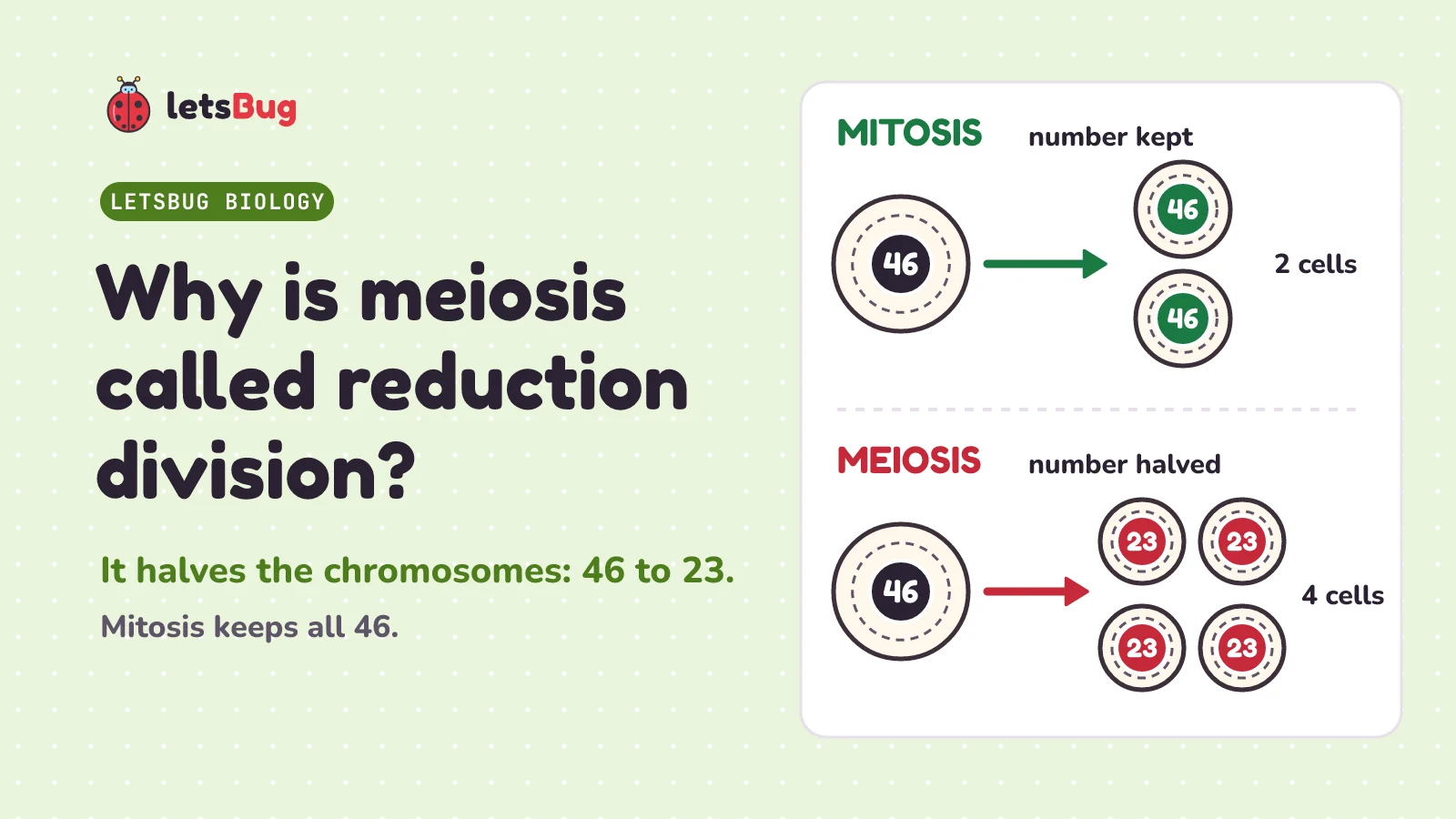
Meiosis is called reduction division because it halves the number of chromosomes, the threads of DNA that carry a cell's instructions. Human body cells have 46 chromosomes, in 23 pairs. Meiosis makes sperm and egg cells with just 23, one from each pair. Mitosis copies all 46 first, then shares them, so each new cell keeps 46.
In this post we compare the two kinds of cell division (one cell splitting to make new cells): mitosis and meiosis. We start with what chromosomes are and how to count them. Then we follow mitosis step by step, and clear up the wrong idea that mitosis halves the chromosome number. Next comes meiosis: why it copies once but divides twice, why its name means "lessening" (making less), and why sperm and egg cells need half the chromosomes. Last, we see why brothers and sisters look different, why a cut is never repaired by meiosis, and what happens when cell division goes out of control. Every hard word is explained the first time it comes up, and the practice questions from the video are answered in full.
Key takeaways
- Human body cells have 46 chromosomes in 23 pairs. One chromosome of each pair came from your mother, and one from your father.
- Mitosis: the DNA is copied, then shared out. One division makes 2 cells, each with the same number of chromosomes as the parent cell (46 stays 46). It's for growth and repair.
- Meiosis: the DNA is copied once, but the cell divides twice. It makes 4 cells, each with half the number (23), and all of them different. They become the gametes (sperm or egg cells).
- Meiosis is called reduction division because it reduces (halves) the chromosome number. At fertilisation, when a sperm and an egg join, 23 + 23 = 46 again.
- For any chromosome count, ask one question: kept, or halved? Mitosis keeps the number. Meiosis halves it.
This post goes with letsBug Biology, episode 6. It covers cell division from Chapter 2 of the new NCERT Class 9 science book ("Exploration", labelled Grade 9; CBSE), and the meiosis part of Chapter 7 of the NCERT Class 10 book. It also covers "Cell Cycle and Cell Division" in ICSE Class 10 biology, and mitosis and meiosis in GCSE and IGCSE biology. Watch the lesson, or read on: the post adds two diagrams, the working for every count, and model answers to practise with.
What are chromosomes?
Every cell in your body carries a full set of instructions for building and running you. Those instructions are written in DNA, a very long molecule (a group of atoms joined together). DNA is packed into chromosomes, which sit inside the nucleus: the control centre of the cell, which we met in animal cell vs plant cell. AQA's GCSE specification puts it like this: "The nucleus of a cell contains chromosomes made of DNA molecules. Each chromosome carries a large number of genes." AQA again: "A gene is a small section of DNA on a chromosome." Each gene holds the instructions for making one protein, one of the materials your body is built from.
AQA goes on: "In body cells the chromosomes are normally found in pairs." And for humans: "Ordinary human body cells contain 23 pairs of chromosomes." That's 23 × 2 = 46 chromosomes. One chromosome in each pair came from your mother, and the other from your father. Wikipedia's article on meiosis says human cells have 46 chromosomes, "half of maternal origin and half of paternal origin". (Maternal means from the mother; paternal means from the father.)
Two words describe how many sets a cell has:
- A diploid cell has both sets: two of each chromosome, 46 in a human. Body cells, like skin cells, are diploid.
- A haploid cell has just one set: one of each chromosome, 23 in a human. Sperm and egg cells are haploid.
OpenStax's university textbook describes meiosis in exactly these words: "Meiosis is the nuclear division that forms haploid cells from diploid cells".
What is mitosis used for?
Mitosis makes new body cells. NCERT's Grade 9 book says: "Mitosis is important for normal growth, repair, maintenance and asexual reproduction". (Asexual reproduction means making new living things from just one parent, with no sperm or egg.) Here's where you see it:
- Growth. "Every human begins life as a single fertilised egg. This one cell divides repeatedly to form trillions of cells in the body."
- Repair. When a cut heals, new skin cells made by mitosis fill the gap. NCERT: "Some cells, such as skin cells divide continuously to replace cells that are lost regularly."
- Plants. Plants grow in their meristems: tissues made of "actively dividing cells", as NCERT puts it. (A tissue is a group of similar cells working together.) NCERT: "The apical meristem, located at the root and shoot tips, increases its length." (Apical means at the tip.) We met meristems in xylem and phloem.
The numbers are huge. In 2021, two scientists, Ron Sender and Ron Milo, added up how many cells the human body replaces. Their study in the journal Nature Medicine found: "In terms of cell numbers, close to 90% of the (0.33 ± 0.02) × 1012 cells per day turnover was blood cells." (Turnover means old cells being replaced by new ones.) 0.33 × 10¹² is 330 billion cells every day, and close to 90% of them are blood cells. A day has 24 × 60 × 60 = 86,400 seconds, so:
What happens during mitosis?
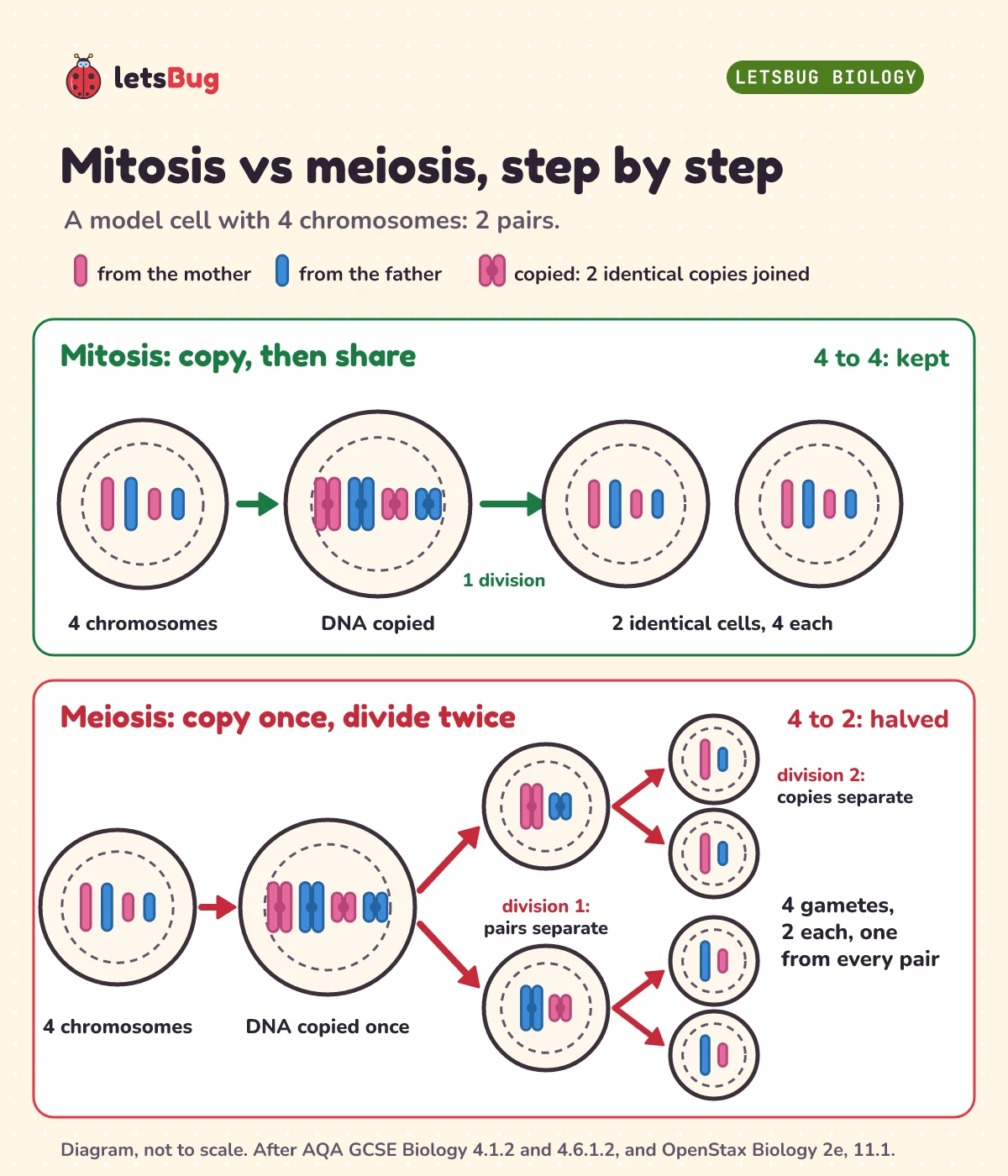
Cells divide in a repeating series of stages called the cell cycle. AQA sums it up in one sentence: "During the cell cycle the genetic material is doubled and then divided into two identical cells." (Genetic material is the DNA.) Picture a model cell with just 4 chromosomes, 2 pairs, like the one in the video and the diagram below. Here are the three stages, in AQA's words:
- The cell grows and copies its DNA. "Before a cell can divide it needs to grow and increase the number of sub-cellular structures such as ribosomes and mitochondria." (Sub-cellular structures are the small parts inside a cell. Ribosomes are where the cell makes proteins. Mitochondria release energy from food.) Then: "The DNA replicates to form two copies of each chromosome." (Replicates means makes a copy of itself.) Each chromosome is now double: two identical copies, joined at one point.
- Mitosis. "In mitosis one set of chromosomes is pulled to each end of the cell and the nucleus divides." The two copies of each chromosome are pulled apart, one to each end.
- The cell splits. "Finally the cytoplasm and cell membranes divide to form two identical cells." (The cytoplasm is the jelly that fills the cell; the cell membrane is its thin outer skin.)
The two new cells are genetically identical: they have exactly the same DNA as each other and as the parent cell. Each one can grow, and divide again.
Does mitosis halve the chromosome number?
No. This is the myth the video is built around. Let's count, for a human skin cell:
DNA copied: still 46 chromosomes, each one now double.
Copies pulled apart: 46 to one end, 46 to the other.
Two new cells: 46 + 46. Nothing was halved.
The DNA is doubled first, then shared, so the number stays the same. NCERT: "Each new cell gets the same DNA and the same number of chromosomes as the parent cell."
Why does the myth start? Each new cell does get half of the doubled DNA. So people say "the DNA halves", and the number seems to drop. Examiners have written about this. In June 2023, a GCSE paper from AQA had a 3-mark question on what happens in mitosis. The examiners' report says very few students wrote about one set of chromosomes being pulled to each end. Instead they gave vague answers like 'DNA halves', "which are insufficient at this level". (Insufficient means not enough.) The result: "Less than 3% of students gained all 3 marks".
What happens in meiosis?
Meiosis makes gametes: the sex cells, sperm and eggs. NCERT: "Meiosis is a type of cell division that produces gametes and occurs only in the cells of reproductive organs." Reproductive organs are the parts of the body that make sperm or eggs. NCERT names them: "In animals including humans, meiosis occurs only in the cells of testes of males to produce sperm and ovaries of females to produce eggs." (The testes are the organs that make sperm; the ovaries are the organs that make eggs.) Flowering plants do it too. NCERT: "In plants, meiosis occurs in the anthers (male parts) to form pollen grains", "and the ovaries (female parts) to produces egg cells." The anthers are the parts of a flower that make pollen.
Here's the key difference from mitosis. OpenStax: "meiosis consists of one round of chromosome replication followed by two rounds of nuclear division." (Nuclear division means the nucleus dividing.) In plain words: the DNA is copied once, but the cell divides twice.
- DNA copied once. Just like before mitosis, every chromosome becomes double.
- Division 1: the pairs separate. Each new cell gets one chromosome from every pair (still double). NCERT: "the number of chromosomes in each daughter cell is reduced to half." (Daughter cells are the new cells made when a cell divides.) This is the step that halves the number.
- Division 2: the copies separate. NCERT: "The second division is similar to mitosis where each daughter cell divides into two thus, forming four daughter cells with half the number of chromosomes."
AQA sums up the result: "the cell divides twice to form four gametes, each with a single set of chromosomes", and "all gametes are genetically different from each other." In humans, each gamete has 23 chromosomes. In males, all four cells become sperm. In females, only one becomes an egg. Wikipedia: "In female animals, three of the four meiotic products are typically eliminated by extrusion into polar bodies, and only one cell develops to produce an ovum." (Polar bodies are tiny cells that break down. An ovum is an egg cell.)
Why is meiosis called reduction division?
To reduce something is to make it smaller. Meiosis reduces the number of chromosomes from 46 to 23: it halves it. That's why it's called reduction division. The ICSE Class 10 syllabus uses exactly this phrase: "A basic understanding of Meiosis as a reduction division (stages not required)."
Even the name says so. Wikipedia explains that the term meiosis "is derived from the Greek word μείωσις, meaning 'lessening'." (Lessening means making less.) It was named this way "since it is a reductional division."
One detail for keen readers: only the first division does the reducing. OpenStax: "Meiosis II is not a reduction division because although there are fewer copies of the genome in the resulting cells, there is still one set of chromosomes, as there was at the end of meiosis I." (Meiosis I and meiosis II are the names for division 1 and division 2. The genome is all of a living thing's DNA.) So the second division only separates the copies. Meiosis as a whole is called reduction division because, start to finish, it halves the chromosome number.
Why do sperm and egg cells have half the chromosomes?
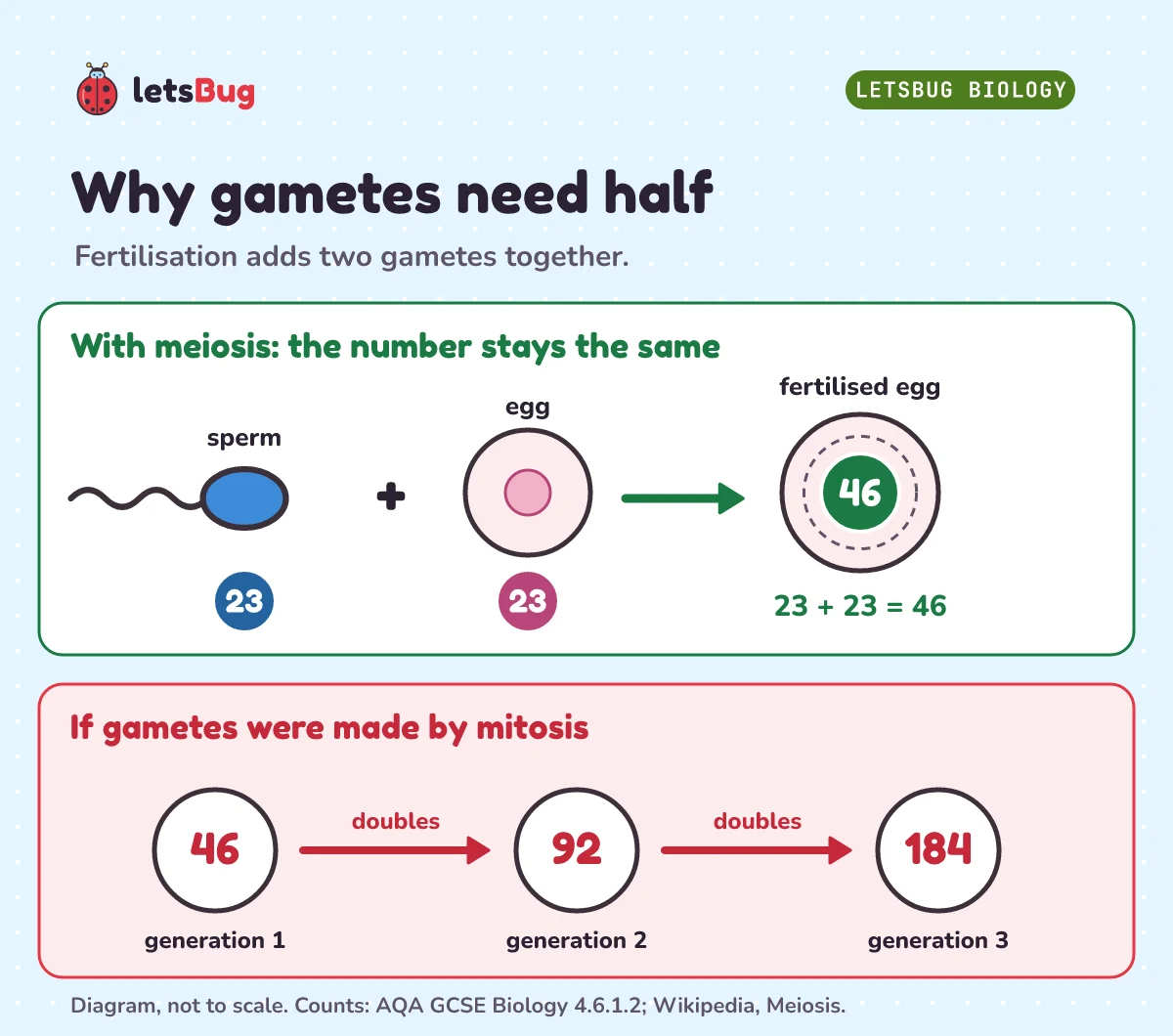
Because two of them join. Fertilisation is when a sperm cell and an egg cell join to make one new cell, the fertilised egg. Wikipedia: "When two gametes (an egg and a sperm) fuse, the resulting zygote is once again diploid, with the mother and father each contributing 23 chromosomes." (Fuse means join. A zygote is the fertilised egg, the first cell of a new living thing.) So:
AQA: "Gametes join at fertilisation to restore the normal number of chromosomes." (Restore means bring back.)
Now imagine gametes were made by mitosis instead, with all 46 chromosomes. A sperm with 46 and an egg with 46 would make a child with 92. If that child had a child with another 92-chromosome person, that child would have 184. Every generation, the number would double: 46, 92, 184. NCERT's Class 10 book makes the same point: each new generation "will end up having twice the amount of DNA that the previous generation had". So gametes must carry half the chromosomes. NCERT: "This is achieved by a process of cell division called meiosis." Meiosis and fertilisation together keep the chromosome number the same, generation after generation. Flowering plants work the same way: meiosis in the anthers makes pollen, and fertilisation brings back the full number.
Why do brothers and sisters look different?
Brothers and sisters have the same two parents, yet they don't look exactly alike. NCERT: "children resemble their parents but are not exactly the same." (Resemble means look like.) Meiosis is the reason.
In division 1, each new cell gets one chromosome from every pair, and which one it gets (the mother's or the father's) is decided by chance. Start small. With 3 pairs, each pair has 2 choices, so there are 2 × 2 × 2 = 23 = 8 different gametes. With 23 pairs, there are 223 = 8,388,608. OpenStax: "Humans have 23 chromosome pairs, which results in over eight million (223) possible genetically-distinct gametes just from the random alignment of chromosomes at the metaphase plate." (Genetically distinct means having different DNA. Random alignment means lining up by chance. The metaphase plate is the line across the middle of the cell where the chromosome pairs line up before they separate.)
And that's before crossing over. Early in meiosis, the two chromosomes in a pair swap matching pieces of DNA. OpenStax describes it as "a reciprocal exchange of equivalent DNA between an egg-derived chromosome and a sperm-derived chromosome". (Reciprocal means both ways: each chromosome gives a piece and gets one back. Equivalent means matching, and egg-derived means it came from the egg.) So each chromosome ends up as a new mix of the mother's and father's genes. Over 8 million choices, then crossing over as well: that's why every gamete is different, and why brothers and sisters, with the same two parents, usually look different.
What is the difference between mitosis and meiosis?
Here they are side by side. For any question, ask: is the number kept, or halved?
| Mitosis | Meiosis | |
|---|---|---|
| Number of divisions | 1 | 2 |
| Cells made | 2 | 4 |
| Chromosome number | The same (46 to 46) | Half (46 to 23): haploid |
| New cells are | Genetically identical | All genetically different |
| Where | Body cells all over the body; meristems in plants | Only in reproductive organs: testes and ovaries; anthers and ovaries in flowers |
| Used for | Growth, repair, asexual reproduction | Making gametes (sperm and eggs); in flowers, pollen grains |
Students often mix these up in exams. In a June 2024 IGCSE paper, students had to pick out which processes on a diagram were mitosis and which were meiosis. Cambridge's examiners wrote: "Most candidates indicated at least a few of the processes on Fig. 3.1 that were mitosis or meiosis, but only a minority correctly identified all of them." (Candidates are the students who sat the exam. A minority is less than half.)
Can meiosis repair a cut?
No. This is the second trap. In the same June 2024 report, Cambridge's examiners wrote: "Many candidates were confused about the products and purpose of meiosis. Meiosis produces cells that are not genetically identical, and these cells are not involved in the repair of damaged tissues." (Skin is a tissue.)
NCERT's Grade 9 book asks a question that shows why: "If the skin cells start dividing by meiosis instead of mitosis, what do you think will happen to a cut on the skin?" Think it through. Every new skin cell would have half the chromosomes, 23 instead of 46, and they would all be different. Cells like that can't work as normal skin. Repair needs cells that are identical to the old ones, with the full set of chromosomes. That's mitosis.
What happens when cell division goes out of control?
Normally, cells divide only when the body needs new ones. Sometimes changes in a cell make it keep dividing. AQA describes "cancer as the result of changes in cells that lead to uncontrolled growth and division." NCERT: "Errors in mitosis lead to uncontrolled cell divisions. This can lead to the formation of tumours". A tumour is a lump of extra cells. NCERT says tumours may be benign or malignant:
- Benign tumours stay in one place. AQA: "They do not invade other parts of the body."
- Malignant tumours can spread. AQA: "Malignant tumour cells are cancers. They invade neighbouring tissues and spread to different parts of the body in the blood where they form secondary tumours." (Cancer is a disease in which cells keep dividing when they shouldn't. To invade is to push into. Secondary tumours are new tumours in other places.)
Your turn. These are the three practice questions from the video. Try each one before you open the answers. For every count, ask: kept, or halved?
1) A cat's body cells have 38 chromosomes. How many chromosomes are in (a) a skin cell made by mitosis, (b) an egg cell, (c) a fertilised egg?
2) Describe what happens during mitosis.
3) Why must gametes be made by meiosis?
Show the answers
1) (a) 38: mitosis keeps the number. (b) 19: meiosis halves it, 38 ÷ 2 = 19. (c) 38: fertilisation adds a sperm and an egg, 19 + 19 = 38. (Cats really do have 38: Wikipedia's list of chromosome counts gives the cat, Felis catus, 38.)
2) Say it in three steps:
- One set of chromosomes is pulled to each end of the cell.
- The nucleus divides.
- The cytoplasm and cell membrane divide to form two identical cells.
"The chromosomes split and the DNA halves" is too vague to score: it doesn't say what happens to the chromosomes.
3) Gametes need half the chromosome number (23 in humans), so that fertilisation restores the normal number (23 + 23 = 46) instead of doubling it every generation.
Exam-style questions with model answers
Our model answers, written in the style of exam mark schemes. The number in brackets is the marks. Each mark is one clear point.
Q1. Give three differences between mitosis and meiosis. [3]
Model answer
Any three [1 each]: mitosis has one division, meiosis has two. Mitosis makes two cells, meiosis makes four. Mitosis keeps the chromosome number (diploid), meiosis halves it (haploid). Mitosis makes genetically identical cells, meiosis makes genetically different cells. Mitosis is for growth, repair and asexual reproduction, meiosis makes gametes.
Q2. A fruit fly's body cells have 8 chromosomes. How many chromosomes are in (a) a fruit fly sperm cell, (b) a cell made by mitosis? [2]
Model answer
(a) 4: sperm are made by meiosis, which halves the number, 8 ÷ 2 = 4 [1]. (b) 8: mitosis keeps the number [1].
Q3. Explain why a cut in the skin is repaired by mitosis, not meiosis. [2]
Model answer
Mitosis makes genetically identical cells with the full chromosome number, like the skin cells they replace [1]. Meiosis makes cells with half the number that are all genetically different, so they could not work as skin cells [1].
Q4. Explain why meiosis is called reduction division. [2]
Model answer
Meiosis halves (reduces) the number of chromosomes [1]: a diploid cell with 46 chromosomes makes haploid gametes with 23 [1].
Q5. A student writes: "A human egg cell has 23 pairs of chromosomes." Correct the sentence. [1]
Model answer
A human egg cell has 23 single chromosomes, one from each pair [1]. It's the body cells that have 23 pairs (46 chromosomes).
Questions people ask
Why is meiosis called reduction division?
Because it reduces the number of chromosomes by half. In humans, a body cell with 46 chromosomes divides by meiosis to make sperm or egg cells with 23. The halving happens in the first of meiosis's two divisions.
How many chromosomes do humans have?
Human body cells have 46 chromosomes, in 23 pairs: one chromosome of each pair from the mother and one from the father. Sperm and egg cells have half that number: 23 single chromosomes.
Does mitosis halve the chromosome number?
No. Before mitosis the DNA is copied, so every chromosome is double. Then one set is pulled to each end of the cell. Each of the two new cells gets the full number: 46 in humans.
How many cells does meiosis make?
Four. The DNA is copied once, then the cell divides twice, making four cells. Each has half the chromosome number, and all four are genetically different. In males all four become sperm; in females only one becomes an egg.
Where does meiosis happen?
Only in the reproductive organs. In humans, that's the testes (making sperm) and the ovaries (making eggs). In flowering plants, it's the anthers (making pollen) and the ovaries.
What is the difference between diploid and haploid?
A diploid cell has two sets of chromosomes, one from each parent: 46 in a human body cell. A haploid cell has one set: 23 in a human sperm or egg cell.
Why are gametes all different?
Each gamete gets one chromosome from every pair, picked by chance: with 23 pairs, that's over 8 million (223) combinations. Crossing over, when the chromosomes in a pair swap pieces of DNA, mixes them even more.
Keep going
- Watch the full lesson, Why Is Meiosis Called Reduction Division? Mitosis vs Meiosis, or the one-minute Short: How Many Chromosomes Do Humans Have? Why Sperm and Eggs Get Half. More in letsBug Biology on YouTube.
- The episode before this one: effect of temperature on enzymes (episode 5, with the pineapple jelly test).
- Where it all happens, the nucleus and the rest of the cell: animal cell vs plant cell (episode 1).
Checked on 1 November 2026 against the 13 sources below. Every count in this post was worked out again in a Python script, and every quote was matched word for word with the source text.
Sources
- AQA: GCSE Biology 8461 specification, cell biology (4.1.2 chromosomes, mitosis and the cell cycle)
- AQA: GCSE Biology 8461 specification, inheritance, variation and evolution (4.6.1.2 meiosis, 4.6.1.8 23 pairs)
- AQA: GCSE Biology 8461 specification, organisation (4.2.2.7 cancer)
- AQA: GCSE Biology 8461/1H Report on the Examination, June 2023 (question 05.6)
- Cambridge International: IGCSE Biology 0610 Principal Examiner Report for Teachers, June 2024
- NCERT Grade 9 Science (Exploration): Chapter 2, Cell: The Building Block of Life
- NCERT Grade 9 Science (Exploration): Chapter 3, Tissues in Action (meristems)
- NCERT Class 10 Science: Chapter 7, How do Organisms Reproduce?
- CISCE: ICSE Biology (52) syllabus, examination year 2028
- OpenStax Biology 2e: 11.1 The Process of Meiosis
- Sender and Milo, Nature Medicine (2021): The distribution of cellular turnover in the human body
- Wikipedia: Meiosis (the name, egg cells and polar bodies)
- Wikipedia: List of organisms by chromosome count (human 46, cat 38, fruit fly 8)