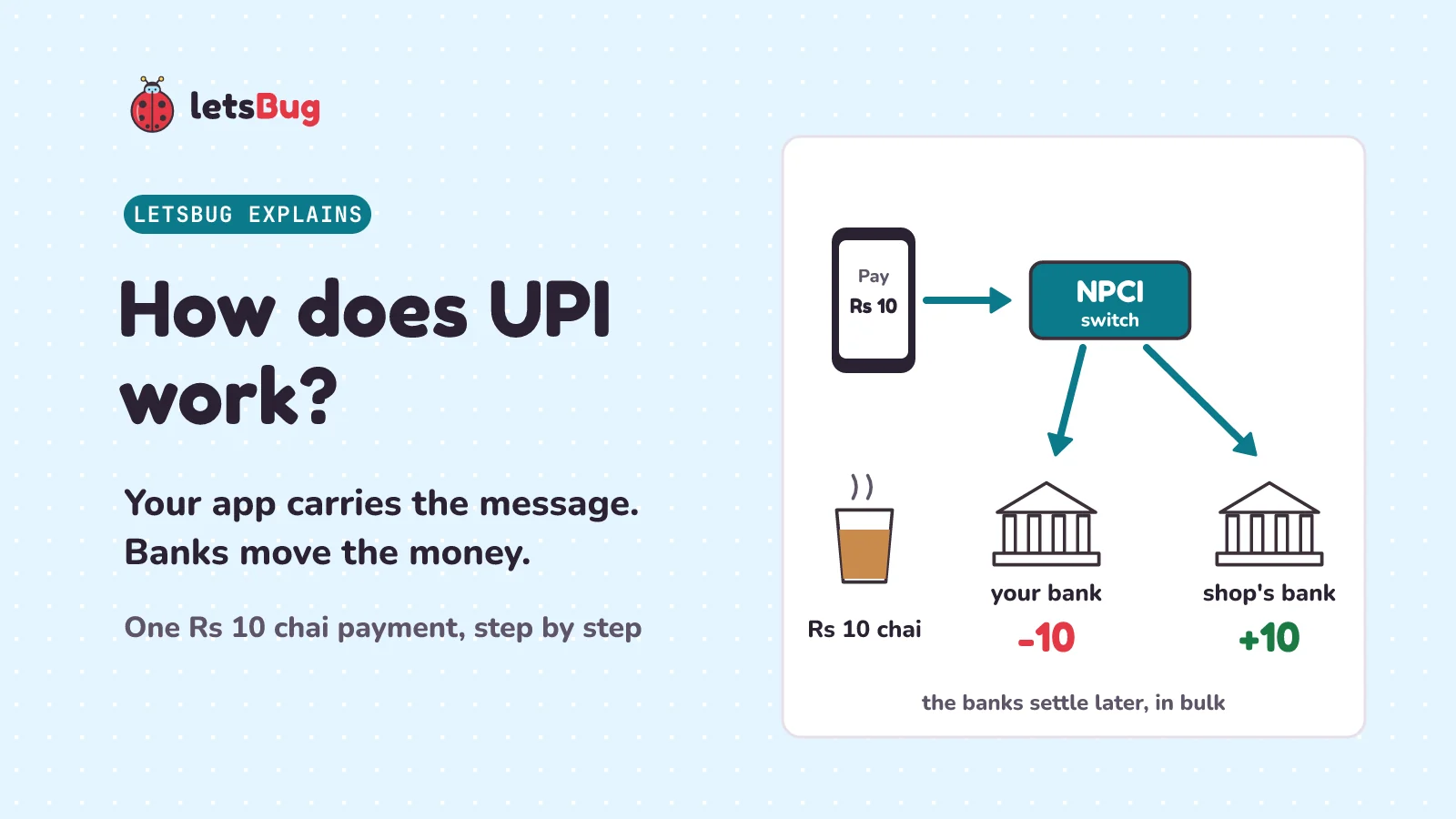
UPI moves money between bank accounts, not between apps. When you pay Rs 10 for chai, your app sends a message through its partner bank to the NPCI switch, the computers at the centre of UPI. Your bank checks your PIN and takes Rs 10. The shop's bank adds Rs 10. The two banks pay each other later, in bulk.
In this post we follow one Rs 10 chai payment from the moment you scan the QR code. We meet everyone it passes through, read what is inside a UPI QR code with a few lines of Python, and see how the banks pay each other later at the Reserve Bank. The payment counts are the latest official ones, from the RBI's September 2026 table.
Key takeaways
- Payment apps like Google Pay and PhonePe don't hold the money in a UPI payment. They carry messages. The money stays in bank accounts, and banks move it.
- One payment can involve up to four banks: your app's partner bank, the shop's partner bank, your bank and the shop's bank. In the middle sits the NPCI switch, which passes every message on.
- The QR code at the stall holds a short link,
upi://pay?pa=...&pn=...: the shop's UPI ID and name. No money moves when you scan it. - Your own bank checks your UPI PIN and takes the money. The shop's bank adds it. NPCI's rule gives the payment request 15 seconds to get its answer.
- Between the banks, no money moves yet. About 10 times a day, they settle through their accounts at the Reserve Bank of India, and only the difference moves.
- In September 2026, UPI handled 24.07 billion payments worth Rs 29.37 lakh crore (RBI data): about 802 million a day.
- Your PIN is only ever for paying. Anyone who asks for it so that you can "receive" money is trying to take your money.
This post goes with letsBug Explains, episode 5. Watch it, or read on: the post adds the latest RBI figures, a UPI link taken apart in Python, a settlement calculator and practice questions with answers.
Does your payment app hold your money?
Myth or fact: when you pay for chai with Google Pay or PhonePe, the app moves your money? Myth. In a UPI payment, the app never holds the money at all. It carries messages. The money sits in bank accounts, and the banks move it.
UPI stands for Unified Payments Interface. In Wikipedia's words, it is an Indian instant payment system "developed by the National Payments Corporation of India (NPCI)", and it is used "to instantly transfer funds between two bank accounts using only a unique UPI ID". NPCI is the organisation that runs UPI. UPI "is regulated by the Reserve Bank of India (RBI)": the RBI sets the rules it must follow.
This post follows a normal UPI payment from your bank account, made with your PIN, the kind in the video. Other kinds, such as UPI Lite, work differently, and this post leaves them out.
How many UPI transactions happen in a day?
First, two Indian number words. One lakh is 100,000. One crore is 10,000,000, which is 100 lakh. A million is 10 lakh, and a billion is 100 crore. So "29.37 lakh crore" means 29.37 × 100,000 × 10,000,000 rupees, about 29 trillion.
The Reserve Bank publishes a table every month called Payment System Indicators. Its September 2026 table (the data is marked "provisional", so it may be revised slightly) gives UPI's numbers. Volume means the number of payments, and value means the money they carried:
| Month | UPI payments (volume) | Money moved (value) |
|---|---|---|
| September 2025 | 19.63 billion | Rs 24.90 lakh crore |
| August 2026 | 24.51 billion | Rs 29.82 lakh crore |
| September 2026 | 24.07 billion | Rs 29.37 lakh crore |
August has 31 days and September 30, so per day September was a little busier: about 802 million payments a day against 791 million.
The RBI's table counts in lakh: September 2026's row says 240683.80 lakh payments, which is 24,068,380,000. Let's turn that into everyday sizes:
- September has 30 days, so that's 24,068,380,000 ÷ 30 ≈ 802 million payments a day.
- A day has 86,400 seconds, so that's about 9,300 payments every second, on average.
- Rs 29.37 lakh crore ÷ 24.07 billion payments ≈ Rs 1,220, the average payment. Your chai is just Rs 10.
- In a year, from September 2025 to September 2026, the number of UPI payments grew by about 23%.
- Of all the digital payments in the RBI's table that month, UPI made about 87 in every 100, counted by number.
UPI began small. Its pilot launch, Wikipedia says, "took place on 11 April 2016", "with 21 member banks participating".
Who is involved in a UPI payment?
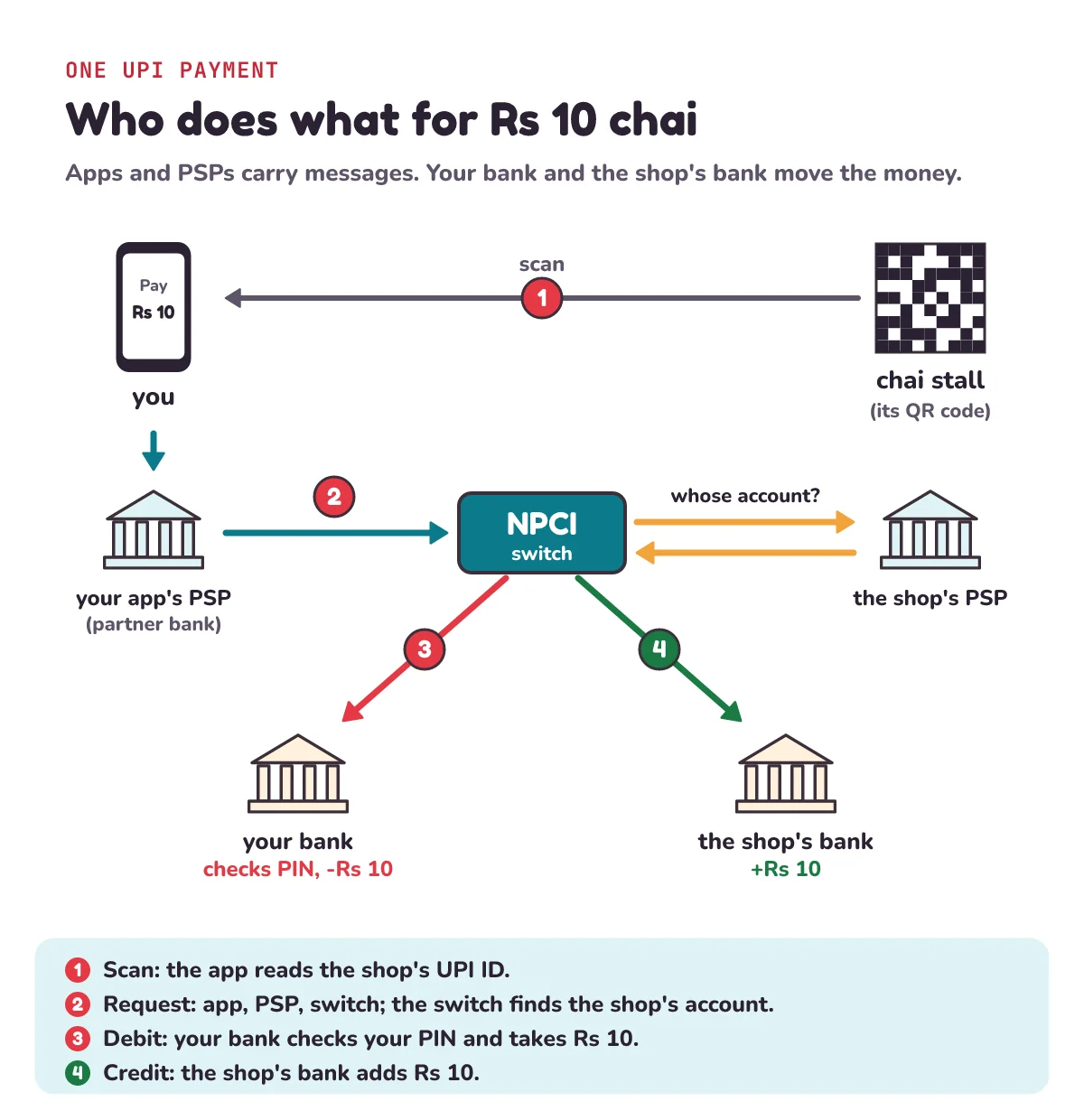
Let's meet everyone involved in one chai payment. You have an account at your bank. The chai stall has an account at its bank. Between you sit a few more players:
- Your app, such as Google Pay. Apps like this are called third-party application providers, or TPAPs. "Third-party" means they are not a bank and not NPCI. An app doesn't talk to NPCI by itself.
- The app's partner bank, called a payment service provider, or PSP. Aswin Mohan's guide to UPI puts it simply: "The banks which provide these services are called Payment Service Providers." Your side has a payer PSP. The shop's side has a payee PSP, named by the handle in its UPI ID.
- The NPCI switch. A switch is a set of computers that passes each message on to the right place. PhonePe's business guide explains what it does: it receives each request, finds the shop's account from its UPI ID, and passes the debit and credit requests between the two banks.
- The remitter bank: your bank, where the money leaves. "Remit" means to send money.
- The beneficiary bank: in PhonePe's words, "The recipient’s account-holding bank". A beneficiary is the person who gets the money, here the chai stall.
That's up to four banks and one switch. Sometimes one bank plays two parts, for example when your app's partner bank is also the bank that holds your account. Wikipedia calls this a "four-pillar" model, with a "front-end PSP" and a "back-end bank" on each side. The front end is the bank behind the app. The back end is the bank that holds the account.
What does @okaxis mean in a UPI ID?
A UPI ID is a name for a bank account, like you@okaxis. Some guides call it a VPA, a virtual payment address. The part after the @ is called the handle, and it points to a PSP.
Try it yourself: open your UPI app and find your UPI ID. Google Pay's help page lists IDs "ending with @okaxis, @okicici, or @oksbi", and another ending "with @okhdfcbank". The letters after "ok" are bank names: Axis, ICICI, SBI and HDFC Bank. Google Pay works through several partner banks, and your ID's ending shows which one handles your payments.
What is inside a UPI QR code?
First comes the scan. The QR code at the stall isn't magic. Inside is a short link. NPCI's linking specification (version 1.6, from 2017: its document of rules for these links) says the format "must be as follows": upi://pay?parm-name=param-value¶m-name=pram-value&... (the spelling slips, "parm" and "pram", are in NPCI's original). Each piece after the ? is a name, an equals sign and a value. The two you always find are:
pa, the payee address: the shop's UPI ID ("Payee VPA" in the spec);pn, the payee name.
There can also be am, the amount. The spec says: "If `am' is not present then field is editable." A printed QR code at a chai stall usually has no amount in it, so you type Rs 10 yourself. And cu is the currency: "Currently ONLY "INR" is the supported value." INR means Indian rupees.
Shops have a lot of these printed codes. The RBI's table counts 885.5 million static UPI QR codes (printed ones that never change) in September 2026.
Let's take a link apart with Python. The UPI ID chaistall@psp is made up, so nobody gets paid by accident. In a link, %20 stands for a space.
from urllib.parse import urlsplit, parse_qs

link = "upi://pay?pa=chaistall@psp&pn=Chai%20Stall&cu=INR"
parts = urlsplit(link)            # cut the link into its pieces
fields = parse_qs(parts.query)    # the part after "?", as a dictionary
print(parts.scheme, parts.netloc)
for name, values in fields.items():
    print(name, "=", values[0])
print("amount given?", "am" in fields)
print("handle:", fields["pa"][0].split("@")[1])
upi pay
pa = chaistall@psp
pn = Chai Stall
cu = INR
amount given? False
handle: pspurlsplitcuts the link at the:, the//and the?. The scheme, the part before the colon, isupi. It tells your phone that a UPI app should open the link: the spec says every PSP app must listen for "UPI" links. The part after//,pay, is the action.parse_qsturnspa=...&pn=...into a dictionary, a lookup table from each name to its value. It also turns%20back into a space.- There is no
am, so the amount box is left for you to fill in. split("@")cuts the UPI ID at the @. Item 1 (Python counts from 0, so that's the second piece) is the handle, which tells the switch which PSP to ask.
So far, no money has moved. Nothing has even left your phone.
What happens when you make a UPI payment?
You tap pay and type your UPI PIN, which has four or six digits. Then, in order:
- The request. Your app sends the payment request to its partner bank. In Aswin Mohan's words, "The TPAP sends the request to the Payer Bank which forwards it to the central UPI switch hosted at NPCI". Here "Payer Bank" means the app's partner bank, the payer PSP.
- The lookup. The switch reads the shop's UPI ID and asks the shop's PSP whose account it is. "The UPI Switch then finds the Payee PSP from the VPA id", and "The Payee PSP validates the request and returns the account details" to NPCI. PhonePe's guide describes the same job: NPCI "resolves the Payee's Virtual Payment Address (VPA)", which means it finds the account behind the UPI ID.
- The debit. A debit means taking money out of an account. The switch asks your bank to take Rs 10. Your bank, not the app, checks your PIN: "The Remitter Bank authenticates the UPI Pin and if it matches, debits the amount and sends the request back to UPI Switch." If the PIN is wrong, or you don't have Rs 10, the payment stops here.
- The credit. A credit means adding money to an account. The switch tells the shop's bank to add Rs 10 to the stall's account. "Once the money reaches the Beneficiary bank, the corresponding account is credited and an acknowledgement is returned." Confirmations travel back, and both phones say paid.
All of this has a time limit. MediaNama reported NPCI's rule, effective from 16 June 2025: "Request and response pay APIs: From 30 seconds to 15 seconds." An API (application programming interface) is a fixed way for one computer to ask another for something. So the payment request now has 15 seconds to get its answer, half the old 30.
When do banks settle UPI payments?
So did your Rs 10 just go from your bank to the stall's bank? It's tempting to think so, but no. Your balance went down by Rs 10 and the stall's went up by Rs 10, straight away. Between the two banks, though, not a single rupee has moved yet.
Setu's guide to UPI settlement says it plainly: "Although, Bob received money in his account realtime, their banks didn’t really exchange money." For now, the banks just keep a record: your bank owes the stall's bank Rs 10.
What is net settlement in UPI?
Settlement is when the banks pay each other what they owe. Here's how UPI does it:
- "Every member bank of UPI needs to have an account with Reserve Bank of India." The RBI is the bank that banks use. Setu calls it "the bank of all banks".
- Every few hours, NPCI adds up all the payments since the last round. Setu: "Once in few hours, NPCI combines all the transactions that happened during the last period and creates a bulk settlement file."
- Business Today reported in September 2025 that "UPI operates 10 settlement cycles each day".
Here's an example. Say that in one round, Bank A's customers paid Bank B's customers Rs 500 crore, and Bank B's customers paid Bank A's Rs 480 crore. That's really millions of payments. Instead of millions of transfers, there's just one: Bank A pays Bank B the difference, 500 − 480 = Rs 20 crore, from its account at the RBI to Bank B's. Paying only the difference like this is called net settlement. "Net" means what's left after you take one side away from the other.
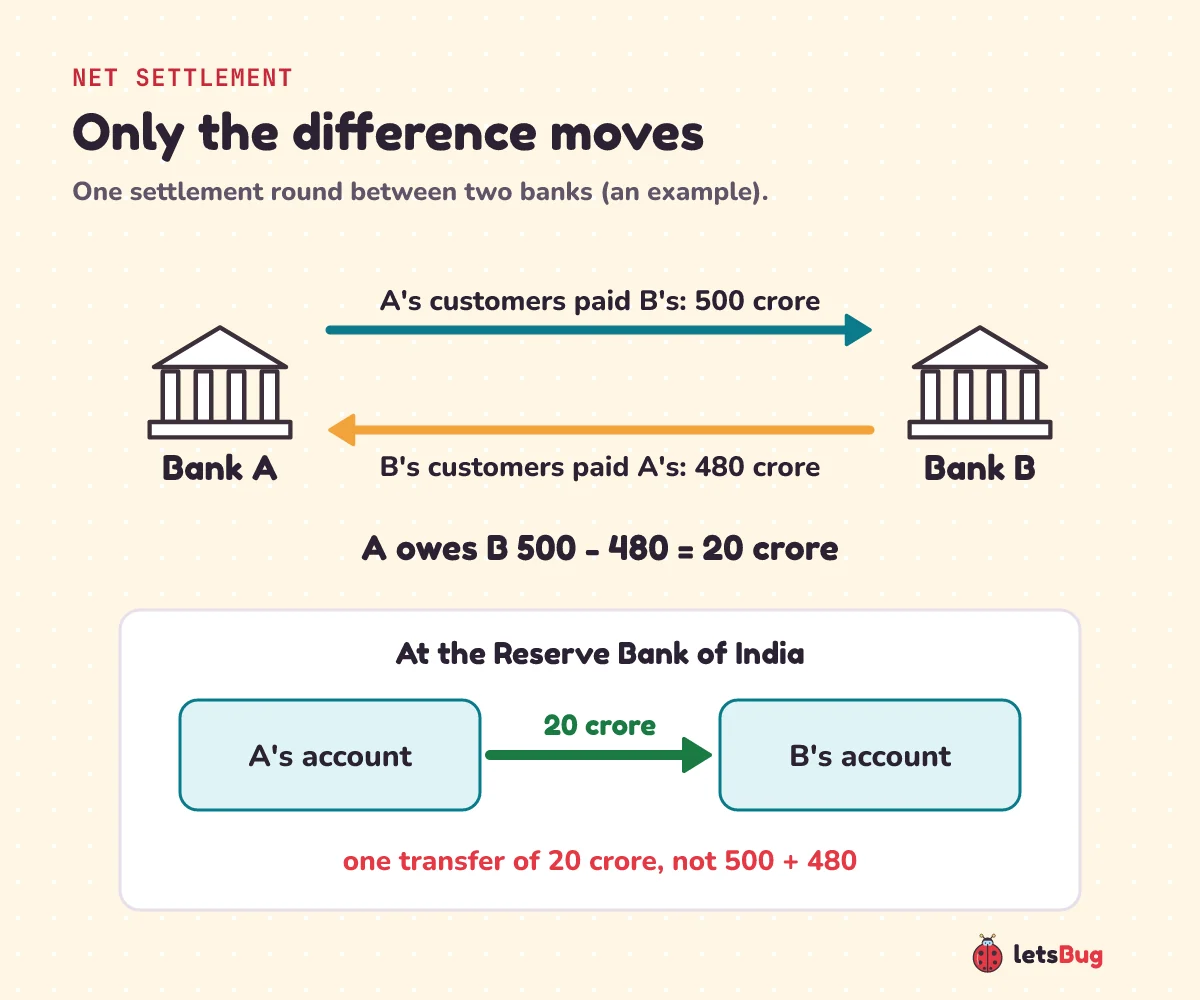
A common slip is to say that 500 + 480 = 980 crore moves between the banks. It doesn't. Only the difference does.
Here's the scorekeeping in Python. Each payment is written as (payer's bank, payee's bank, amount in crore). A positive number means the bank owes money at settlement. A negative number means it is owed money.
def net(payments):
    owes = {}
    for payer_bank, payee_bank, crore in payments:
        owes[payer_bank] = owes.get(payer_bank, 0) + crore   # its customers paid out
        owes[payee_bank] = owes.get(payee_bank, 0) - crore   # its customers were paid
    return owes

print(net([("A", "B", 500), ("B", "A", 480)]))
{'A': 20, 'B': -20}Bank A owes 20 and Bank B is owed 20, so A pays B Rs 20 crore. owes.get(bank, 0) reads a bank's score so far, or 0 if it has none yet. With many banks, the same code gives each bank one number: what it owes, or is owed, by all the others together. This is a toy model, not NPCI's real code. Try it on the practice questions below.
Why should you never enter your UPI PIN to receive money?
The steps above explain a safety rule. Your PIN is checked by your bank in step 3, the debit. It is only ever used to take money out of your account. To receive money, you never need it.
The RBI's booklet on fraud, BE(A)WARE, warns about exactly this trick, a message saying "Please enter PIN to receive money!!". Its advice: "Always remember that there is no need to enter PIN / password anywhere to receive money. If UPI or any other app requires you to enter PIN to complete a transaction, it means you will be sending money instead of receiving it." It adds: "Never scan any QR code to receive money."
So if anyone asks for your PIN to send you a refund, a prize or cashback, it's a scam.
Back to the myth
So, your app didn't move your money. It carried a message to its partner bank, and on to the NPCI switch. Your bank checked your PIN and took Rs 10. The stall's bank added Rs 10. Within a few hours, the banks paid each other in bulk, through their accounts at the Reserve Bank. In September 2026, all of that happened about 802 million times a day.
1) In one round, Bank P's customers sent Rs 320 crore to Bank Q's customers, and Bank Q's customers sent Rs 350 crore back. Who pays whom at settlement, and how much?
2) Bank X's customers send Rs 900 crore to Bank Y's, and Bank Y's customers send Rs 650 crore back. Who pays whom?
3) A month has 31 days, and UPI handles 25 billion payments in it. About how many is that a day?
4) A QR code holds upi://pay?pa=teacorner@psp&pn=Tea%20Corner&am=15. Who are you paying, and can you change the amount?
5) Someone messages you: "Enter your UPI PIN to receive your cashback." What do you do?
Show the answers
1) Bank Q pays Bank P Rs 30 crore: 350 − 320 = 30. Q's customers sent more, so Q owes the difference. Not 670 crore.
2) Bank X pays Bank Y Rs 250 crore: 900 − 650 = 250.
3) 25,000,000,000 ÷ 31 ≈ 806 million a day.
4) Tea Corner, at the UPI ID teacorner@psp, for Rs 15. The link has am=15, so your app fills in Rs 15 for you. The spec says the amount is editable only when am is missing.
5) Refuse. The PIN is only for paying, never for receiving.
Questions people ask
How does UPI work, step by step?
You scan the shop's QR code, which holds its UPI ID. Your app sends the request through its partner bank (PSP) to the NPCI switch. The switch asks the shop's PSP for the shop's account. Your bank checks your PIN and takes the money, and the shop's bank adds it. The banks settle with each other later, at the RBI.
Do Google Pay or PhonePe hold my money?
Not in a UPI payment from your bank account. The app only carries messages. The money is taken from your bank account by your bank and added to the shop's account by the shop's bank.
What does @okaxis or @oksbi mean in my UPI ID?
The part after the @ is the handle, and it points to a payment service provider (PSP), the partner bank your app works through. Google Pay's IDs end in handles such as @okaxis, @okicici, @oksbi and @okhdfcbank.
How long does a UPI payment take?
For you and the shop, the balances change at once. NPCI's rule, from 16 June 2025, gives the payment request 15 seconds to get its answer (it used to be 30). The banks settle with each other later, about 10 times a day.
Do I need my UPI PIN to receive money?
No. The RBI says "there is no need to enter PIN / password anywhere to receive money". If an app asks for your PIN, you are sending money, not receiving it.
How many UPI transactions happen in a day?
In September 2026, UPI handled 24.07 billion payments worth Rs 29.37 lakh crore, according to the RBI's Payment System Indicators. That's about 802 million a day, or about 9,300 every second.
Who runs UPI?
The National Payments Corporation of India (NPCI) developed UPI and runs its switch. The Reserve Bank of India (RBI) regulates it.
Keep going
- Watch the full lesson, How Does UPI Work? One Rs 10 Chai Payment, Step by Step, and its Short, How Does UPI Work? Your App Never Touches Your Money. Then see the rest of letsBug Explains on YouTube.
- Messages passed from computer to computer: what happens when you type a URL?, letsBug Explains episode 3.
- Another kind of switch that routes every request: what is an API gateway?
- The episode before this one: how does a rotary encoder work?
- The next episode: switch debouncing explained, why one button press can count as 7.
Checked on 1 November 2026 against the 10 sources below.
Sources
- Reserve Bank of India: Payment System Indicators, September 2026 (UPI volume and value for September 2025, August 2026 and September 2026; total digital payments; static UPI QR codes; data provisional)
- Reserve Bank of India: BE(A)WARE, a booklet on fraudsters' methods (no PIN needed to receive money; never scan a QR code to receive money)
- Wikipedia: Unified Payments Interface (developed by NPCI, regulated by the RBI; pilot launch 11 April 2016 with 21 banks; four-pillar model; four- or six-digit PIN)
- PhonePe Business: What is a UPI switch (beneficiary bank; NPCI resolves the UPI ID and routes debit and credit requests)
- Aswin Mohan: How UPI works (TPAPs and PSPs; the request, lookup, PIN check, debit and credit)
- Setu: UPI 103: The Settlement (customers paid in real time, banks settle later; every UPI bank has an RBI account)
- Business Today: UPI settlement rules to change from November 3 (2025; 10 settlement cycles a day)
- MediaNama: NPCI cuts UPI response times (June 2025; pay request answered within 15 seconds)
- Google Pay Help: UPI ID (handles @okaxis, @okicici, @oksbi, @okhdfcbank)
- NPCI: UPI Linking Specifications 1.6 (2017, copy hosted by Labnol; upi://pay links, pa, pn, am, cu)
Every code sample in this post was run in Python 3.13 before publishing.