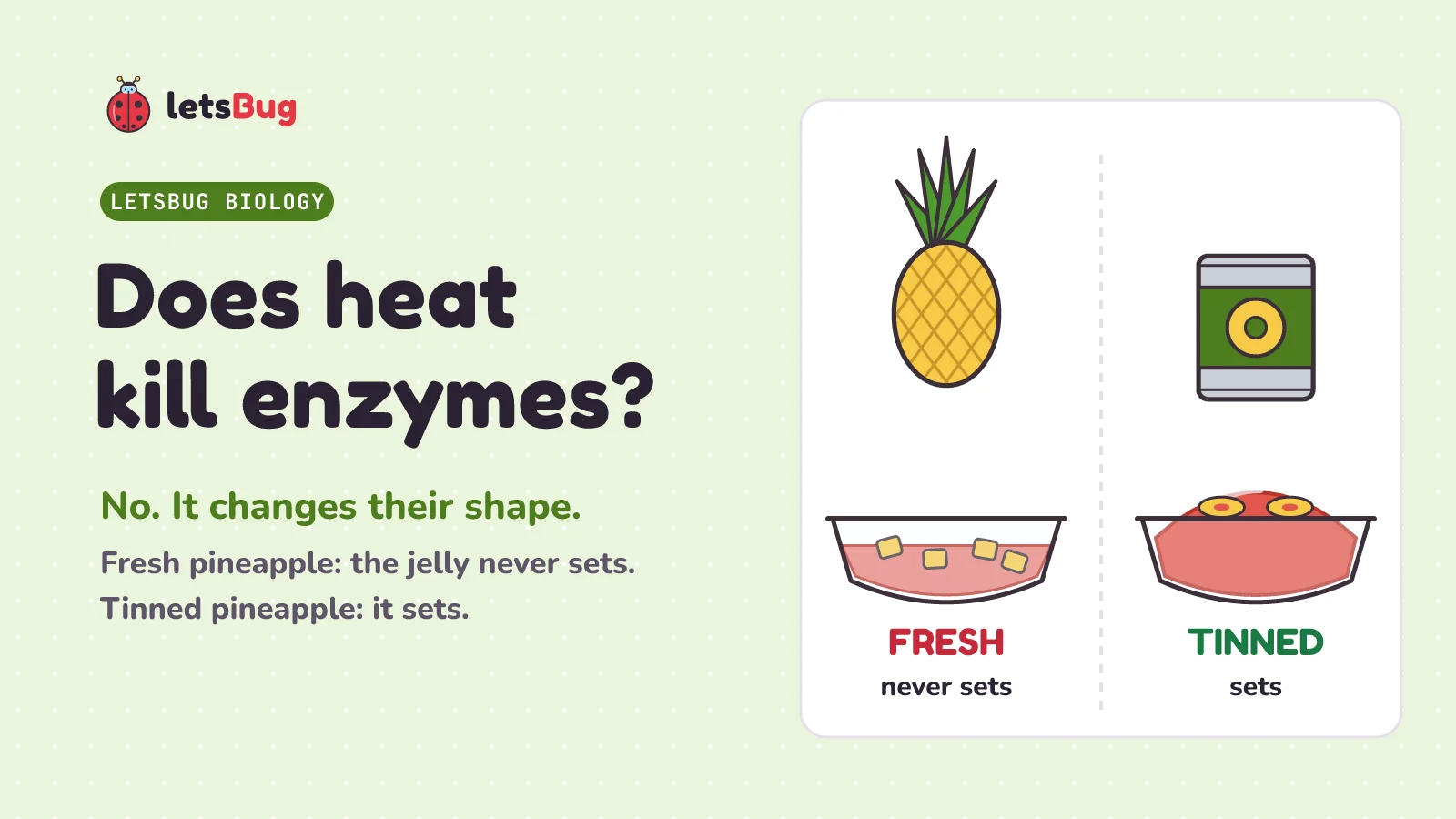
Heat doesn't kill enzymes, because an enzyme was never alive. Warming an enzyme speeds it up until it reaches its best temperature, called the optimum: about 37 °C for most human enzymes. Above that, the rate falls fast: the enzyme's shape changes and it stops working. We say it is denatured. Cold doesn't denature enzymes. It only slows them down.
In this post we start with a kitchen puzzle: fresh pineapple stops a jelly setting, but pineapple from a tin doesn't. To solve it, we see what an enzyme is and how the lock and key model works. Then we see what heat, cold and pH (how acidic something is) really do to an enzyme. After that, we work out how fast amylase digests starch, using rate = 1 ÷ time. Last, we meet an enzyme from a hot spring that survives 95 °C. Every hard word is explained the first time it comes up, and the practice questions from the video are answered in full.
Key takeaways
- An enzyme is a biological catalyst: a protein that speeds up a reaction in a living thing without being used up. It is a molecule (a tiny group of atoms joined together), not a living thing.
- Each enzyme has an active site, a pocket with an exact shape. Only a substrate (the molecule it works on) with the matching shape fits, like a key in a lock. That's why enzymes are specific: each one only works on substrates of one shape.
- Warmer means faster, up to the optimum. Too hot, or the wrong pH, and the active site changes shape: the enzyme is denatured and stops working.
- Cold does not denature enzymes. It only slows them down. Frozen pineapple still stops jelly setting.
- In the amylase experiment, rate = 1 ÷ time. A longer time means a slower reaction: 1 ÷ 2.5 minutes = 0.4 per minute.
This post goes with letsBug Biology, episode 5. It covers the enzymes in digestion from Chapter 5 of the NCERT Class 10 science book ("Life Processes", CBSE). It also covers the enzymes topic of GCSE and IGCSE biology, where temperature and pH come in. Watch the lesson, or read on: the post adds the working for every calculation, a jelly test you can try at home, and model answers to practise with.
What is an enzyme?
An enzyme is a biological catalyst. A catalyst is something that speeds up a chemical reaction without being used up, so it can do the same job again and again. A chemical reaction is any change that turns substances into new ones, like starch turning into sugar. NCERT's Class 10 chapter puts it simply: "organisms use bio-catalysts called enzymes". Wikipedia's article on enzymes adds that nearly all the reactions inside a cell depend on enzymes to happen fast enough, including the reactions in the cytoplasm of a cell.
Most enzymes are proteins. A protein is a long chain of small building blocks called amino acids, folded up into one exact shape, like a long necklace of beads scrunched into a ball. Oxford University's chemists put it this way: "Enzymes are made up of proteins that are folded to produce a shape". That shape decides what the enzyme can do, as we'll see.
Your digestion depends on enzymes. Digestion means breaking big food molecules into small ones that your body can soak up into the blood. AQA's GCSE specification lists the three big groups: "Amylase is a carbohydrase which breaks down starch. Proteases break down proteins to amino acids. Lipases break down lipids (fats) to glycerol and fatty acids." (A carbohydrase is any enzyme that breaks down carbohydrates, the starches and sugars in food. Glycerol and fatty acids are the two smaller parts that a fat molecule splits into.)
| Enzyme (example) | Breaks down | Into |
|---|---|---|
| Amylase, a carbohydrase (salivary amylase, in your spit) | Starch | Simple sugars |
| Protease (pepsin, in your stomach) | Proteins | Shorter chains, then amino acids |
| Lipase (in pancreatic juice, made by the pancreas, an organ just behind your stomach) | Fats (lipids) | Fatty acids and glycerol |
NCERT names each one in its chapter: "The saliva contains an enzyme called salivary amylase", the stomach makes "a protein digesting enzyme called pepsin", and "pancreatic juice" contains "lipase for breaking down emulsified fats". (Emulsified fats are fats broken into tiny droplets, the way washing-up liquid breaks up grease.) Pepsin starts the job on proteins: Wikipedia says it "breaks down proteins into smaller peptides and amino acids". (Peptides are short chains of amino acids.) Other enzymes in the small intestine finish it. NCERT says they "finally convert the proteins to amino acids".
And here's the one that matters for our jelly: the enzyme in pineapple, bromelain, is a protease. Wikipedia describes bromelain as a mix of protein-digesting enzymes.
How does the lock and key model work?
Every enzyme has an active site: a small pocket on its surface with a precise shape. Oxford: "The shape provides a specific space where the reactions take place. This is called the active site." The molecule the enzyme works on is called its substrate, and what it's turned into are the products. Wikipedia: "The molecules on which enzymes act are called substrates, which are converted into products."
Only a substrate with the matching shape fits the active site, like a key in a lock. This idea is more than a century old: in 1894, a chemist called Emil Fischer suggested that an enzyme and its substrate have shapes that fit exactly into one another. Biologists call shapes like this complementary: shapes that fit together, like two jigsaw pieces. Here's what happens, step by step:
- The substrate slots into the active site. The enzyme and substrate stuck together are called an enzyme-substrate complex.
- The reaction happens: the substrate is split (or joined to something).
- The products leave. The enzyme is unchanged, and ready for the next substrate.
That's why enzymes are specific: each one only works on substrates of one shape. Amylase can't digest protein, because protein doesn't fit its active site. AQA: "Enzymes catalyse specific reactions in living organisms due to the shape of their active site." (To catalyse a reaction is to speed it up.) AQA also says students should use the "lock and key theory" as "a simplified model", so it's a picture that helps, not every detail.
Does heat kill enzymes?
No. To kill something, it has to be alive first, and an enzyme was never alive. It's a molecule: a chain of amino acids folded into a shape, no more alive than a grain of salt. "Heat kills enzymes" is the myth the video is named after, and it leads to a mix-up that Cambridge examiners wrote about in June 2024.
In that report, one IGCSE question asked students to explain why yeast made no carbon dioxide gas at 95 °C. The examiners' report says: "Some candidates wrongly assumed that yeast is an enzyme and that it, rather than the enzymes, is denatured." (Candidates are the students who sat the exam.) Yeast is not an enzyme. It's a living thing: "A yeast is any species of fungus that grows primarily in a unicellular form". In other words, a fungus made of just one cell. (Fungi are the group of living things that includes mushrooms and moulds.) It's the same yeast that makes bread dough rise. Yeast contains enzymes, and it's those enzymes that are denatured.
So what does heat really do? It changes the enzyme's shape. Oxford's chemists explain: "If the shape of the active site is distorted, the enzyme can no longer function and is described as being denatured." Distorted means bent out of shape. Denatured is the right word for an enzyme whose shape has been changed like this, so it can't work. Not "killed".
What is the effect of temperature on enzymes?
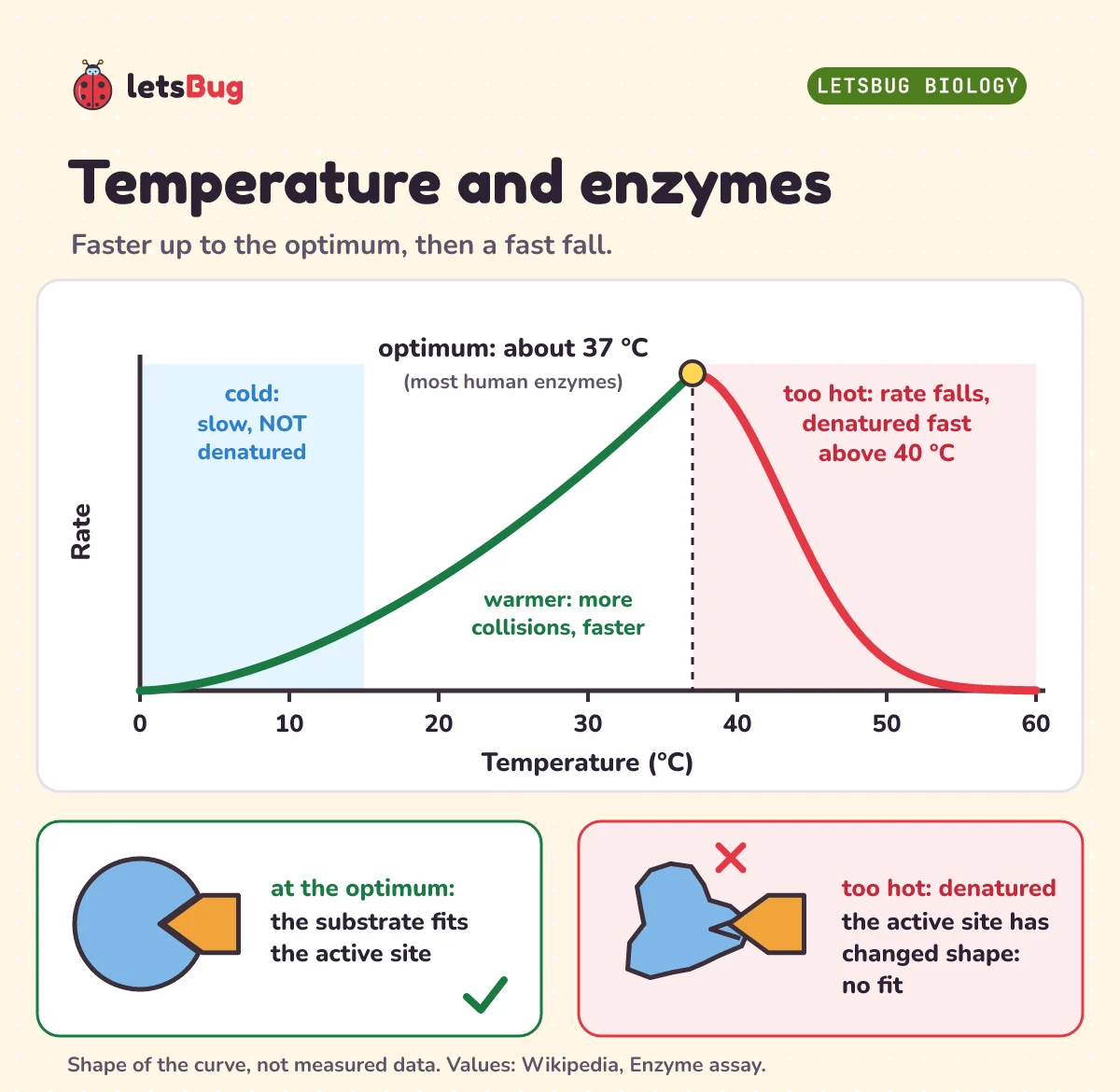
Think of the rate of an enzyme reaction (how fast it goes) as you warm it up from cold. It happens in three parts, and the graph below shows all three.
1. Warmer means faster. When something warms up, its molecules move faster. The enzyme and its substrate bump into each other more often, and harder, so more substrates land in an active site every second. In science, these bumps are called collisions. Wikipedia's article on collision theory: "Increasing the temperature increases the average kinetic energy of the molecules in a solution, increasing the number of collisions that have enough energy." (Kinetic energy is the energy of movement.) So the rate goes up.
2. The peak is the optimum. Every enzyme has one temperature where it works fastest. That's its optimum temperature. For us, it's close to body temperature. Wikipedia's article on enzyme assays (ways of measuring enzymes) says the optimum temperature for human enzymes "is usually between 35 and 40 °C. The average temperature for humans is 37 °C."
3. Too hot, and the rate falls fast. Go hotter than the optimum, and the enzyme shakes so much that the weak bonds holding its folded shape break. (Bonds are the links that hold atoms and the folds of the chain together.) Wikipedia's enzyme assay article explains denaturing this way: the weak bonds that hold the active site in shape come apart. The active site changes shape, the substrate no longer fits, and the rate drops. The same article goes on: "Human enzymes start to denature quickly at temperatures above 40 °C."
Can a denatured enzyme work again?
Usually not, once it has been heated far past its optimum. Cooking is the everyday example. Wikipedia's article on denaturing: "When food is cooked, some of its proteins become denatured. This is why boiled eggs become hard and cooked meat becomes firm." A boiled egg never goes runny again when it cools. The article says it plainly: "Denaturation can also be irreversible", which means it can't be undone. It isn't always like that. The same article also says: "In many cases, denaturation is reversible". But the bromelain in tinned pineapple stays denatured: that's why the jelly sets. And in exams, treat a boiled enzyme as denatured and inactive. Cambridge examiners noticed that some students "did not realise that boiled lipase would be denatured and therefore inactive."
Does cold denature enzymes?
No. This is the second wrong idea in the myth. Cambridge's examiners wrote about it twice in the same June 2024 report: "A common misconception is that enzymes will denature at both high and low temperatures." And: "A common misconception was that a change in temperature would cause denaturation of an enzyme, when only an increase would achieve this and not a decrease." (A misconception is a wrong idea that a lot of people believe.)
Here's why. In the cold, molecules move slowly, so there are fewer collisions, and the reaction slows down. But nothing shakes the enzyme apart. Its active site keeps its shape. Warm it up again, and it works again. At school level, the rule is: only a rise in temperature denatures an enzyme, not a fall.
The pineapple proves it. Oxford's jelly experiment freezes pineapple for two hours, and its notes say: "frozen pineapple can be used as the freezing process does not denature the enzymes." Frozen pineapple stops jelly setting, just like fresh.
Why does fresh pineapple stop jelly setting?
Now we can solve the puzzle. Start with the jelly. Oxford: "Jelly contains gelatine which sets the jelly when added to hot water." And: "Gelatine is derived from the protein collagen." So gelatin (or gelatine, the British spelling) is a protein, made from collagen, a tough protein found in animals' bodies. Wikipedia says it's "commonly derived from partial hydrolysis of collagen taken from animal body parts". (Hydrolysis is breaking big molecules into smaller ones using water.)
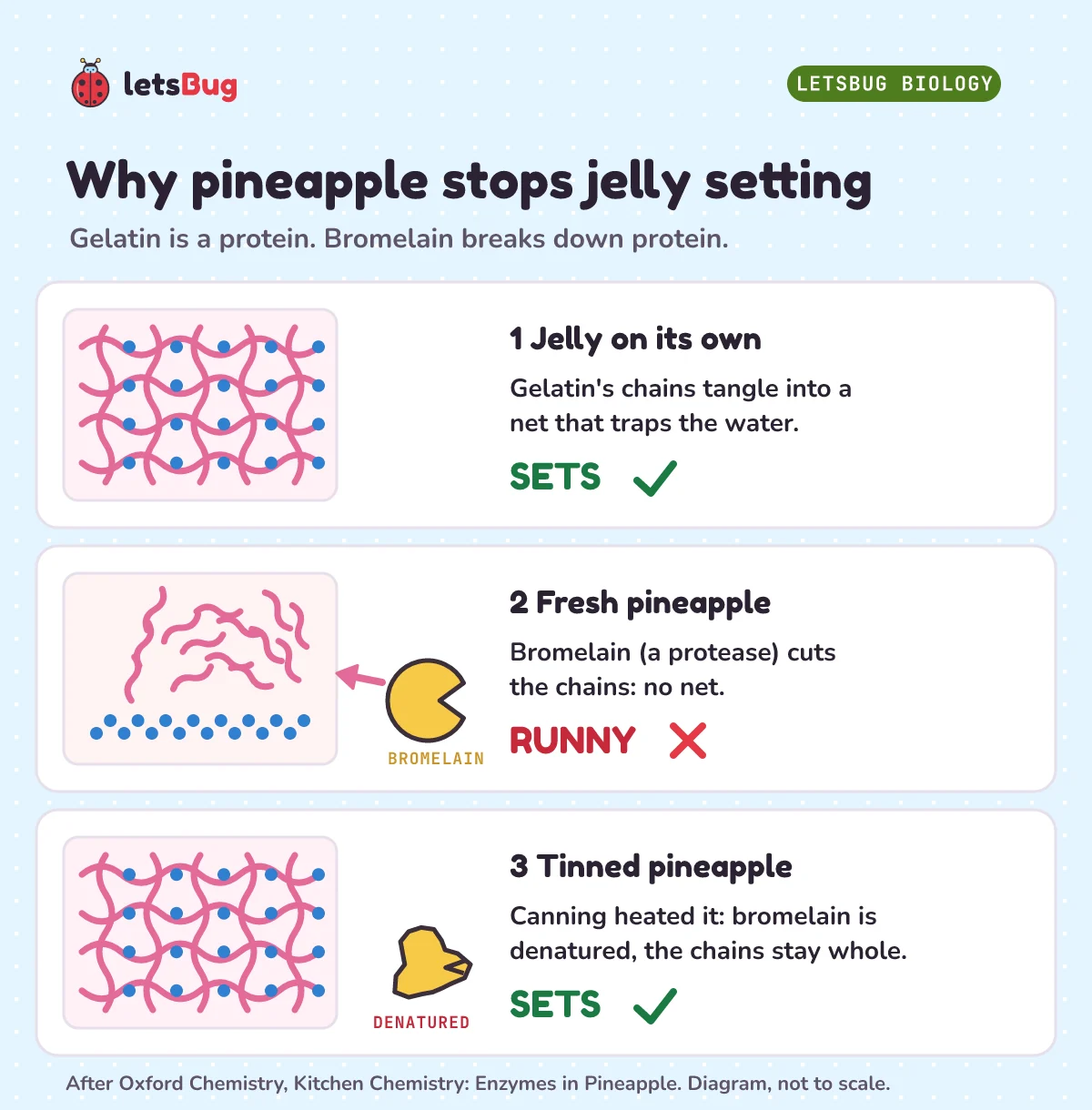
Gelatin is made of long protein chains. As the jelly cools, the chains tangle into a net. Wikipedia: "These amino acid chains form a three-dimensional network". And: "When cooled, water is trapped within its network structure". That trapped water is why jelly wobbles instead of sloshing. The net is what makes it set.
Fresh pineapple contains bromelain, a protease, and gelatin is a protein. Bromelain cuts the gelatin's chains into short pieces, so the net never forms. Oxford's notes spell it bromelin, and talk about collagen, the protein gelatin is made from. They say the enzyme in fresh pineapple "breaks down collagen and this prevents the jelly from setting."
Pineapple in a tin has been heated when it was canned. Its bromelain is denatured, the chains stay whole, and the jelly sets. Cooks know the same thing from meat. Bromelain softens meat by breaking down its protein: "Along with papain, bromelain is one of the most popular proteases to use for meat tenderizing." But "Cooked or canned pineapple does not have a tenderizing effect, as the enzymes are heat-labile and denatured in the cooking process." (Heat-labile means easily damaged by heat.)
Pineapple isn't the only fruit that does this: "kiwi contains the enzyme actinidin, papaya contains the enzyme papain, both act in the same way as bromelin, and prevent jelly setting."
Try it at home: the pineapple jelly test
Oxford's Department of Chemistry turned this into a kitchen experiment (adapted from the Royal Society of Chemistry's Kitchen Chemistry). Ask an adult to do the cutting and the boiling water. Make up one packet of jelly, pour it into four small bowls, then add the chunks:
- Heated pineapple chunks: "Microwave one portion of pineapple chunks for one minute."
- Frozen chunks: "Place one portion of pineapple chunks in the freezer for two hours."
- Fresh chunks.
- No pineapple. This is the control: a bowl with nothing changed, so you can compare the others with it.
You could add a fifth bowl with tinned pineapple too. Put them all in the fridge. Oxford's notes say to give the control 2–4 hours to set, then look at all the bowls. From the science above, you'd expect the fresh and frozen bowls to stay runny, and the heated bowl to set like the control. Keep the chunks the same size and the jelly from the same batch, so it's a fair test.
How does pH affect enzymes?
Heat isn't the only thing that changes an enzyme's shape. pH does too. pH is a scale that shows how acidic or alkaline a liquid is. Wikipedia: "Pure water has a pH of 7 at 25 °C, meaning it is neutral. When an acid is dissolved in water, the pH will be less than 7, while a base, or alkali, will have a pH greater than 7." (Neutral means neither acid nor alkali. An alkali is the chemical opposite of an acid: the same article puts bleach at pH 12.5.) The same article lists stomach acid at "Gastric acid 1.0–1.5": very acidic.
Every enzyme has an optimum pH, the pH where it works fastest, and it matches where the enzyme works:
- Pepsin, a protease in your stomach, likes strong acid. "Pepsin is most active in acidic environments between pH 1.5 to 2.5." NCERT says the stomach makes hydrochloric acid for exactly this reason: "The hydrochloric acid creates an acidic medium which facilitates the action of the enzyme pepsin." (Facilitates means makes it possible.)
- Salivary amylase, in your mouth, likes it nearly neutral. It is a type called alpha-amylase, and Wikipedia gives alpha-amylase's "optimum pH is 6.7–7.0".
Too far from the optimum pH, the active site loses its shape, and the enzyme stops working. OpenStax: "extreme environmental pH values (acidic or basic) can cause enzymes to denature." Pepsin shows that this happens in steps: "Pepsin is inactive at pH 6.5 and above; however, pepsin is not fully denatured or irreversibly inactivated until pH 8.0." (Inactive means not working.) So between pH 6.5 and 8, pepsin stops but can still start again if it gets acidic. Above pH 8, its shape is changed permanently.
How do you calculate the rate of an enzyme reaction?
The classic school experiment measures how fast amylase digests starch at different pH values. In AQA's GCSE it's a required practical, an experiment every student has to do. (We worked through a different classic practical, with potatoes, in what is osmosis?) AQA's wording: "Required practical activity 5: investigate the effect of pH on the rate of reaction of amylase enzyme."
Here's how it works. Starch and a buffer (a solution that keeps the pH fixed at one value) go into a test tube in a warm water bath, because "Temperature must be controlled by use of a water bath or electric heater." When they have warmed up, add the amylase and start the timer. Then, as AQA says: "Iodine reagent is to be used to test for starch every 30 seconds." (A reagent is a chemical used to test for something.) Each time, a drop of the mixture goes onto a drop of iodine on a white spotting tile (a tile with small dips in it). Iodine is a test for starch: "The combination of starch and iodine is intensely blue-black." Iodine doesn't turn blue-black with the simple sugars that amylase makes. So when a drop no longer turns blue-black, the starch is all gone. The time on the timer then is how long the amylase took.
Say the starch is gone after 1 minute at pH 6, and after 2.5 minutes at pH 8. (These are made-up times to practise with, like in the video.) Which pH was faster?
The common mistake is to say pH 8, because 2.5 is the bigger number. But 2.5 is a time, and a longer time means a slower reaction. Turn each time into a rate first:
pH 6: rate = 1 ÷ 1 = 1 per minute
pH 8: rate = 1 ÷ 2.5 = 0.4 per minute
1 ÷ 0.4 = 2.5, so at pH 6 the amylase worked 2.5 times faster.
The unit, per minute, tells you how many times the whole job could be done in one minute. At pH 6 that's once a minute; at pH 8 it's only 0.4 of the job in a minute.
Which enzyme survives 95 °C?
Not every enzyme stops working above 40 °C. In 1969, two scientists described a bacterium from a hot spring in Yellowstone National Park, in the USA: "In 1969, Thomas D. Brock and Hudson Freeze of Indiana University reported a new species of thermophilic bacteria which they named Thermus aquaticus." (Thermophilic means heat-loving. A bacterium, plural bacteria, is a living thing made of one tiny cell.) We'll call it T. aquaticus for short. It came from "Mushroom Spring in the Lower Geyser Basin of Yellowstone National Park". It likes it far hotter than our bodies: "T. aquaticus shows best growth at 65–70 °C".
Its enzymes are built for that heat. One of them, Taq polymerase, copies DNA (the molecule that carries the instructions for building a living thing). A polymerase is an enzyme that builds long chains, here new copies of DNA. Wikipedia gives Taq's "optimum temperature for activity is 75–80 °C", and a half-life of "40 minutes at 95 °C". A half-life is the time it takes to lose half of its activity. So after 40 minutes at 95 °C, Taq still has half its activity left. A human enzyme would start to denature above 40 °C.
That toughness made Taq famous. Scientists copy DNA with a method called PCR (polymerase chain reaction). DNA is made of two long strands (threads) twisted together. In each round of PCR, the mixture is heated above 90 °C to pull the two strands apart. (Biologists call this denaturing the DNA too, but here it just means the two strands come apart.) An ordinary DNA-copying enzyme would be denatured by that heat, as Wikipedia's PCR article explains. Taq survives it, so almost all PCR uses a heat-stable enzyme like Taq. PCR is used in genetics and in medical diagnostics: the tests doctors use to find out what illness someone has.
So each enzyme's optimum suits the place where it works: about 37 °C for us, and 75–80 °C for Taq.
Your turn. These are the three practice questions from the video. Try each one before you open the answers.
1) Amylase took 2.5 minutes to digest the starch at pH 8 and 1 minute at pH 6. Calculate both rates.
2) Does fresh pineapple stop a carrageenan (vegetarian) jelly from setting? Explain. Carrageenan is a jelly-maker taken from seaweed.
3) Explain why fresh pineapple stops jelly setting but tinned pineapple does not.
Show the answers
1) Rate = 1 ÷ time. pH 8: 1 ÷ 2.5 = 0.4 per minute. pH 6: 1 ÷ 1 = 1 per minute. So the reaction was 2.5 times faster at pH 6. (The longer time, 2.5 minutes, is the slower reaction.)
2) No, it still sets. Bromelain is a protease: it only breaks down proteins. Carrageenan is not a protein. It's a carbohydrate (a sugar-based molecule): Wikipedia describes carrageenans as polysaccharides (long chains of sugar units) taken from red seaweeds. Carrageenan doesn't fit bromelain's active site, so it isn't broken down. Enzymes are specific. Oxford's notes agree: "vegetarian jelly usually contains carrageenan (found in seaweed) which is not affected by the enzymes in pineapple".
3) Say it in four steps:
- Bromelain, in fresh pineapple, is a protease. It breaks down gelatin, a protein, so the jelly can't set.
- Canning heats the pineapple to a high temperature, far above the enzyme's optimum.
- Bonds holding the enzyme's shape break, and the active site changes shape: the enzyme is denatured.
- Gelatin no longer fits the active site, so it isn't broken down, and the jelly sets.
"The heat killed the enzyme" is the wrong answer. An enzyme was never alive.
Exam-style questions with model answers
Our model answers, written in the style of exam mark schemes. The number in brackets is the marks. Each mark is one clear point.
Q1. Describe and explain the effect of temperature on the rate of an enzyme-controlled reaction. [3]
Model answer
As the temperature rises, the rate increases, because the molecules have more kinetic energy and collide more often [1]. The rate is highest at the optimum temperature [1]. Above the optimum, the enzyme is denatured: the active site changes shape, so the substrate no longer fits, and the rate falls [1].
Q2. A student says enzymes are denatured in a fridge. Explain why this is wrong. [2]
Model answer
Low temperature only slows the reaction down, because there is less kinetic energy and there are fewer collisions [1]. The active site keeps its shape, so the enzyme works again when it's warmed up [1].
Q3. Amylase digested all the starch in 2 minutes at pH 7. Calculate the rate. [1]
Model answer
Rate = 1 ÷ time = 1 ÷ 2 = 0.5 per minute [1].
Q4. Name the products of the digestion of (a) starch by amylase, (b) protein by protease, (c) fat by lipase. [3]
Model answer
(a) Simple sugars, such as maltose or glucose [1]. (b) Amino acids [1]. (c) Fatty acids and glycerol [1].
Q5. Yeast makes no gas at 95 °C. A student writes: "the yeast was denatured". Correct the sentence. [1]
Model answer
The enzymes in the yeast were denatured [1]. Yeast is a living fungus, not an enzyme. This is the mistake from Cambridge's June 2024 report.
Questions people ask
Does heat kill enzymes?
No. Enzymes are molecules, not living things, so they can't be killed. High temperature changes the shape of the enzyme's active site, so the substrate no longer fits. This is called denaturing.
At what temperature do enzymes denature?
It depends on the enzyme. Most human enzymes work best at about 37 °C and start to denature quickly above 40 °C. Enzymes from hot-spring bacteria, like Taq polymerase, work best at 75–80 °C.
Does cold denature enzymes?
No. Cold only slows enzymes down, because the molecules move more slowly and collide less often. The active site keeps its shape, so the enzyme works again when it warms up. At school level: only a rise in temperature denatures an enzyme.
What is the optimum temperature of an enzyme?
The temperature at which the enzyme works fastest. For most human enzymes it's between about 35 and 40 °C, close to body temperature, 37 °C.
Can a denatured enzyme work again?
An enzyme denatured by boiling usually stays that way, like a boiled egg that never goes runny again. Some proteins can refold, but in exams, treat a boiled enzyme as denatured and inactive.
Why does fresh pineapple stop jelly setting?
Fresh pineapple contains bromelain, a protease that breaks down gelatin, the protein that makes jelly set. Tinned pineapple has been heated, so its bromelain is denatured and the jelly sets.
Does frozen pineapple stop jelly setting?
Yes. Freezing doesn't denature bromelain, so frozen pineapple still breaks down the gelatin and the jelly stays runny.
Keep going
- Watch the full lesson, Effect of Temperature on Enzymes: Does Heat Kill Them?, or the one-minute Short: Pineapple in Jelly Experiment: Does Heat Kill Enzymes? More in letsBug Biology on YouTube.
- The next episode: why is meiosis called reduction division? Mitosis vs meiosis, and why your cells keep 46 chromosomes.
- The episode before this one, with another rate to calculate: difference between xylem and phloem (episode 4, with the celery experiment).
- Another classic practical worked through step by step: what is osmosis? (episode 3, the potato practical).
Checked on 31 October 2026 against the 21 sources below. Every rate and practice answer in this post was worked out again in a Python script, and every quote was matched word for word with the source text.
Sources
- University of Oxford, Department of Chemistry: Kitchen Chemistry: Enzymes in Pineapple (gelatine, bromelain, frozen pineapple, kiwi and papaya, vegetarian jelly)
- AQA: GCSE Biology 8461 specification, organisation (4.2.2.1 enzymes, required practical 5)
- Cambridge International: IGCSE Biology 0610 Principal Examiner Report for Teachers, June 2024
- NCERT Class 10 Science: Chapter 5, Life Processes
- OpenStax Biology 2e: 6.5 Enzymes
- Wikipedia: Enzyme, Enzyme assay, Denaturation (biochemistry), Collision theory and Yeast
- Wikipedia: Bromelain, Gelatin and Carrageenan
- Wikipedia: pH, Pepsin, Amylase, Iodine–starch test and Lugol's iodine
- Wikipedia: Thermus aquaticus, Taq polymerase and Polymerase chain reaction