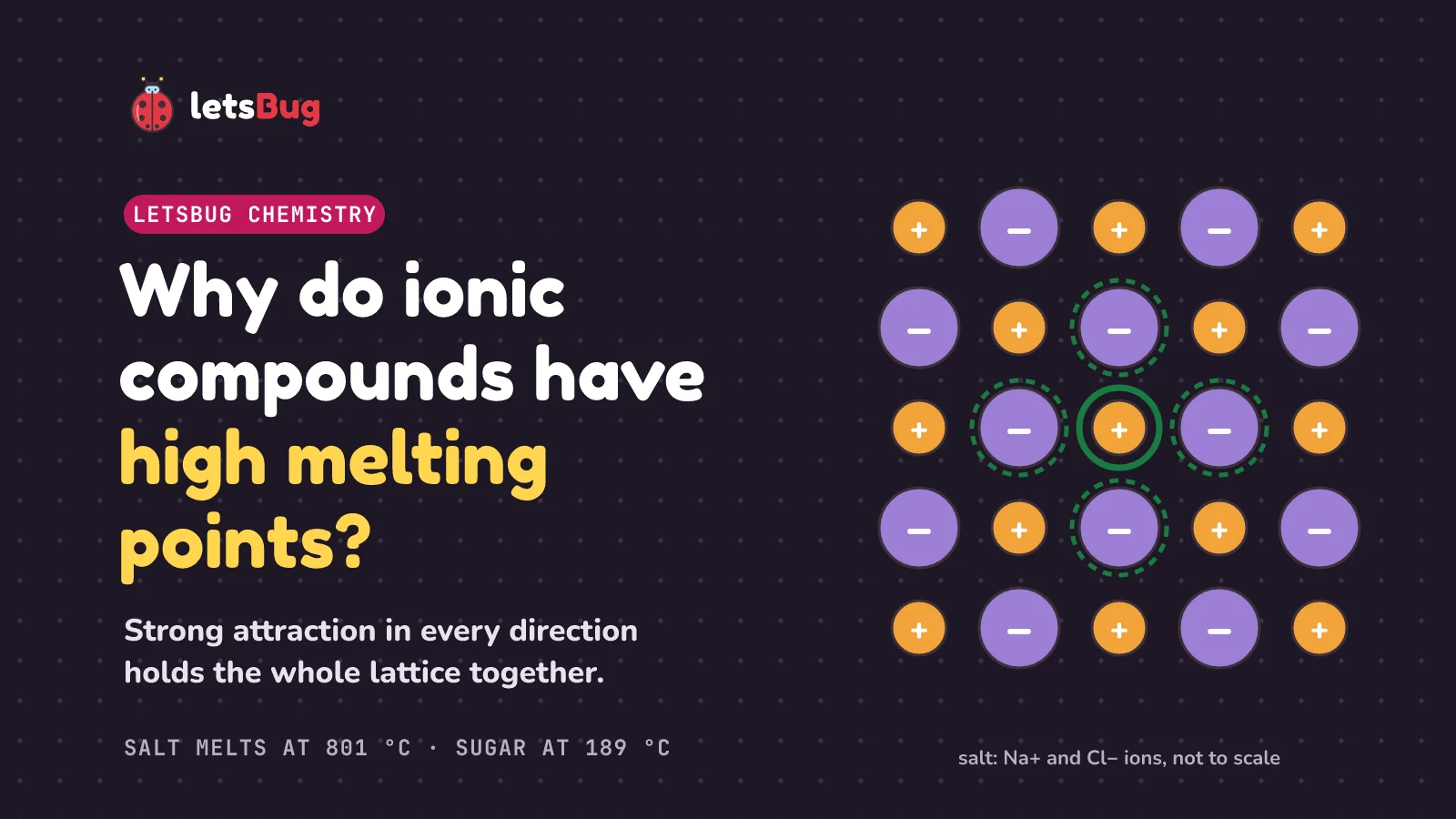
Ionic compounds have high melting points because they are giant lattices of oppositely charged ions. Every ion is held by strong electrostatic attraction (the pull between opposite charges) to the oppositely charged ions around it. Melting means overcoming many strong bonds, which takes a lot of energy. Salt melts at 801 °C; sugar, not ionic, melts at about 189 °C.
In this post we watch sodium hand its outer electron to chlorine, see why that happens (atoms don't "want" full shells), and draw dot-and-cross diagrams the way examiners want them. Then we build the giant lattice, explain the high melting points and why salt conducts only when molten or dissolved, catch a classic wrong diagram, and finish with practice and exam-style questions with model answers.
Key takeaways
- In ionic bonding, a metal atom transfers electrons to a non-metal atom. Nothing is shared.
- Sodium (2,8,1) loses one electron and becomes Na⁺ (2,8). Chlorine (2,8,7) gains it and becomes Cl⁻ (2,8,8). Both ions have full outer shells, like neon and argon.
- The ionic bond is the strong electrostatic attraction (the pull) between oppositely charged ions. It acts in all directions, so the ions build a giant lattice: a huge, regular grid of ions. There is no "molecule" of NaCl.
- In a dot-and-cross diagram, show outer shells only, put each ion in square brackets with its charge at the top right, and draw no shared pair.
- High melting points: melting means overcoming many strong bonds, which needs a lot of energy. Bigger charges (Mg²⁺, O²⁻) attract more strongly: magnesium oxide melts at 2,852 °C.
- Conductivity: solid ionic compounds don't conduct, because their ions can't move. Molten or dissolved, the ions are free to move, so they conduct.
This post goes with letsBug Chemistry, episode 6. It covers section 3.3 of Chapter 3, Metals and Non-metals, in the NCERT Class 10 science book, the ionic bond in Chapter 9 of the new NCERT Class 9 book Exploration, and ionic bonding in GCSE and IGCSE chemistry. Watch the lesson, or read on: the post adds the energy numbers behind the "full shells" story, why magnesium oxide has a higher melting point than salt, a model exam answer and practice questions.
Do ionic bonds share electrons?
No. It's easy to think that in salt, sodium and chlorine share electrons, but they don't. In an ionic bond, an electron moves from one atom to the other, and the bond is the pull between the two charged particles that are left.
AQA's GCSE specification says: "When a metal atom reacts with a non-metal atom electrons in the outer shell of the metal atom are transferred." NCERT's Class 10 book calls the products "ionic compounds or electrovalent compounds" (electrovalent is an older name), made "by the transfer of electrons from a metal to a non-metal".
Sharing a pair of electrons is a different kind of bond: a covalent bond. The Cambridge IGCSE syllabus defines it as "a pair of electrons is shared between two atoms". It's the bond between two non-metal atoms, and it comes next in the series. A quick way to remember the difference: ionic means transfer, covalent means share.
What happens when sodium reacts with chlorine?
Start with the electron arrangements (we met these in why noble gases are unreactive):
- Sodium has 11 electrons, arranged 2,8,1. Just one electron sits in its outer shell.
- Chlorine has 17 electrons, arranged 2,8,7. Its outer shell is one electron short of eight.
When they react, sodium's one outer electron moves to the chlorine atom. Now count the charges (we counted protons and electrons in what is inside an atom). NCERT says the sodium nucleus "still has 11 protons but the number of electrons has become 10, so there is a net positive charge giving us a sodium cation". So we get a sodium ion, Na⁺, arranged 2,8. A cation is a positive ion.
The chlorine atom now has one extra electron. In NCERT's words, it "gets a unit negative charge, because its nucleus has 17 protons and there are 18 electrons in its K, L and M shells" (the first, second and third shells). That's a chloride ion, Cl⁻, arranged 2,8,8. A negative ion is an anion, and when chlorine becomes an ion its name changes to "chloride".
Both ions now have full outer shells. Na⁺ (2,8) has the same arrangement as neon, and Cl⁻ (2,8,8) has the same arrangement as argon. AQA says it like this: the ions made by metals in Groups 1 and 2 and non-metals in Groups 6 and 7 "have the electronic structure of a noble gas (Group 0)". Electronic structure means the electron arrangement.
Do atoms want full outer shells?
Atoms don't want anything. "Sodium wants to lose an electron" is a common way to say it, but it's not the reason the reaction happens. A teaching article from the Royal Society of Chemistry (RSC) warns that bonding is often taught "based on the notion of atoms ‘needing’ full outer shells", and says: "These processes are not driven by a desire for full shells, but by energetics." Energetics means the energy changes. This part goes beyond most school syllabuses, and you won't need these numbers for the questions below, but they show the real reason. Here they are, in kilojoules per mole (kJ/mol: the energy for one mole, a fixed and very large number of atoms):
- Pulling the electron off sodium costs energy. This is called ionisation energy, and for sodium it's 496 kJ/mol. Wikipedia's article on it says: "Ionization energy is positive for neutral atoms, meaning that the ionization is an endothermic process." (A neutral atom has no overall charge.) Endothermic means it takes energy in.
- Chlorine taking the electron gives some back: 349 kJ/mol. That's less than 496, so making the two separate ions still costs 496 − 349 = 147 kJ/mol.
- The ions attracting each other gives out much more. When separate Na⁺ and Cl⁻ ions come together into solid salt, 786 kJ/mol is released. This is the lattice energy of sodium chloride.
So the ions don't form because they "want" a full shell. They form because opposite charges pull together so strongly that, overall, energy is given out. These numbers are for separate atoms and ions in a gas. Starting from solid sodium and chlorine gas adds a few steps, but energy is still given out overall: about 411 kJ for every mole of salt made. NCERT's Class 9 book says: "When atoms combine, the total energy of the system becomes lower than the sum of the energies of the individual atoms, making the resulting arrangement more stable."
How do you draw a dot-and-cross diagram for sodium chloride?
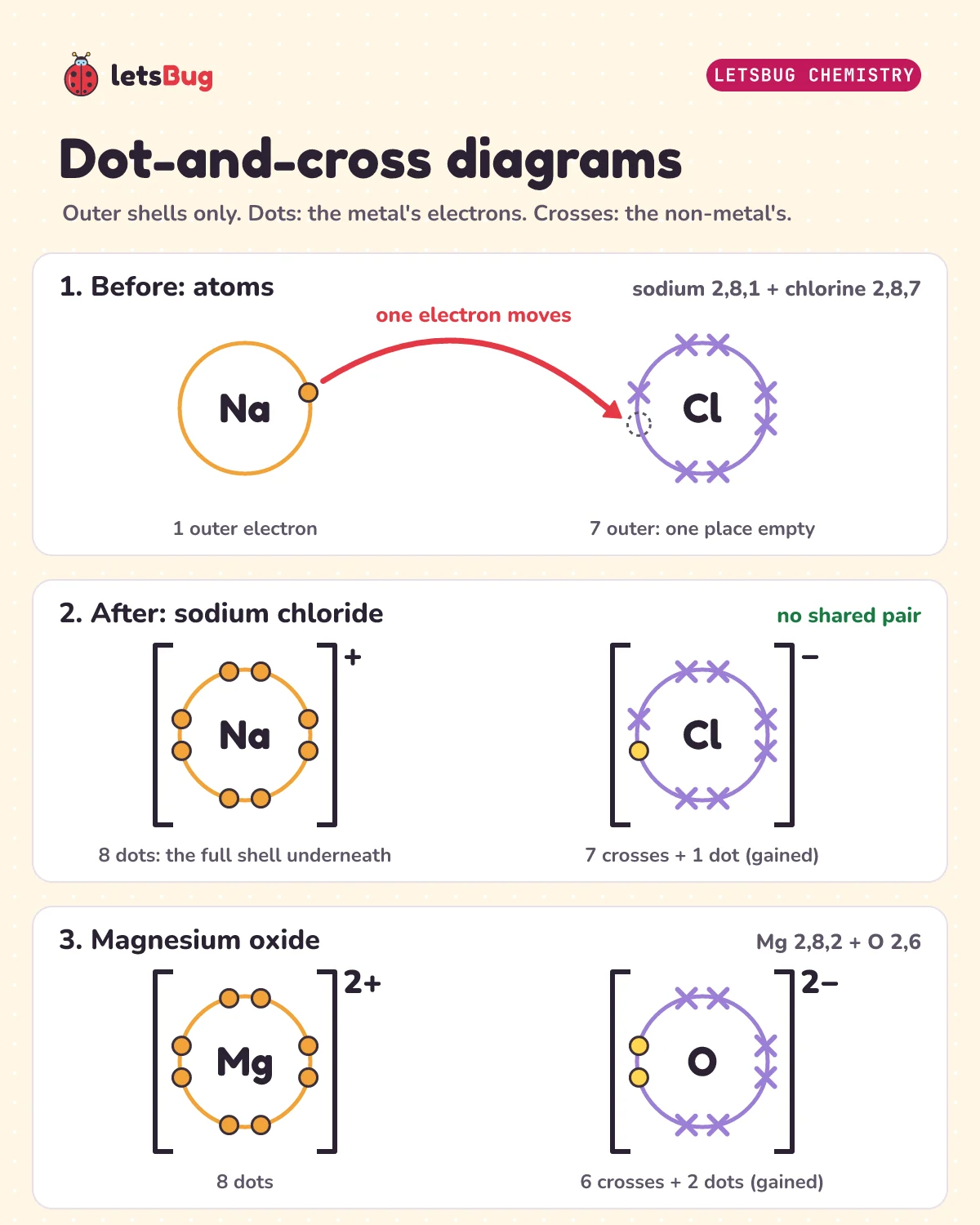
A dot-and-cross diagram shows where each electron came from. AQA and Cambridge both ask for it: AQA wants you to "draw dot and cross diagrams for ionic compounds formed by metals in Groups 1 and 2 with non-metals in Groups 6 and 7". The rules:
- Show outer shells only. The inner shells don't change.
- Dots for one atom's electrons, crosses for the other's. Here, dots are sodium's electrons and crosses are chlorine's.
- Draw the ions after the transfer. Sodium has lost its third shell, so its second shell is now its outer shell: a full shell of 8 dots. Chloride has 7 crosses and 1 dot: the dot is the electron it gained from sodium.
- Put each ion in square brackets, with its charge at the top right: [Na]⁺ and [Cl]⁻.
- Draw no shared pair and don't let the circles overlap. Nothing is shared.
What is an ionic bond?
The Cambridge IGCSE syllabus gives the definition to learn: "an ionic bond is a strong electrostatic attraction between oppositely charged ions". Electrostatic attraction is the pull between a positive charge and a negative charge. NCERT's Class 9 book says the same: "The electrostatic force of attraction between oppositely charged ions that holds them together is called an ionic bond."
That pull doesn't just join one Na⁺ to one Cl⁻. A charge attracts in every direction, so each ion pulls on all the oppositely charged ions near it. AQA: "These forces act in all directions in the lattice and this is called ionic bonding." The ions stack up into a regular, repeating 3D pattern called a giant ionic lattice (a lattice is a grid-like arrangement, and "giant" means it is made of a huge number of ions, with no fixed size).
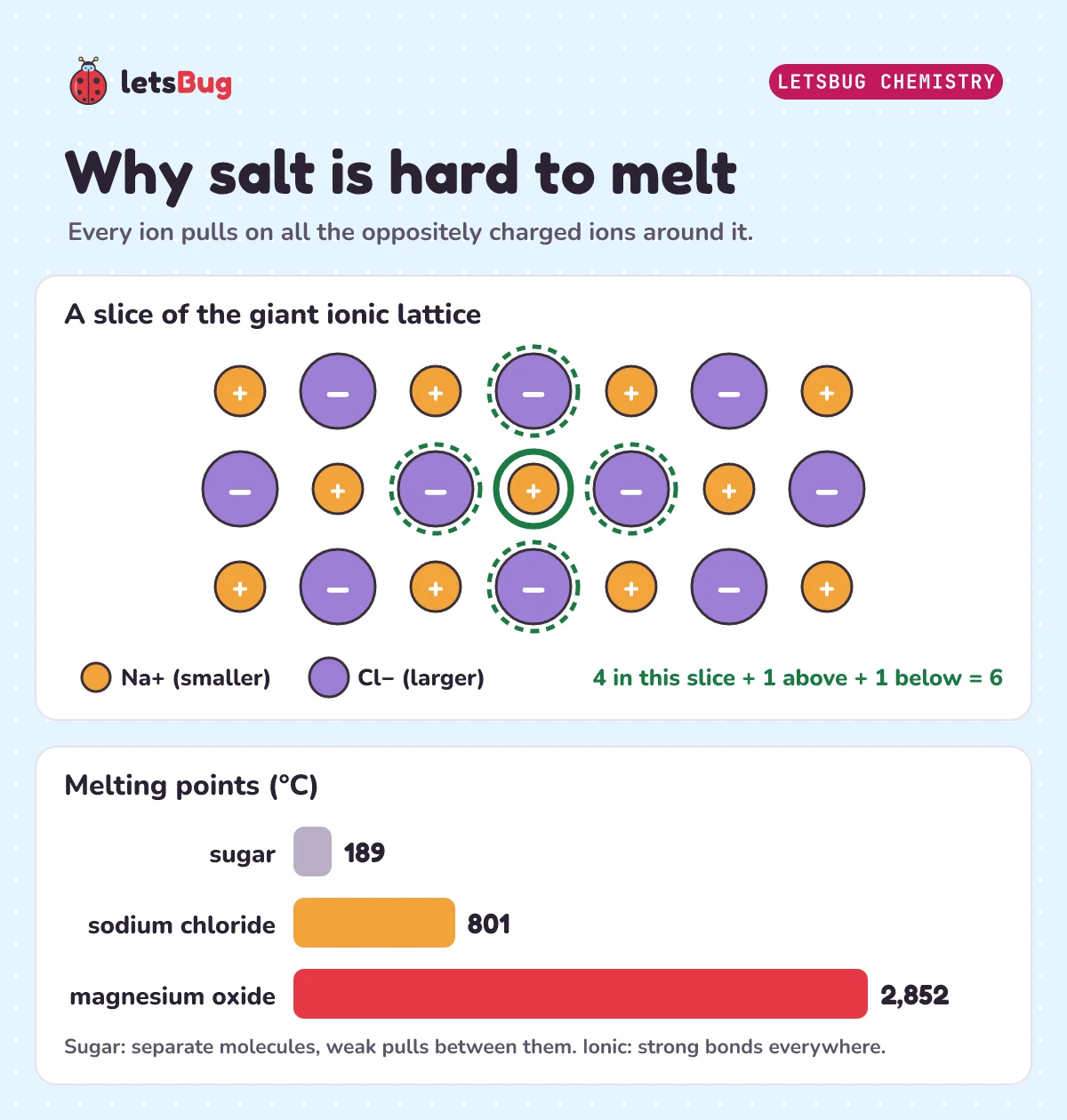
In salt, NCERT says "each sodium ion (Na+) is surrounded by six chloride ions", and each chloride ion is surrounded by six sodium ions. In a flat slice you see four neighbours around each ion. The other two are in the layers above and below.
Is there a molecule of sodium chloride?
No. A molecule is a separate group of atoms joined together, like a water molecule. Salt has no separate groups: one crystal is one huge lattice. NCERT says it directly: "ionic compounds do not form molecules". The formula NaCl only tells you the ratio of ions: one Na⁺ for every Cl⁻, 1 : 1. NCERT calls the smallest group of ions in this ratio, one Na⁺ and one Cl⁻, a formula unit.
Why do ionic compounds have high melting points?
To melt a solid, its particles must get enough energy to break out of their fixed places and slide past each other. In an ionic lattice, every ion is held by strong attraction to the oppositely charged ions all around it, and there are huge numbers of these bonds. AQA's specification gives the reason in one sentence: ionic compounds "have high melting points and high boiling points because of the large amounts of energy needed to break the many strong bonds". NCERT's Class 10 book says "a considerable amount of energy is required to break the strong inter-ionic attraction" (inter-ionic means between ions).
Compare salt with sugar. Wikipedia gives salt's melting point as 800.7 °C, about 801 °C, and NCERT's Table 3.4 gives the same value in kelvin, 1074 K (1074 − 273 = 801). Sugar isn't ionic: "Pure crystalline sucrose melts at approximately 189 °C." That's 612 degrees lower. Sugar is a covalent compound made of separate molecules, and the pulls between molecules (intermolecular forces) are weak. AQA explains what happens when a substance made of small molecules melts: "It is these intermolecular forces that are overcome, not the covalent bonds, when the substance melts or boils."
Why does magnesium oxide have a higher melting point than sodium chloride?
Magnesium is 2,8,2, so it has two outer electrons to lose. Oxygen is 2,6, two short of a full shell. When they react, both of magnesium's outer electrons go to one oxygen atom. You get Mg²⁺ (2,8) and O²⁻ (2,8): magnesium oxide, MgO. Wikipedia describes it as a lattice of Mg²⁺ and O²⁻ ions held together by ionic bonding.
The charges are doubled, so the pull between neighbouring ions is much stronger. The lattice energy shows it: 3,795 kJ/mol for magnesium oxide against 786 kJ/mol for sodium chloride, about 4.8 times as much. Wikipedia's lattice energy article compares two compounds with the same structure and similar-sized ions (barium oxide and sodium chloride) and says "the difference in charge numbers is the principal reason for the large difference in lattice energies".
This is the main reason magnesium oxide melts at 2,852 °C, over 2,000 degrees higher than salt. That makes it useful: "MgO is used as a refractory material for crucibles." A refractory material stays solid and stable when very hot, and a crucible is a pot for heating or melting things at high temperatures.
What about magnesium chloride?
Magnesium still has two electrons to lose, but each chlorine atom can take only one. So one magnesium atom needs two chlorine atoms: one Mg²⁺ ion and two Cl⁻ ions, MgCl₂. NCERT shows the same in Figure 3.6, "Formation of magnesium chloride". Check the charges: +2 + 2 × (−1) = 0. Counting electrons this way always gives the same formula as balancing the ion charges.
Why do ionic compounds conduct electricity only when molten or dissolved?
An electric current is a flow of charge. In an ionic compound, the charges are carried by the ions, so the ions must be able to move. NCERT's Class 10 book: "Ionic compounds in the solid state do not conduct electricity because movement of ions in the solid is not possible due to their rigid structure."
Melt it (molten means melted) or dissolve it in water, and the lattice breaks up. AQA: "When melted or dissolved in water, ionic compounds conduct electricity because the ions are free to move and so charge can flow." The Cambridge syllabus lists the same property: "good electrical conductivity when aqueous or molten and poor when solid". Aqueous means dissolved in water.
Sugar dissolves in water too, but its solution doesn't conduct. NCERT explains why: "some covalent compounds, such as sugar, are soluble in water but do not provide ions in solution; therefore, they do not conduct electricity".
How much better does seawater conduct than pure (deionised) water?
Seawater is full of dissolved ions. NCERT notes that "Seawater also contains some soluble salts such as sodium chloride, magnesium chloride". Wikipedia's table of conductivities gives seawater 4.8 siemens per metre (S/m, the unit of conductivity: bigger means it carries current more easily) and deionised water, which has had its ions removed, 4.2 × 10⁻⁵ S/m. Divide: 4.8 ÷ 0.000042 is about 114,000. So seawater conducts over 100,000 times better. Drinking water, which carries some dissolved ions, sits in between at 5 × 10⁻⁴ to 5 × 10⁻² S/m: roughly 10 to 1,000 times better than deionised water.
What is wrong with drawing a shared pair?
Picture a diagram that gets it wrong: the sodium and chlorine circles overlap, a pair of electrons sits in the middle, and the label says "Na and Cl share electrons". That's a covalent bond, not an ionic one. Fix it in three steps:
- Separate the ions. No overlapping circles.
- Show the electron that moved: a dot among chlorine's crosses.
- Add square brackets and charges.
And in words, never write "a molecule of sodium chloride". Write ions, transfer and electrostatic attraction.
How do you describe the formation of sodium chloride?
Here's an exam-style question: Describe what happens when sodium reacts with chlorine to form sodium chloride. Answer in terms of electrons. A weak answer says "sodium and chlorine share electrons to get full shells". That describes the wrong kind of bond, and "to get full shells" is a wish, not a reason. A full answer has four steps:
2. A chlorine atom gains that electron.
3. This forms sodium ions, Na⁺, and chloride ions, Cl⁻, both with full outer shells (the electronic structure of a noble gas).
4. The oppositely charged ions are held together by strong electrostatic attraction, in a giant lattice.
Where is salt used?
A lot of salt is made: "In 2017, world production was estimated at 280 million tonnes". Most of it goes into making other chemicals. Wikipedia says salt is used "in the production of many chemicals, which consumes most of the world's production", such as chlorine and sodium hydroxide. Then: "The second major application of salt is for deicing and anti-icing of roads" (anti-icing means stopping ice from forming). Another ionic compound, calcium chloride, does the same job. Dissolved in the water on a road, it lowers the temperature at which that water freezes: "By depressing the freezing point of water, calcium chloride is used to prevent ice formation and is used to de-ice." Its formula is your first practice question.
Your turn. Work each one out before you open the answers.
1) Calcium is 2,8,8,2. How many electrons does each calcium atom lose? How many chlorine atoms does it need? What is the formula of calcium chloride?
2) Potassium is 2,8,8,1 and sulfur is 2,8,6. Give the charges on their ions and the formula of potassium sulfide.
3) Draw a dot-and-cross diagram for lithium fluoride. Lithium is 2,1 and fluorine is 2,7. Show the outer shells only.
Show the answers
1) Calcium loses its 2 outer electrons and becomes Ca²⁺. Each chlorine atom takes only one, so calcium needs 2 chlorine atoms. One Ca²⁺ and two Cl⁻: CaCl₂. Check: +2 + 2 × (−1) = 0.
2) Potassium loses 1 electron: K⁺. Sulfur gains 2: S²⁻. You need two K⁺ for each S²⁻: K₂S. Check: 2 × (+1) + (−2) = 0.
3) [Li]⁺ with its full first shell (2 dots), and [F]⁻ with 7 crosses and 1 dot (the electron from lithium). Square brackets round both, charges at the top right, and no shared pair.
Exam-style questions with model answers
The marks in brackets follow GCSE and IGCSE mark schemes: B is a mark for a correct point.
Q1 (1 mark). State what is meant by an ionic bond.
Model answer
A strong electrostatic attraction between oppositely charged ions [B1]. "A bond between a metal and a non-metal" doesn't say what the bond is.
Q2 (3 marks). Explain why sodium chloride has a high melting point.
Model answer
Sodium chloride has a giant ionic lattice [B1]. There are strong electrostatic attractions between the oppositely charged ions, in all directions [B1]. A lot of energy is needed to overcome these many strong bonds [B1]. Don't write "strong intermolecular forces": there are no molecules in salt.
Q3 (2 marks). Explain why solid sodium chloride does not conduct electricity, but a solution of it does.
Model answer
In the solid, the ions are fixed in the lattice and can't move [B1]. In solution the ions are free to move and carry charge [B1]. Say ions, not electrons: the ions carry the charge.
Q4 (2 marks). A student writes: "A sodium chloride molecule forms when the atoms share a pair of electrons." Give two corrections.
Model answer
Electrons are transferred from sodium to chlorine, not shared [B1]. Sodium chloride is a giant lattice of ions, not molecules [B1].
Q5 (2 marks). Magnesium oxide melts at 2,852 °C and sodium chloride at 801 °C. Explain the difference.
Model answer
The ions in magnesium oxide have bigger charges, Mg²⁺ and O²⁻, than Na⁺ and Cl⁻ [B1]. So the electrostatic attraction between the ions is stronger, and more energy is needed to overcome it [B1].
Questions people ask
Why do ionic compounds have high melting points?
They are giant lattices in which every ion is held by strong electrostatic attraction to the oppositely charged ions around it. Melting means overcoming many strong bonds, which needs a lot of energy. Salt melts at 801 °C.
Do ionic bonds share electrons?
No. In ionic bonding, electrons are transferred from a metal atom to a non-metal atom, and the bond is the attraction between the ions that form. Sharing a pair of electrons is a covalent bond.
What is the difference between ionic and covalent bonds?
An ionic bond forms when a metal transfers electrons to a non-metal, and the oppositely charged ions attract. A covalent bond forms when two non-metal atoms share a pair of electrons.
Why don't ionic compounds conduct electricity when solid?
The ions are held in fixed places in the lattice, so they can't move and carry charge. When the compound is melted or dissolved in water, the ions are free to move, so it conducts.
Why is there no molecule of sodium chloride?
Sodium chloride is a giant lattice in which each ion is surrounded by six ions of the opposite charge, with no separate groups. The formula NaCl only gives the ratio of ions, 1 : 1.
How do you draw a dot-and-cross diagram for an ionic compound?
Show outer shells only, with dots for one atom's electrons and crosses for the other's. Draw the ions after the transfer, put each in square brackets with its charge at the top right, and draw no shared pair.
Why does magnesium oxide have a higher melting point than sodium chloride?
Its ions have double charges, Mg²⁺ and O²⁻, so they attract each other much more strongly than Na⁺ and Cl⁻. Magnesium oxide melts at 2,852 °C, salt at 801 °C.
Keep going
- Watch the full lesson, Why Do Ionic Compounds Have High Melting Points? Ionic Bonding, or the one-minute Short: Ionic vs Covalent Bond: Does Salt Share Electrons? More in letsBug Chemistry on YouTube.
- Why 2,8,7 makes chlorine reactive and 2,8,8 makes argon calm: why are noble gases unreactive? (episode 2).
- Protons, electrons and why 11 protons and 10 electrons make a charge of +1: what is inside an atom? (episode 1).
- Chlorine again, and why its atomic mass is 35.5: isotopes and relative atomic mass (episode 4).
- The episode before this one, where the formulae come from: why is aluminium oxide Al2O3? Valency explained (episode 5).
Checked on 31 October 2026 against the 13 sources below. Every electron count, charge, formula, energy sum and ratio in this post was worked out again in a Python script, and every quote was matched word for word with the source text.
Sources
- NCERT Class 10 Science: Chapter 3, Metals and Non-metals (3.3 formation of sodium chloride and magnesium chloride, ionic compounds, 3.3.1 properties, Table 3.4)
- NCERT Class 9 Science, Exploration: Chapter 9, Atomic Foundations of Matter (9.4 How Atoms Combine?, 9.4.2 ionic bond, six neighbours, conductivity, 9.7 and 9.8 formula unit)
- AQA: GCSE Chemistry 8462 specification, bonding, structure and the properties of matter (4.2.1.2, 4.2.1.3, 4.2.2.3)
- Cambridge International: IGCSE Chemistry 0620 syllabus for 2026 to 2028 (2.4 ions and ionic bonds, 2.5 covalent bonds)
- RSC Education: Avoiding bonding misconceptions, David Read, 2018
- Wikipedia: Ionization energy (endothermic, sodium 496 kJ/mol), Electron affinity (chlorine 349 kJ/mol) and Lattice energy (NaCl 786 and MgO 3,795 kJ/mol, the effect of charge)
- Wikipedia: Sodium chloride (melting point, enthalpy of formation, production and uses), Magnesium oxide (melting point, crucibles), Calcium chloride (de-icing) and Sucrose (melting point)
- Wikipedia: Electrical resistivity and conductivity (seawater, drinking water and deionised water)