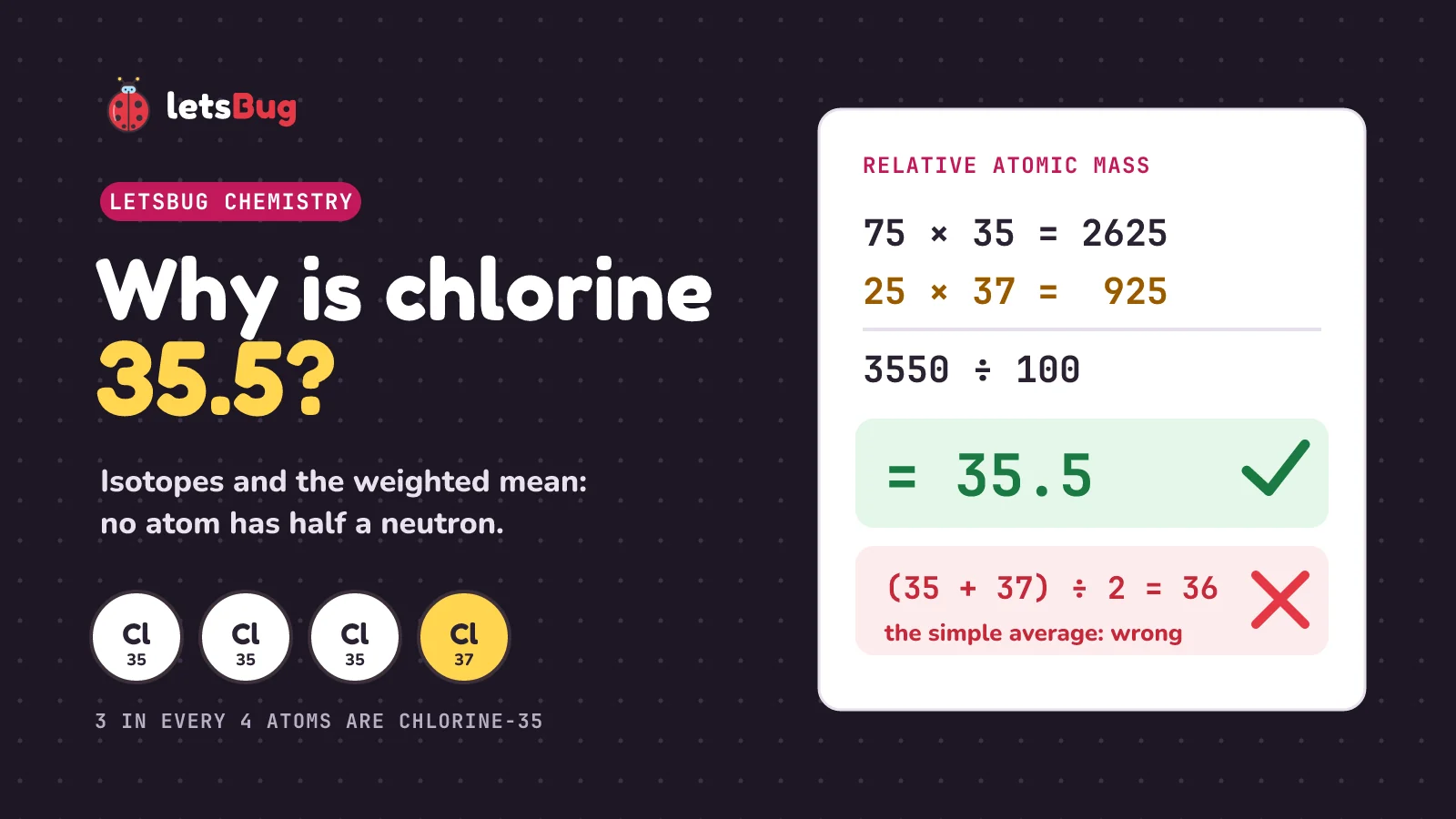
Chlorine's relative atomic mass is 35.5 because natural chlorine is a mixture of two isotopes, chlorine-35 and chlorine-37, and about three in every four atoms are chlorine-35. The periodic table shows their weighted mean: (75 × 35 + 25 × 37) ÷ 100 = 35.5. No single chlorine atom has a mass of 35.5, and none has half a neutron.
In this post we define isotopes with hydrogen's three, read isotope notation, and see why isotopes react the same way but don't weigh the same (ice made of heavy water sinks). Then we calculate relative atomic mass step by step, catch the "just average 35 and 37" trap, do a three-isotope question that only about half the candidates on one 2025 GCSE paper could answer, and finish with exam-style questions and model answers.
Key takeaways
- Isotopes are atoms of the same element with the same number of protons but different numbers of neutrons. Chlorine-35 has 18 neutrons; chlorine-37 has 20.
- Isotopes have the same number of electrons in the same arrangement, so they have the same chemical properties. Their mass, density and melting point differ.
- Relative atomic mass (Ar) is the average mass of an element's atoms, weighted by how common each isotope is, compared with 1/12 of a carbon-12 atom. It has no units.
- Ar = (mass × % + mass × %) ÷ 100. For chlorine: (75 × 35 + 25 × 37) ÷ 100 = 35.5.
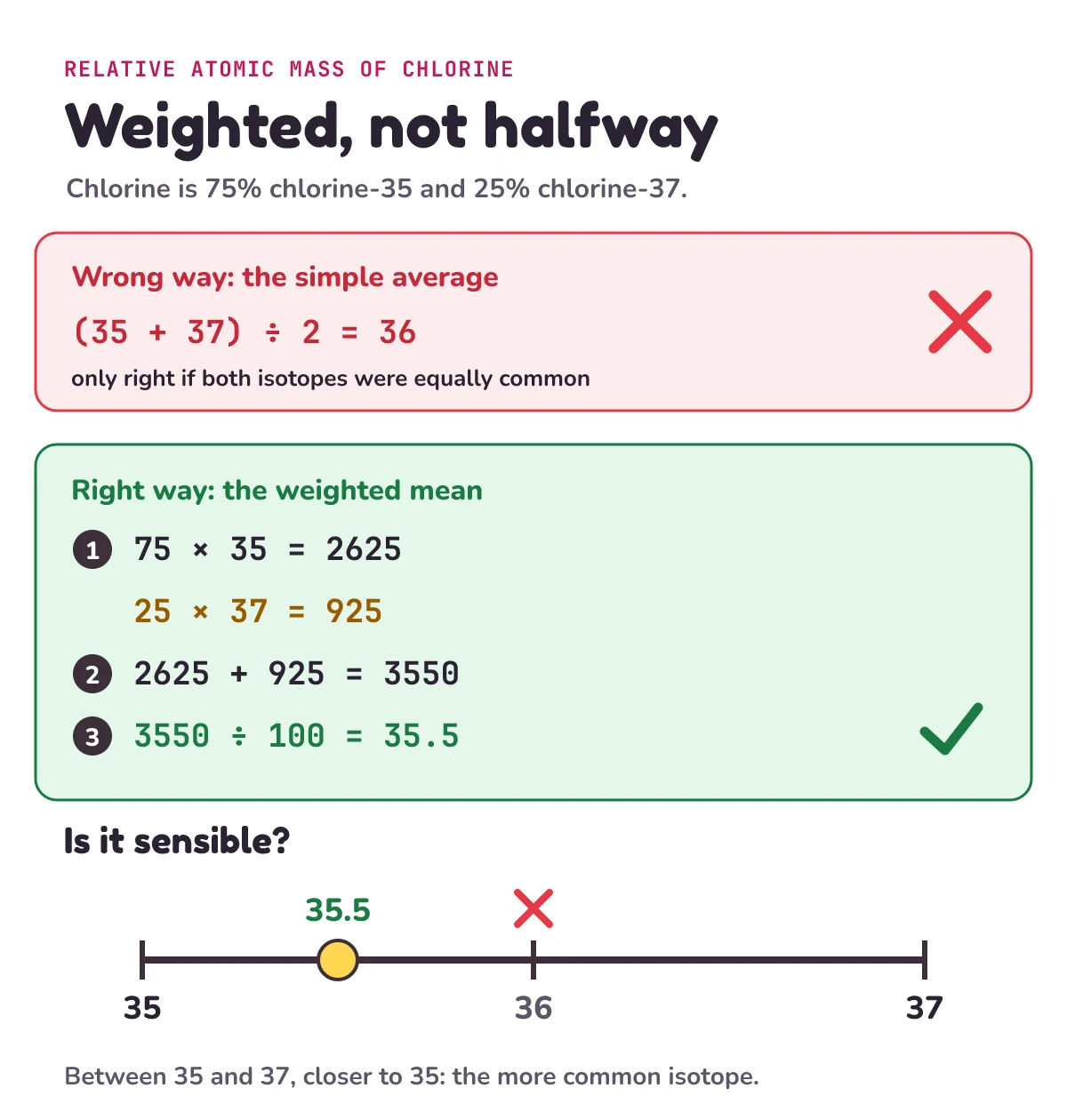
- The simple average, (35 + 37) ÷ 2 = 36, is wrong: it only works if both isotopes are equally common.
- Check every answer: it must sit between the lightest and heaviest isotope masses. With two isotopes, it's always nearer the more common one.
This post goes with letsBug Chemistry, episode 4. It covers isotopes and average atomic mass in Chapter 8 of the new NCERT Class 9 science book, Exploration ("Journey Inside the Atom"), and the isotopes and relative atomic mass topics of GCSE and IGCSE chemistry. Watch the lesson, or read on: the post adds a three-isotope example, the reverse question (finding the abundance), why data books say 35.45, and exam-style questions with model answers.
What are isotopes?
Drop an ice cube into a glass of water and it floats. Drop in an ice cube made of heavy water and it sinks. It's still water, two hydrogen atoms and one oxygen atom, but its hydrogen atoms are heavier. Wikipedia's article on heavy water puts it this way: "Heavy water is 10.6% denser than ordinary water, and heavy water's physically different properties can be seen without equipment if a frozen sample is dropped into normal water, as it will sink."
Those heavier hydrogen atoms are an isotope of hydrogen. The Cambridge IGCSE syllabus asks you to "define isotopes as different atoms of the same element that have the same number of protons but different numbers of neutrons". AQA's GCSE specification says the same thing in its own words: "Atoms of the same element can have different numbers of neutrons; these atoms are called isotopes of that element."
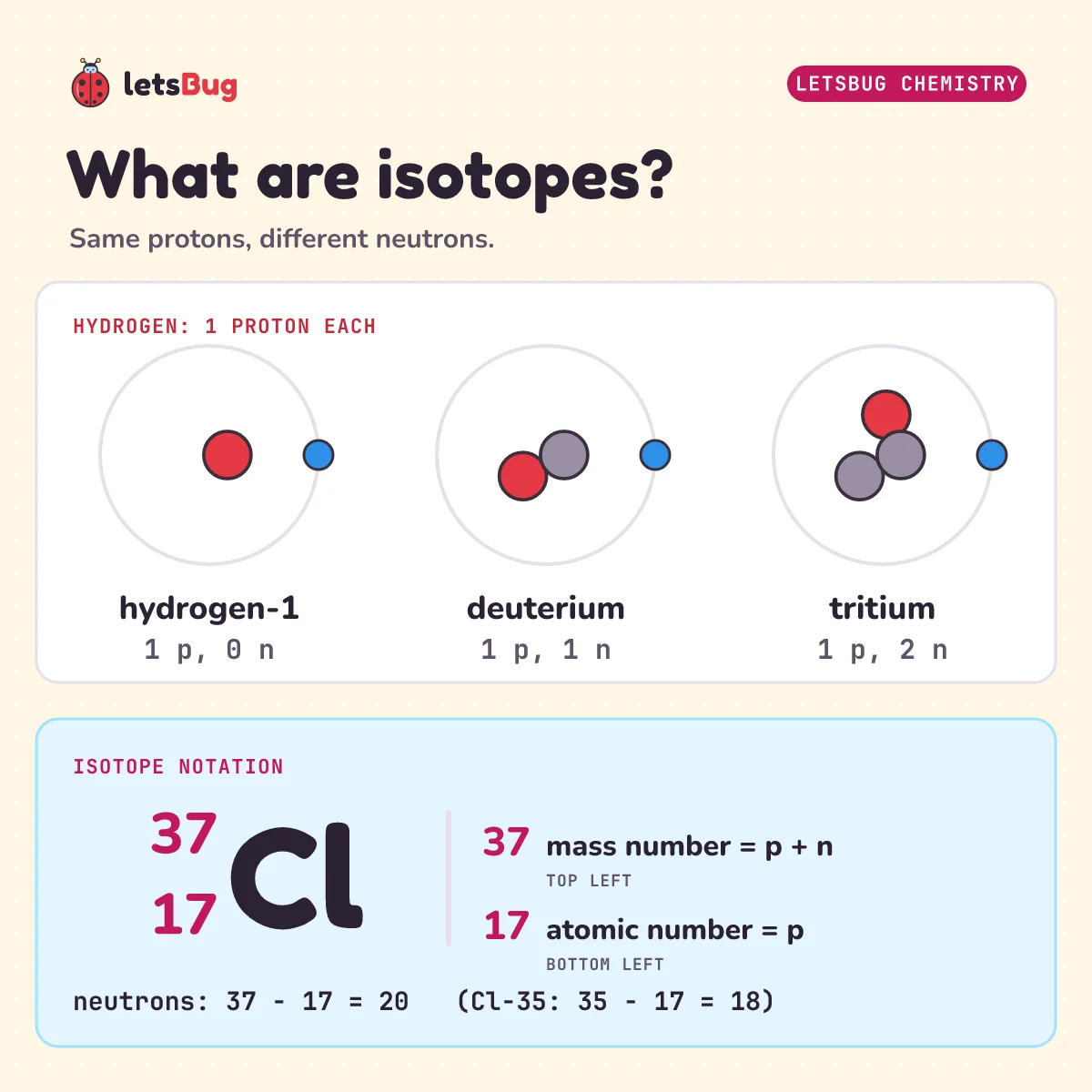
Hydrogen has three:
- Hydrogen-1 (protium): 1 proton, 0 neutrons. This is almost all hydrogen.
- Hydrogen-2 (deuterium, D): 1 proton, 1 neutron. It's the heavy hydrogen in heavy water, D₂O.
- Hydrogen-3 (tritium): 1 proton, 2 neutrons. It's radioactive.
NCERT's chapter gives the same picture: all three have one proton, "whereas deuterium contains one neutron, and tritium contains two neutrons". One proton each means all three are hydrogen. The number of protons decides the element; the neutrons only change the mass. (We met protons, neutrons and electrons properly in what is inside an atom.)
How do you write isotope notation?
Chemists write an isotope with the element's symbol in the middle and two numbers on its left:
- Top left: the mass number (A), the number of protons plus neutrons. AQA: "The sum of the protons and neutrons in an atom is its mass number."
- Bottom left: the atomic number (Z), the number of protons. It's the same for every isotope of an element.
So chlorine-37 is written with 37 at the top left and 17 at the bottom left of Cl (see the picture above). In words it's just chlorine-37, or Cl-37. To find the neutrons, subtract: neutrons = mass number − atomic number. Chlorine-37 has 37 − 17 = 20 neutrons, and chlorine-35 has 35 − 17 = 18. Both have 17 protons, and in a neutral atom 17 electrons.
Do isotopes have the same chemical properties?
Yes. Reactions depend on electrons, and isotopes of an element have the same number of electrons in the same arrangement. Chlorine-35 and chlorine-37 are both 2,8,7: seven electrons in the outer shell, one short of the full shell that makes noble gases unreactive. The IGCSE syllabus wants this exact reason: isotopes "have the same chemical properties because they have the same number of electrons and therefore the same electronic configuration".
What changes are the physical properties that depend on mass. NCERT says isotopes "differ in their physical properties, for example, boiling and melting points." Heavy water shows both: it's 10.6% denser, so its ice sinks, and Wikipedia notes that heavy ice "melts at 3.7 °C, and thus does not melt in ice-cold normal water". Ordinary ice melts at 0 °C.
What is relative atomic mass?
Atoms are far too light to weigh in grams one at a time. NCERT: "Atoms are too tiny to be weighed in kilograms or grams like everyday objects." So chemists compare them. The Cambridge IGCSE syllabus describes relative atomic mass, Ar, "as the average mass of the isotopes of an element compared to 1/12th of the mass of an atom of ¹²C". It's a comparison, so it has no units. NCERT calls the same number the average atomic mass and gives it in unified atomic mass units, u: chlorine is 35.5 u.
The key word is average. A sample of chlorine is a mixture of chlorine-35 and chlorine-37 atoms, so the periodic table can't give one atom's mass. It gives the mean. AQA's specification adds the important part: "The relative atomic mass of an element is an average value that takes account of the abundance of the isotopes of the element." Abundance means how common each isotope is, usually as a percentage.
Don't mix up the two numbers. The mass number belongs to one isotope and is always a whole number (35 or 37). The relative atomic mass belongs to the element and is often not whole (35.5).
Why isn't chlorine's relative atomic mass 36?
Here's the trap. Add the two mass numbers and halve: (35 + 37) ÷ 2 = 36. NCERT works out this simple average too, then says: "However, this does not accurately reflect nature, since isotopes do not occur in equal ratios."
Halfway is only right if there are equal numbers of each isotope. In nature, NCERT says chlorine-35 "constitutes about 75%", while chlorine-37 "makes up about 25%": a ratio of 3:1. Three atoms in every four are the lighter one, so the average has to sit closer to 35 than to 37.
How do you calculate relative atomic mass?
Use a weighted mean, in three steps:
- Multiply each mass number by its percentage abundance.
- Add the results.
- Divide by 100, the total of the percentages.
For chlorine, 75% chlorine-35 and 25% chlorine-37:
Step 2: 2625 + 925 = 3550
Step 3: 3550 ÷ 100 = 35.5
Now check it's sensible. 35.5 is between 35 and 37, and closer to 35, the more common isotope. If your answer is outside the range of the mass numbers, something went wrong; with two isotopes, so did an answer nearer the rarer one.
If you're given a ratio instead of percentages, like NCERT's "They occur in the ratio 3:1", divide by the total of the ratio: (3 × 35 + 1 × 37) ÷ 4 = 142 ÷ 4 = 35.5.
Does any chlorine atom have a mass of 35.5?
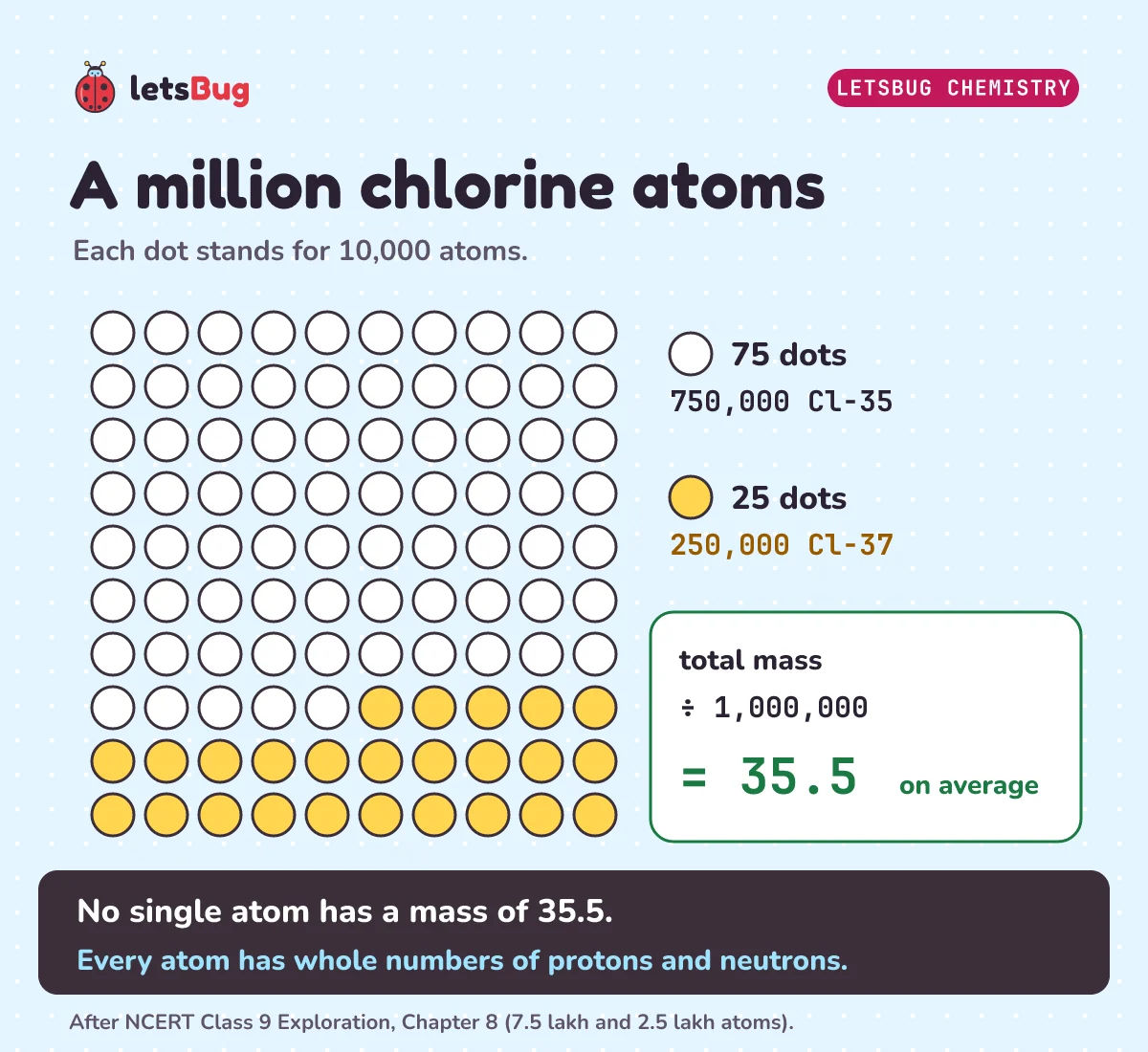
No. Picture a million chlorine atoms, as NCERT does: about 750,000 are chlorine-35 and 250,000 are chlorine-37 (NCERT writes 7.5 lakh and 2.5 lakh). Add up all their masses and share the total out equally, and each atom gets 35.5 on average. But every real atom has a whole number of protons and neutrons. NCERT is clear: "This does not mean that any one atom of chlorine has a fractional mass of 35.5 u." The half comes from averaging, not from half a neutron.
How do you calculate relative atomic mass with three isotopes?
The same way: one multiplication per isotope, then add, then divide by 100. Neon in air is 90.48% neon-20, 0.27% neon-21 and 9.25% neon-22:
0.27 × 21 = 5.67
9.25 × 22 = 203.5
1809.6 + 5.67 + 203.5 = 2018.77
2018.77 ÷ 100 = 20.1877, or 20.2 to 3 significant figures
Check: 20.2 is between 20 and 22 and very close to 20, because nine atoms in ten are neon-20.
Some people turn each percentage into a decimal first (75% = 0.75, 0.27% = 0.0027) and skip the divide-by-100 step. It gives the same answer, as long as the decimal point moves two places.
A neon question came up on the June 2025 Edexcel GCSE Combined Science chemistry paper 1CH, and the examiners' report says: "About half the candidates could calculate the relative atomic mass of neon using the information about the abundance of its isotopes." The errors it lists are worth learning:
- "Approximating the isotopic abundances to the nearest whole number." Use 0.27, not 0.
- "Adding the isotopic masses together: ‘20 + 21 + 22 = 63’." Without the abundances, it isn't an average at all.
- "Forgetting to find the average mass by dividing the total mass contributions by 100." The 2018.77 is not the answer.
- Slipping a decimal place with the decimal method. Correcting one candidate, the examiners wrote "0.0027 x 21 = 0.0567, not 0.567".
One more lesson from the same report: a candidate "gave the correct answer of 20.1877, but then lost the second mark by adding 'or 20'." Give one answer, to the accuracy the question asks for.
Why do data books say 35.45, not 35.5?
The 75% and 25% are rounded. IUPAC's Commission on Isotopic Abundances and Atomic Weights (CIAAW) gives chlorine-35 as 75.5% to 76.1% of natural chlorine, about 75.8%, and chlorine-37 as about 24.2%. The real masses of those atoms, on the carbon-12 scale, are not exactly 35 and 37 but 34.969 and 36.966. Put the exact figures in (as decimals, so there's no divide by 100):
That's chlorine's standard atomic weight, the official name for its relative atomic mass: CIAAW gives it as a range, 35.446 to 35.457, because natural chlorine varies slightly from place to place. School periodic tables round it to 35.5, and how much they round varies: the periodic table in the Cambridge IGCSE syllabus gives chlorine as 35.5 but copper as 64 and boron as 11, while boron's standard atomic weight is 10.806 to 10.821, about 10.81. Always use the values on the periodic table your exam gives you.
What are isotopes used for?
- Heavy water. Deuterium is rare: in normal water "one hydrogen in 6,400 is ²H". Heavy water is used in some nuclear reactors to slow neutrons down (neutron moderation), and Wikipedia's heavy water article notes that "India is the world's largest producer of heavy water through its Heavy Water Board".
- Medical scans. "Technetium-99m is used in 20 million diagnostic nuclear medical procedures every year." It's injected, and gamma cameras follow it inside the body. Half of it decays in about 6 hours (its half-life), so within a day 93.7% of it is gone.
- Energy, cancer treatment and dating. NCERT lists uranium-235 as fuel in nuclear power plants, cobalt-60 for "radiation treatment for cancer", iodine-131 "to treat goitre and thyroid cancer", and carbon-14 "to determine the age of ancient fossils and artefacts".
What are isobars?
Isotopes share an atomic number. Isobars flip it round: NCERT says "When atoms of different elements have the same mass number, but different atomic numbers, they are called isobars." Calcium-40, potassium-40 and argon-40 all have a mass number of 40, but 20, 19 and 18 protons, so they are three different elements. Calcium-40 has 20 neutrons, potassium-40 has 21 and argon-40 has 22.
Your turn. Work each one out before you open the answers.
1) Boron goes into the heat-resistant borosilicate glass of lab beakers: "Virtually all modern laboratory glassware is made of borosilicate glass." Natural boron is about 20% boron-10 and 80% boron-11. Calculate boron's relative atomic mass to 1 decimal place.
2) NCERT's own question: bromine is 49.7% bromine-79 and 50.3% bromine-81. Calculate its average atomic mass.
3) How many protons, neutrons and electrons are in an atom of bromine-81 (mass number 81, atomic number 35)?
Show the answers
1) 20 × 10 = 200, 80 × 11 = 880, 200 + 880 = 1080, 1080 ÷ 100 = 10.8. Check: between 10 and 11, closer to 11, the common isotope. Its standard atomic weight is about 10.81.
2) 49.7 × 79 = 3926.3 and 50.3 × 81 = 4074.3. Add: 8000.6. Divide by 100: 80.006, so 80.0 (80 u). It's almost exactly halfway because the two isotopes are almost equally common: a case where the simple average nearly works.
3) 35 protons, 35 electrons and 81 − 35 = 46 neutrons.
Exam-style questions with model answers
The marks in brackets follow GCSE and IGCSE mark schemes: M is a method mark, A is an accuracy mark that needs the method, and B is a mark on its own.
Q1 (3 marks). Explain why the relative atomic mass of chlorine is 35.5 and not a whole number.
Model answer
Chlorine has two isotopes, chlorine-35 and chlorine-37, atoms with different numbers of neutrons [B1]. Relative atomic mass is the mean mass of the atoms, weighted by the abundance of each isotope [B1]. Chlorine-35 is more abundant (about 75%), so the mean is closer to 35: 35.5 [B1]. "Because of isotopes" on its own is true, but it stops too soon: say why the average isn't halfway.
Q2 (2 marks). Copper is 69% copper-63 and 31% copper-65. Calculate its relative atomic mass to 1 decimal place.
Model answer
(69 × 63 + 31 × 65) ÷ 100 = (4347 + 2015) ÷ 100 [M1] = 6362 ÷ 100 = 63.6 [A1]. Check: between 63 and 65, closer to 63. (The accepted value is 63.546, a little lower: the real mix is 69.15% and 30.85%, and real isotope masses aren't exactly whole numbers.)
Q3 (2 marks). Explain why chlorine-35 and chlorine-37 have the same chemical properties.
Model answer
They have the same number of electrons, 17 [B1], so the same electronic configuration, 2,8,7, with the same number of outer-shell electrons [B1]. Chemical reactions depend on electrons, not neutrons.
Q4 (3 marks, higher). Chlorine has two isotopes, chlorine-35 and chlorine-37, and a relative atomic mass of 35.5. Calculate the percentage abundance of chlorine-35.
Model answer
Let x% be chlorine-35, so chlorine-37 is (100 − x)%. Then 35x + 37(100 − x) = 35.5 × 100 [M1]. 35x + 3700 − 37x = 3550, so −2x = 3550 − 3700 = −150 [M1] and x = 75% [A1]. Check: 75 × 35 + 25 × 37 = 3550.
Q5 (2 marks). Two atoms have 11 protons each, but one has 12 neutrons and the other has 13. Are they the same element? Compare their atomic and mass numbers.
Model answer
Yes: same number of protons, so the same element (sodium), and they are isotopes [B1]. Same atomic number, 11; different mass numbers, 11 + 12 = 23 and 11 + 13 = 24 [B1].
Questions people ask
Why is the atomic mass of chlorine 35.5?
Natural chlorine is about 75% chlorine-35 and 25% chlorine-37. The periodic table gives the weighted mean of the two: (75 × 35 + 25 × 37) ÷ 100 = 35.5. No single atom has a mass of 35.5.
What is the difference between isotopes and isobars?
Isotopes are atoms of the same element: same number of protons, different numbers of neutrons (chlorine-35 and chlorine-37). Isobars are atoms of different elements with the same mass number (calcium-40 and argon-40).
How do you work out relative atomic mass from percentage abundance?
Multiply each isotope's mass by its percentage abundance, add the results, and divide by 100. Then check the answer lies between the isotope masses (with two isotopes, nearer the more common one).
How do you find percentage abundance from relative atomic mass?
Call one isotope's abundance x% and the other's (100 − x)%, then solve: for chlorine, 35x + 37(100 − x) = 3550 gives x = 75, so 75% chlorine-35.
Is relative atomic mass the same as mass number?
No. The mass number is the number of protons plus neutrons in one isotope, always a whole number. Relative atomic mass is the weighted average for the element, so it is often not whole.
Do isotopes have the same chemical properties?
Yes, because they have the same number of electrons and the same electronic configuration. Their physical properties that depend on mass, like density and melting point, are different.
Does relative atomic mass have units?
No. It compares the average mass of the element's atoms with 1/12 of the mass of a carbon-12 atom, so it is a ratio. NCERT calls the same number average atomic mass and writes it in u, for example 35.5 u.
Keep going
- Watch the full lesson, Why Is Chlorine's Atomic Mass 35.5? Isotopes Explained, or the one-minute Short: Half a Neutron? The Average Atomic Mass of Chlorine. More in letsBug Chemistry on YouTube.
- Where isotopes first came up, with protons, neutrons, atomic number and mass number: what is inside an atom? (episode 1).
- Why chlorine's 2,8,7 makes it reactive and argon's 2,8,8 doesn't: why are noble gases unreactive? (episode 2).
- The episode before this one: is air a mixture or a compound? (episode 3, separating mixtures).
Checked on 24 October 2026 against the 11 sources below. Every relative atomic mass, neutron count and practice answer in this post was worked out again in a Python script, and every quote was matched word for word with the source text.
Sources
- NCERT Class 9 Science, Exploration: Chapter 8, Journey Inside the Atom (8.9.1 isotopes of hydrogen and carbon, uses of isotopes, average atomic mass of chlorine, the million atoms, isobars, Pause and Ponder 17 and 18)
- AQA: GCSE Chemistry 8462 specification, atomic structure and the periodic table (4.1.1.5 isotopes and mass number, 4.1.1.6 relative atomic mass)
- Cambridge International: IGCSE Chemistry 0620 syllabus for 2026 to 2028 (2.3 isotopes, 3.2 relative atomic mass, the periodic table)
- Pearson Edexcel: Examiners' report, June 2025, GCSE Combined Science 1SC0 1CH (Question 1(b), the relative atomic mass of neon)
- Wikipedia: Heavy water (10.6% denser, ice that sinks and melts at 3.7 °C, 1 hydrogen in 6,400, India's Heavy Water Board)
- IUPAC Commission on Isotopic Abundances and Atomic Weights (CIAAW): chlorine, neon, boron and copper (isotope masses, natural abundances, standard atomic weights)
- Wikipedia: Technetium-99m (20 million procedures a year, half-life 6.0066 hours, gamma cameras)
- Wikipedia: Borosilicate glass (silica and boron trioxide, laboratory glassware)