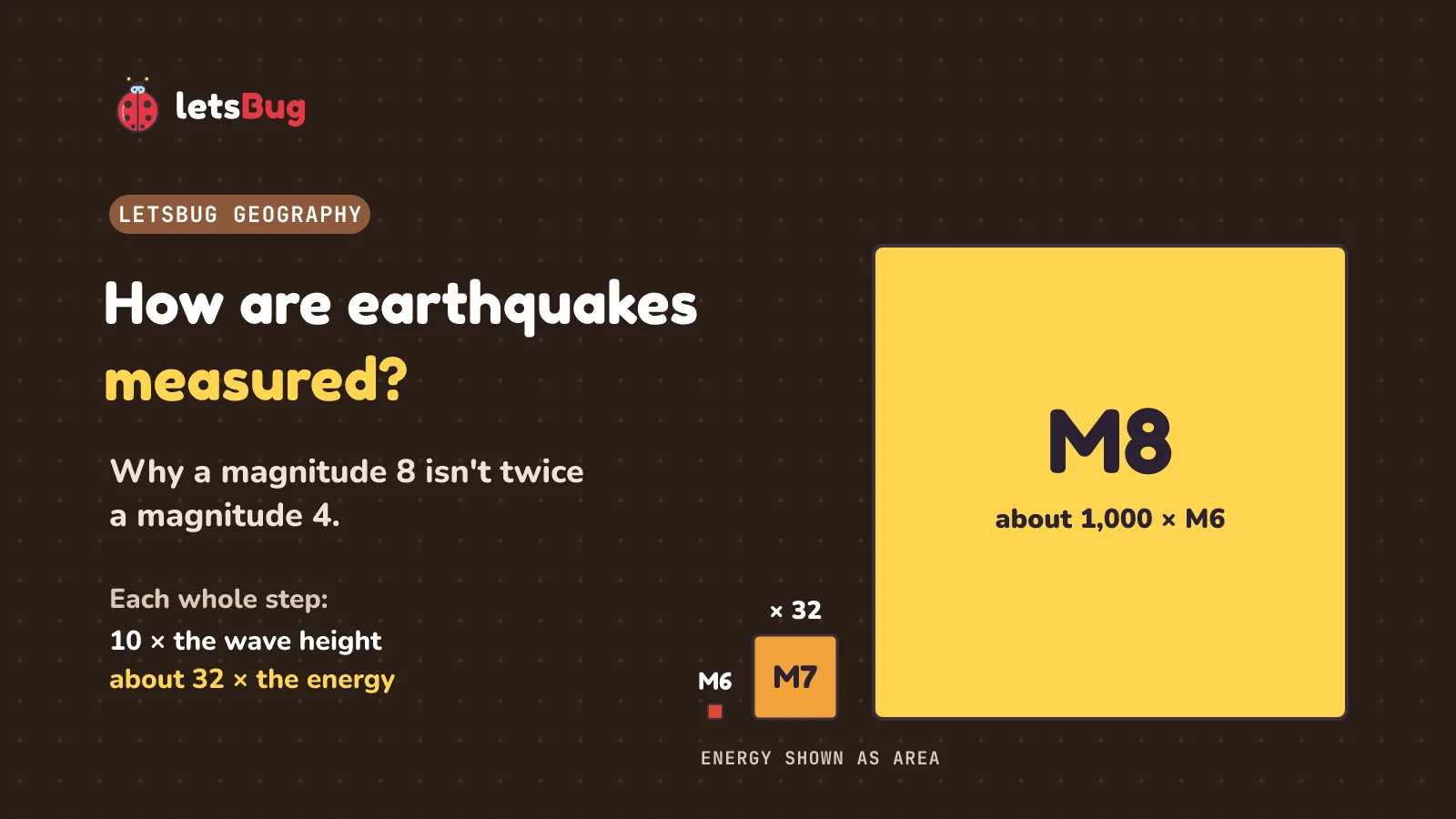
Earthquakes are measured with seismometers, instruments that record the ground shaking as a wiggly line called a seismogram. From those recordings, scientists work out the magnitude: one number for the size of the earthquake at its source, on the moment magnitude scale. The scale is logarithmic. Each whole step up means the waves on the seismogram are 10 times taller and the earthquake released about 32 times more energy. So a magnitude 8 isn't twice a magnitude 4. It's four steps bigger: 32 × 32 × 32 × 32, about a million times the energy.
Magnitude isn't the whole story, though. How hard the ground shakes where you are is a different measurement, called intensity. Let's go through both, see why nobody uses the Richter scale for big earthquakes any more, and work out the gap between the first jolt and the strong shaking, the head start that earthquake early warning is built on.
Key takeaways
- Seismometers record seismic waves. P waves arrive first (about 5 to 7 km/s in the crust), S waves after them (about 3 to 4 km/s).
- Magnitude is the size at the source. An earthquake has a single magnitude. Today it's measured on the moment magnitude scale (Mw).
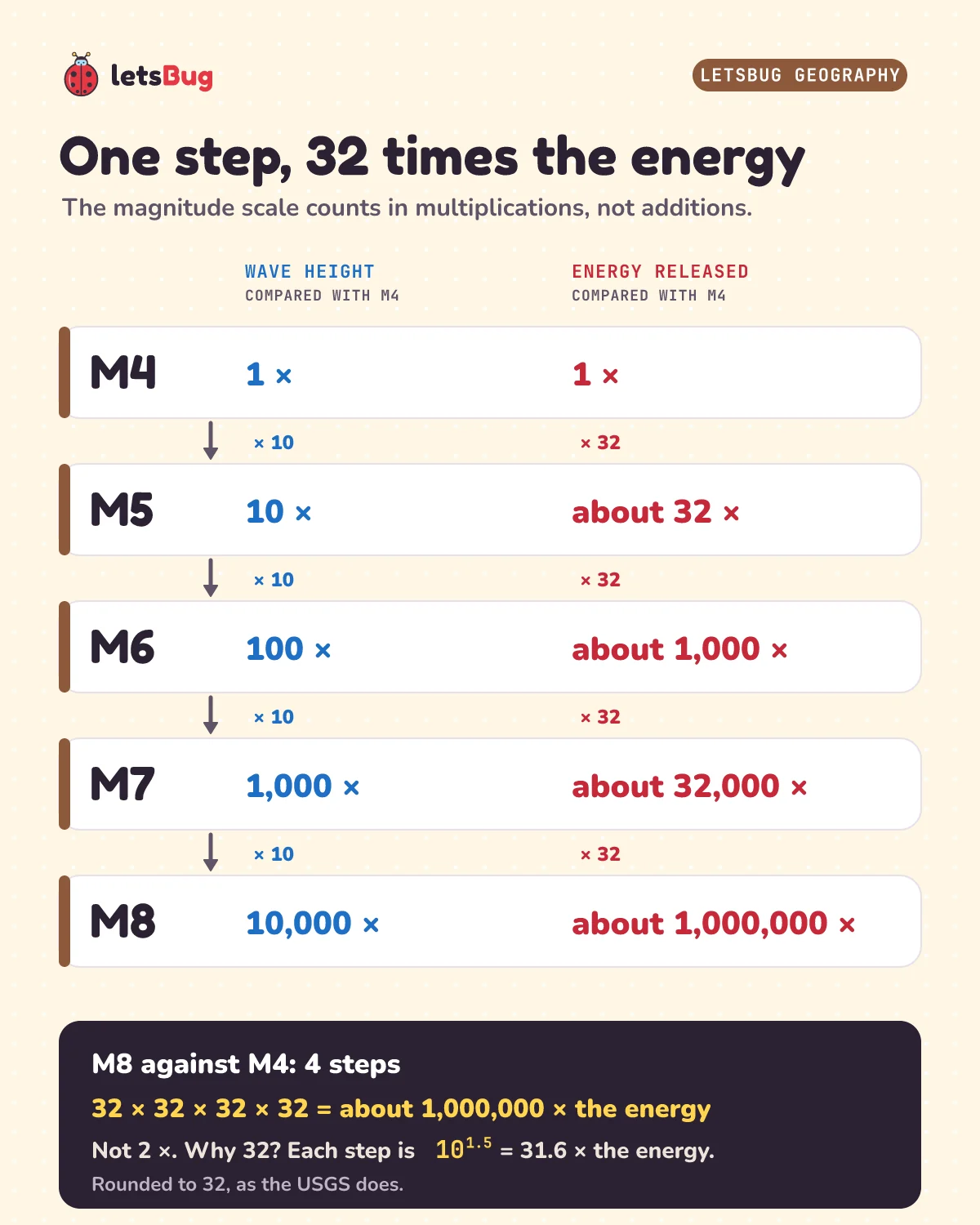
- Each whole step: 10 times the wave height and about 32 times the energy. M8 against M4 is about 1,000,000 times the energy, not 2 times.
- Intensity is the shaking at one place, from I to XII on the Modified Mercalli scale. One earthquake has many intensities.
- A bigger earthquake isn't always deadlier. Chile 2010 (M8.8) released about 32 times the energy of Nepal 2015 (M7.8), but Nepal lost about 17 times as many lives.
This post goes with letsBug Geography, episode 2. It carries on from episode 1, where plates lock together and then suddenly slip. Watch the lesson, or read on: the post adds a full magnitude table, the maths behind 32, worked examples and practice questions with answers.
How are earthquakes measured? Seismometers and seismic waves
An earthquake starts underground, where the rock suddenly breaks and slips along a fault. That point is the focus. The point on the surface directly above it is the epicentre. From the focus, energy spreads out through the rock as seismic waves, and the USGS puts it simply: "Seismic waves are the vibrations from earthquakes that travel through the Earth; they are recorded on instruments called seismographs."
A seismometer (also called a seismograph) works on a neat trick. The BGS explains that almost all of them use inertia, "where a suspended mass tends to remain still when the ground moves." The ground, and the case around the mass, move; the mass stays put, and the difference is recorded as a seismogram. Two kinds of wave travel through the rock to it, and a third kind travels along the surface:
- P waves (primary) squeeze and stretch the rock along the direction they travel. The British Geological Survey says "The P stands for primary because they travel the fastest": about 5 to 7 km/s in typical crust.
- S waves (secondary, or shear) shake the rock from side to side, across the direction they travel. "The S stands for shear or secondary since they are slower than P-waves": about 3 to 4 km/s in the crust.
- Surface waves form where P and S waves reach the Earth's surface, and roll along the ground. The BGS says P waves are the first signal to arrive, "followed by the slower S-wave, then the surface waves", and that "The ground motions from surface waves are often much larger than those motions from body waves."
Hold on to that gap between P and S. It's what earthquake early warning is built on, later in this post.
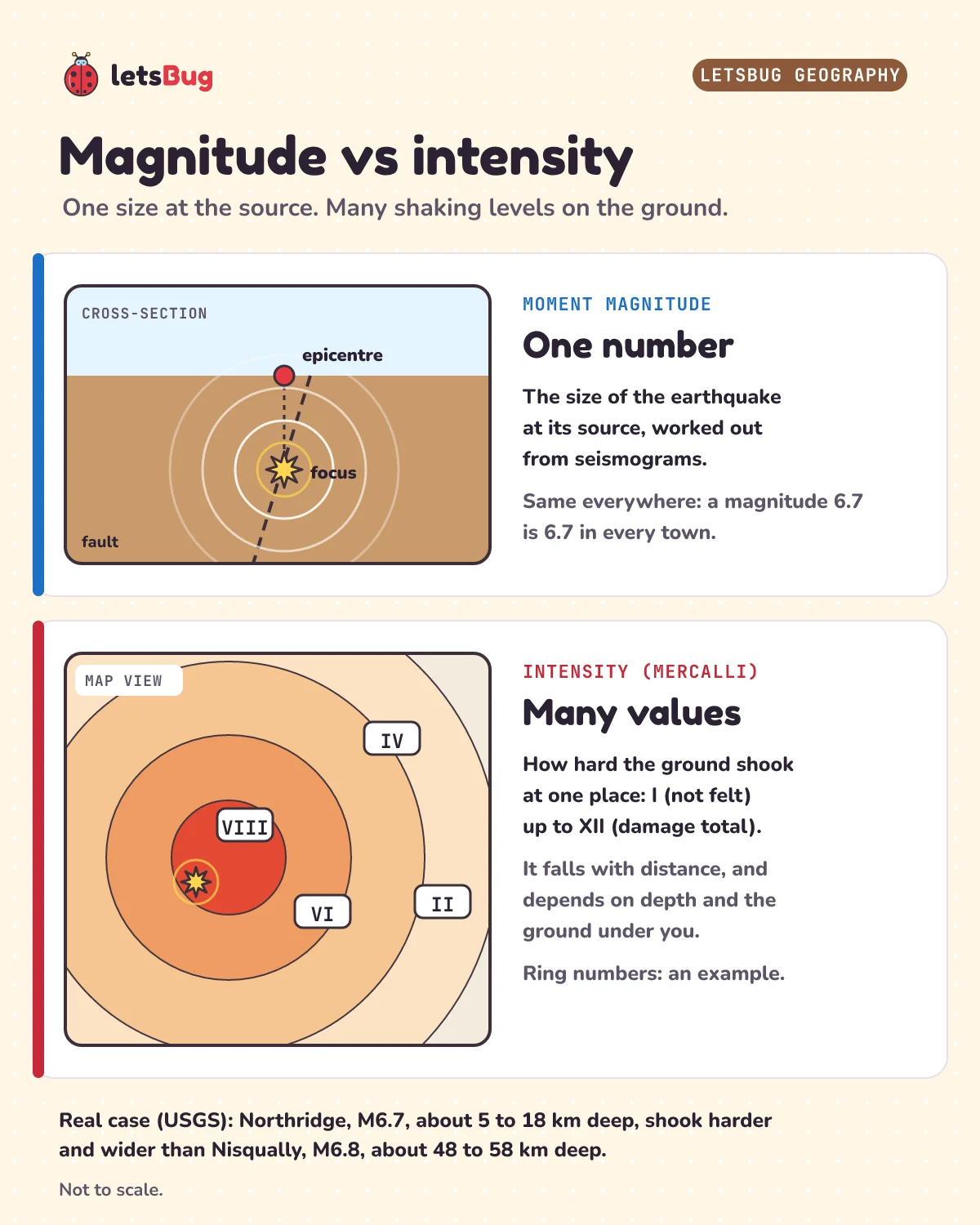
Magnitude: one number for the size at the source
The USGS sums it up in two sentences: "Magnitude is the size of the earthquake. An earthquake has a single magnitude." Seismologists work it out from the seismograms recorded at many stations. Even Richter's original method included adjustments "for the variation in the distance between the various seismographs and the epicenter".
Today the standard is the moment magnitude scale, written Mw. Instead of only measuring how tall the wiggles are, it's based on the physics of the break: the strength of the rock, the area of the fault that slipped, and how far it moved. In the USGS's words, "rigidity is the strength of the rock along the fault, area is the area of the fault that slipped, and slip is the distance the fault moved." A bigger fault area or a longer slip gives a bigger magnitude.
The scale is logarithmic, which means each whole step multiplies instead of adding:
- Wave height: each whole number up is "a tenfold increase in measured amplitude as measured on a seismogram" (USGS). Amplitude is the height of the wiggle.
- Energy: each whole number up "represents an 32 times more energy release" (USGS, typo theirs).
Where does 32 come from? The energy goes up by 10 to the power 1.5 for every whole step. 101.5 = 31.6, which rounds to 32. That's why the USGS booklet The Severity of an Earthquake says "about 31 times" and its newer pages say 32: the same number, rounded differently. Wikipedia's moment magnitude article gives the general rule: the energy ratio between two earthquakes is 101.5 × (difference in magnitude).
Why a magnitude 8 isn't twice a magnitude 4
Going from 4 to 8 is four steps. Each step multiplies, so let's build it up:
| Magnitude | Wave height, compared with M4 | Energy, compared with M4 |
|---|---|---|
| M4 | 1 × | 1 × |
| M5 | 10 × | about 32 × |
| M6 | 100 × | about 1,000 × |
| M7 | 1,000 × | about 32,000 × |
| M8 | 10,000 × | about 1,000,000 × |
So a magnitude 8 makes waves 10,000 times taller on the seismogram and releases about a million times the energy of a magnitude 4. With the rounded 32 you get 32 × 32 × 32 × 32 = 1,048,576; with the exact 101.5 it's 106 = 1,000,000 exactly. Either way: about a million, not 2.
Decimals count too. A magnitude 6.5 against a 6.0 is half a step: 100.75 = about 5.6 times the energy. That's why a news report that upgrades an earthquake "from 6.0 to 6.5" is a big change, not a small one.
Is it still the Richter scale?
Not for big earthquakes. Charles Richter invented the idea of magnitude in 1935, for earthquakes in southern California. The USGS notes that "His original definition held only for California earthquakes occurring within 600 km of a particular type of seismograph". It worked well for small, nearby earthquakes, but it can't keep up with very large ones. The British Geological Survey says "Richter’s original magnitude scale underestimates the size of large events", a problem called saturation: for very big earthquakes, the number comes out too low.
That's why moment magnitude replaced it. The USGS says the Richter scale "is not commonly used anymore, except for small earthquakes recorded locally", and that "for very large earthquakes, moment magnitude gives the most reliable estimate of earthquake size." Moment magnitude was designed "to be roughly equal to the Richter Scale in the magnitude range where they overlap", so old and new values still line up for small earthquakes.
Magnitude vs intensity: the Mercalli scale
Magnitude is one number for the whole earthquake. Intensity is how strongly the ground shook at one particular place, judged by what people felt and what got damaged. The USGS: "The intensity is the measure of shaking at each location, and this varies from place to place, depending mostly on the distance from the fault rupture area."
The scale used in the United States is the Modified Mercalli Intensity scale, developed in 1931 by Harry Wood and Frank Neumann. It has 12 levels written in Roman numerals, from I to XII. The low numbers describe what people feel; the high numbers describe damage to buildings:
- I: "Not felt except by a very few under especially favorable conditions."
- VI: "Felt by all, many frightened."
- XII: "Damage total. Lines of sight and level are distorted. Objects thrown into the air."
Unlike magnitude, the USGS says it "does not have a mathematical basis; instead it is an arbitrary ranking based on observed effects." There's no ×32 rule here.
Intensity depends on more than distance. Depth and the ground under you matter too. The USGS compares two earthquakes in the United States: "The shaking from the M6.7 Northridge, CA earthquake was more intense and covered a wider area than the slightly larger M6.8 Nisqually, WA earthquake." Northridge started about 5 to 18 km down (3 to 11 miles); Nisqually about 48 to 58 km down (30 to 36 miles). A smaller magnitude, closer to the surface, shook harder.
Bigger isn't always deadlier: Chile 2010 vs Nepal 2015
On 27 February 2010, a magnitude 8.8 earthquake struck Maule, Chile. On 25 April 2015, a magnitude 7.8 earthquake struck Nepal (both are the USGS's moment magnitudes). Chile's was one whole step bigger, so it released about 32 times the energy.
Yet about 525 people died in Chile, and 8,962 in Nepal: about 17 times as many. (Those are Wikipedia's totals. The USGS's own summaries say "At least 523 people killed" in Chile and "At least 8,669 people killed" in Nepal, counting a magnitude 7.3 aftershock on 12 May. Either way, about 17 times as many.) Why?
- Buildings. Chile's newer seismic building codes took effect in 1985. A Seattle City Council report on the lessons from Chile found that "Of the 9,974 modern mid and high rises that had been constructed since 1985, when the new seismic codes took effect, only 35 had to be evacuated". That's 0.35%. Most of the deaths in buildings were in "old-style adobe houses".
- The tsunami. In Chile, many of the deaths were from the tsunami that followed, not from collapsing buildings. A field survey of the tsunami found that "Many of the tsunami victims were tourists in coastal campgrounds", while most people living on the coast evacuated on their own after the shaking (Fritz and others, 2011).
- Vulnerability in Nepal. Experts had warned for decades that Nepal was vulnerable, "particularly because of its geology, urbanization, and architecture" (Wikipedia, April 2015 Nepal earthquake).
Intensity tells the same story: Wikipedia gives Chile's strongest shaking as Mercalli IX and Nepal's as X, even though Nepal's magnitude was lower. Nepal's earthquake started about 8 km down, Chile's about 23 km down (USGS).
Earthquake early warning: how your phone gets a head start
Your phone buzzes "Earthquake!" a few seconds before the shaking. That isn't a prediction. The earthquake has already started, and the alert is winning a race against the S waves.
On the west coast of the United States, the USGS-run ShakeAlert system "detects significant earthquakes quickly enough so that alerts can be delivered to people and automated systems potentially seconds before strong shaking arrives." It serves over 50 million residents and visitors in California, Oregon and Washington. Its fastest method uses the P waves: as soon as seismometers at "at least four stations" near the earthquake pick them up, it estimates the earthquake's magnitude, epicentre and start time. Wikipedia's early warning article sums up the idea: "When P waves are detected, the readings are analysed immediately", and the warning goes out to phones, radio, television and sirens before the S waves arrive. The alert travels over networks, not through rock, so a town far from the epicentre can get it before the shaking reaches it. Those seconds are enough to "Drop, Cover, and Hold On", and ShakeAlert lists automatic actions such as "slowing trains, closing water valves, turning on backup generators".
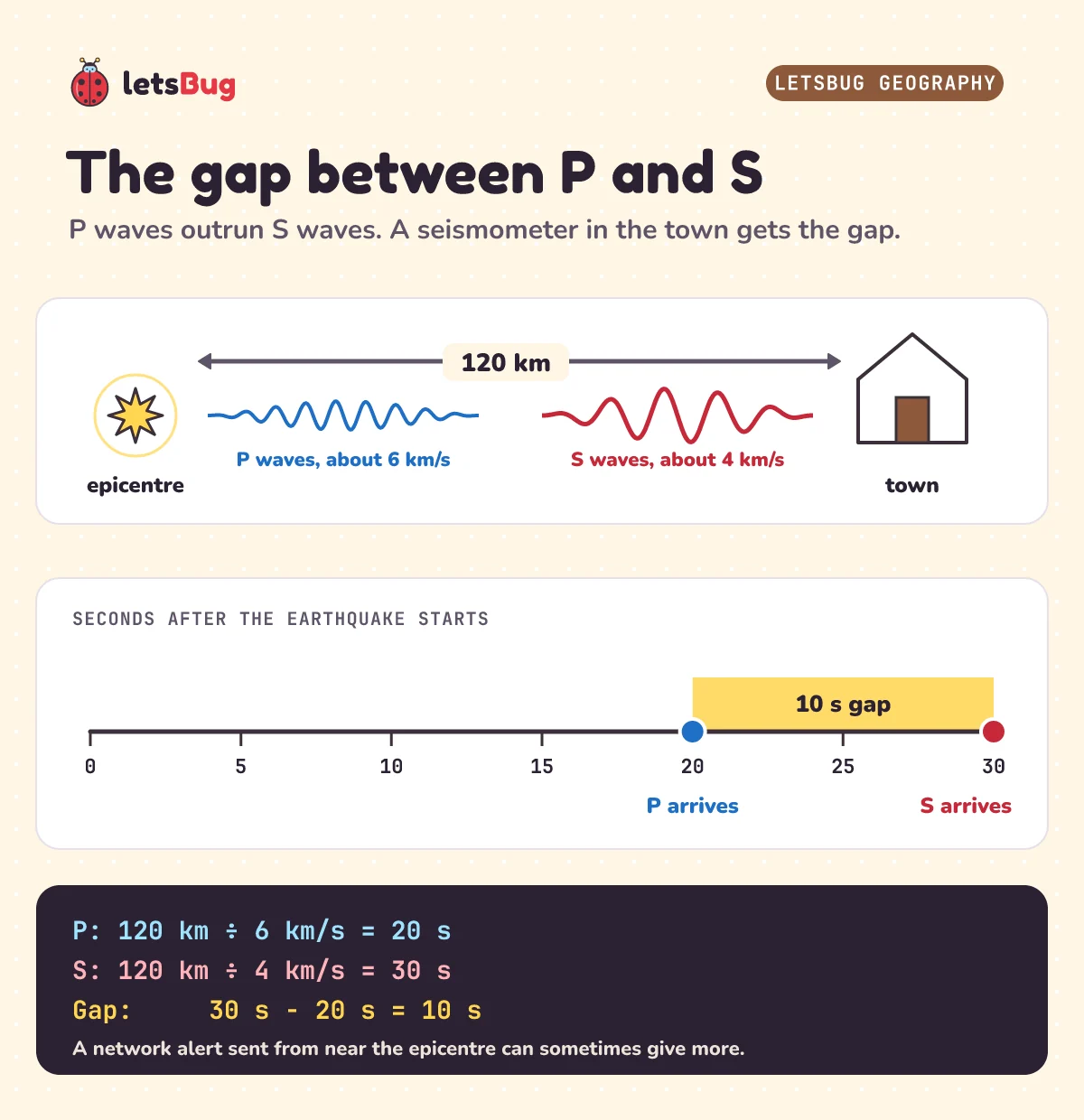
Worked example. A town is 120 km from the epicentre. P waves travel at about 6 km/s and S waves at about 4 km/s. How long is the gap between the first jolt and the strong shaking?
- Units first: time = distance ÷ speed, and km ÷ km/s = s.
- P waves: 120 ÷ 6 = 20 s.
- S waves: 120 ÷ 4 = 30 s.
- Gap: 30 − 20 = 10 s between the first jolt and the strong shaking. A seismometer in the town gets that much warning; a network like ShakeAlert, which spots the quake near the epicentre and sends the alert at network speed, can sometimes give more, minus a few seconds to process.
Close to the epicentre, the P and S waves arrive almost together, so the gap shrinks to almost nothing, and there's almost no time for any alert. Further away, the gap grows.
A city is 180 km from the epicentre. P waves travel at 6 km/s and S waves at 4 km/s. How long is the gap between the P waves and the S waves arriving there?
Show the answer
P waves: 180 ÷ 6 = 30 s. S waves: 180 ÷ 4 = 45 s. So there's a 15-second gap (45 − 30). A seismometer in the city gets that much warning; a network alert sent from near the epicentre can sometimes give more.
Can earthquakes be predicted?
No. The USGS answers its own question in one word, then: "Neither the USGS nor any other scientists have ever predicted a major earthquake." A real prediction would have to give three things: the date and time, the location and the magnitude. Nobody can do that.
What scientists can do is forecast: the USGS can "only calculate the probability that a significant earthquake will occur (shown on our hazard mapping) in a specific area within a certain number of years." A forecast says how likely; a prediction would say exactly when. And early warning is neither: it only starts once the earthquake has begun.
Don't mix it up with the volcano scale
Volcanic eruptions have their own scale, the Volcanic Explosivity Index (VEI), from 0 to 8. It's based mainly on how much material an eruption throws out and how high it goes. From VEI 2 upwards each step is 10 times as much, not 32:
| Eruption | VEI | Material thrown out |
|---|---|---|
| Mount St. Helens, 1980 | 5 | at least 1 km³ |
| Pinatubo, 1991 | 6 | at least 10 km³ |
| Tambora, 1815 | 7 | at least 100 km³ |
Practice questions
Q1. A news alert says a magnitude 5.0 earthquake hit one region, and a week later a magnitude 7.0 hit another. How many times more energy did the second one release?
Show the answer
7.0 − 5.0 = 2 steps. 32 × 32 = 1,024, or exactly 101.5 × 2 = 103 = 1,000. So about 1,000 times the energy. Its waves were 10 × 10 = 100 times taller on a seismogram.
Q2. A town is 60 km from an epicentre. P waves travel at 6 km/s and S waves at 4 km/s. How long is the gap between the P waves and the S waves arriving there?
Show the answer
P: 60 ÷ 6 = 10 s. S: 60 ÷ 4 = 15 s. Gap: 15 − 10 = 5 seconds. Compare 10 s at 120 km and 15 s at 180 km: the further from the epicentre, the longer the gap.
Q3. After an earthquake, a friend in a city near the epicentre says "it was a magnitude 7 here", and a friend 300 km away says "it was only a magnitude 4 here". What have they mixed up?
Show the answer
Magnitude and intensity. The earthquake has one magnitude, the same for both of them. What changed with distance is the intensity, the shaking at each place, which is described on the Mercalli scale in Roman numerals (for example VIII near the epicentre and IV far away).
Q4. A report upgrades an earthquake from magnitude 6.0 to 6.5. Is that a small change?
Show the answer
No. Half a step is 101.5 × 0.5 = 100.75, about 5.6 times the energy.
Questions people ask
How are earthquakes measured?
With seismometers, which record the seismic waves as seismograms. From these, scientists calculate the magnitude, the size at the source, on the moment magnitude scale. Separately, the shaking at each place is rated as an intensity on the Modified Mercalli scale, from I to XII.
How much stronger is each magnitude number?
Each whole number up means 10 times the wave height on a seismogram and about 32 times the energy. Two steps is about 1,000 times the energy, and four steps about 1,000,000 times.
Is the Richter scale still used?
Only for small, local earthquakes. Richter's 1935 scale underestimates large earthquakes, so seismologists now report them in moment magnitude (Mw). As the BGS puts it, "Press reporters love the Richter scale", so you'll still hear the name.
What's the difference between magnitude and intensity?
Magnitude is one number for the whole earthquake: its size at the source. Intensity is the shaking and damage at one place, so it changes from place to place. The BGS says it "normally decreases with distance from the epicentre."
Can earthquakes be predicted?
No. No scientist has ever predicted a major earthquake's date and time, location and magnitude. Scientists can forecast the probability of a strong earthquake in a region over a number of years, and early warning systems can send alerts seconds after one starts.
Can there be a magnitude 10 earthquake?
None has ever been recorded, and one is very unlikely: it would take a gigantic fault. The biggest earthquake in the USGS catalogue since 1900 is the 1960 Great Chilean Earthquake, magnitude 9.5. The USGS works out that a magnitude 10 would need a fault about 14,000 km long slipping an average of 30 m. Adding up the energy of every earthquake in about the past 110 years gives the equivalent of a single magnitude of about 9.95.
Keep going
- Watch the full lesson, How Are Earthquakes Measured? Why M8 Isn't Twice M4.
- Why earthquakes happen in the first place, plates that lock and slip: why do earthquakes and volcanoes happen? (Geography, episode 1).
- How an alert reaches millions of phones in seconds: how the internet works.
- Another system that measures the Earth from signals and time: how GPS works without internet.
Sources
- USGS: The Severity of an Earthquake (seismographs, tenfold amplitude, about 31 times the energy, the 12 Mercalli levels), Earthquake Magnitude, Energy Release, and Shaking Intensity (single magnitude, 32 times the energy, Richter 1935 and 600 km, moment magnitude, Northridge and Nisqually, magnitude 10), The Modified Mercalli Intensity Scale, Moment magnitude, Richter scale: the different magnitude scales and Can you predict earthquakes?
- USGS earthquake catalogue: M 8.8, 2010 Maule, Chile and M 7.8, Nepal 2015 (magnitude, date, depth, deaths) and M 9.5, 1960 Great Chilean Earthquake (the largest since 1900)
- British Geological Survey: How are earthquakes detected? (seismometers, P, S and surface waves and their speeds, Richter and moment magnitude, intensity)
- ShakeAlert: home page (earthquake early warning on the US west coast) and ShakeAlert system algorithms (P-wave detection)
- Wikipedia: Earthquake warning system (how alerts beat the S waves)
- Seattle City Council: Earthquake lessons from Chile (building codes since 1985, 35 of 9,974 buildings, adobe houses)
- Fritz and others (2011), Field Survey of the 27 February 2010 Chile Tsunami, Pure and Applied Geophysics (tsunami victims, evacuation)
- Wikipedia: Moment magnitude scale (101.5 per step, saturation), 2010 Chile earthquake (525 dead, intensity IX), April 2015 Nepal earthquake (8,962 dead, intensity X) and Volcanic explosivity index
Every number in this post was checked against these sources, and the arithmetic was run in Python before publishing.