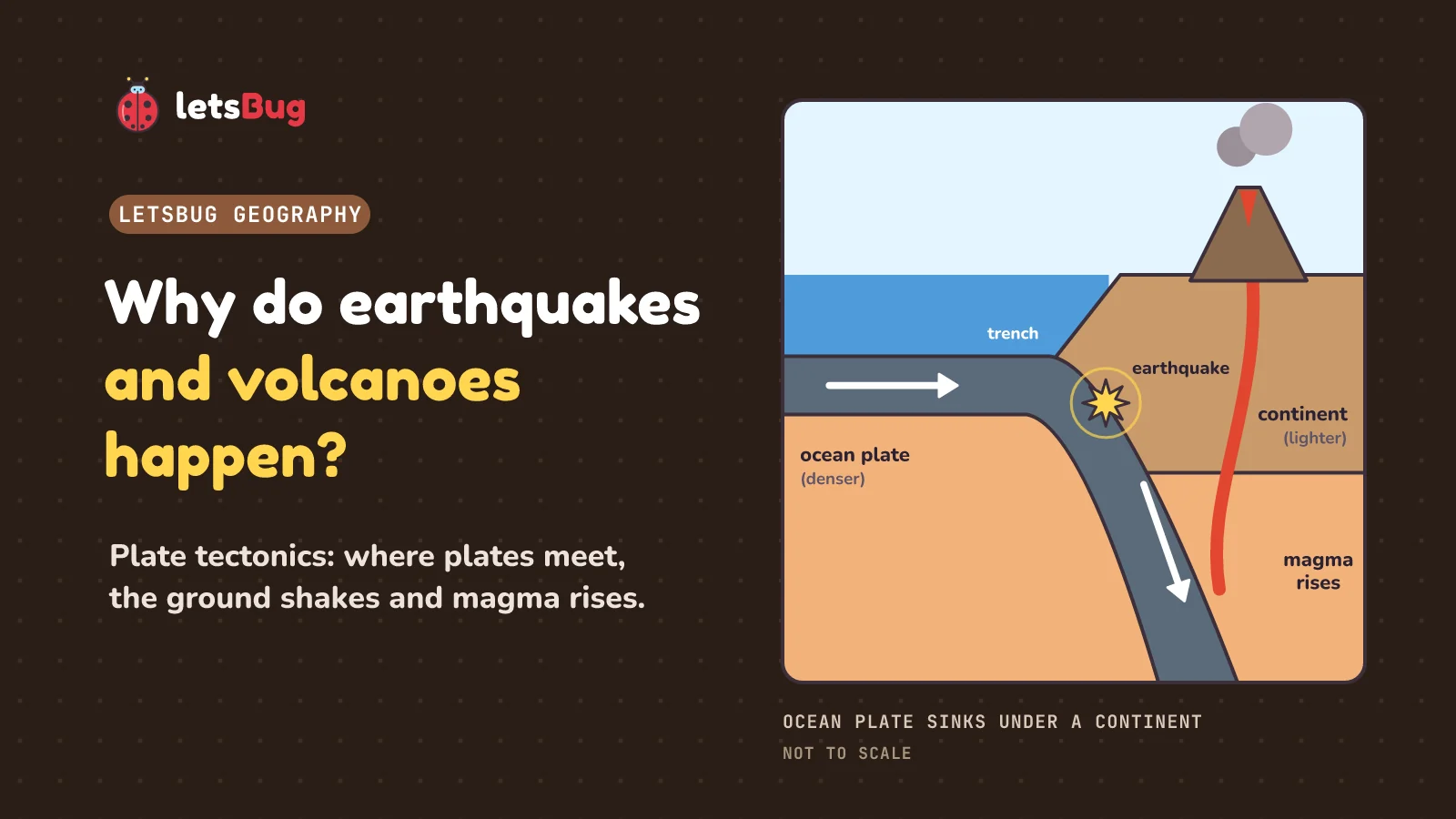
Earthquakes and volcanoes happen mostly where tectonic plates meet. Earth's rigid outer shell is broken into plates that move a few centimetres a year.
Where plates pull apart, molten rock rises and erupts. Where one plate sinks under another, the plates lock, then suddenly slip (an earthquake), and water from the sinking plate melts the rock above it into magma that feeds volcanoes. Where plates slide past each other, they stick and jerk, giving earthquakes but no volcanoes. A few volcanoes, like Hawaii's, sit over hotspots in the middle of a plate, but they're the exception. Let's see what moves the plates, compare every type of boundary in one table, and see how the same process built the Himalayas.
Key takeaways
- The crust and the top of the mantle form a rigid shell, the lithosphere, broken into tectonic plates.
- The mantle is mostly solid rock that flows very slowly. Plates don't float on a sea of lava.
- The main force moving plates is slab pull: old, cold, dense ocean plate sinking into the mantle and dragging the rest behind it. Convection is the heat engine underneath.
- Constructive margins pull apart, destructive margins sink, conservative margins slide past. Each gives a different mix of earthquakes and volcanoes.
- The Himalayas formed, and are still rising, where the Indian plate pushes into the Eurasian plate.
This post goes with letsBug Geography, episode 1 (GCSE and IGCSE geography, and the plate tectonics behind Class 9 "Physical Features of India"). Watch it, or read on: the post adds a full comparison table, the Himalayas, and exam-style questions with model answers.
Inside the Earth: four layers
Earth has a radius of about 6,371 km. Let's go from the outside in.
| Layer | How thick | How hot | Solid or liquid? |
|---|---|---|---|
| Crust | 5 to 10 km under oceans; up to about 70 km under continents | coolest layer | solid |
| Mantle | about 2,900 km | about 1,000 °C at the top to 3,700 °C at the bottom | mostly solid, flows very slowly |
| Outer core | about 2,200 km | several thousand °C | liquid iron and nickel |
| Inner core | radius about 1,220 km | about 5,200 °C | solid iron |
The inner core, at about 5,200 °C, is almost as hot as the surface of the Sun (about 5,500 °C). It stays solid because the pressure down there is enormous.
The two kinds of crust matter later. Ocean crust is mostly basalt, almost 3.0 g/cm³. Continental crust is thicker but lighter, about 2.7 g/cm³. When the two meet, the denser one sinks.
Tectonic plates: Earth's cracked shell
The crust and the cooler, rigid top part of the mantle together form the lithosphere. It's broken into about 15 large plates (the British Geological Survey's count) and many smaller ones. The plates move over the asthenosphere, a hotter, weaker layer of the mantle that can soften and flow over millions of years.
Where two plates meet is a plate boundary, also called a plate margin.
What moves the plates?
The classic textbook answer is convection currents: heat from the core warms the bottom of the mantle, warm rock rises very slowly, cools near the top and sinks again, and the plates ride along like boxes on a conveyor belt. The USGS notes that until the 1990s, most explanations were built around convection.
The modern view puts the plates themselves at the centre. Ocean plate cools and gets denser as it ages. Where it meets another plate, its old, cold edge sinks into the mantle, and its weight drags the rest of the plate behind it, like a tablecloth sliding off a table. This is slab pull. The British Geological Survey says research shows slab pull is "the major driving force for most plate movement", because the plates with more of their edges sinking are the fastest-moving ones.
There's also ridge push: new seafloor at a mid-ocean ridge is warm and sits high, so gravity makes it slide away from the ridge. It adds a smaller push, often put at only 5 to 10% of the total. Scientists still debate the exact mix, so the safe exam answer is: convection is the heat engine, slab pull is the main force, and ridge push helps.
Types of plate boundaries
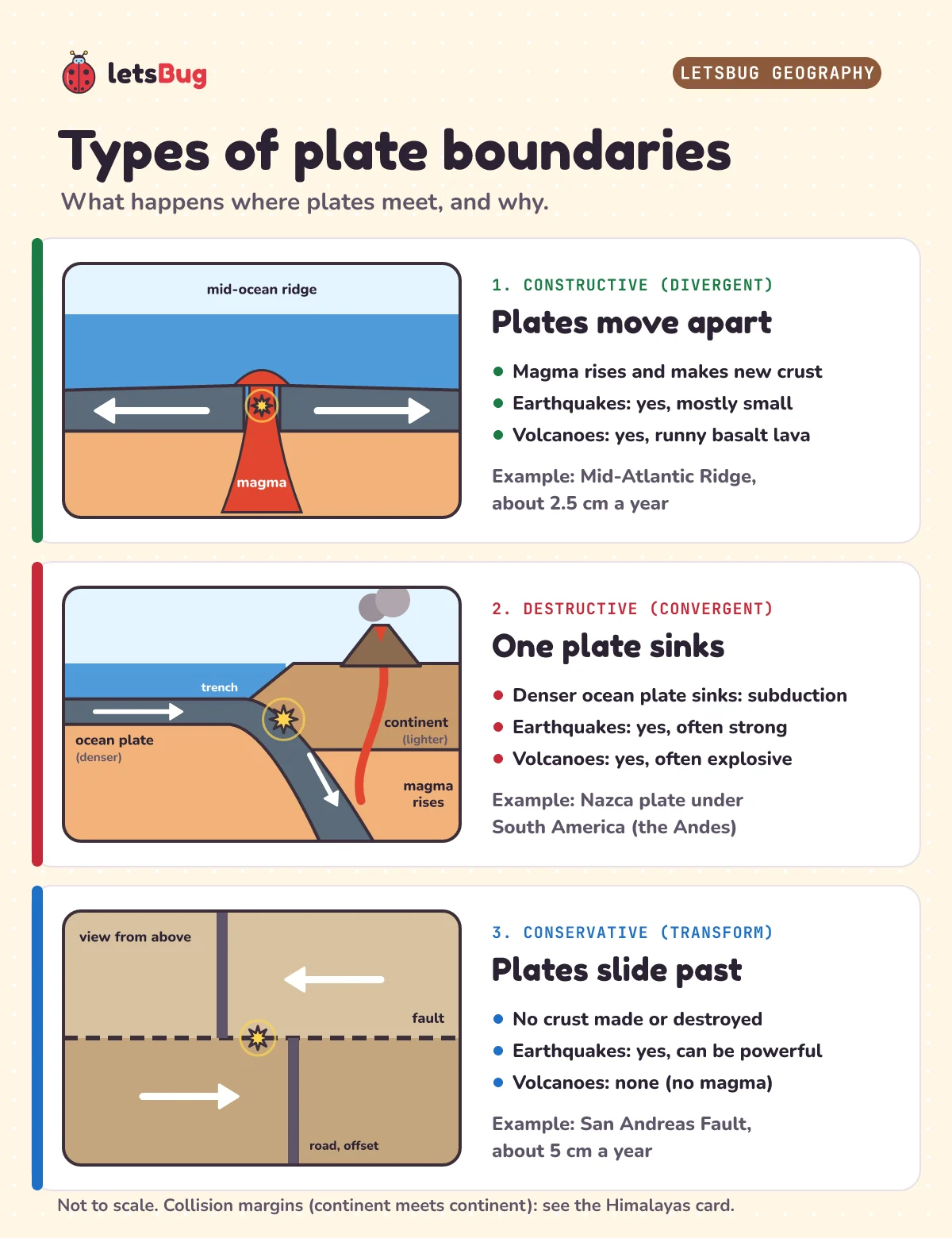
GCSE courses call them constructive, destructive and conservative margins. Many textbooks and the USGS use divergent, convergent and transform. They're the same thing. When two continents push together, it's often taught as a fourth type, a collision margin.
| Boundary | Plates | Earthquakes | Volcanoes | Example |
|---|---|---|---|---|
| Constructive (divergent) | move apart; new crust is made | yes, mostly small | yes, runny basalt lava | Mid-Atlantic Ridge, Iceland |
| Destructive (convergent) | move together; the denser ocean plate sinks | yes, often strong | yes, often explosive | Nazca plate under South America (Andes) |
| Collision (convergent, continent meets continent) | move together; neither sinks, the crust crumples up | yes, can be very strong | rare | India meets Asia (Himalayas) |
| Conservative (transform) | slide past; crust is neither made nor destroyed | yes, can be powerful | no | San Andreas Fault, California |
Constructive margins: plates move apart
The best example is the Mid-Atlantic Ridge, an underwater mountain range down the middle of the Atlantic. As the plates separate, the pressure on the mantle underneath drops, some of it melts, and magma rises to fill the gap. It cools into brand-new ocean floor. The lava is basalt, which is runny, so it tends to flow out rather than explode. Iceland sits right on top of the ridge and is splitting along it, which is why it has so many volcanoes. Earthquakes here are common but mostly small.
Destructive margins: one plate sinks
Off the west coast of South America, the ocean Nazca plate meets the continental South American plate. The ocean plate is denser, so it sinks underneath. This is subduction, and it digs a deep ocean trench, here the Peru–Chile Trench. Ocean trenches like this can be 8 to 10 km deep.
The plates don't slide smoothly. Parts of them lock together for long periods, then suddenly move, causing large earthquakes. Some are very deep: in 1994 a magnitude 8.3 earthquake struck Bolivia 636 km underground, in the subduction zone where the Nazca plate sinks. Further down, the sinking plate releases water into the mantle above it. Water lowers the melting point of the rock, so it melts into magma, which rises and feeds the volcanoes of the Andes.
Conservative margins: plates slide past
Here no crust is made and none is destroyed, so there's no magma and no volcanoes. But the plates still stick, store energy and jerk forward. The famous example is the San Andreas Fault in California, about 1,300 km long, where the Pacific plate grinds north-west past the North American plate at an average of about 5 cm a year. On 18 April 1906, 477 km of it broke at once in the great San Francisco earthquake.
So why do earthquakes happen?
Plates move steadily, but the rocks along a boundary are rough and get stuck. As the plates keep moving, the rocks bend and store energy, like a stretched elastic band. When the stress gets too big, the rocks suddenly slip along a fault. The British Geological Survey calls the stored energy "elastic strain" energy: it's released as seismic waves, which shake the ground. That sudden slip is an earthquake, and it can happen at every type of boundary.
And why do volcanoes happen?
Solid mantle rock melts in only two common situations at plate boundaries:
- The pressure drops. At a constructive margin, rock rising under the ridge is squeezed less, so it melts.
- Water is added. At a destructive margin, water from the sinking plate lowers the melting point of the rock above it.
Neither happens at a conservative margin, which is why it has earthquakes but no volcanoes. At a collision margin no ocean plate sinks, so no water is added, and volcanoes are rare.
The Ring of Fire
Around most of the Pacific Ocean, ocean plates are sinking under their neighbours, from the Andes to Japan to New Zealand. This 40,000 km horseshoe is the Ring of Fire. National Geographic puts it at about 90% of all the world's earthquakes and 75% of its active volcanoes; the British Geological Survey says over 80% of large earthquakes happen there.
India meets Asia: how the Himalayas formed
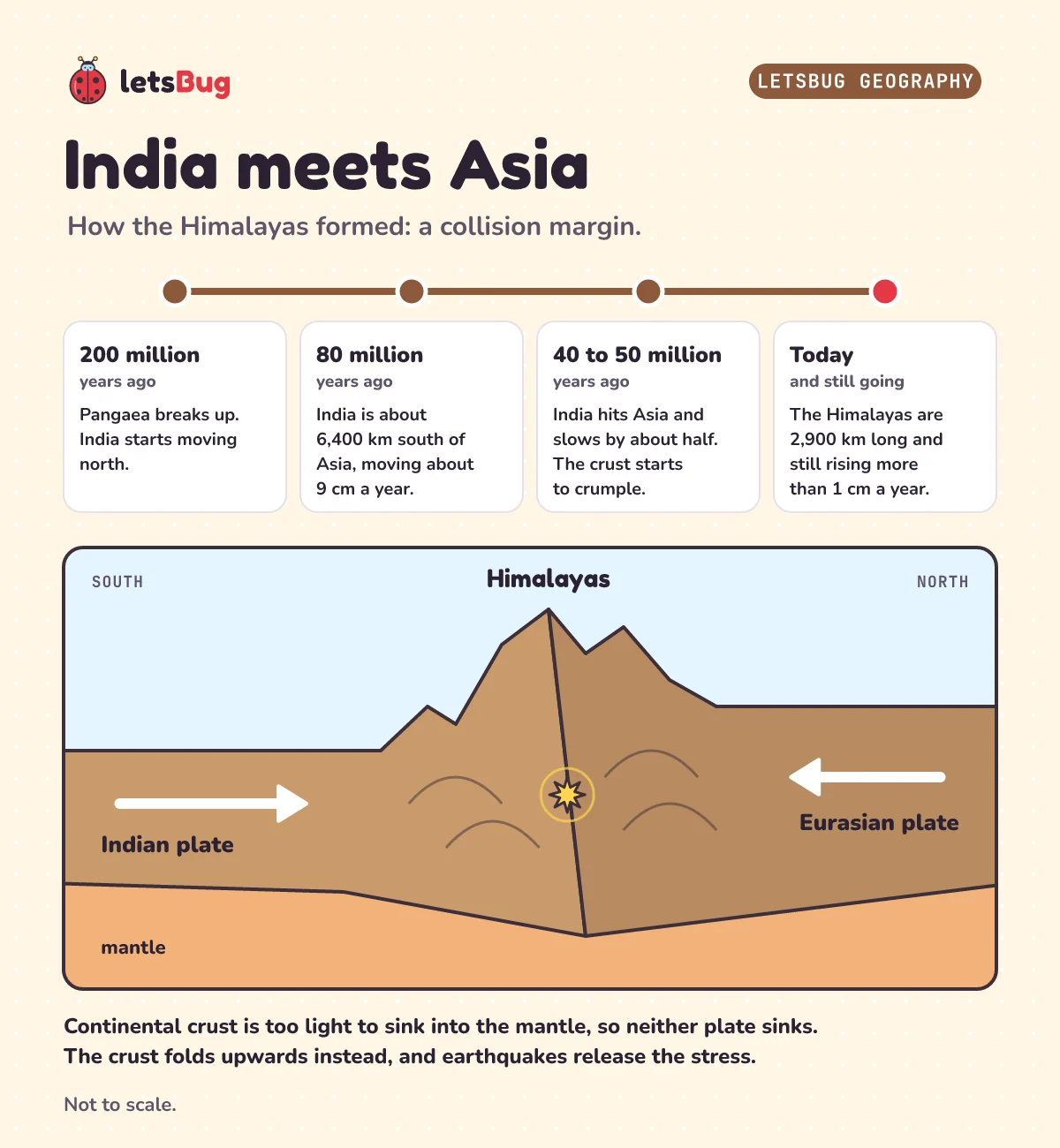
Class 9's "Physical Features of India" calls the Himalayas young fold mountains, and says the peninsular plateau formed when the old landmass of Gondwana broke up and drifted. Here's the plate tectonics behind both. About 200 million years ago, the supercontinent Pangaea (which included Gondwana) broke apart and India began to move north. About 80 million years ago it was roughly 6,400 km south of Asia, moving at about 9 cm a year, faster than most plates move today.
Between 40 and 50 million years ago, India hit Asia. Continental crust is too light to sink into the mantle, so neither plate could be pushed under the other. The crust had nowhere to go but up: it crumpled and folded into the Himalayas, which now stretch about 2,900 km. India slowed down by about half when it hit, but it hasn't stopped. The Himalayas are still rising by more than 1 cm a year, and the stress released along their faults causes some of the world's most destructive earthquakes.
Worked example: how fast is slow?
The Mid-Atlantic Ridge spreads at an average of about 2.5 cm a year. Let's put that in human and geological terms.
- A lifetime: 2.5 cm/year × 80 years = 200 cm = 2 m.
- Change the units: 2.5 cm × 1,000,000 years = 2,500,000 cm = 25 km. So 2.5 cm a year is 25 km every million years.
- An ocean: take a gap of 4,500 km, similar to the width of the Atlantic in many places. 4,500 km ÷ 25 km per million years = 180 million years.
That fits the evidence: the USGS says seafloor spreading over the past 100 to 200 million years turned the Atlantic from a narrow inlet into today's ocean. Tiny speeds, huge times. Speeds vary a lot, from under 2.5 cm a year at the Arctic Ridge to more than 15 cm a year at the East Pacific Rise.
At the San Andreas Fault, the Pacific plate moves past the North American plate at about 5 cm a year. How long would it take for the two plates to move 100 km past each other?
Show the answer
100 km = 100,000 m = 10,000,000 cm. Then 10,000,000 ÷ 5 = 2,000,000. So about 2 million years.
How we measure plate movement today
We don't have to wait millions of years to see plates move. GPS receivers fixed to the ground on different plates measure their exact positions again and again. The USGS says GPS has been the most useful space technique for studying the Earth's crustal movements, and that the speeds measured over a few years match the speeds worked out over millions of years from the rocks of the ocean floor.
Exam-style questions with model answers
Q1 (4 marks). Explain why volcanoes form at destructive plate margins.
Model answer
The denser oceanic plate sinks (is subducted) under the less dense continental plate [1]. As it sinks, it releases water into the mantle above [1]. The water lowers the melting point of the rock, so it melts to form magma [1]. The magma is less dense than the rock around it, so it rises through cracks and erupts as a volcano [1].
Q2 (3 marks). Explain why conservative margins have earthquakes but no volcanoes.
Model answer
The plates slide past each other, so no crust is made or destroyed and no magma forms [1]. The plates stick, and stress builds up [1]. When it's released by sudden movement along the fault, it causes an earthquake [1]. Example: the San Andreas Fault.
Q3 (2 marks). Two plates move apart at 3 cm per year. How long would it take to open a gap 1,500 km wide?
Model answer
1,500 km = 150,000,000 cm [1]. 150,000,000 ÷ 3 = 50,000,000 years, so 50 million years [1].
Q4 (3 marks, Class 9). How were the Himalayas formed?
Model answer
The Indian plate moved north towards the Eurasian plate [1]. When they collided, neither sank, because continental crust is too light to sink into the mantle [1]. The crust between them was squeezed, folded and pushed up to form the Himalayas, which are fold mountains and are still rising [1].
Questions people ask
Why do earthquakes and volcanoes happen in the same places?
Because most of both happen at plate boundaries. At destructive margins, like the Ring of Fire, the sinking plate causes earthquakes where it locks and slips, and makes the magma that feeds volcanoes. Conservative margins get earthquakes only.
What are the types of plate boundaries?
Constructive (divergent): plates move apart. Destructive (convergent): plates move together and one sinks. Conservative (transform): plates slide past each other. When two continents meet, it's often called a collision margin.
Is the mantle liquid?
No. The mantle is mostly solid rock that flows very slowly over millions of years. The only liquid layer is the outer core.
Do convection currents move the plates?
Convection in the mantle is the heat engine, but the main force on the plates is slab pull: cold, dense ocean plate sinking into the mantle and dragging the rest of the plate behind it. Ridge push adds a smaller push.
Are the Himalayas still growing?
Yes. India is still pushing into Asia, and the USGS says the Himalayas are rising by more than 1 cm a year.
Keep going
- Watch the full lesson, Plate Tectonics Explained.
- For the NCERT chapter on the Himalayas, plains and plateaus: Physical Features of India Class 9 Q&A.
- The satellites that measure plate movement: how GPS works without internet.
Sources
- USGS, This Dynamic Earth: Inside the Earth (layers, lithosphere, asthenosphere), Understanding plate motions (boundary types, spreading rates, trenches, the 1994 Bolivia earthquake, San Andreas, GPS), Hotspots, The Himalayas: two continents collide and Some unanswered questions (convection and subduction)
- British Geological Survey: What causes earthquakes? (slab pull, about 15 plates, elastic strain) and Where do earthquakes occur?
- National Geographic Education: Crust, Mantle, Core and Plate tectonics and the Ring of Fire
- NOAA Ocean Exploration: What is a mid-ocean ridge?
- NASA: Sun facts (surface about 5,500 °C)
- USGS Earthquake Hazards Program: The great 1906 San Francisco earthquake
- Wikipedia: Internal structure of Earth (6,371 km), Slab pull (ridge push 5 to 10%), Mid-ocean ridge (decompression melting), Plate tectonics (water lowers the melting point) and Gondwana (part of Pangaea)
Every number in this post was checked against these sources, and the arithmetic was run in Python before publishing.