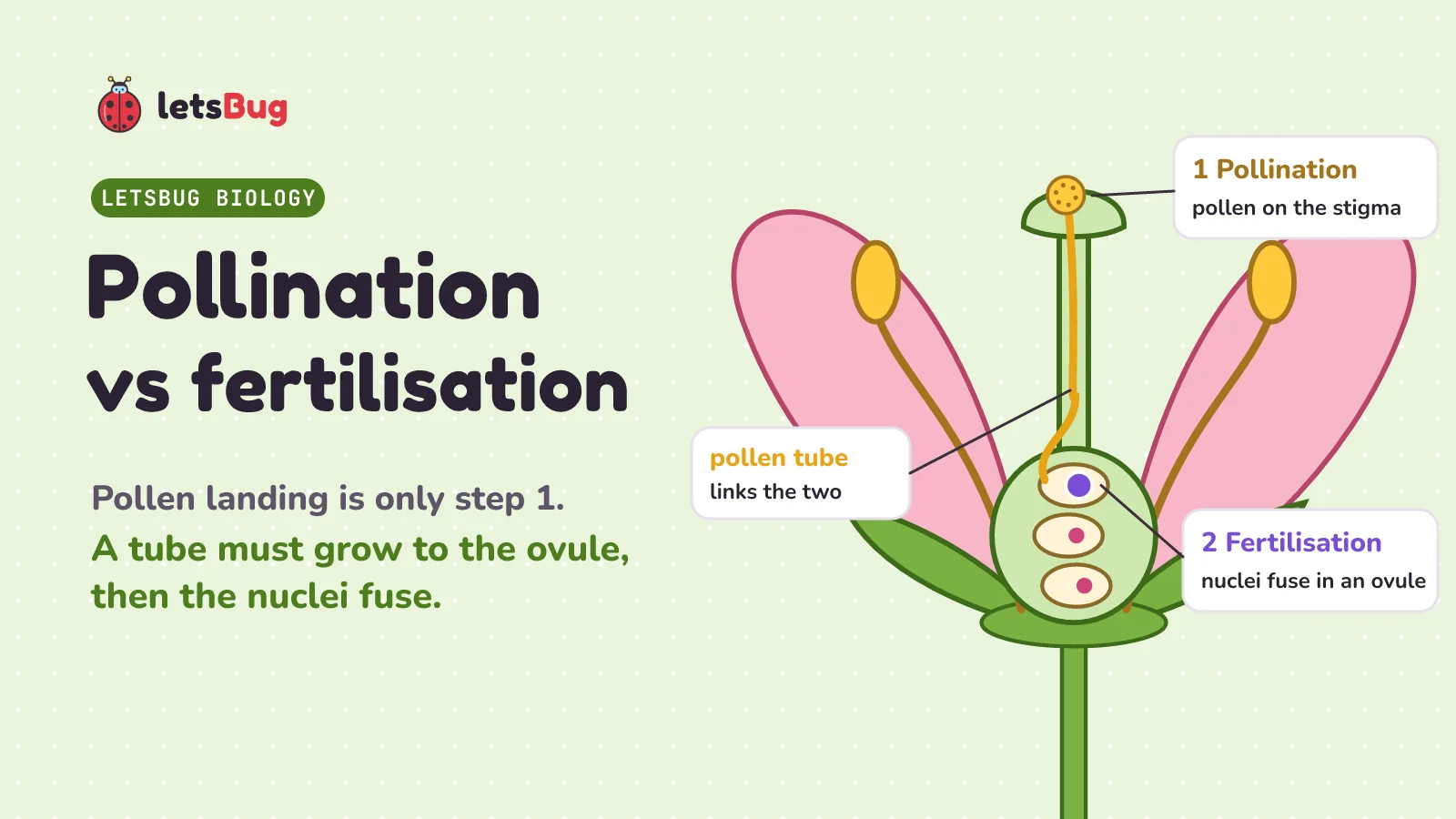
Pollination and fertilisation are two different steps. Pollination is the transfer of pollen grains from an anther to a stigma: it is only a delivery. Fertilisation comes later, deep inside the flower. A pollen tube grows from the pollen grain down to an ovule, and a male nucleus fuses with the nucleus of the egg cell.
In this post we start with a corn cob, and why it often has missing kernels. Then we name the parts of a flower, see how pollen gets carried, and compare wind and insect flowers using NCERT's numbers. We follow the pollen tube down to the ovule, watch the nuclei fuse, and see the ovule turn into a seed and the ovary into a fruit. Every hard word is explained where it comes up, and the practice questions from the video are answered in full.
Key takeaways
- Pollination is the transfer of pollen grains from an anther (the male part) to a stigma (the female part). No seed has started yet.
- Fertilisation is when a male nucleus fuses with the egg cell's nucleus, inside an ovule. Say that the nuclei fuse, not just the gametes.
- The pollen tube links the two. It grows from the pollen grain, down the style, into an ovule. The grain itself stays on the stigma.
- Self-pollination: pollen reaches the same flower, or another flower on the same plant. Cross-pollination: pollen comes from a flower on a different plant of the same species.
- Wind flowers make light, small pollen in huge numbers. Insect flowers have bright petals, nectar and sticky or spiky pollen.
- After fertilisation, the ovule becomes a seed and the ovary becomes the fruit. Every pea in a pod is a fertilised ovule.
This post goes with letsBug Biology, episode 10. It covers sexual reproduction in flowering plants in Cambridge IGCSE biology (section 16.3) and CBSE Class 10 science (NCERT Chapter 7, How do Organisms Reproduce?). Watch the lesson, or read on: the post adds two diagrams, three tables, a worked pollen-to-seed calculation and model answers to practise with.
Why do corn cobs have missing kernels?
Because every kernel needs two things to happen. Its silk has to catch pollen, and then its ovule has to be fertilised. If either step fails, there is no kernel. (A kernel is one of the yellow grains on a cob.) Corn is also called maize. Wikipedia says: "Up to 1000 ovules (potential kernels) form per ear of corn, each of which produces a strand of corn silk from its tip that eventually emerges from the end of the ear." (Emerges means comes out. An ear of corn is the whole cob. An ovule is the small part inside a flower that can become a seed. Potential means possible.)
The silk is the long, soft thread you peel off a cob. Wikipedia: "Each individual fiber is an elongated style, attached to an individual ovary." (An elongated part is a stretched-out, long one. We meet the style and the ovary in the next section.) It also says "Corn silk is part stigma and part style, providing a female flower surface to which pollen grains can adhere". (To adhere is to stick. The stigma is the part of a flower that catches pollen.) And: "Kernel formation in the cob requires pollination of the external corn silk by wind or insects."
So up to 1,000 ovules can form on a cob. But Wikipedia goes on: "Typically 400 to 600 kernels are successfully formed in this way." A grain of pollen on a silk is only the start. To make a kernel, the pollen "must germinate and form a pollen tube that extends down nearly the full length of the corn silk strand". (To germinate here means to start growing.) Then the ovule must be fertilised. That's the difference between pollination and fertilisation, and the rest of this post follows it step by step.
What are the parts of a flower?
A flowering plant is any plant that makes flowers. Biologists call this group the angiosperms. NCERT, which makes India's school textbooks, says: "The reproductive parts of angiosperms are located in the flower." (Reproductive means to do with making new living things.) So the flower is where the plant makes seeds.
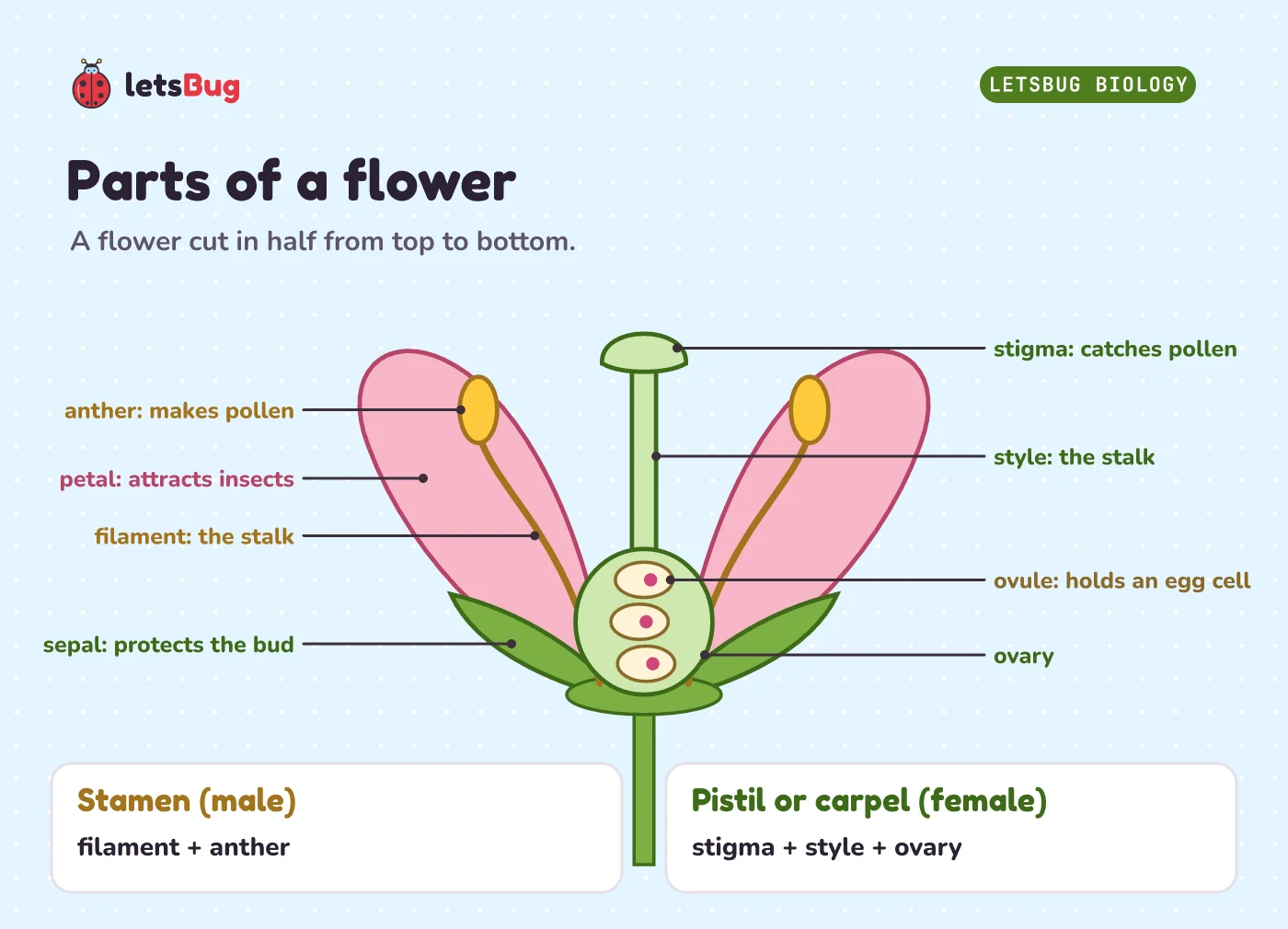
Here are the parts, from the outside in:
- Sepals are the green, leaf-like parts at the base. NCERT's Grade 9 book: "In the bud stage, green covering around all the parts is the outermost whorl of the flower." (A bud is a flower that hasn't opened yet. A whorl is a ring of parts round the flower.) So the sepals wrap and protect the bud.
- Petals are the coloured parts. NCERT: "The coloured projections of flowers are called petals". (Projections are parts that stick out.) In many flowers they attract insects.
- The stamen is the male part. NCERT: "Stamen is the male reproductive part and it produces pollen grains that are yellowish in colour." A stamen has two parts. The Grade 9 book says it "consists of a filament and an anther, which produces pollen grains containing male gametes." The filament is the thin stalk, and the anther is the top part that makes pollen. (Gametes are sex cells. In plants, the male gamete is carried inside the pollen grain.)
- The pistil is the female part, in the middle. Cambridge's list of flower parts says carpels instead, so you need both words. NCERT describes its three parts: "The swollen bottom part is the ovary, middle elongated part is the style and the terminal part which may be sticky is the stigma." (Terminal here means at the very end.) The stigma catches pollen. The style "is a thin long tube which connects the stigma to the ovary."
- Inside the ovary are the ovules. NCERT: "The ovary contains ovules and each ovule has an egg cell." The egg cell is the female gamete.
Not every flower has all of these. NCERT: "The flower may be unisexual (papaya, watermelon) when it contains either stamens or pistil or bisexual (Hibiscus, mustard) when it contains both stamens and pistil." (Unisexual means having only male or only female parts. Bisexual here means having both.)
What is pollination?
Cambridge's IGCSE syllabus (its list of what to learn) asks you to "Describe pollination as the transfer of pollen grains from an anther to a stigma". (Transfer means moving something from one place to another.) That's all pollination is: a delivery. The pollen has arrived at the stigma, but nothing has fused yet.
There are two kinds, and they depend on where the pollen comes from.
- Self-pollination. Cambridge: "the transfer of pollen grains from the anther of a flower to the stigma of the same flower or a different flower on the same plant".
- Cross-pollination. Cambridge: "the transfer of pollen grains from the anther of a flower to the stigma of a flower on a different plant of the same species". (A species is one kind of living thing.)
To reach another flower, pollen needs something to carry it. NCERT: "Pollination depends on external agents called pollinators, such as wind, water, insects (bees, butterflies), or birds." (External agents are things outside the plant that do a job for it. A pollinator is anything that carries pollen.) Some flowers even use birds: "Some flowers like those of the coral tree and hibiscus plant, are pollinated by birds, such as Indian white-eye and sunbirds." (So hibiscus can be pollinated by both insects and birds.)
Our food depends on this. Our World in Data, a research website, says (it means animals that carry pollen, like bees, not wind): "It's true: around three-quarters (75%) of the different crops we grow for food depend on pollinators to some extent." It adds an important "but": "Three-quarters of our crops depend on pollinators to some extent, but only one-third of global crop production does." (Global crop production means all the food crops grown in the world.) Why the gap? "This is because many of our largest producing crops (staples such as cereals) are not dependent on them at all." (Staples are the foods people eat most, like rice and wheat. Cereals are grasses grown for their grain.) Those big cereal crops are mostly wind-pollinated, which brings us to the next question.
How are wind-pollinated and insect-pollinated flowers different?
They are built for different carriers. NCERT's Grade 9 book describes wind first: "Pollination by wind is seen in plants like wheat, maize and rice, where pollen grains are light and small, produced in large numbers, and the stigma is long and feathery to trap them." (Feathery means branched like a feather, so it has a big surface to catch pollen from the air.)
Then insects: "Many plants, including sunflower, hibiscus and marigold are pollinated by insects, such as bees and butterflies. Their flowers are often brightly coloured, produce nectar, and give off fragrance to attract pollinators." (Nectar is a sugary liquid that insects drink. Fragrance means a smell.) And their pollen is different: "The pollen grains are large, sticky or spiny, so they can attach to the insect". (Spiny means covered in small spikes.) The stigma of an insect flower is sticky too, "to receive them".
| Feature | Wind-pollinated | Insect-pollinated |
|---|---|---|
| Examples | Maize, wheat, rice | Sunflower, hibiscus, marigold |
| To attract insects | Nothing needed | Bright petals, nectar and a smell |
| Pollen grains | Light and small | Large, sticky or spiny |
| How much pollen | Huge numbers | Far fewer |
| Stigma | Long and feathery, to trap pollen from the air | Sticky, to receive pollen from the insect |
NCERT gives numbers in its Table 11.3. It says "Studies of pollen production and seed formation by two different pollination strategies in different flowers show the following approximate trends", so treat them as rough guides, not exact counts. The table gives "Approximate pollen grains released per flower" next to the "Estimated average number of seeds formed". (Approximate means roughly. Estimated average means a typical number, worked out from studies.) NCERT writes big numbers in the Indian style, so 5,00,000 means five lakh, which is 500,000.
| Flower | Pollen grains per flower | Seeds formed |
|---|---|---|
| Wind-pollinated grasses (maize, wheat) | 500,000 to 1,000,000 | 50 to 200 |
| Insect-pollinated (sunflower) | 20,000 to 40,000 | 800 to 1,000 |
NCERT asks you to compare the "pollen to seed ratio". (A ratio compares two numbers: here, how many pollen grains are made for each seed.) Let's work it out for the lowest and the highest number of pollen grains per seed.
Wind, highest: 1,000,000 ÷ 50 = 20,000 pollen grains for each seed.
Insect, lowest: 20,000 ÷ 1,000 = 20 pollen grains for each seed.
Insect, highest: 40,000 ÷ 800 = 50 pollen grains for each seed.
So a wind flower makes at least 50 times as many pollen grains per seed as an insect flower (2,500 ÷ 50 = 50). Most of its pollen blows away and lands nowhere useful. An insect carries pollen straight from one flower to another, so far less is wasted. NCERT then asks you to "Explain why producing a very large number of pollen grains can still be an effective pollination strategy." The plant doesn't need insects at all. If it makes enough pollen, some of it will land on a feathery stigma by chance. (Effective means it works. A strategy is a way of doing something.)
What happens after pollination?
The pollen grain grows a tube. NCERT's Class 10 book: "After the pollen lands on a suitable stigma, it has to reach the female germ-cells which are in the ovary. For this, a tube grows out of the pollen grain and travels through the style to reach the ovary." (Germ-cells is NCERT's word for gametes. Suitable means the right kind of stigma, usually one of the same species.)
The Grade 9 book gives the full path: "Pollen grains produce pollen tubes that grow down through the style into the ovary. The male gamete moves through this tube and arrives at the ovule". Cambridge asks you to "Describe the growth of the pollen tube and its entry into the ovule followed by fertilisation". (Entry means going in.)
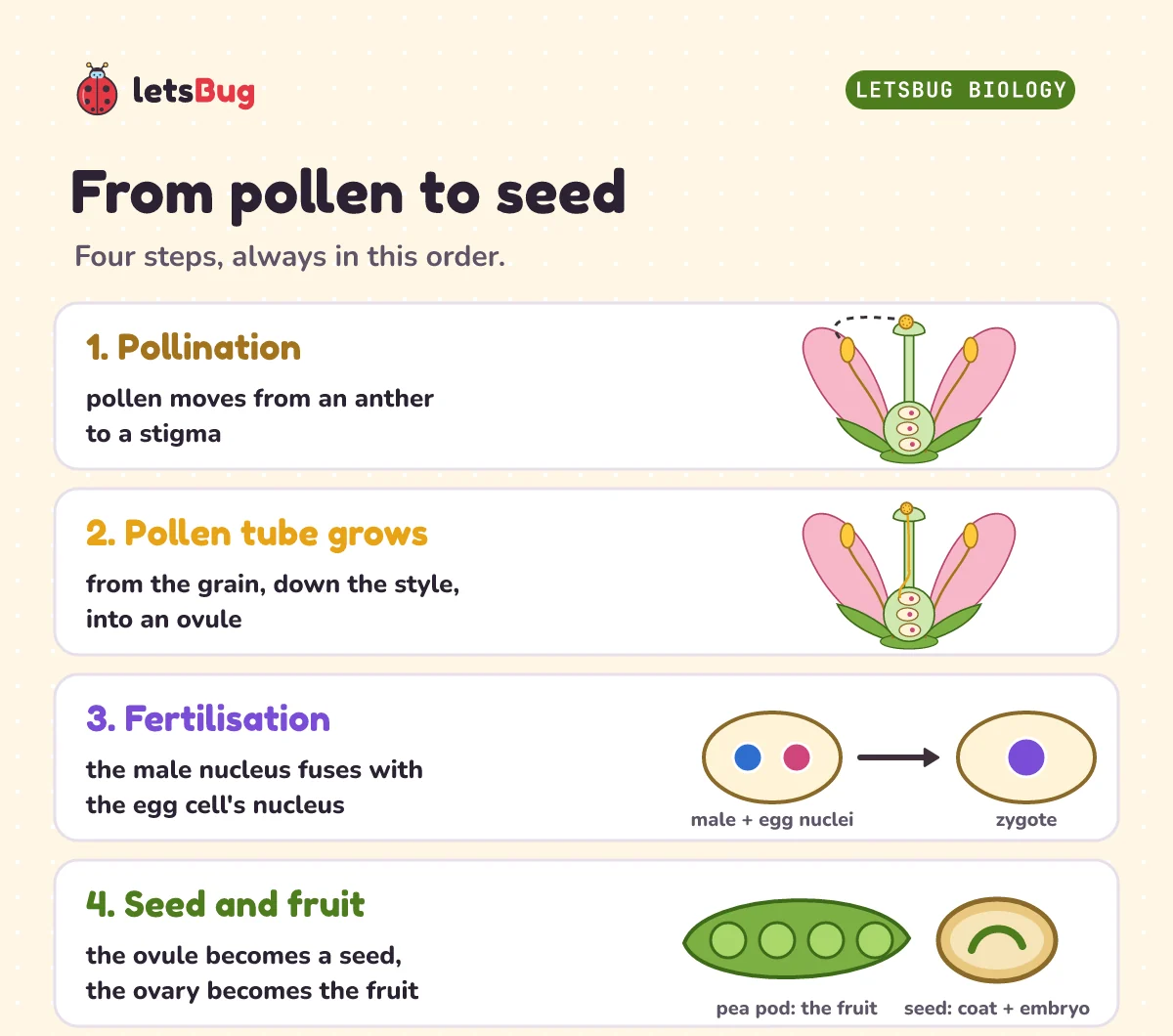
Notice what moves and what doesn't. The pollen grain stays on the stigma. It is the tube that reaches the ovule. Cambridge's examiners saw students confuse the two in June 2024: "There was also confusion over whether it was pollen or the pollen tube that reached the ovule."
A pollen tube can be very long. Wikipedia: "In maize, this single cell can grow longer than 12 inches (30 cm) to traverse the length of the pistil." (To traverse is to travel all the way across or along.) That's one cell, longer than a 30 cm ruler, growing down the length of a corn silk. It grows fast too. Wikipedia's corn silk article says: "The pollen tube extends at a rate of over 1 centimeter per hour".
What is fertilisation?
Fertilisation is the moment the nuclei of two gametes fuse. Cambridge says it exactly: "State that fertilisation occurs when a pollen nucleus fuses with a nucleus in an ovule". (A nucleus is the control centre of a cell, which holds its DNA. The plural is nuclei. We met it in animal cell vs plant cell. To fuse is to join into one.)
The steps are:
- The male gamete's nucleus travels down the pollen tube.
- Inside the ovule, it fuses with the nucleus of the egg cell. That fusion is fertilisation.
- NCERT: "This fusion of the germ-cells or fertilisation gives us the zygote which is capable of growing into a new plant." (Capable of means able to. A zygote is the first cell of a new living thing.)
- "After fertilisation, the zygote divides several times to form an embryo within the ovule." (An embryo is a tiny young plant at its earliest stage.)
Why must the nuclei fuse? Cambridge: "State that nuclei of gametes are haploid and that the nucleus of a zygote is diploid". (Haploid means having one set of chromosomes, half the usual number. Diploid means having two sets, the full number. Chromosomes are the long threads of DNA in a nucleus.) So fusing two haploid nuclei gives the zygote the full number again. We met this in mitosis vs meiosis.
What is the difference between pollination and fertilisation?
NCERT's Class 10 chapter asks exactly this: "How is the process of pollination different from fertilisation?" It's a common mistake to treat them as one thing. In June 2024, Cambridge's examiners wrote: "Many candidates thought that pollination and fertilisation were the same thing." In another paper, "a significant number incorrectly believed that fertilisation had occurred even though the pollen tube has not reached the ovary."
| Feature | Pollination | Fertilisation |
|---|---|---|
| What happens | Pollen grains are moved from an anther to a stigma | A male nucleus fuses with the egg cell nucleus |
| Where | On the stigma, outside the ovary | Inside an ovule, inside the ovary |
| Order | First | Second, after the pollen tube has grown |
| What carries the male part | Wind, water, insects or birds carry the pollen | The pollen tube carries the male nucleus |
| What it makes | Nothing new yet | A zygote, which grows into an embryo |
A good way to remember it: pollination gets the pollen to the front door. Fertilisation happens deep inside the house. The pollen tube is the corridor between them.
What do the ovule and the ovary become?
The ovule becomes the seed, and the ovary becomes the fruit. NCERT: "The ovule develops a tough coat and is gradually converted into a seed. The ovary grows rapidly and ripens to form a fruit. Meanwhile, the petals, sepals, stamens, style and stigma may shrivel and fall off." (Rapidly means quickly. Gradually means slowly, step by step. To ripen is to become ready to eat or to drop its seeds. To shrivel is to dry up and shrink.) The Grade 9 book puts it in one line: "the ovary surrounding the ovules enlarges and develops into a fruit, while the ovules develop into seeds inside it".
Open a pea pod and you can see this. The pod grew from the ovary, and each pea grew from one ovule. So every pea in the pod grew from a fertilised ovule.
The corn cob works in a similar way. Each kernel forms from one ovule, and only if that ovule is fertilised. Wikipedia even says how to spot it: "If an ovule is successfully fertilized, the corn silk will detach from it two or three days later." (To detach is to come off.)
Is pollination necessary for fruit formation?
Yes. NCERT shows it with a simple test on a pea plant, using cloth bags.
NCERT's Grade 9 book asks you to pick two young flower buds and three flowers that have just opened, all on the same pea plant. Then:
- Carefully remove the stamens from one of the buds and from one of the open flowers.
- Cover four of the five with bags of muslin, a thin cotton cloth, so no pollen can get in from outside.
- "Leave one freshly blossomed flower uncovered (without muslin cloth bag)."
What happens? NCERT: "You will notice that fruits are formed in place of flowers in all treatments except the one in which the stamens were removed from the flower bud." (A treatment is one of the set-ups being tested.) That bud had no pollen of its own, and the bag kept other pollen out. No pollination meant no pollen tube, no fertilisation and no pod. NCERT's conclusion: "We can infer that the transfer of pollen grains from the anther to the stigma is necessary for fruit formation." (To infer is to work something out from the evidence.)
A wrong conclusion would be "bagged flowers can't make fruit". The bagged bud that kept its stamens still made a pod. The bag wasn't the problem. What a flower needs is pollen on its stigma. (Why did the opened flower with its stamens removed still make a pod? Its stamens were taken off after the flower opened, so its pollen had already had the chance to reach the stigma.)
Your turn. These are the practice questions from the video, plus one from NCERT. Try each one before you open the answers.
1) Put these in order: fertilisation, pollen tube grows, pollination, zygote forms, seed forms. Say where each one happens.
2) What happens between pollination and fertilisation? Give three steps.
3) The video's challenge: take the bagged bud with no stamens, and dust its stigma with pollen from another pea plant. Pod or no pod? And what kind of pollination is it?
4) From NCERT: a flower's anthers are removed before it matures (is fully grown). Later, pollen from another plant of the same species is dusted onto its stigma, and seeds are made. Which process has been ensured here: self-pollination, cross-pollination, fertilisation or tissue culture? (Tissue culture means growing new plants from a few cells in a lab.)
Show the answers
1) Pollination, on the stigma. Then the pollen tube grows, down the style. Then fertilisation, in the ovule. Then the zygote forms, in the ovule. Then the seed forms, in the ovary: the ovule becomes a seed.
2) Three steps:
- A pollen tube grows from the pollen grain, down through the style.
- It enters an ovule, in the ovary.
- The male nucleus passes down the tube and fuses with the egg cell nucleus.
A weak answer is "the pollen travels down to the ovule". The grain doesn't travel: it stays on the stigma and grows a tube.
3) A pod forms. Pollen reached the stigma, so a pollen tube can grow and fertilisation can follow. It is cross-pollination, because the pollen came from a different plant of the same species.
4) Cross-pollination. The flower's own anthers were removed, so the pollen must have come from another plant of the same species.
Exam-style questions with model answers
Our model answers, written in the style of exam mark schemes. The number in brackets is the marks. Each mark is one clear point.
Q1. Define pollination. [1]
Model answer
The transfer of pollen grains from an anther to a stigma [1].
Q2. Describe the events after pollination that lead to fertilisation. [3]
Model answer
A pollen tube grows from the pollen grain down through the style [1]. The pollen tube enters an ovule in the ovary [1]. The male nucleus moves down the tube and fuses with the nucleus of the egg cell [1].
Q3. State what the ovule and the ovary become after fertilisation. [2]
Model answer
The ovule becomes a seed [1]. The ovary becomes the fruit [1].
Q4. Give two differences between the pollen of wind-pollinated and insect-pollinated flowers. [2]
Model answer
Wind-pollinated pollen is light and small; insect-pollinated pollen is larger [1]. Insect-pollinated pollen is sticky or spiny, so it attaches to the insect; wind-pollinated pollen is not [1]. (Wind-pollinated flowers also make far more pollen grains.)
Q5. Pollen from one flower lands on the stigma of another flower on the same plant. Is this self-pollination or cross-pollination? Explain. [2]
Model answer
Self-pollination [1]. The pollen came from the same plant; cross-pollination needs a flower on a different plant of the same species [1].
Questions people ask
What is the difference between pollination and fertilisation?
Pollination is the transfer of pollen grains from an anther to a stigma. Fertilisation comes later: a pollen tube grows down to an ovule, and a male nucleus fuses with the egg cell nucleus inside it. Pollination happens on the outside of the pistil; fertilisation happens inside the ovary.
Does pollination always lead to fertilisation?
No. The pollen has to be from the same species, and it has to grow a tube that reaches an ovule. Cambridge's examiners found many students thought fertilisation had happened even though the pollen tube had not reached the ovary.
What is a pollen tube?
A tube that grows out of a pollen grain on the stigma, down through the style and into an ovule. The male nucleus travels down it. In maize, this single cell can grow more than 30 cm long.
What is the difference between self-pollination and cross-pollination?
In self-pollination, pollen reaches the stigma of the same flower, or another flower on the same plant. In cross-pollination, pollen reaches a flower on a different plant of the same species.
What does the ovary become after fertilisation?
The fruit. The ovules inside it become the seeds. A pea pod is the ovary, and each pea is a fertilised ovule.
Why do wind-pollinated plants make so much pollen?
Because most of it is wasted. Wind blows pollen in every direction, so a plant needs huge numbers for a few grains to land on a stigma. A wind-pollinated grass flower can release 500,000 or more grains; a sunflower about 20,000 to 40,000.
Keep going
- Watch the full lesson, Pollination vs Fertilisation: What's the Difference?, or the one-minute Short: How Do Bees Pollinate Flowers? (No Seed Yet). More in letsBug Biology on YouTube.
- The episode before this one: fission vs fragmentation (episode 9, asexual reproduction, where one parent makes clones).
- Why gametes have half the chromosomes: mitosis vs meiosis (episode 6).
- What a nucleus is, and how plant cells differ from animal cells: animal cell vs plant cell.
- The next episode is on human reproduction and the menstrual cycle.
Checked on 29 November 2026 against the 8 sources below. Every number in this post was worked out again in a Python script, and every quote was matched word for word with the source text.
Sources
- NCERT: Science Class 10, Chapter 7: How do Organisms Reproduce? (section 7.3.2)
- NCERT: Science Grade 9 (Exploration), Chapter 11: Reproduction: How Life Continues (sections 11.2.2 to 11.2.5, Activity 11.6, Table 11.3)
- Cambridge International: IGCSE Biology 0610 syllabus 2026-2028 (16.3)
- Cambridge International: IGCSE Biology 0610 Principal Examiner Report for Teachers, June 2024 (Papers 22, 32, 42 and 43)
- Our World in Data: How many crops depend on pollinators?
- Wikipedia: Corn silk
- Wikipedia: Pollen tube
- Wikipedia: Double fertilization