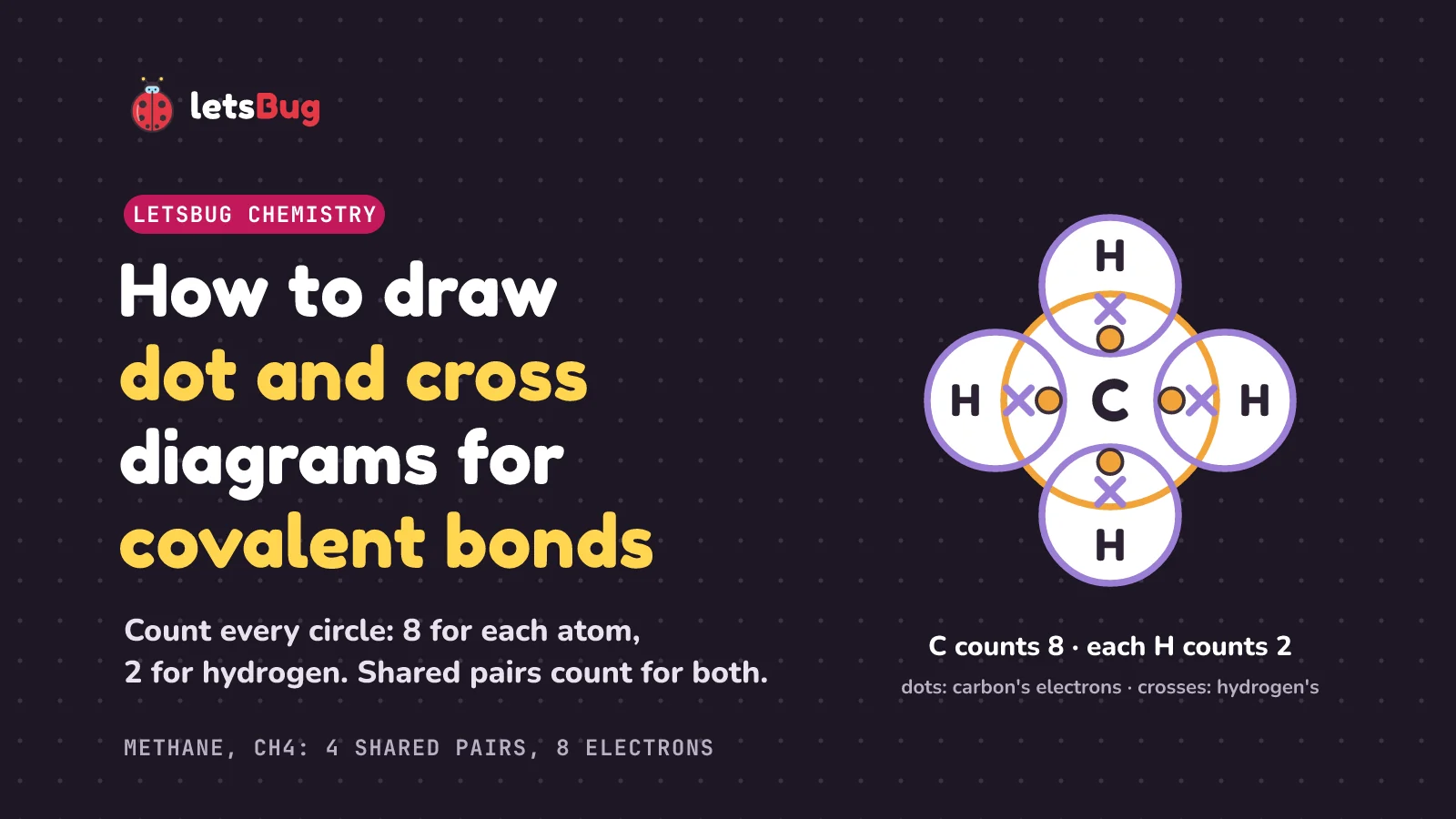
To draw a dot and cross diagram for a covalent bond, show the outer electrons only: dots for one atom, crosses for the atoms it bonds to. Put each shared pair where the circles overlap. Then check two numbers. Every atom counts 8 electrons in its circle (hydrogen counts 2), and the total equals the outer electrons the atoms brought.
In this post we see what a covalent bond is, learn a counting check that catches a wrong diagram, and draw hydrogen, chlorine, hydrogen chloride, water, ammonia, methane, oxygen and nitrogen. Then we catch a methane diagram with one electron too many, see why methane boils at about −162 °C, and finish with practice and exam-style questions with model answers.
Key takeaways
- A covalent bond is a shared pair of electrons between two atoms, usually two non-metals. The pair is pulled by both nuclei (the centres of the atoms), and that pull holds the atoms together.
- For the non-metals in this post, bonds an atom makes = 8 − its outer electrons. Hydrogen is the exception: it needs 2, so it makes 2 − 1 = 1. Chlorine makes 1, oxygen 2, nitrogen 3 and carbon 4.
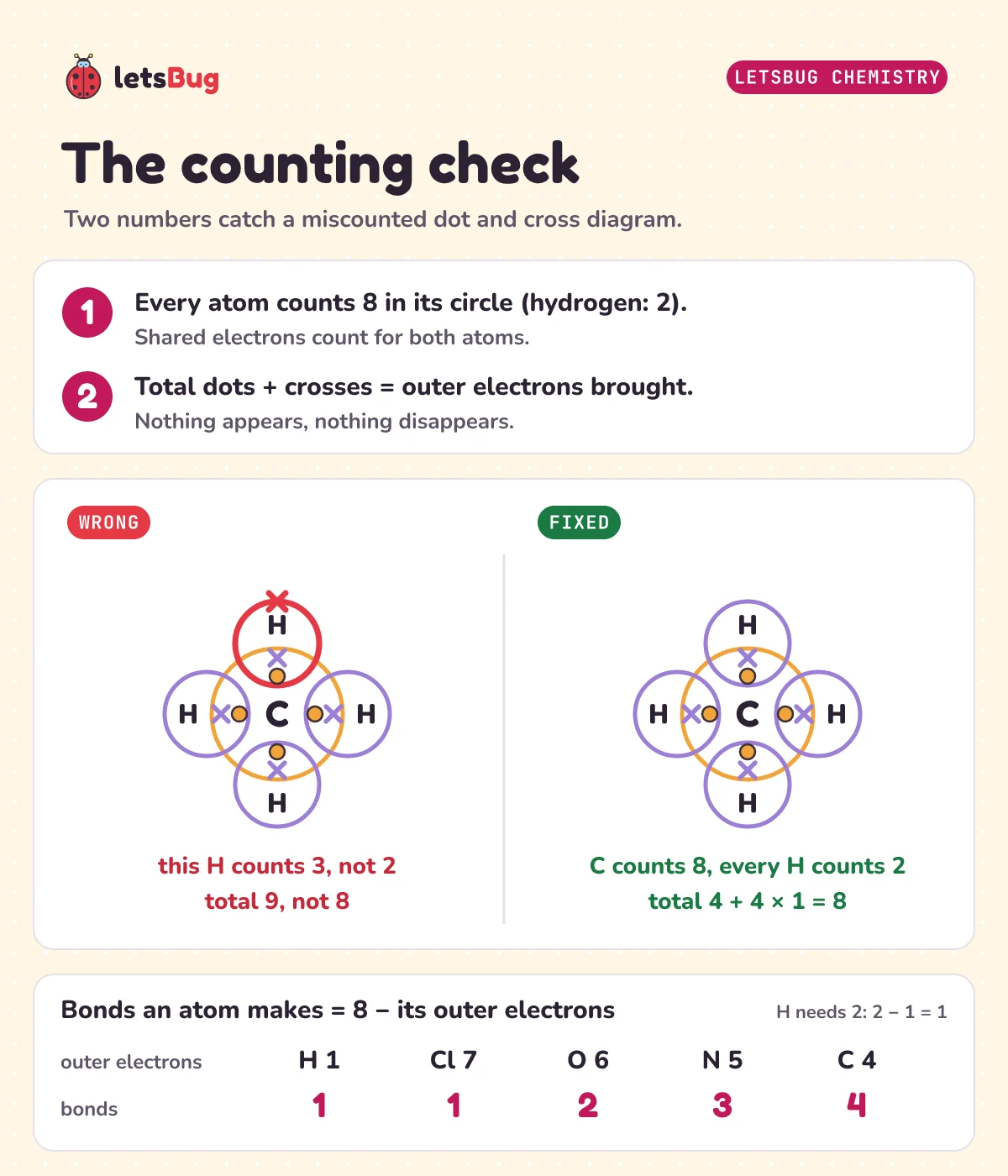
- The counting check: every atom counts 8 electrons in its circle (hydrogen counts 2), and shared electrons count for both atoms. The total number of dots and crosses equals all the outer electrons the atoms brought.
- A lone pair is a pair of outer electrons that is not shared. Water has two on the oxygen. Ammonia has one on the nitrogen.
- Two shared pairs make a double bond (O₂). Three make a triple bond (N₂).
- Methane boils at about −162 °C because the forces between its molecules are weak. The covalent bonds inside each molecule are strong, and boiling doesn't break them.
This post goes with letsBug Chemistry, episode 7. It covers section 4.1 of Chapter 4, Carbon and its Compounds, in the NCERT Class 10 science book. It also covers the covalent bond in Chapter 9 of the new NCERT Class 9 book Exploration, and covalent bonding in GCSE and IGCSE chemistry. Watch the lesson, or read on: the post adds what examiners saw in a real exam question, the boiling point from the NCERT table, a model exam answer and practice questions.
What is a covalent bond?
A covalent bond is a pair of electrons shared by two atoms. AQA's GCSE specification says: "When atoms share pairs of electrons, they form covalent bonds. These bonds between atoms are strong." The Cambridge IGCSE syllabus asks you to "State that a covalent bond is formed when a pair of electrons is shared between two atoms leading to noble gas electronic configurations". A noble gas electronic configuration means the same electron arrangement as a noble gas, such as helium (2) or neon (2,8).
In the ionic bonding post (episode 6), a metal gave electrons to a non-metal. Two non-metal atoms don't do that. Neither gives an electron away. Instead, each puts one electron into a pair that both of them hold.
Take two hydrogen atoms. Each has 1 electron. When they share, each hydrogen counts 2 electrons, the same as helium. NCERT's Class 9 book calls 2 electrons for hydrogen its "duplet" (a full first shell). It also explains what holds the atoms together: "The shared pair of electrons attracts both the nuclei and makes the molecule stable." A molecule is a group of atoms joined by shared pairs. A nucleus (plural nuclei) is the tiny, positive centre of an atom (see what is inside an atom).
One shared pair is a single bond. NCERT's Class 10 book says: "A single covalent bond is also represented by a line between the two atoms". So H₂ can be written H–H.
Where do the dots come from? Wikipedia's article on the covalent bond names the chemist Gilbert N. Lewis, "who in 1916 described the sharing of electron pairs between atoms". Lewis "introduced the Lewis notation or electron dot notation". In his notation (way of writing), valence electrons (the outer electrons) "are represented as dots around the atomic symbols. Pairs of electrons located between atoms represent covalent bonds." A dot and cross diagram is the same idea, with crosses added so you can see which atom each electron came from.
How do you draw a dot and cross diagram step by step?
For the hydrogen molecule, NCERT's Class 10 book says: "We can depict this using dots or crosses to represent valence electrons" (depict means draw). It adds: "Note that only the valence shell electrons need to be depicted." So you draw the outer shell only. Follow these five steps:
- Write each atom's outer electrons. Use the electron arrangement (we met these in why noble gases are unreactive). Chlorine is 2,8,7, so it has 7 outer electrons.
- Work out how many bonds each atom makes: 8 minus its outer electrons. Hydrogen is the exception: it needs 2, so it makes 2 − 1 = 1 bond.
- Draw a circle for each atom's outer shell. Let the circles of bonded atoms overlap.
- Put the shared pairs in the overlap. Each shared pair is one dot and one cross: one electron from each atom.
- Add the lone pairs, the outer electrons that aren't shared, on the ring of each circle, away from the overlap. They still count as inside that atom's circle. Then run the counting check below.
Do you have to draw the circles? Not always. On a 2023 exam question about HCl, AQA's examiners wrote that most students drew "a ring around each atom", but answers "without rings were equally acceptable". Rings just make counting easier.
How do you check a dot and cross diagram?
This is a check we use in the lesson, built from the rule that each atom ends up with a noble gas arrangement. It isn't a rule from a syllabus. It works for every molecule in this post, which includes all eight molecules on the AQA list. It is a counting tool for these molecules, not a law of nature: a few molecules you may meet later in chemistry break it. The check has two numbers:
- Count each circle. Every atom must count 8 electrons in its circle. Hydrogen counts 2. Shared electrons count for both atoms, because they sit in both circles.
- Count the whole diagram. The total number of dots and crosses must equal all the outer electrons the atoms brought. Nothing appears and nothing disappears.
And the number of bonds an atom makes is how many electrons it is short of 8. That's its valency, from the valency post (episode 5):
- Hydrogen: 1 outer electron, makes 1 bond (it only needs 2).
- Chlorine (2,8,7): 7 outer electrons, 8 − 7 = 1 bond.
- Oxygen (2,6): 6 outer electrons, 8 − 6 = 2 bonds.
- Nitrogen (2,5): 5 outer electrons, 8 − 5 = 3 bonds.
- Carbon (2,4): 4 outer electrons, 8 − 4 = 4 bonds. NCERT: "Carbon is tetravalent because it has four valence electrons." Tetravalent means it has a valency of 4.
How do you draw dot and cross diagrams for hydrogen, chlorine and HCl?
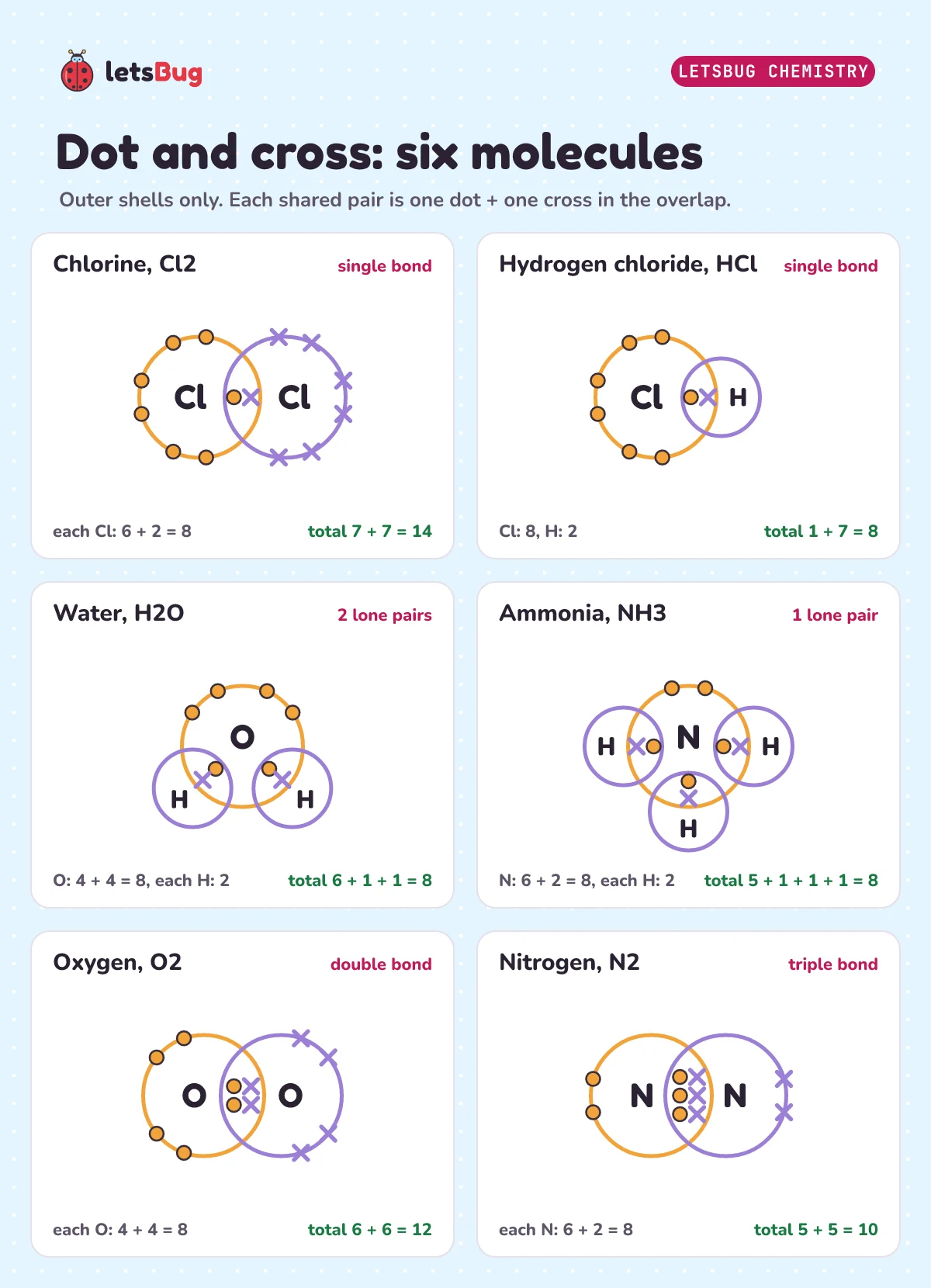
Hydrogen, H₂. The simplest one. Each hydrogen brings 1 electron: one is drawn as a dot, the other as a cross. They share them as one pair. Each hydrogen counts 2, and the total is 1 + 1 = 2.
Chlorine, Cl₂. Each chlorine atom has 7 outer electrons, so each makes 1 bond. The two atoms share one pair. Each chlorine keeps its other 6 electrons as 3 lone pairs. Count the left chlorine: 6 of its own in lone pairs plus the shared 2 makes 8. The right one is the same. The total is 7 + 7 = 14 electrons.
Hydrogen chloride, HCl. Hydrogen has 1 outer electron and chlorine has 7. They share one pair. Hydrogen counts 2, and chlorine counts 6 + 2 = 8. The total is 1 + 7 = 8 electrons.
This exact diagram was a real exam question. In June 2023, AQA's GCSE Chemistry exam (Higher Tier Paper 1) asked: "Draw a dot and cross diagram for a molecule of hydrogen chloride (HCl)." It was worth 2 marks. The examiners' report on that question, 04.4, says: "Nearly three quarters of students scored both marks."
The report also lists the mistakes. It says: "A few students drew an extra electron on either hydrogen or carbon, and some drew ions instead of a molecule." HCl has no carbon, so "carbon" looks like a slip in the report. AQA's mark scheme for 04.4 gives one mark for "chlorine with 6 non-bonded" electrons, and it does not accept extra electrons on H (hydrogen). An ion is an atom (or group of atoms) with a charge, as in ionic bonding. The counting check catches the first mistake. We come back to the second one in the methane section below.
How do you draw dot and cross diagrams for water and ammonia?
Water, H₂O. Oxygen has 6 outer electrons, so it makes 2 bonds. It shares one pair with each hydrogen and keeps 2 lone pairs. Count oxygen: 2 lone pairs and 2 shared pairs makes 8. Each hydrogen counts 2. The total is 6 + 1 + 1 = 8 electrons.
Ammonia, NH₃. Nitrogen has 5 outer electrons, so it makes 3 bonds, one with each hydrogen. Wikipedia's ammonia article counts the pairs around the nitrogen: "Three of these electron pairs are used as bond pairs, which leaves one lone pair of electrons." Count nitrogen: 3 shared pairs plus 1 lone pair makes 8. The total is 5 + 1 + 1 + 1 = 8.
The lone pair is easy to forget. Leave it out, and nitrogen counts only 6. The total is 6, not 8. The check shows it at once.
How do you draw a dot and cross diagram for methane?
Methane is CH₄. NCERT says: "Methane is widely used as a fuel and is a major component of bio-gas and Compressed Natural Gas (CNG)." Carbon has 4 outer electrons, so it makes 4 bonds, one with each hydrogen.
Now picture a diagram that goes wrong (it is the wrong diagram in the counting check picture above): one hydrogen has an extra cross, so three electrons sit in its circle. Run the check:
- Count that circle. The hydrogen counts 3. Hydrogen must count 2, so the diagram is wrong.
- Count the whole diagram. There are 9 dots and crosses. But carbon brings 4 and the four hydrogens bring 4 × 1 = 4, so the total must be 8.
The fixed diagram has 4 shared pairs and no lone pairs: 8 electrons. Carbon counts 8, and every hydrogen counts 2.
Notice what the fixed diagram does not have: square brackets or charges. Those belong to ions, as in the ionic dot and cross diagrams of episode 6. Methane is a molecule: a group of atoms joined by shared pairs, with no charges. On the HCl question, examiners saw students draw "ions instead of a molecule". The same rule applies to methane: no brackets, no charges.
Why does oxygen have a double bond and nitrogen a triple bond?
Oxygen, O₂. Oxygen has 6 outer electrons, and NCERT says "it requires two more electrons to complete its octet" (an octet is a set of 8 outer electrons). One shared pair only gives it one more. So two oxygen atoms share two pairs: "The two electrons contributed by each oxygen atom give rise to two shared pairs of electrons. This is said to constitute a double bond between the two atoms." (Constitute means make up.) Count each oxygen: 4 shared electrons plus 4 in 2 lone pairs makes 8. The total is 6 + 6 = 12. It's written O=O, with two lines.
Here's a common mistake. Draw O₂ with only one shared pair, and each oxygen counts 2 shared plus its other 5 electrons: 7. The check says it's wrong.
Nitrogen, N₂. Nitrogen has 5 outer electrons and needs 3 more. NCERT: "each nitrogen atom in a molecule of nitrogen contributes three electrons giving rise to three shared pairs of electrons. This is said to constitute a triple bond between the two atoms." Count each nitrogen: 6 shared plus 1 lone pair (2) makes 8. The total is 5 + 5 = 10. It's written N≡N, with three lines.
This table puts all the molecules so far together. Lone pairs are counted for the whole molecule, and the total is the number of electrons drawn. In every row, the total is 2 × (shared pairs + lone pairs).
| Molecule | Shared pairs | Lone pairs | Total |
|---|---|---|---|
| Hydrogen, H₂ | 1 | 0 | 2 |
| Chlorine, Cl₂ | 1 | 6 | 14 |
| Hydrogen chloride, HCl | 1 | 3 | 8 |
| Water, H₂O | 2 | 2 | 8 |
| Ammonia, NH₃ | 3 | 1 | 8 |
| Methane, CH₄ | 4 | 0 | 8 |
| Oxygen, O₂ | 2 | 4 | 12 |
| Nitrogen, N₂ | 3 | 2 | 10 |
Why does methane have a low boiling point?
Natural gas is "predominantly methane" (mostly methane), says Wikipedia. To store and move it, it is cooled until it turns into a liquid, called liquefied natural gas (LNG). This happens at "approximately −162 °C". The liquid takes up about 1/600 of the space of the gas, so a tank holds about 600 times as much.
That is almost exactly methane's boiling point. NCERT's Class 10 Table 4.1 gives it in kelvin as 111 K. Kelvin (K) is a temperature scale that starts at the coldest possible temperature, and 0 °C is about 273 K. So 111 − 273 = −162 °C. The NIST Chemistry WebBook, run by the US National Institute of Standards and Technology, also gives 111 K, an average of 13 reported values.
So are methane's bonds weak? No. The C–H covalent bonds inside each molecule are strong. But the pulls between separate methane molecules, called intermolecular forces, are weak ("inter" means between). NCERT: "Covalently bonded molecules are seen to have strong bonds within the molecule, but intermolecular forces are weak." Boiling only pulls the molecules apart. AQA's specification says: "It is these intermolecular forces that are overcome, not the covalent bonds, when the substance melts or boils." After boiling, every methane molecule is still a whole CH₄.
Examiners saw this mistake on the 2023 paper. Question 04.5 compared methane with poly(ethene), a polymer. AQA's specification says "Polymers have very large molecules." Bigger molecules need more energy to pull apart, but not because their bonds break. AQA: "The intermolecular forces increase with the size of the molecules, so larger molecules have higher melting and boiling points."
In its comment on 04.5, the report found: "Students often thought intermolecular forces had to be broken in methane but bonds had to be broken in poly(ethene)." The report also says: "There was much confusion between bonds and intermolecular forces." It adds: "Students sometimes think that by including both intermolecular forces and covalent bonds they will cover all eventualities, but this often results in contradictions which lose marks." ("Cover all eventualities" means cover every possible case.) So don't write that both break. Say the intermolecular forces are overcome, and the covalent bonds are not broken.
How do you explain methane's low boiling point in an exam?
Here's an exam-style question: Explain why methane has a low boiling point. A weak answer says "the covalent bonds are weak and break easily". That's wrong twice: the bonds are strong, and they don't break. A full answer has three steps:
- Methane is made of small, simple molecules.
- The intermolecular forces between the molecules are weak.
- So little energy is needed to overcome them.
You can add: no covalent bonds are broken when methane boils.
Why don't covalent molecules conduct electricity?
A current needs moving charged particles. Pure substances made of small molecules generally have none. NCERT explains: "Since the electrons are shared between atoms and no charged particles are formed, such covalent compounds are generally poor conductors of electricity." That's the opposite of molten (melted) salt, whose ions are free to move.
Your turn. Work each one out before you open the answers.
1) Dry ice is solid carbon dioxide, CO₂. Draw its dot and cross diagram. How many shared pairs are there? (Carbon has 4 outer electrons, oxygen 6.)
2) Draw a dot and cross diagram for hydrogen sulfide, H₂S. Sulfur is 2,8,6.
3) Phosphine is PH₃. Phosphorus is 2,8,5. How many lone pairs are on the phosphorus?
4) How many electrons in total are drawn in a dot and cross diagram of ethene, C₂H₄?
Show the answers
1) Carbon needs 4 more electrons and each oxygen needs 2. So carbon makes a double bond with each oxygen: 4 shared pairs. Each oxygen keeps 2 lone pairs. Check: carbon counts 8, each oxygen counts 8, and the total is 4 + 6 + 6 = 16. Wikipedia describes CO₂ as "one carbon atom covalently double bonded to two oxygen atoms". Dry ice turns straight into gas at −78.5 °C, and in water it makes a thick, low fog.
2) Sulfur has 6 outer electrons, so it makes 2 bonds, like oxygen in water. One shared pair with each hydrogen, and 2 lone pairs on the sulfur. Total: 6 + 1 + 1 = 8.
3) Phosphorus has 5 outer electrons, so it makes 3 bonds and keeps 1 lone pair, just like nitrogen in ammonia. Total: 5 + 3 × 1 = 8.
4) 2 × 4 + 4 × 1 = 12. That's 6 shared pairs: a C=C double bond (2 pairs) and four C–H bonds (4 pairs), with no lone pairs.
Exam-style questions with model answers
Q2 is the real AQA question from June 2023, and its marks follow AQA's mark scheme. The other marks are our own model marking in the same style: [1] is one mark for a correct point.
Q1 (1 mark). State what is meant by a covalent bond.
Model answer
A shared pair of electrons between two atoms [1]. Say "a shared pair": AQA's specification says atoms "share pairs of electrons".
Q2 (2 marks). Draw a dot and cross diagram for a molecule of hydrogen chloride (HCl). Show the outer shell electrons only.
Model answer
A bonded pair of electrons in the overlap [1] (our tip: draw it as one dot and one cross). Chlorine with 6 non-bonded electrons (3 lone pairs) [1]. AQA's mark scheme does not accept extra electrons on H. No brackets and no charges: it's a molecule.
Q3 (3 marks). Explain why methane has a low boiling point.
Model answer
Methane is made of small molecules [1]. The intermolecular forces between the molecules are weak [1]. So little energy is needed to overcome them [1]. Don't write "the covalent bonds are weak" or "the bonds break".
Q4 (2 marks). A student draws O₂ with one shared pair. Use the electrons in each circle to show why this is wrong.
Model answer
With one shared pair, each oxygen counts only 7 electrons [1]. O₂ needs two shared pairs, a double bond, so that each oxygen counts 8 [1].
Q5 (3 marks). Explain why water has a much lower melting point than sodium chloride.
Model answer
Water is made of small, simple molecules, but sodium chloride is a giant ionic lattice (a huge grid of ions) [1]. When water melts, only the weak intermolecular forces are overcome [1]. Melting sodium chloride means overcoming many strong ionic bonds, which needs much more energy [1].
Questions people ask
How do you draw a dot and cross diagram for a covalent bond?
Draw each atom's outer shell as a circle, with dots for one atom's electrons and crosses for the other's. Put each shared pair, one dot and one cross, where the circles overlap. Add the lone pairs, then check that every atom counts 8 (hydrogen 2).
What is a covalent bond?
A shared pair of electrons between two atoms, usually two non-metals. The pair is attracted to both nuclei, which holds the atoms together.
How do you know how many bonds an atom makes?
For the non-metals in this post, subtract its outer electrons from 8. Chlorine (7) makes 1, oxygen (6) makes 2, nitrogen (5) makes 3 and carbon (4) makes 4. Hydrogen makes 1, because it only needs 2 electrons.
What is a lone pair?
A pair of outer electrons on an atom that is not shared with another atom. Water has two lone pairs on its oxygen, and ammonia has one on its nitrogen.
Why does nitrogen have a triple bond?
Nitrogen has 5 outer electrons and needs 3 more. Two nitrogen atoms share three pairs, so each counts 6 shared electrons plus a lone pair: 8.
Why do simple molecules have low boiling points?
The forces between the molecules (intermolecular forces) are weak, so little energy is needed to overcome them. The covalent bonds inside the molecules are strong and don't break when the substance boils.
What is the difference between a dot and cross diagram for ionic and covalent bonds?
An ionic diagram shows electrons moved from one atom to another, with separate ions in square brackets and charges. A covalent diagram shows shared pairs where the circles overlap, with no brackets and no charges.
Keep going
- Watch the full lesson, How to Draw Dot and Cross Diagrams for Covalent Bonds, or the Short: Electron Dot Structure of Methane: Spot the Mistake. More in letsBug Chemistry on YouTube.
- The episode before this one, where electrons move instead of being shared: why do ionic compounds have high melting points? (episode 6).
- Where "8 − outer electrons" comes from: why is aluminium oxide Al2O3? Valency explained (episode 5).
- Why 8 outer electrons (2 for helium) means a full shell: why are noble gases unreactive? (episode 2).
- The next episode: what is a mole in chemistry? Avogadro's number explained, and why one mole of oxygen gas doesn't weigh the same as one mole of hydrogen gas (episode 8).
Checked on 5 November 2026 against the 13 sources below. Every electron count, bond count, total and conversion in this post was worked out again in a Python script, and every quote was matched word for word with the source text.
Sources
- NCERT Class 10 Science: Chapter 4, Carbon and its Compounds (4.1 the covalent bond, double and triple bonds, methane, Table 4.1)
- NCERT Class 9 Science, Exploration: Chapter 9, Atomic Foundations of Matter (9.4.1 covalent bond, duplet, hydrogen chloride, oxygen)
- AQA: GCSE Chemistry 8462 specification, bonding, structure and the properties of matter (4.2.1.4, 4.2.2.4)
- AQA: GCSE Chemistry Paper 1 (higher tier) question paper, June 2023 (question 04.4), mark scheme (04.4) and report on the examination (04.4 and 04.5)
- Cambridge International: IGCSE Chemistry 0620 syllabus for 2026 to 2028 (2.5 simple molecules and covalent bonds)
- NIST Chemistry WebBook: Methane, phase change data (boiling point)
- Wikipedia: Covalent bond (Lewis, 1916) and Ammonia (one lone pair)
- Wikipedia: Liquefied natural gas (mostly methane, −162 °C, 1/600 of the volume)
- Wikipedia: Carbon dioxide (double bonds) and Dry ice (−78.5 °C, fog)