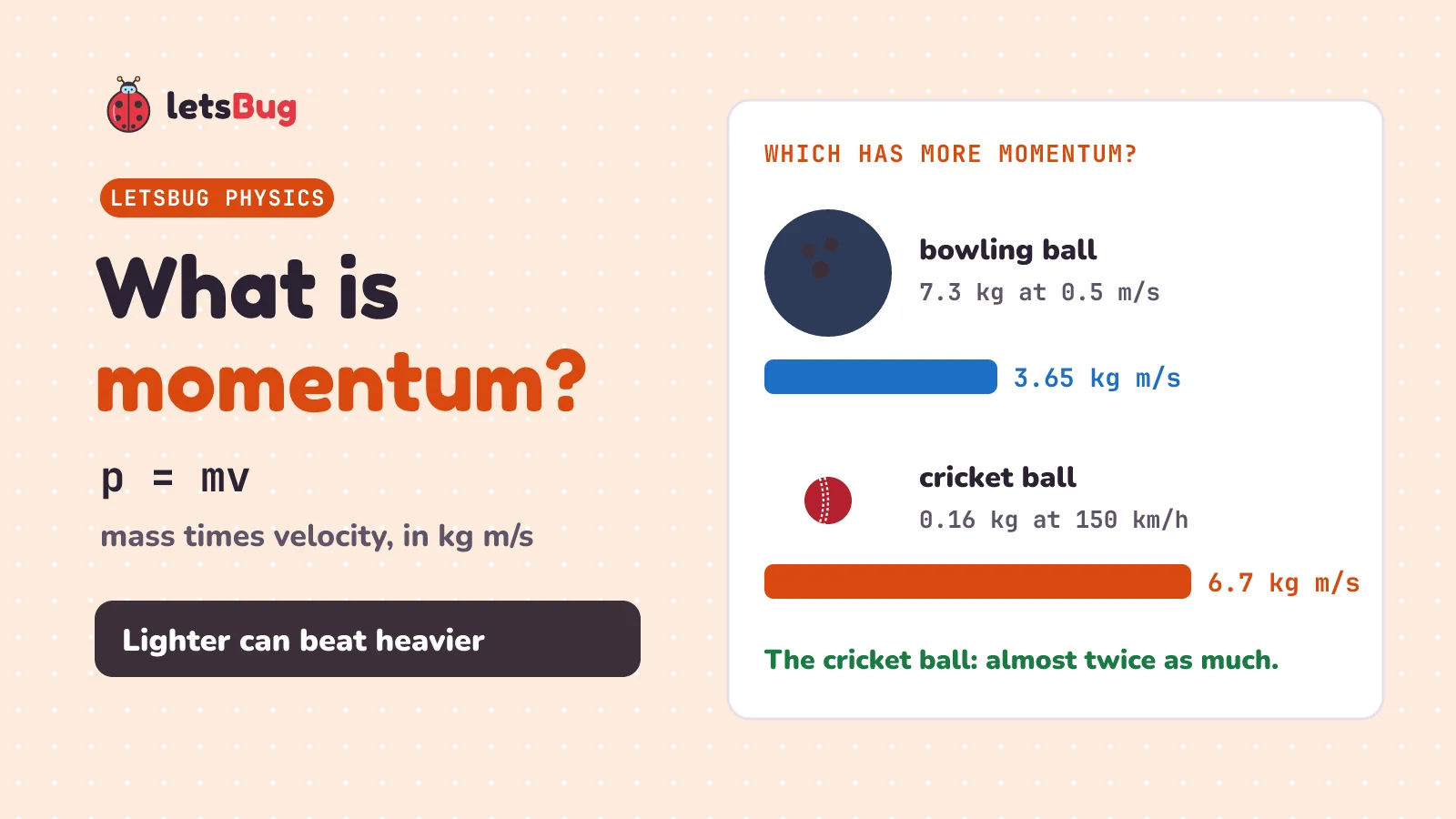
Momentum is mass times velocity (speed in a set direction): p = mv, in kilogram metres per second (kg m/s). When no outside force acts, the total momentum of objects that collide (crash together) or push apart stays the same. This is conservation of momentum. It explains recoil: the backward kick when one thing pushes another away.
In this post we work out why a small cricket ball can have more momentum than a heavy bowling ball. Then we see why momentum is conserved, follow an astronaut who throws a tool bag on a spacewalk, and fix the change in momentum mistake that many students make in exams. We finish with practice and exam-style questions with model answers.
Key takeaways
- Momentum = mass × velocity, p = mv. Its unit is the kilogram metre per second, kg m/s.
- Momentum has a direction. Pick one direction as positive. Anything moving the other way has negative momentum.
- Mass and speed both count. A 0.16 kg cricket ball at 150 km/h has almost twice the momentum of a 7.3 kg bowling ball rolling at 0.5 m/s.
- Conservation of momentum: with no outside force, the total momentum before = the total momentum after.
- Recoil: if two things start still and push apart, they get equal and opposite momentum. The lighter one moves faster.
- Change in momentum = after − before, with the signs. Resultant force = change in momentum ÷ time.
This post goes with letsBug Physics, episode 7. Momentum, impulse and conservation of momentum are in the Cambridge IGCSE Physics syllabus (section 1.6, in the Extended part, which Cambridge calls the Supplement). CBSE Class 9 Science meets momentum in an extension box in Chapter 6, How Forces Affect Motion. Watch the lesson, or read on: the post adds where every number comes from, two more worked examples, and exam-style questions with full answers.
What is momentum in physics?
Momentum tells you how much motion something carries. In everyday words, it's how hard the object is to stop. OpenStax, a free online physics textbook, puts it like this: "Linear momentum is the product of a system’s mass and its velocity." (A product is what you get when you multiply. "Linear" just means moving in a line, not spinning.)
In symbols:
p = m × v, where p is the momentum, m is the mass in kilograms (kg), and v is the velocity in metres per second (m/s).
So the unit of momentum is the kilogram metre per second, kg m/s. (OpenStax writes it kg·m/s. It's the same unit.)
Momentum has a direction
Velocity is speed in a set direction, and momentum takes the same direction. OpenStax says: "Momentum is a vector and has the same direction as velocity v." (A vector is an amount that has a size and a direction.) The NCERT textbook agrees: "The direction of the momentum is same as that of the velocity."
When things move along one straight line, we choose one direction to be positive. Anything moving the other way gets a minus sign. Two identical balls, one moving right at 2 m/s and one moving left at 2 m/s, have the same speed but opposite momentum: +p and −p.
Which has more momentum, a bowling ball or a cricket ball?
Most people pick the bowling ball, because it's so much heavier. Let's check with real numbers.
- The bowling ball. The rules for ten-pin bowling (set by the USBC, the United States Bowling Congress) allow a ball of up to 16 pounds, which Wikipedia gives as 7.3 kg. So 7.3 kg is the heaviest allowed. Say it rolls slowly, at 0.5 m/s.
- The cricket ball. A men's cricket ball has a mass of 156 to 163 g, so about 160 g. Wikipedia says "The fastest bowlers bowl the ball at over 86 mph (138 km/h)." (mph means miles per hour.) The top of Wikipedia's list of the fastest recorded deliveries is Shoaib Akhtar, at 161.3 km/h. We'll use 150 km/h for a fast delivery (one ball bowled).
Units first
The formula needs kilograms and metres per second. So 160 g = 0.16 kg. One kilometre is 1000 m and one hour is 3600 s, so to change km/h into m/s, divide by 3.6: 150 ÷ 3.6 ≈ 41.7 m/s.
Now the momentum
- Cricket ball: p = 0.16 × 41.7 ≈ 6.7 kg m/s.
- Bowling ball: p = 7.3 × 0.5 = 3.65 kg m/s.
| Object | Mass | Velocity | Momentum, p = mv |
|---|---|---|---|
| Bowling ball | 7.3 kg | 0.5 m/s | 3.65 kg m/s |
| Cricket ball | 0.16 kg | 41.7 m/s (150 km/h) | 6.7 kg m/s |
The cricket ball wins, with almost twice the momentum (6.7 ÷ 3.65 ≈ 1.8). The bowling ball has about 46 times the mass (7.3 ÷ 0.16 ≈ 46), but the cricket ball is about 83 times faster (41.7 ÷ 0.5 ≈ 83). Mass and speed both count.
This doesn't mean heavy things always lose. We gave the bowling ball a slow roll on purpose. Roll it at just 1 m/s and its momentum is 7.3 × 1 = 7.3 kg m/s, more than the cricket ball's. OpenStax gives a general rule: "A large, fast-moving object has greater momentum than a smaller, slower object." When one object is heavier and the other is faster, you have to multiply to find out.
What is the law of conservation of momentum?
Here's what makes momentum so useful. When two objects collide (crash into each other) or push apart, they push on each other with equal and opposite forces. That's Newton's third law. The two forces act for exactly the same time, and force × time is the change in momentum (more on that below). So whatever momentum one object gains, the other one loses.
That gives us the law of conservation of momentum. OpenStax states it like this: "The law of conservation of momentum states that for an isolated system with any number of objects in it, the total momentum is conserved."
Two words in there need explaining:
- Conserved: "To say that a quantity is conserved means that it is constant throughout the event." In other words, it stays the same.
- Isolated system: the group of objects you're looking at, with no outside force on them overall. OpenStax calls it "any system where the net external force is zero, which is known as an isolated system." (Net means all added up. External means from outside.)
So, in plain words: with no outside force, the total momentum before = the total momentum after.
Two skaters push apart
Two skaters stand still on smooth ice, hand to hand. One has a mass of 70 kg and the other 50 kg. Nothing is moving, so the total momentum is 0.
They push apart. Take the 50 kg skater's direction as positive. If the 70 kg skater glides off at 1.0 m/s, the 50 kg skater must glide the other way at 70 ÷ 50 = 1.4 m/s:
- 70 kg skater: 70 × (−1.0) = −70 kg m/s
- 50 kg skater: 50 × 1.4 = +70 kg m/s
- Total: −70 + 70 = 0, the same as before.
Same size of momentum, opposite directions. The lighter skater moves faster.
How does recoil work?
Recoil is the backward movement of one object when it pushes another object forwards. It's conservation of momentum when everything starts still: the total starts at zero, so it must end at zero.
An astronaut throws a tool bag
Picture an astronaut on a spacewalk, floating still next to the space station. Her total momentum is zero.
She has more mass than you might think. Wikipedia gives the spacesuit used on the International Space Station as "Total ISS EVA suit weight: 319 lb (144.7 kg)". (EVA stands for extravehicular activity: work outside the spacecraft, a spacewalk. Wikipedia says "weight", but 144.7 kg is a mass.) Weight is a force, measured in newtons, as the resultant force post explains. Add an astronaut of about 75 kg and the total is 144.7 + 75 ≈ 220 kg.
She throws a 2 kg tool bag away at 3 m/s:
- Bag: p = 2 × 3 = +6 kg m/s, forwards.
- So she must get −6 kg m/s, backwards, to keep the total at zero.
- Her speed: v = 6 ÷ 220 ≈ 0.027 m/s, under 3 cm every second.
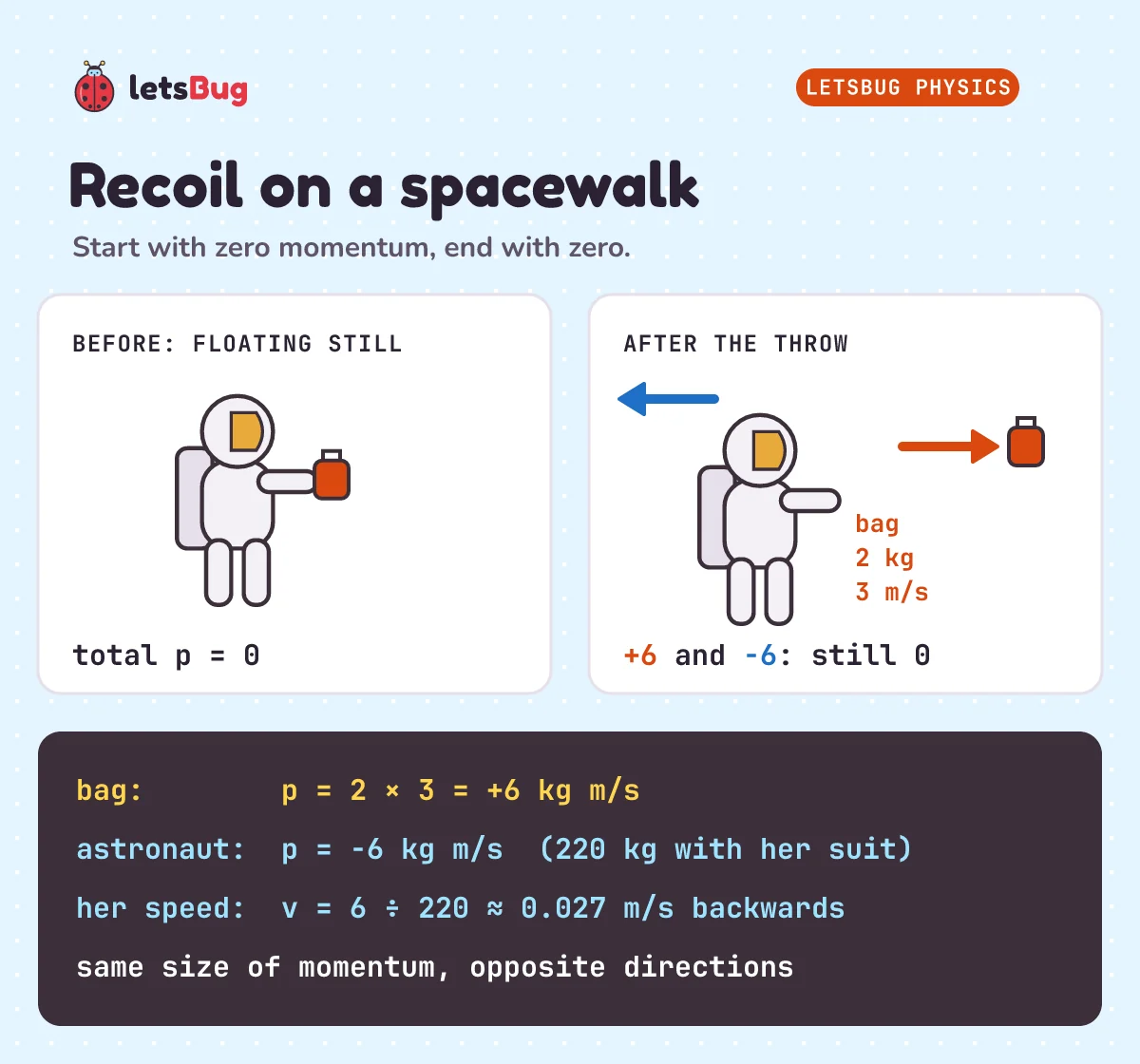
That's slow, but in space there's no air and no ground to slow her down. After one minute (60 s) she has drifted about 0.027 × 60 ≈ 1.6 m, and she keeps going.
Notice that the bag and the astronaut have the same size of momentum, 6 kg m/s each, even though she has 110 times the mass (220 ÷ 2 = 110). The bag just moves 110 times faster. Don't think the object with more mass gets more momentum in recoil. It gets the same amount, and moves more slowly.
Recoil is everywhere
A skateboarder who throws a ball forwards rolls backwards (you'll work that one out below). A rocket pushes gas down, and the gas pushes the rocket up. OpenStax even points out that when a football player runs into a goalpost and bounces back, the whole planet moves a tiny bit: "Surprisingly, Earth also recoils—conserving momentum—because of the force applied to it through the goalpost." The Earth has so much mass that its speed is far too small to notice. OpenStax says: "The effect on Earth is not noticeable because it is so much more massive than the player, but the effect is real." (Massive here means having a lot of mass.)
How do you calculate the change in momentum?
The change in momentum is the momentum after minus the momentum before. OpenStax says: "The change in momentum is the difference between the final and initial values of momentum." (Final means after. Initial means before.) The signs matter.
A batter hits the ball straight back
Our cricket ball arrives at 41.7 m/s. The batter hits it straight back towards the bowler at 30 m/s (an example number we chose). What is the change in its momentum?
Take the ball's new direction, back towards the bowler, as positive. Then the ball arrived moving the negative way.
- Before: p = 0.16 × (−41.7) ≈ −6.7 kg m/s
- After: p = 0.16 × 30 = +4.8 kg m/s
- Change = after − before = 4.8 − (−6.7) ≈ 11.5 kg m/s, back towards the bowler
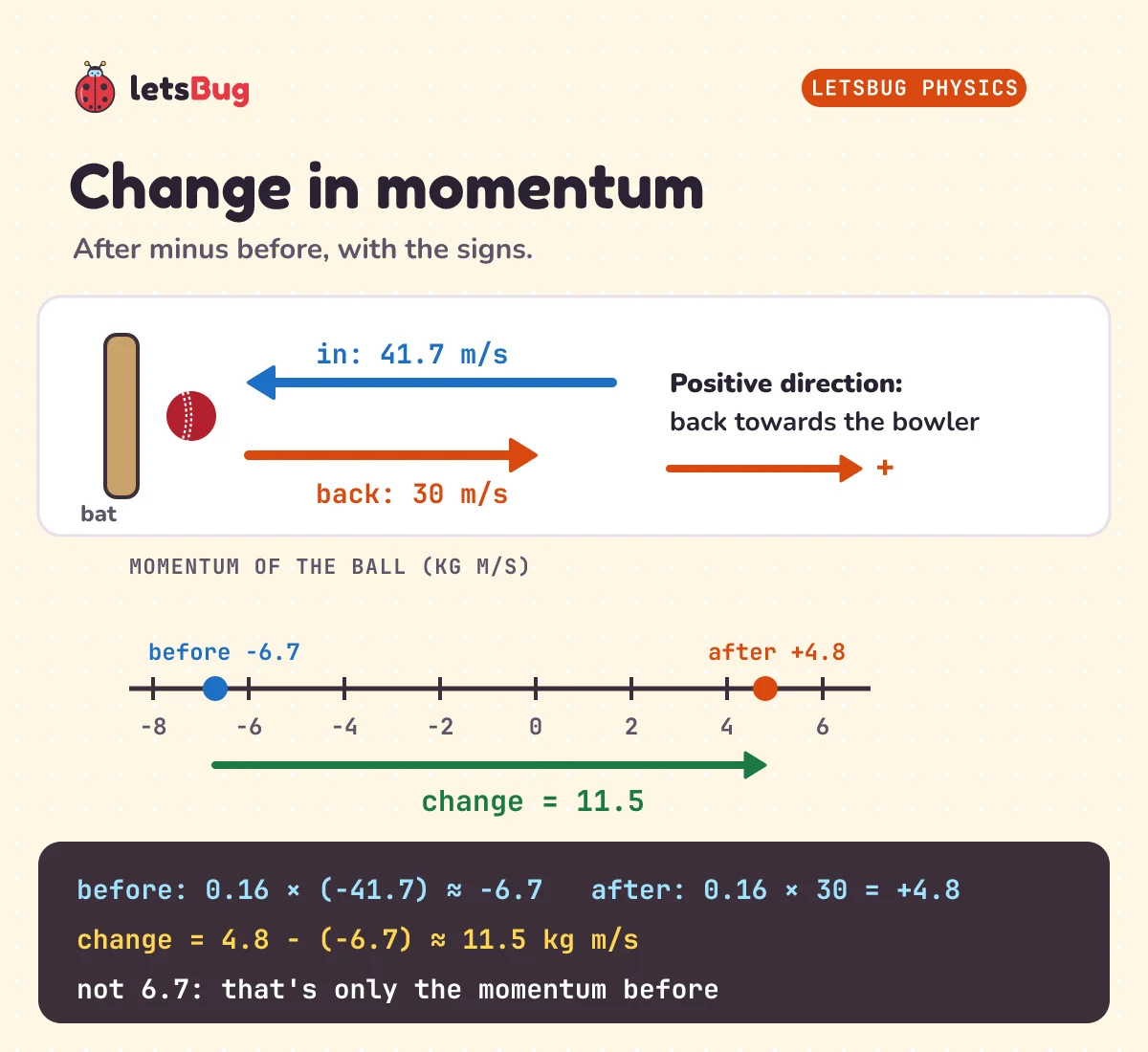
A very common wrong answer is 6.7 kg m/s, the momentum before the hit. Cambridge's June 2025 examiner report for IGCSE Physics (a report by the people who mark the exam, on what students got right and wrong) describes exactly this mistake in a multiple-choice question about a ball and a bat: "The majority of weaker candidates chose option A as they only determined the momentum before the impact of the ball on the bat rather than the change of momentum." (A candidate is a student taking the exam.)
Think about what the bat does. First it has to stop the ball, which takes away 6.7 kg m/s. Then it has to send the ball back, which adds another 4.8 kg m/s. Turning the ball round takes far more than just stopping it.
Force = change in momentum ÷ time
Newton's second law can also be written using momentum. NCERT says: "Newton's second law states that the rate of change of momentum of an object is proportional to the net force and takes place in the direction in which the net force acts." (Rate of change means change per second. Proportional means that if one doubles, so does the other.) OpenStax puts it as an equation: "The net external force equals the change in momentum of a system divided by the time over which it changes." So:
Resultant force = change in momentum ÷ time, or F = Δp ÷ t (Δ, the Greek letter delta, means "change in").
A bigger change in momentum, or a shorter time, means a bigger force. When the mass stays the same, this is the same law as F = ma from the Newton's second law post, written another way. It's also why fielders pull their hands back when they catch a fast cricket ball. The NCERT textbook says "the fielder gradually pulls their hands backwards with the moving ball just after catching it", and "In doing so, the time duration is increased during which the high velocity of the ball reduces to zero." The same change in momentum over a longer time needs a smaller force, so it hurts less.
What is impulse?
Multiply both sides by the time and you get impulse: force × the time the force acts. The Cambridge IGCSE syllabus (section 1.6) defines impulse as force × the time for which the force acts, and OpenStax says of impulse: "It is equal to the change in momentum." So:
impulse = F × t = change in momentum, where F is the resultant force. Impulse is measured in newton seconds (N s). One N s is the same as one kg m/s.
OpenStax sums up why it matters: "The effect of a force on an object depends on how long it acts, as well as the strength of the force." A resultant force of 200 N for 0.03 s gives an impulse of 200 × 0.03 = 6 N s, and so a change in momentum of 6 kg m/s.
How do you find the speed after two objects collide and stick together?
The question asks for speed, but the full answer is a velocity: the speed and its direction.
Cambridge set a question like this in June 2025. The examiner report for Paper 0625/23 says "This question required candidates to use the law of conservation of momentum when two trucks collided" and "Weaker candidates found this question challenging."
A railway wagon of mass 2000 kg moves at 3 m/s. It hits a stationary (still) wagon of mass 1000 kg, and they couple (join) together. Work out their velocity just after the collision.
Two wrong answers to avoid are "the speed halves" (that only happens if the moving mass doubles, and here it only goes from 2000 kg to 3000 kg) and "it stays at 3 m/s". Our model answer has three steps:
- Momentum before = 2000 × 3 = 6000 kg m/s. (The stationary wagon has zero momentum.)
- Momentum is conserved, and the two wagons now move as one 3000 kg object: (2000 + 1000) × v = 6000.
- v = 6000 ÷ 3000 = 2 m/s, in the same direction as the first wagon was moving.
Be careful when the two objects move towards each other. Then one of them has negative momentum. The same report, on another paper (0625/42), says: "Some candidates added the initial momentum of each train, not taking account of the opposing direction of the momentum vectors." And: "Candidates should be reminded that both velocity and momentum are vectors and so have a direction." Question 4 below practises exactly this.
Your turn. Choose a positive direction first, then write down the total momentum before and after.
1) What is the unit of momentum?
2) A skateboarder, 50 kg with her board, stands still and throws a 2 kg ball forwards at 5 m/s. How fast does she roll backwards? (Ignore friction.)
3) A 0.5 kg ball hits a wall at 8 m/s and bounces straight back at 6 m/s. Work out the change in its momentum.
Show the answers
1) The kilogram metre per second, kg m/s.
2) Before the throw, the total momentum is 0. Ball: 2 × 5 = 10 kg m/s forwards. So she has 10 kg m/s backwards: v = 10 ÷ 50 = 0.2 m/s backwards.
3) Take the bounce direction as positive. Before: 0.5 × (−8) = −4 kg m/s. After: 0.5 × 6 = +3 kg m/s. Change = 3 − (−4) = 7 kg m/s, away from the wall. (Not 4, and not 1.)
Exam-style questions with model answers
The marks in brackets are our estimate: one mark for each correct step or idea.
Q1 (2 marks). State what is meant by momentum, and give its unit.
Model answer
Momentum is mass × velocity, p = mv [1]. Unit: kg m/s [1]. Say velocity, not speed. On a question asking for this definition, the 2025 report noted that "some stated speed instead of velocity". Momentum has a direction, and speed doesn't.
Q2 (3 marks). A 40 kg child stands in a 120 kg boat that is still on a calm lake. She jumps off the front at 3 m/s. Find the speed of the boat just after she jumps. (Ignore drag: the water pushing back on the boat.)
Model answer
Total momentum before = 0 [1]. Child: 40 × 3 = 120 kg m/s forwards, so the boat has 120 kg m/s backwards [1]. v = 120 ÷ 120 = 1 m/s, backwards [1].
Q3 (3 marks). In question 3 of "Your turn", the ball touches the wall for 0.05 s. Calculate the average force of the wall on the ball.
Model answer
Change in momentum = 7 kg m/s [1]. F = change in momentum ÷ time = 7 ÷ 0.05 [1] = 140 N, away from the wall [1].
Q4 (4 marks). A 3000 kg truck moving right at 4 m/s collides front to front with a 2000 kg truck moving left at 2 m/s. They stick together. Find their velocity just after the collision.
Model answer
Take right as positive. Momentum before: 3000 × 4 = 12 000 kg m/s and 2000 × (−2) = −4000 kg m/s [1]. Total = 12 000 − 4000 = 8000 kg m/s [1]. After: (3000 + 2000) × v = 8000 [1]. v = 8000 ÷ 5000 = 1.6 m/s, to the right [1].
Questions people ask
What is the formula for momentum?
Momentum = mass × velocity, p = mv. With the mass in kilograms and the velocity in metres per second, the momentum comes out in kg m/s.
Does a heavier object always have more momentum?
No. Speed counts too. A 0.16 kg cricket ball at 150 km/h (41.7 m/s) has about 6.7 kg m/s, almost twice as much as a 7.3 kg bowling ball rolling at 0.5 m/s (3.65 kg m/s).
Is momentum a vector or a scalar?
A vector: it has a size and a direction, the same direction as the velocity. (A scalar, like mass or speed, has only a size.) Along a line, momentum one way is positive and momentum the other way is negative.
When is momentum conserved?
When no outside force acts on the group of objects overall (an isolated system). Then the total momentum before a collision or explosion (things pushed apart, like the skaters) equals the total momentum after.
Why does a heavy object recoil more slowly?
Both parts get the same size of momentum, in opposite directions. Momentum is mass × velocity, so the heavier part must have the smaller velocity. An astronaut of 220 kg with her suit who throws a 2 kg bag at 3 m/s drifts back at only about 0.027 m/s.
What is the difference between momentum and change in momentum?
Momentum is mass × velocity at one moment. The change in momentum is the momentum after minus the momentum before, with signs. For a ball hit straight back, the change (11.5 kg m/s towards the bowler in our example) is bigger than the momentum before (6.7 kg m/s).
Keep going
- Watch the full lesson, What Is Momentum? Conservation of Momentum and Recoil, and its Short, Bowling Ball or Cricket Ball: Which Has More Momentum? More in letsBug Physics on YouTube.
- The episode before this one, on balanced forces and mass vs weight: what is a resultant force?
- Why recoil happens at all, with a real rocket: Newton's third law and how rockets work in space.
- Force, mass and acceleration in everyday life: Newton's second law examples. And for speeds that change, which SUVAT equation to use.
Checked on 3 November 2026 against the 10 sources below. Every momentum, speed, force and practice answer in this post was worked out again in a Python script, and every quote was matched word for word with the source text.
Sources
- OpenStax Physics: 8.1 Linear Momentum, Force, and Impulse (p = mv, kg·m/s, momentum as a vector, force = change in momentum ÷ time, impulse)
- OpenStax Physics: 8.2 Conservation of Momentum (the law, isolated systems, the Earth recoiling)
- Cambridge International, via PapaCambridge: IGCSE Physics 0625, Principal Examiner Report for Teachers, June 2025 (PDF) (the change in momentum, two trucks and opposite directions findings)
- Cambridge International: IGCSE Physics 0625 syllabus for 2026, 2027 and 2028 (PDF) (section 1.6 Momentum)
- NCERT: Exploration, Science for Grade 9, Chapter 6, How Forces Affect Motion (PDF) (momentum, its direction, Example 6.8 on recoil)
- Wikipedia: Bowling ball (the USBC limit of 16 pounds, 7.3 kg)
- Wikipedia: Cricket ball (156 to 163 g)
- Wikipedia: Fast bowling (over 138 km/h; the 161.3 km/h record)
- Wikipedia: Extravehicular Mobility Unit (the ISS spacesuit, 144.7 kg)
- Wikipedia: SAFER (tethers, grips and the rescue jet pack)