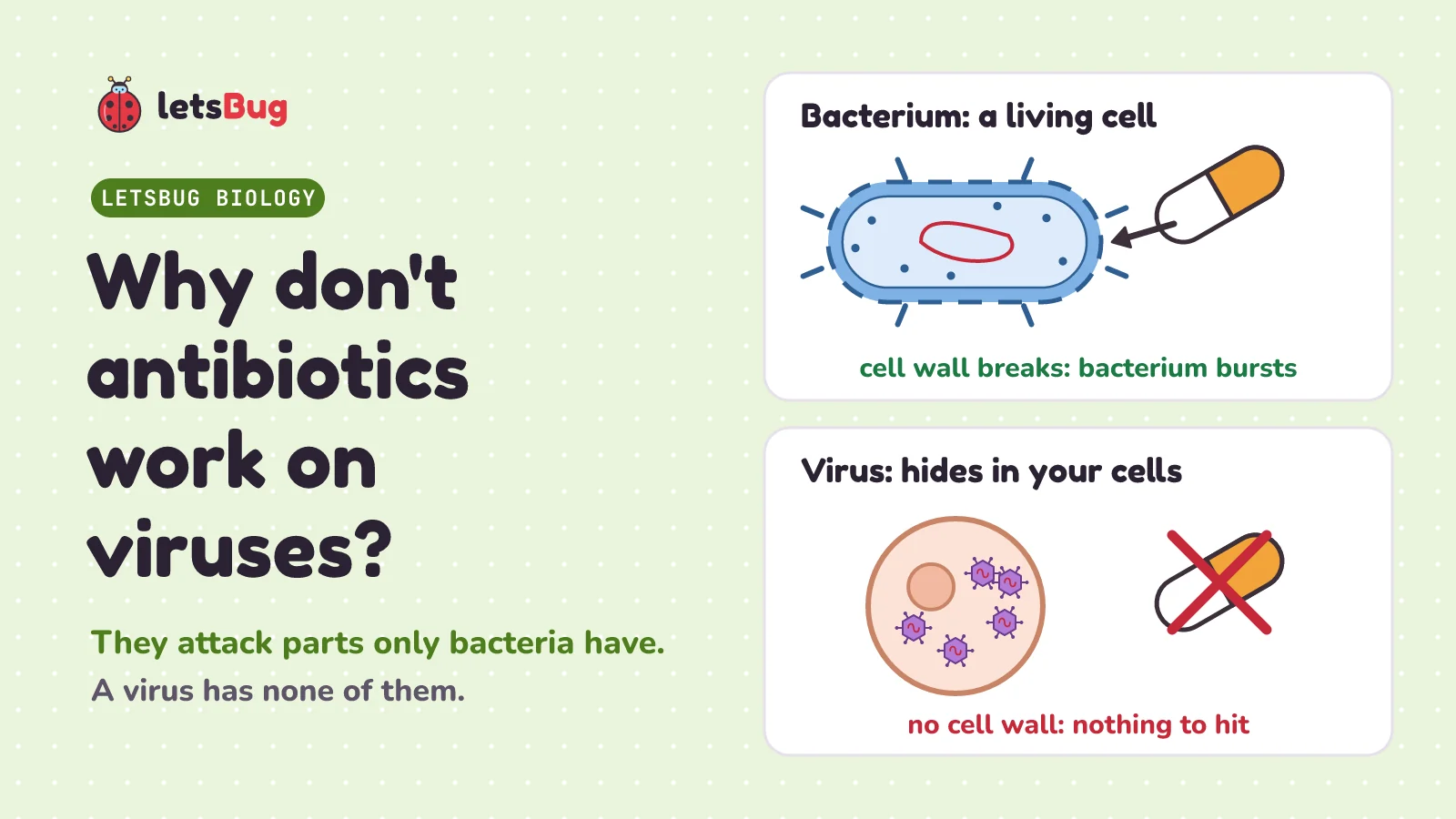
Antibiotics don't work on viruses because they attack parts that only bacteria have, such as the bacterial cell wall. A virus has no cell wall and almost none of the working parts of a cell. It copies itself inside your own cells. So an antibiotic has nothing to hit, and it can't cure a cold or flu.
In this post we start with a survey where most of the people asked got this wrong. Then we meet the four kinds of pathogen: bacteria, viruses, fungi and protists. We see how bacteria and viruses make us ill, how big they are, and how they spread. After that comes penicillin, why antibiotics can't touch a virus, what does help with a cold, and what antibiotic resistance really means. Every hard word is explained in the section where it comes up, and the practice questions from the video are answered in full.
Key takeaways
- A pathogen is a microorganism that causes an infectious disease. The four kinds are bacteria, viruses, fungi and protists.
- Bacteria are living cells. Many make poisons called toxins. Viruses are not cells: they are genetic material inside a protein coat, and they reproduce inside your cells.
- Antibiotics kill bacteria, for example by stopping them building their cell walls. They have no effect on viruses, which have no cell wall and copy themselves inside your cells.
- With a cold, you usually begin to feel better in 1 to 2 weeks. Medicines such as painkillers only treat symptoms. They don't kill pathogens.
- Bacteria become resistant to antibiotics, not "immune". Using antibiotics only when they are needed slows resistance down.
- Penicillin, found by Alexander Fleming in 1928, is often called the first antibiotic. But it was not the first drug to kill bacteria. Salvarsan was on sale in 1910.
This post goes with letsBug Biology, episode 8. It covers pathogens and antibiotics in GCSE biology (AQA 4.3), diseases and drugs in Cambridge IGCSE biology, and health and hygiene in ICSE Class 9 biology. Watch the lesson, or read on: the post adds two diagrams, a comparison table, and model answers to practise with.
Do antibiotics kill viruses?
No. An antibiotic is a medicine that kills bacteria or stops them spreading. But many people think antibiotics kill viruses too. In 2015 the World Health Organization (WHO) asked people in 12 countries, including India, China, Egypt and Mexico, about antibiotics. WHO reported: "64% of respondents believe antibiotics can be used to treat colds and flu, despite the fact that antibiotics have no impact on viruses." (Respondents are the people who answered the survey.) 9,772 people took part.
That's a little under 2 in 3 of the people asked. (2 in 3 would be about 67%.) It's true of this survey, not of everyone in the world. WHO says so itself: "Data cannot be considered to be representative of each Region, nor of the global situation."
The NHS, the UK's health service, gives a clear answer: "Antibiotics do not work for viral infections such as colds and flu, and most coughs." To see why, we need to know what bacteria and viruses are.
What is a pathogen?
AQA's GCSE specification says: "Pathogens are microorganisms that cause infectious disease." A microorganism is a living thing too small to see without a microscope. An infectious disease is one that can pass from one person, animal or plant to another. Cambridge's IGCSE syllabus says it more simply: describe a pathogen "as a disease-causing organism". (An organism is any living thing.)
AQA lists the four kinds: "Pathogens may be viruses, bacteria, protists or fungi." We'll meet each one below.
How do bacteria make us ill?
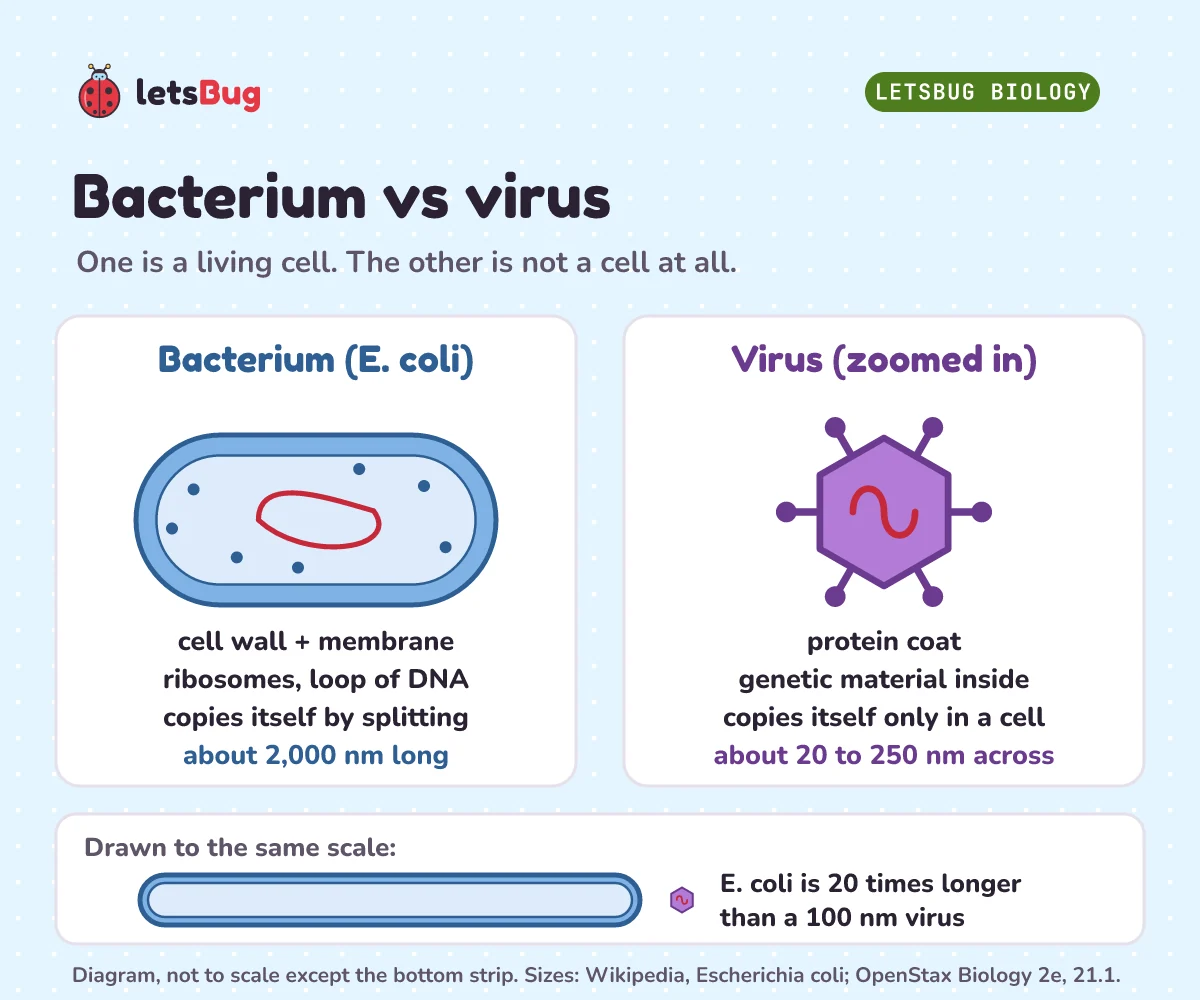
Bacteria are living cells. They are prokaryotes: cells with no true nucleus, which we met in why are cells so small? (The nucleus is the control centre of a cell.) A bacterium's DNA floats loose inside it. Around the outside it has a cell wall, a stiff layer like a cardboard box around a toy. (We compared cell walls in animal cell vs plant cell.) Remember that wall: it matters most in this post.
Bacteria are small. A common one, E. coli, is "about 2.0 μm long", says Wikipedia. (A micrometre, μm, is one-thousandth of a millimetre.) So about 500 of them would fit end to end across 1 millimetre.
They also multiply fast. AQA: "Bacteria multiply by simple cell division (binary fission) as often as once every 20 minutes if they have enough nutrients and a suitable temperature." (Binary fission means one cell splitting into two. Nutrients are the food substances a living thing needs.) In 2 hours there are 6 lots of 20 minutes. The number doubles each time.
How do they make us feel ill? AQA: "Bacteria may produce poisons (toxins) that damage tissues and make us feel ill." (A tissue is a group of similar cells working together, like muscle or skin.) Two bacterial diseases to know:
- Salmonella food poisoning. AQA: it "is spread by bacteria ingested in food, or on food prepared in unhygienic conditions." (Ingested means swallowed. Unhygienic means not clean.)
- Tuberculosis (TB). WHO: "Tuberculosis (TB) is an infectious disease caused by bacteria that most often affects the lungs." Because it is caused by bacteria, antibiotics can treat it. WHO: "Tuberculosis disease is treated with special antibiotics."
What is a virus, and how does it make us ill?
Viruses are not cells at all. A virus has no ribosomes, the parts of a cell that build proteins. It has no plasma membrane, the thin skin around a cell. It has almost none of the small working parts a cell has inside it. OpenStax's university textbook puts it this way: viruses "lack most of the components of cells, such as organelles, ribosomes, and the plasma membrane." (Components are parts. Organelles are the small working parts inside a cell.)
So what is a virus? Cambridge's syllabus lists just two features: "a protein coat and genetic material". The genetic material is a set of instructions, made of DNA or a similar molecule called RNA. The protein coat is the shell around it.
Viruses are also far smaller than bacteria. OpenStax: "Most virions, or single virus particles, are very small, about 20 to 250 nanometers in diameter." (A nanometre, nm, is one-thousandth of a micrometre. The diameter is the width across.) Our E. coli is 2 μm, which is 2,000 nm long. So E. coli is 20 times longer than a virus 100 nm across.
2,000 ÷ 100 = 20, so E. coli is 20 times longer than a 100 nm virus.
2,000 ÷ 250 = 8 and 2,000 ÷ 20 = 100, so between 8 and 100 viruses would fit along one E. coli.
A virus can't grow or copy itself on its own. It has to get inside a living cell. AQA: "Viruses live and reproduce inside cells, causing cell damage." (To reproduce is to make more of the same kind.) Once inside, the virus makes the cell build new viruses. The cell the virus gets into is called the host cell. Diseases caused by viruses include:
- Measles. AQA: "The measles virus is spread by inhalation of droplets from sneezes and coughs." (Inhalation means breathing in.)
- Flu. The NHS calls flu a viral infection: "Antibiotics do not work for viral infections such as flu."
- Chicken pox and HIV. ICSE's syllabus lists them as viral: "Viral: AIDS, Chicken pox, Hepatitis." HIV is a virus that attacks the body's defences. AQA says that unless it is controlled, "the virus attacks the body’s immune cells". AIDS is the illness HIV causes at its late stage.
- Tobacco mosaic virus, in plants. AQA: it "is a widespread plant pathogen affecting many species of plants including tomatoes." (A species is one kind of living thing.)
Here are the two side by side:
| Bacterium | Virus | |
|---|---|---|
| Is it a cell? | Yes, a living cell | No |
| Size | About 2,000 nm long (E. coli) | About 20 to 250 nm across |
| Cell wall? | Yes | No: a protein coat |
| Ribosomes? | Yes | No |
| How it reproduces | Splits in two (binary fission) | Only inside a host cell |
| How it makes us ill | Many make toxins | Damages the cells it copies itself in |
| Example diseases | Salmonella food poisoning, TB | Measles, flu, chicken pox |
| Killed by antibiotics? | Yes | No |
What diseases do fungi and protists cause?
Fungi, from why are fungi not plants?, can be pathogens too.
- Athlete's foot. The NHS says it "is a common fungal infection that affects the feet" and that it "is unlikely to get better on its own". It's treated with antifungal medicines, which kill fungi, not with antibiotics. Fungi have cell walls too. But theirs are made of chitin, a tough material. Bacteria build their walls from a different material, peptidoglycan. That's one reason penicillin, which stops bacteria building peptidoglycan, can't treat athlete's foot.
- Rose black spot. AQA: "Rose black spot is a fungal disease where purple or black spots develop on leaves, which often turn yellow and drop early."
Protists are living things mostly made of one cell that has a nucleus, such as Amoeba. Some cause disease. AQA: "The pathogens that cause malaria are protists." They travel between people inside mosquitoes. AQA says "The malarial protist has a life cycle that includes the mosquito." An animal that carries a pathogen from one person to another like this is called a vector.
How do pathogens spread?
Cambridge's syllabus gives two routes. A pathogen spreads:
- "by direct contact, including through blood and other body fluids". (Direct contact means touching the infected person, or their blood or body fluids.)
- "indirectly, including from contaminated surfaces, food, animals and air". (Contaminated means carrying the pathogen.)
Water is a route too: ICSE lists "Modes of transmission: air; water; vectors (housefly, mosquito, cockroach)." (Transmission means passing a disease on.) Some real examples:
- Through the air. Measles travels in droplets from coughs and sneezes. TB "spreads through the air when people with TB cough, sneeze or spit", says WHO.
- From surfaces. You can catch athlete's foot by "walking barefoot in places where someone else has athlete's foot – especially changing rooms and showers", says the NHS.
- In food. Salmonella spreads in food that was not prepared cleanly.
That's why simple habits help. Washing your hands, cooking food properly and covering coughs each stop one route.
Who discovered penicillin, and was it the first antibiotic?
AQA describes antibiotics like this: "Antibiotics, such as penicillin, are medicines that help to cure bacterial disease by killing infective bacteria inside the body." (Infective bacteria are the ones causing the infection.)
Penicillin came from a mould, which is a kind of fungus. AQA: "Penicillin was discovered by Alexander Fleming from the Penicillium mould." Wikipedia describes Fleming as "a Scottish physician" (a doctor) and tells the story: "On 3 September 1928 he observed by chance that fungal contamination of a bacterial culture ( Staphylococcus aureus) appeared to kill the bacteria." (A bacterial culture is a dish of bacteria grown on purpose. Staphylococcus aureus is a common kind of bacteria.) The mould was a Penicillium. Around it, the bacteria had died.
Turning that into a medicine took years. A team at the University of Oxford, led by Howard Florey and Ernst Chain, purified penicillin in 1940. (Purified means made pure, with nothing else mixed in.) Then factories began to make huge amounts. Wikipedia: "by June 1945 over 646 billion units per year were being produced." (A unit is a small, fixed amount of penicillin.) The Nobel Prize website says the 1945 Nobel Prize in Physiology or Medicine "was awarded jointly to Sir Alexander Fleming, Ernst Boris Chain and Sir Howard Walter Florey". (Jointly means shared.)
Why don't antibiotics work on viruses?
Antibiotics work by attacking parts that bacteria have and your own cells don't. That's how they can kill bacteria while mostly leaving your own cells alone.
Penicillin is a good example. Bacteria build their walls from a material called peptidoglycan. Penicillin stops them finishing it. The wall gets weak, water rushes into the cell, and the bacterium bursts. Wikipedia says the same thing in scientific words: "Penicillin kills bacteria by inhibiting the completion of the synthesis of peptidoglycans, the structural component of the bacterial cell wall." (Inhibiting means blocking. Synthesis means building.) It adds: "This results in cell lysis and death." (Lysis means bursting open.)
Now think about a virus:
- It has no cell wall. There's no wall for penicillin to stop.
- It has almost none of the working parts of a cell. It copies itself inside your own cells, using your cell's parts. So there is almost nothing of its own to attack.
So an antibiotic has nothing to hit. AQA says it in five words: "Antibiotics cannot kill viral pathogens."
Why not just make drugs that kill viruses? AQA: "It is difficult to develop drugs that kill viruses without also damaging the body’s tissues." A drug that stops a virus copying itself inside your cells can easily harm those cells too. For some viruses there are special antiviral drugs, which work against viruses. AQA says HIV can be "successfully controlled with antiretroviral drugs". (Antiretroviral drugs are antivirals made for HIV.) They are not antibiotics.
What helps with a cold, if not antibiotics?
- Mostly, your own body. For a cold, the NHS says: "You should begin to feel better in about 1 to 2 weeks."
- Some medicines only treat symptoms. AQA: "Painkillers and other medicines are used to treat the symptoms of disease but do not kill pathogens." (Symptoms are the signs that you are ill, like a sore throat or a fever.)
- Vaccines prevent some viral diseases. A vaccine trains your body to fight a pathogen before you meet it. AQA explains: "Vaccination involves introducing small quantities of dead or inactive forms of a pathogen into the body to stimulate the white blood cells to produce antibodies." (White blood cells are the cells that defend your body. Antibodies are proteins they make that stick to one pathogen.) AQA says "most young children are vaccinated against measles".
The NHS explains why doctors say no: "GPs do not recommend antibiotics for colds because they will not relieve your symptoms or speed up your recovery." (A GP is a family doctor in the UK.) It says the same about flu. If you're unwell and worried, see a doctor or a pharmacist. The NHS advice is: "When it comes to antibiotics, take your doctor's advice on whether you need them or not."
What is antibiotic resistance?
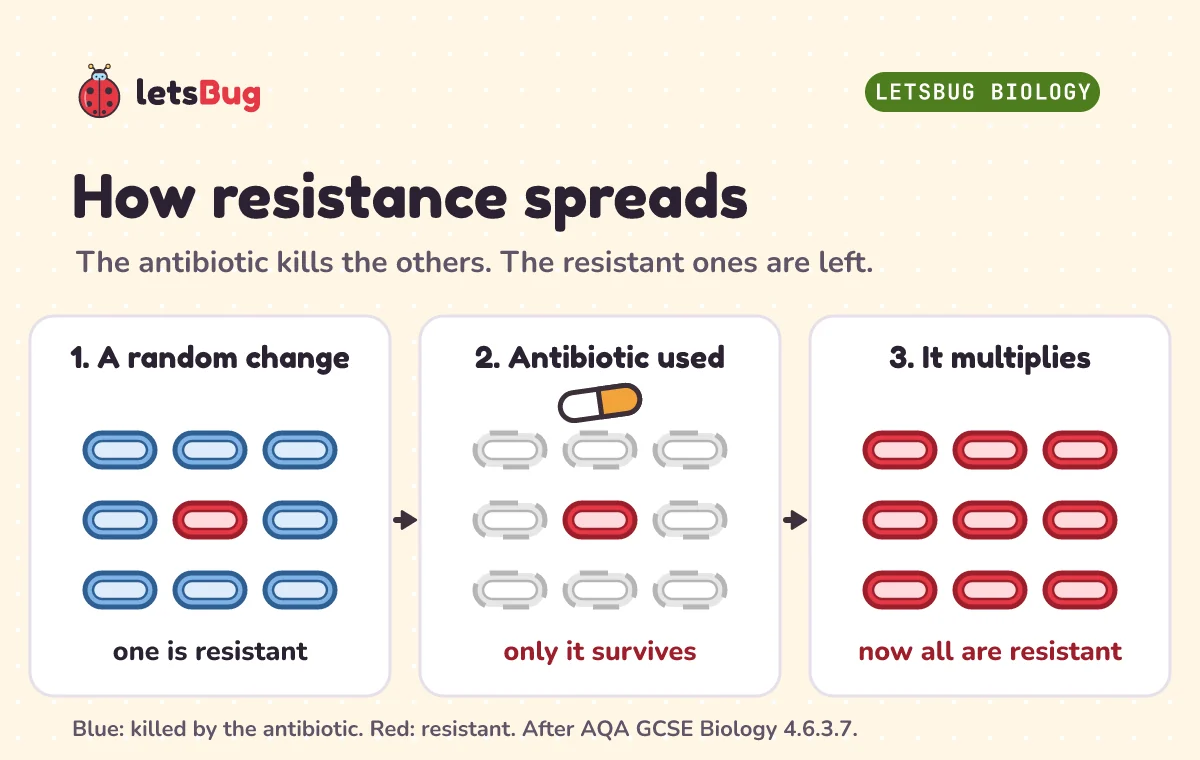
WHO: "Antibiotic resistance happens when bacteria change and become resistant to the antibiotics used to treat the infections they cause." Being resistant means the antibiotic no longer kills them. Here's how it happens:
- A random change. AQA: "Mutations of bacterial pathogens produce new strains." (A mutation is a random change in a living thing's DNA. A strain is one type within a kind of bacteria.)
- Some survive. "Some strains might be resistant to antibiotics, and so are not killed." The antibiotic kills the others.
- The survivors multiply. "They survive and reproduce, so the population of the resistant strain rises." (The population is how many there are.) Soon the antibiotic stops working on them.
One well-known example is MRSA. AQA: "MRSA is resistant to antibiotics." MRSA is a kind of Staphylococcus aureus, the same kind of bacteria Fleming was growing in 1928. Its name means methicillin-resistant Staphylococcus aureus. Methicillin is an antibiotic in the same family as penicillin, and MRSA is resistant to penicillin and most antibiotics like it. Cambridge's syllabus says "some bacteria are resistant to antibiotics which reduces the effectiveness of antibiotics".
What can we do? Cambridge asks students to explain "how using antibiotics only when essential can limit the development of resistant bacteria such as MRSA". (Essential means really needed.) AQA adds that "doctors should not prescribe antibiotics inappropriately, such as treating non-serious or viral infections". (To prescribe a medicine is to tell a patient to take it. Inappropriately means when they are not right for the job.) So taking antibiotics for a cold does not help, and it also gives bacteria in your body more chances to become resistant. The NHS warns: "taking antibiotics when you do not need them can mean they will not work for you in the future." And if you are prescribed them, the NHS says: "Take antibiotics as directed on the packet or the patient information leaflet that comes with the medicine, or as instructed by your GP or pharmacist."
Your turn. These are the three practice questions from the video. Try each one before you open the answers.
1) Four illnesses: measles, tuberculosis, flu and athlete's foot. Which one could an antibiotic treat, and why not the others?
2) Explain why a doctor won't prescribe antibiotics for flu.
3) One bacterium divides every 20 minutes. How many bacteria are there after 2 hours?
Show the answers
1) Only tuberculosis, because it is caused by bacteria. Measles and flu are caused by viruses. Athlete's foot is caused by a fungus, so it is treated with antifungal medicines.
2) Three steps:
- Flu is caused by a virus.
- Antibiotics only kill bacteria. A virus has none of the parts they attack, and it lives inside the body's cells.
- Using antibiotics when they can't help gives bacteria more chances to become resistant.
3) 2 hours is 6 lots of 20 minutes, so 26 = 64.
Exam-style questions with model answers
Our model answers, written in the style of exam mark schemes. The number in brackets is the marks. Each mark is one clear point.
Q1. Describe how bacteria and viruses make us feel ill. [2]
Model answer
Bacteria may produce toxins (poisons) that damage tissues [1]. Viruses live and reproduce inside cells, causing cell damage [1].
Q2. Name the type of pathogen that causes (a) athlete's foot, (b) tuberculosis, (c) malaria. [3]
Model answer
(a) A fungus [1]. (b) A bacterium [1]. (c) A protist [1].
Q3. Explain how antibiotic-resistant bacteria such as MRSA become common. [3]
Model answer
A random change makes some bacteria resistant [1]. When antibiotics are used, the bacteria that are not resistant are killed and the resistant ones survive [1]. The survivors reproduce, so the number of resistant bacteria grows [1].
Q4. Give two ways the spread of measles could be reduced. [2]
Model answer
Vaccination [1]. Isolating infected people (keeping them away from others), or covering coughs and sneezes [1].
Q5. A bacterium divides every 20 minutes. How many bacteria come from one bacterium after 4 hours? Show your working. [2]
Model answer
4 hours = 240 minutes, and 240 ÷ 20 = 12 divisions [1]. 212 = 4,096 bacteria [1].
Questions people ask
Do antibiotics kill viruses?
No. Antibiotics attack parts that only bacteria have, such as their cell walls. A virus has no cell wall and none of the parts antibiotics attack, and it copies itself inside your cells. So antibiotics cannot cure viral infections like colds and flu.
What is the difference between bacteria and viruses?
Bacteria are living cells with a cell wall, and they can reproduce on their own. Viruses are not cells: they are genetic material inside a protein coat, and they can only reproduce inside another living cell. Viruses are also much smaller, about 20 to 250 nanometres across, while E. coli is about 2,000 nanometres long.
Can antibiotics cure a cold?
No. Colds are caused by viruses, so antibiotics will not help you get better faster. The NHS says you should begin to feel better in about 1 to 2 weeks. A pharmacist can tell you what might help.
Was penicillin the first antibiotic?
It is often called the first, and Alexander Fleming found it in a mould in 1928. But it was not the first drug used to kill bacteria. Salvarsan, a man-made drug, was already on sale at the end of 1910.
What is antibiotic resistance?
It's when bacteria change so that an antibiotic no longer kills them. When antibiotics are used, the resistant bacteria survive and multiply. MRSA is a well-known example. Say bacteria become resistant, not immune.
What treats athlete's foot?
Antifungal medicines, not antibiotics, because athlete's foot is caused by a fungus. A pharmacist can give advice.
Keep going
- Watch the full lesson, Why Don't Antibiotics Work on Viruses? Bacteria vs Viruses, or the one-minute Short: Do Antibiotics Kill Viruses? 2 in 3 People Think So. More in letsBug Biology on YouTube.
- The episode before this one: why are fungi not plants? (episode 7, five kingdom classification).
- Bacteria as prokaryotes, and why cells are so small: why are cells so small? (episode 2).
- The cell wall, the nucleus and the rest of the cell: animal cell vs plant cell (episode 1).
- The next episode is on asexual reproduction: life without a partner, from bacteria splitting in two to new plants growing from a single leaf.
Checked on 14 November 2026 against the 21 sources below. Every number in this post was worked out again in a Python script, and every quote was matched word for word with the source text.
Sources
- WHO: WHO multi-country survey reveals widespread public misunderstanding about antibiotic resistance (16 November 2015)
- WHO: Tuberculosis fact sheet
- NHS: Antibiotics
- NHS: Common cold
- NHS: Flu
- NHS: Athlete's foot
- AQA: GCSE Biology 8461 specification, infection and response (4.3.1)
- AQA: GCSE Biology 8461 specification, cell biology (4.1.1.6 culturing microorganisms)
- AQA: GCSE Biology 8461 specification, inheritance, variation and evolution (4.6.3.7 resistant bacteria)
- AQA: GCSE Biology 8461/1H examiners' report, June 2023 (question 03.8)
- Cambridge International: IGCSE Biology 0610 syllabus 2026-2028 (1.3, 10.1, 15.1)
- Cambridge International: IGCSE Biology 0610 Principal Examiner Report for Teachers, June 2024 (Paper 31, question 4(a))
- CISCE: ICSE Biology (52) syllabus, examination year 2028
- OpenStax Biology 2e: 21.1 Viral Evolution, Morphology, and Classification
- NobelPrize.org: The Nobel Prize in Physiology or Medicine 1945
- Wikipedia: Escherichia coli
- Wikipedia: Penicillin
- Wikipedia: Alexander Fleming
- Wikipedia: Antibiotic (Salvarsan and Prontosil)
- Wikipedia: Arsphenamine (Salvarsan)
- Wikipedia: Methicillin-resistant Staphylococcus aureus