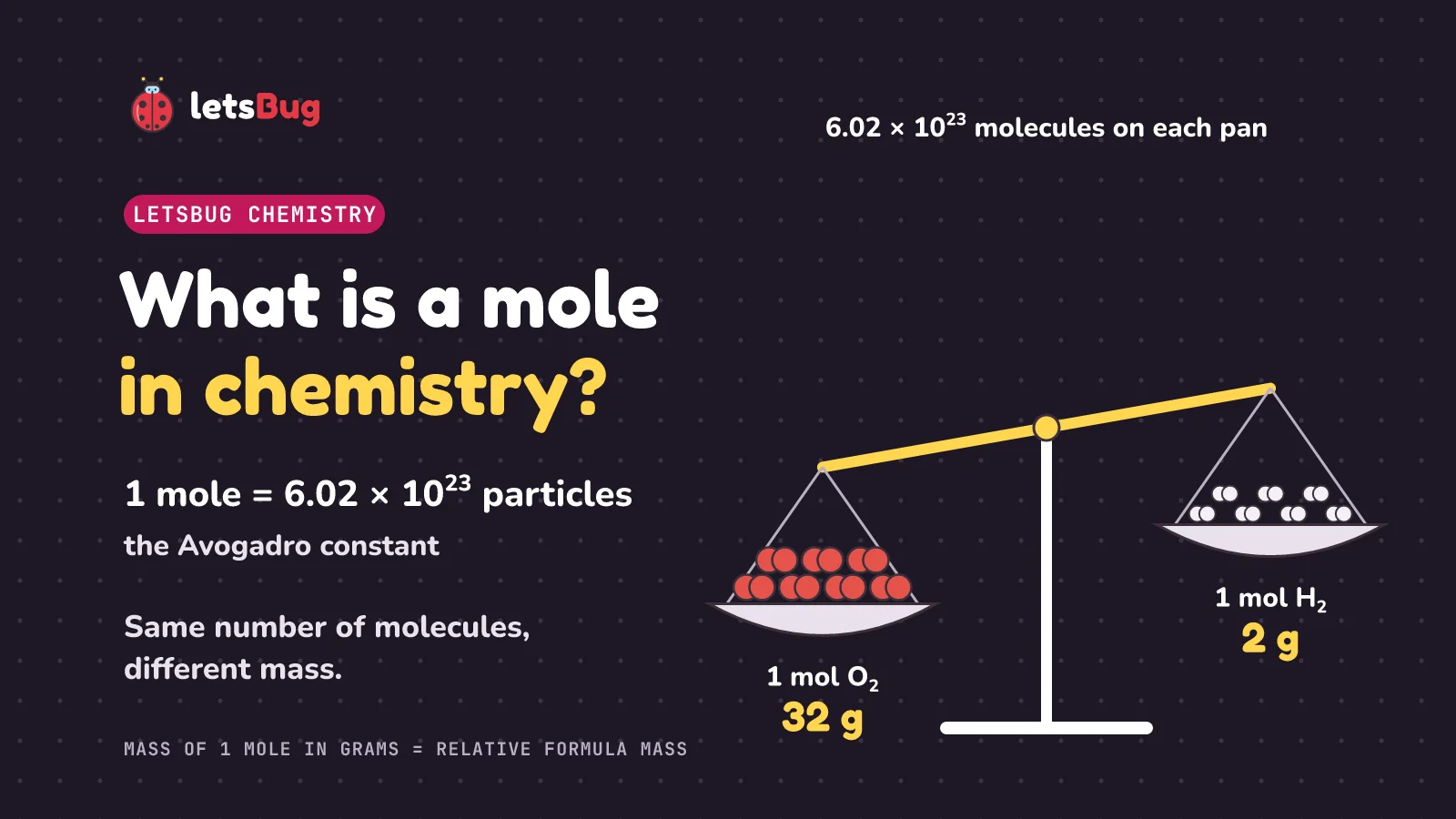
A mole is a number of particles, the way a dozen means 12. One mole is 6.02 × 10²³ particles (atoms, molecules or charged ions). That number is called Avogadro's number. One mole of any substance has a mass in grams equal to its relative formula mass (its atoms' masses added up). For water, that's 18 g.
In this post we see what a mole is and why its number has been exact since 2019. We find out why the mass of one mole is its relative formula mass in grams. We also see why one mole of oxygen gas is 16 times heavier than one mole of hydrogen gas. Then we use moles = mass ÷ molar mass (the mass of one mole) and convert kilograms first. Last, we count the molecules in a paracetamol tablet and finish with practice and exam-style questions and model answers.
Key takeaways
- A mole (symbol mol) is a count: 6.02 × 10²³ particles. It is the same count for atoms, molecules and ions.
- Since 20 May 2019 the number is exact: one mole contains exactly 6.022 140 76 × 1023 particles. Use 6.02 × 10²³ in GCSE and IGCSE answers.
- The mass of one mole in grams equals the relative formula mass, Mr. Water (Mr 18) is 18 g per mole. Oxygen gas, O₂, is 32 g. Hydrogen gas, H₂, is 2 g.
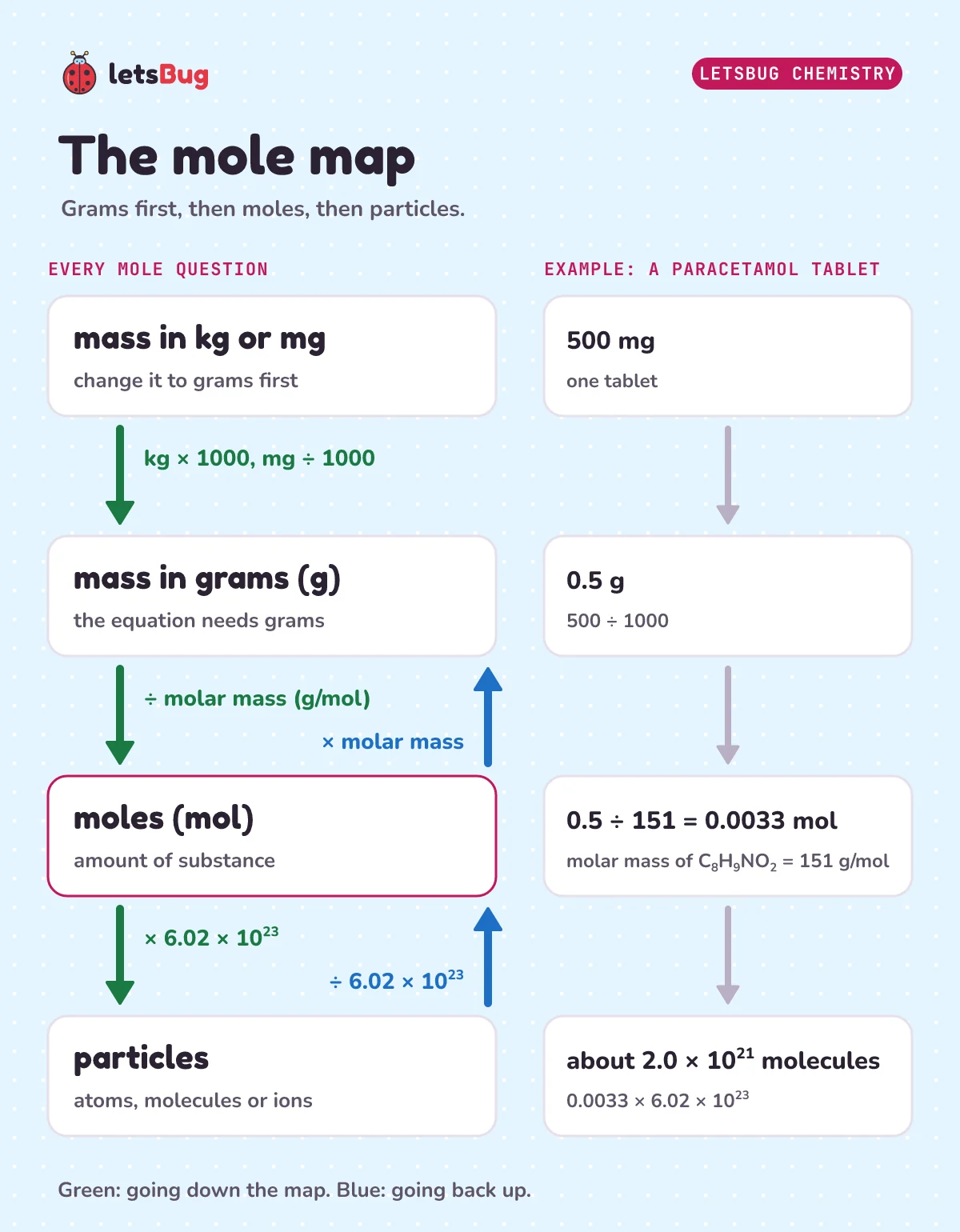
- moles = mass (g) ÷ molar mass (g/mol), and mass = moles × molar mass. Change kilograms or milligrams into grams first.
- particles = moles × 6.02 × 10²³. Say which particles you mean: one mole of O₂ molecules holds two moles of oxygen atoms.
This post goes with letsBug Chemistry, episode 8. It covers moles in GCSE chemistry (AQA 4.3.2.1, a Higher Tier topic). Higher Tier is the harder exam paper. It also covers section 3.3 of the Cambridge IGCSE syllabus, in the Supplement (the extended part of the course). Watch the lesson, or keep reading. The post adds the official 2019 definition, what examiners saw in a real exam question, a model exam answer and practice questions.
What is a mole in chemistry?
A mole is a number of particles. A dozen eggs is 12 eggs. A mole of atoms is 6.02 × 10²³ atoms. A mole of molecules (groups of atoms joined together) is 6.02 × 10²³ molecules. The number is huge because atoms are tiny. Written out in full, it is 602,000,000,000,000,000,000,000. That's 602,000 billion billion.
AQA's GCSE specification (the official list of what the exam covers) puts it like this: "Chemical amounts are measured in moles. The symbol for the unit mole is mol." It also says: "One mole of a substance contains the same number of the stated particles, atoms, molecules or ions as one mole of any other substance." An ion is an atom or group of atoms with an electric charge (see why ionic compounds have high melting points, episode 6).
The Cambridge IGCSE syllabus asks you to state that the mole is "the unit of amount of substance". Amount of substance is the quantity chemists measure in moles. It tells you how many particles there are, counted in moles. If an exam asks what a mole is, write: the mole is the unit of amount of substance, and one mole contains 6.02 × 10²³ particles.
Why not just count the particles? Nobody can. One 500 mg paracetamol tablet holds about 2 × 10²¹ paracetamol molecules (we work this out below). Counting them at one a second would take more than 60 trillion years. Chemists count by weighing, and the mole is what links a count to a mass.
What is Avogadro's number (the Avogadro constant)?
Avogadro's number is the number of particles in one mole. The BIPM (the International Bureau of Weights and Measures) publishes the SI Brochure, the official rule book for the SI (the International System of Units). It says: "The mole, symbol mol, is the SI unit of amount of substance."
The BIPM then gives the number: one mole contains exactly 6.022 140 76 × 1023 "elementary entities". An elementary entity is the particle you are counting. The BIPM says it "may be an atom, a molecule, an ion, an electron, any other particle or specified group of particles."
The number and the constant are almost the same thing. Avogadro's number is the plain number, 6.022 140 76 × 1023. A constant is a fixed number. The Avogadro constant has the symbol NA. It is the same number, but per mole: 6.022 140 76 × 1023 mol−1. The mol−1 means "per mole". Both are named after the Italian scientist Amedeo Avogadro.
Why is it exact? The rules changed on 20 May 2019. (The SI Brochure, the official rule book, says "effective from 20 May 2019".) Before that, a mole was defined using carbon-12. The Brochure says that the Avogadro constant "was equal to the number of atoms in 12 grams of carbon 12." Measuring got better and better. The Brochure says that "because of recent technological advances" the number became "known with such precision" (so exactly) that it could be fixed. Since 2019 it works in reverse. The number is fixed, and the number defines the mole.
In GCSE and IGCSE answers, use the rounded value. AQA's specification says: "The value of the Avogadro constant is 6.02 x 10²³ per mole." AQA and Cambridge both call 6.02 × 10²³ the Avogadro constant, so use that name in exam answers.
Why does one mole weigh its relative formula mass in grams?
This is what lets chemists count by weighing. The relative formula mass, Mr, is the masses of all the atoms in the formula added up. You add relative atomic masses, Ar, from the periodic table. AQA's specification says: "The mass of one mole of a substance in grams is numerically equal to its relative formula mass." Numerically equal means it is the same number. Mr has no unit. The mass of one mole is that same number in grams.
The Cambridge syllabus describes Ar as "the average mass of the isotopes of an element compared to 1/12th of the mass of an atom of 12C" (12C means carbon-12). Isotopes are atoms of the same element with different masses. So one carbon-12 atom counts as exactly 12. To see how Ar is worked out, read why chlorine's relative atomic mass is 35.5 (episode 4).
- Carbon-12: one mole is 12 g.
- Water, H₂O: Mr = 1 + 1 + 16 = 18, so one mole of water is 18 g. NCERT's Class 9 book works out the same sum: "Molecular mass of H2O = (1 u × 2) + (16 u × 1) = 18 u". Here u is the atomic mass unit, a tiny unit for the mass of atoms. NCERT calls this molecular mass; it is the same number as Mr.
18 g of water is about 18 mL, about one mouthful. That's because water's density (how much mass fits in each mL) is close to 1 g per mL. The NIST Chemistry WebBook gives 997.05 kg/m³ at 25 °C, which is 0.997 g/mL. 18 g takes up 18 ÷ 0.997 = 18.05 mL. And in that mouthful there are 6.02 × 10²³ water molecules.
Why does this work for every substance? Ar compares each atom with carbon-12. An oxygen atom (Ar 16) has 16/12 of the mass of a carbon-12 atom. A mole of oxygen atoms has the same number of atoms as a mole of carbon-12, which is 12 g. So a mole of oxygen atoms has a mass of 16/12 × 12 g = 16 g. The same works for every atom and every molecule. That's why the mass of one mole is always its Ar or Mr in grams.
For the curious: is one mole of carbon-12 still exactly 12 g?
Not quite, since 2019. The SI Brochure says the mass of one mole of carbon-12 "is no longer known exactly and must be determined experimentally". That means it has to be measured. When the new definition was agreed, it was still 12 g, with an uncertainty of about 4.5 parts in 10 billion. (Uncertainty means how far a measured value might be from the true value.) For every GCSE calculation, use 12 g.
Does one mole of oxygen weigh the same as one mole of hydrogen?
No. It's easy to think "a mole is a mole, so they weigh the same". Let's check it.
- Oxygen gas, O₂: Mr = 16 + 16 = 32, so one mole is 32 g.
- Hydrogen gas, H₂: Mr = 1 + 1 = 2, so one mole is 2 g.
Both contain exactly the same number of molecules: 6.02 × 10²³. But each oxygen molecule has 16 times the mass of a hydrogen molecule (32 ÷ 2 = 16, using the GCSE values H 1 and O 16). The mole of oxygen is therefore 16 times heavier. It's like a dozen eggs and a dozen melons: the same number, but very different masses.
AQA's specification gives a similar example: "in one mole of carbon (C) the number of atoms is the same as the number of molecules in one mole of carbon dioxide (CO2)". One mole of carbon is 12 g. One mole of carbon dioxide is 12 + 16 + 16 = 44 g. They have the same number of particles, but not the same mass.
This table puts the substances in this post side by side. Every row is one mole, so every row has the same number of molecules: 6.02 × 10²³. Only the mass changes.
| Substance | Formula | Mr | Mass of 1 mole |
|---|---|---|---|
| Hydrogen gas | H₂ | 2 | 2 g |
| Water | H₂O | 18 | 18 g |
| Oxygen gas | O₂ | 32 | 32 g |
| Carbon dioxide | CO₂ | 44 | 44 g |
| Paracetamol | C₈H₉NO₂ | 151 | 151 g |
How do you compare one mole of oxygen and one mole of hydrogen in an exam?
Here's an exam-style question: Compare one mole of oxygen gas with one mole of hydrogen gas, in terms of the number of molecules and their mass. A weak answer says "they weigh the same, because a mole is a mole". Part of that is right: the number is the same. But the mass is not. A full answer has three steps:
- Both contain the same number of molecules, 6.02 × 10²³ (the Avogadro constant).
- One mole of oxygen gas has a mass of 32 g, and one mole of hydrogen gas has a mass of 2 g.
- This is because each O₂ molecule has 16 times the mass of an H₂ molecule (Mr 32 and 2).
How do you calculate moles from mass?
You need one equation. The Cambridge IGCSE syllabus writes it as:
amount of substance (mol) = mass (g) ÷ molar mass (g/mol)
Molar mass is the mass of one mole, in grams per mole (g/mol). It is the same number as Mr. So water's molar mass is 18 g/mol. Here's how to use the equation:
- Write the equation first, before any numbers.
- Change the mass into grams. 1 kg = 1000 g, and 1000 mg = 1 g.
- Work out the molar mass from the formula and the Ar values.
- Divide, and check the units: g ÷ g/mol leaves mol.
Need the mass instead? Rearrange it: mass = moles × molar mass. AQA says you should be able to calculate "the number of moles in a given mass of that substance and vice versa" (vice versa means the other way round too).
Why must you convert kilograms to grams first?
The equation needs grams. Molar mass is in grams per mole, so the mass must be in grams too.
Try this: how many moles of water are in a 1 kg bottle?
- Wrong way: 1 ÷ 18 = 0.056 mol. Check it: that's not even a tenth of a mole, for a whole bottle. One mole of water is only 18 g, so the answer can't be right.
- Right way: 1 kg = 1000 g. Then 1000 ÷ 18 = 55.6 mol.
Examiners saw this mistake in a real exam. In June 2023, AQA's GCSE Chemistry Higher Tier Paper 1 asked students to "Calculate the volume of chlorine gas needed to react completely with 100 kg of titanium dioxide." It was question 10.2, worth 6 marks. The report on that exam says: "The most common error was not converting 100 kilograms to grams in order to calculate the moles, or converting incorrectly."
It also says: "A few seemed to be concerned by the large value of the answer and introduced a division by 1000 into what would have been a correct answer." In other words, some students got the right answer, then divided it by 1000 because it looked too big.
So a big answer is not a sign that you went wrong. 100 kg is a big mass, so it is a lot of moles. Change the units first. If your working is right, keep your answer, even if it is big.
How many molecules are in a paracetamol tablet?
The NHS says: "Paracetamol tablets and capsules for adults usually contain 500mg of paracetamol." The formula of paracetamol is C₈H₉NO₂ (the NIST Chemistry WebBook lists it under another name, acetaminophen). Let's count the paracetamol molecules in one 500 mg tablet.
- Molar mass. Carbon: 8 × 12 = 96. Hydrogen: 9 × 1 = 9. Nitrogen: 1 × 14 = 14. Oxygen: 2 × 16 = 32. Total: 96 + 9 + 14 + 32 = 151 g/mol. (NIST gives 151.1626, using more exact atomic masses.)
- Units first. 500 mg = 0.5 g.
- Moles. 0.5 ÷ 151 = 0.0033 mol.
- Molecules. 0.0033 mol × 6.02 × 1023 = about 2.0 × 10²¹ molecules. That's 2,000 billion billion.
With the exact values (151.1626 g/mol and 6.022 140 76 × 1023), the answer is still about 2.0 × 10²¹. Rounding the numbers doesn't change the answer you would write.
How do you convert moles to particles?
It works both ways:
- Moles to particles: multiply by 6.02 × 10²³.
- Particles to moles: divide by 6.02 × 10²³.
Always say which particles you mean. The SI Brochure says: "It is important to give a precise definition of the elementary entity involved". Take one mole of oxygen gas. It is one mole of O₂ molecules. But each molecule has two oxygen atoms, so it holds two moles of oxygen atoms. That's 2 × 6.02 × 1023 = about 1.2 × 1024 atoms.
That makes "one mole of oxygen" unclear. Write "one mole of oxygen molecules, O₂" or "one mole of oxygen atoms, O". The O₂ sample has twice as many atoms and twice the mass (32 g against 16 g).
Your turn. Use H 1, C 12, N 14, O 16 and Na 23. Work each one out before you open the answers.
1) Baking soda is sodium hydrogencarbonate, NaHCO₃. NCERT notes it is "used to relieve acidity" (to ease the burning feeling when there is too much acid in your stomach). A student weighs out 8.4 g. How many moles is that?
2) How many molecules are in 0.5 mol of water?
3) How many atoms are in 1 mol of ammonia, NH₃?
4) What is the mass of 2 mol of oxygen atoms, O? And of 2 mol of oxygen molecules, O₂?
Show the answers
1) Mr = 23 + 1 + 12 + 3 × 16 = 84. Moles = 8.4 ÷ 84 = 0.1 mol. Check: 8.4 is a tenth of 84, so it's a tenth of a mole.
2) 0.5 × 6.02 × 1023 = 3.01 × 10²³ molecules.
3) Each NH₃ molecule has 4 atoms (1 nitrogen, 3 hydrogen). So 4 × 6.02 × 1023 = 2.41 × 1024 atoms.
4) Atoms: 2 × 16 = 32 g. Molecules: 2 × 32 = 64 g. The molecules have twice the mass of the atoms. That is why you must say which particles you mean.
Exam-style questions with model answers
The marks are our own model marking, in the style of GCSE mark schemes: [1] is one mark for a correct point. Use H 1, C 12, O 16 and Ca 40.
Q1 (2 marks). What is meant by one mole of a substance?
Model answer
The unit of amount of substance [1]. It contains 6.02 × 10²³ particles (the Avogadro constant) [1].
Q2 (2 marks). Calculate the mass of 0.25 mol of carbon dioxide, CO₂.
Model answer
Mr = 12 + 2 × 16 = 44 [1]. Mass = 0.25 × 44 = 11 g [1].
Q3 (3 marks). How many moles are in 2.5 kg of calcium carbonate, CaCO₃?
Model answer
2.5 kg = 2500 g [1]. Mr = 40 + 12 + 3 × 16 = 100 [1]. Moles = 2500 ÷ 100 = 25 mol [1]. If you got 0.025 mol, you skipped the kilograms step.
Q4 (3 marks). What is the mass of 3.01 × 10²³ molecules of carbon dioxide, CO₂?
Model answer
Moles = 3.01 × 10²³ ÷ 6.02 × 1023 = 0.5 mol [1]. Mr = 12 + 2 × 16 = 44 [1]. Mass = 0.5 × 44 = 22 g [1].
Q5 (2 marks). A student says "1 g of hydrogen gas and 1 g of oxygen gas contain the same number of molecules." Explain why this is wrong.
Model answer
1 g of H₂ is 1 ÷ 2 = 0.5 mol, but 1 g of O₂ is 1 ÷ 32 = 0.031 mol [1]. The same mass is not the same number of moles: 1 g of hydrogen has 16 times as many molecules [1].
Questions people ask
What is a mole in simple terms?
A mole is a number, like a dozen. One mole is 6.02 × 10²³ particles. Chemists use it because atoms are far too small and too many to count one by one.
What is Avogadro's number?
The number of particles in one mole: exactly 6.022 140 76 × 1023 since 2019. In school answers, use 6.02 × 10²³.
What is the difference between Avogadro's number and the Avogadro constant?
Avogadro's number is the plain number, 6.022 140 76 × 1023. The Avogadro constant, NA, is that number per mole, with the unit mol−1.
How do you calculate moles?
Moles = mass in grams ÷ molar mass in g/mol. The molar mass is the relative formula mass, Mr, in g/mol. Change kilograms or milligrams into grams first.
What is molar mass?
The mass of one mole of a substance, in grams per mole. It has the same number as the relative formula mass: water is 18 g/mol, carbon dioxide 44 g/mol.
Why is Avogadro's number so big and strange?
Atoms are tiny, so a few grams of anything holds a huge number of them. The number was chosen so that one mole of carbon-12 atoms has a mass of 12 g (since 2019, 12 g with an uncertainty of about 4.5 parts in 10 billion). That makes the mass of one mole of anything equal to its relative formula mass in grams, which is easy to use.
Is a mole the same as a molecule?
No. A molecule is one particle: a group of atoms joined together. A mole is 6.02 × 10²³ particles, so one mole of water is 6.02 × 10²³ water molecules.
Keep going
- Watch the full lesson, What Is a Mole in Chemistry? Avogadro's Number Explained, or the Short: What Is 1 Mole? Same Number, Different Mass. More in letsBug Chemistry on YouTube.
- The episode before this one, where we drew H₂, O₂, water and ammonia, the molecules we found the masses of here: how to draw dot and cross diagrams for covalent bonds (episode 7).
- Where the Ar values come from: why is chlorine's atomic mass 35.5? Isotopes explained (episode 4).
- How formulas like NaHCO₃ and CaCO₃ are put together: why is aluminium oxide Al2O3? Valency explained (episode 5).
- Next in letsBug Chemistry: how to calculate concentration in mol/dm³ and reacting masses, and why using the atomic number instead of the relative atomic mass gives the wrong answer (episode 9).
Checked on 10 November 2026 against the 12 sources below. Every relative formula mass, mole, mass and particle count in this post was worked out again in a Python script. Every quote was checked against the exact source text.
Sources
- BIPM: SI base unit: mole (the 2019 definition, exactly 6.022 140 76 × 1023)
- BIPM: The International System of Units (SI Brochure, 9th edition) (effective 20 May 2019, the old carbon-12 definition, the molar mass of carbon-12)
- NIST: CODATA value: Avogadro constant (exact)
- AQA: GCSE Chemistry 8462 specification, quantitative chemistry (4.3.2.1 Moles)
- AQA: GCSE Chemistry Paper 1 (higher tier) question paper, June 2023 (question 10.2)
- AQA: GCSE Chemistry Paper 1 (higher tier) report on the examination, June 2023 (question 10.2)
- Cambridge International: IGCSE Chemistry 0620 syllabus for 2026 to 2028 (relative atomic mass; 3.3 The mole and the Avogadro constant)
- NCERT Class 9 Science, Exploration: Chapter 9, Atomic Foundations of Matter (9.7 molecular mass, Example 9.4, sodium hydrogencarbonate)
- NHS: How and when to take paracetamol for adults (500 mg tablets)
- NIST Chemistry WebBook: Acetaminophen (formula and molecular weight)
- NIST Chemistry WebBook: Thermophysical properties of water at 25 °C (density)
- Wikipedia: Avogadro constant (named after Amedeo Avogadro)