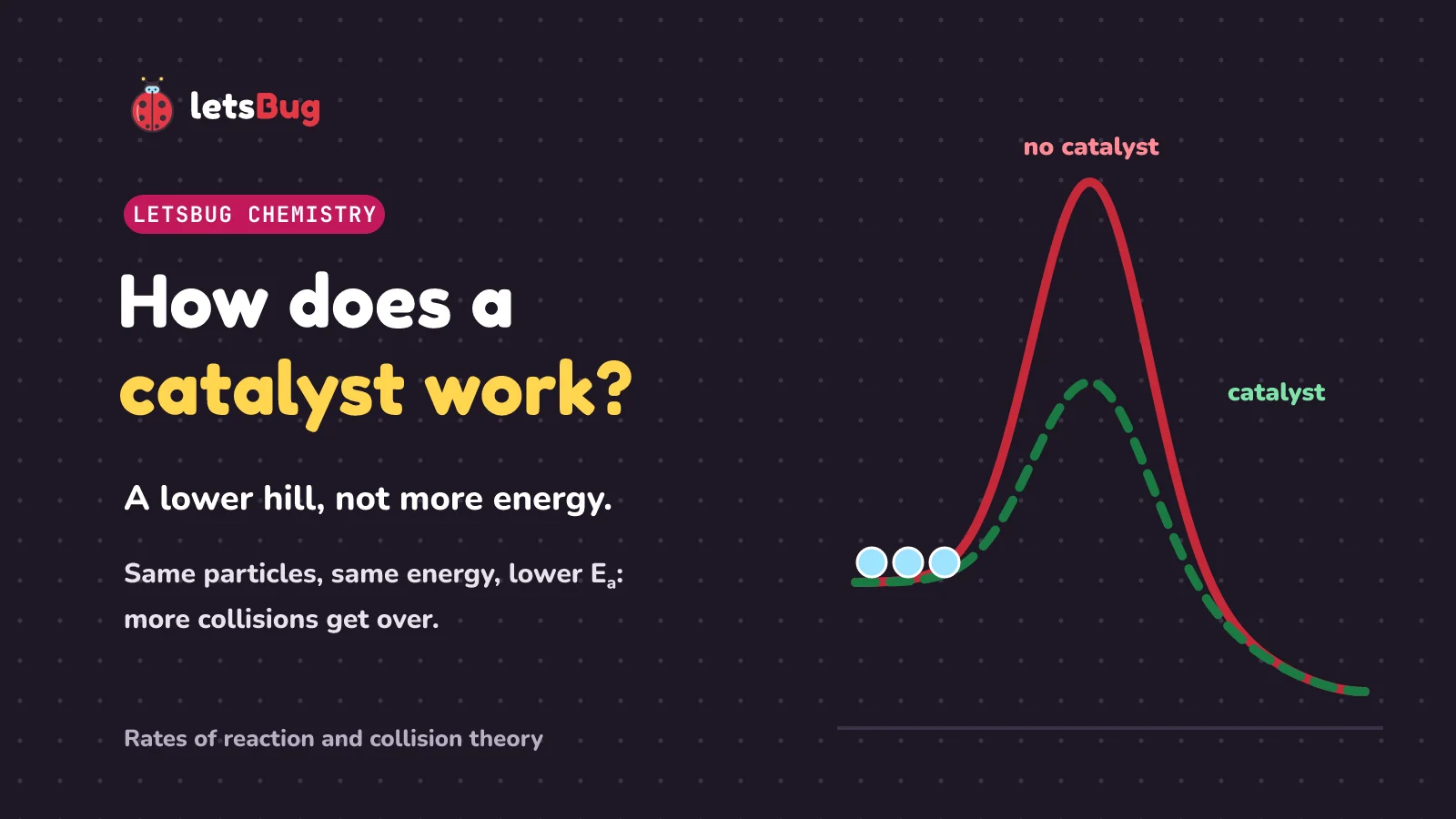
A catalyst speeds up a reaction by giving it a different route with a lower activation energy. Activation energy is the smallest amount of energy that particles need when they collide, so that they react. With a lower activation energy, more collisions succeed each second. The catalyst gives the particles no extra energy, and it is not used up.
In this post we start with a sugar refinery (a factory that cleans and packs sugar) that exploded, and see how collision theory explains it. We calculate a mean rate and read a rate graph, and see why the volume of gas is not the rate. Then we explain the four things that change a rate: concentration (or pressure), surface area, temperature and a catalyst. We show that a catalyst does not give particles energy, and look inside a car's catalytic converter. We finish with real exam questions, what examiners wrote about them, and practice questions with answers.
Key takeaways
- Particles react only when they collide, and only if the collision has at least the activation energy, Ea. Most collisions just bounce off.
- mean rate = amount of reactant used (or product made) ÷ time taken, in cm³/s or g/s. 60 cm³ of gas in 30 s is 2 cm³/s.
- On a rate graph, steep means fast and flat means stopped. The final volume of gas is the amount made, not the rate.
- Higher concentration or pressure, a bigger surface area and a higher temperature all mean more successful collisions per second. With a higher temperature, a bigger share of collisions also have at least the activation energy.
- A catalyst lowers the activation energy by giving a different route. It does not add energy, and it is still there, unchanged, at the end.
This post goes with letsBug Chemistry, episode 10. It follows on from how to calculate concentration in mol/dm³ (episode 9), because concentration is one of the things that changes a rate. It covers rates of reaction in GCSE chemistry (AQA 4.6.1) and section 6.2 of the Cambridge IGCSE syllabus. Watch the lesson, or keep reading. The post adds four parts of two real exam questions, what examiners wrote about them, model answers and practice questions.
Why does sugar dust explode but a sugar cube doesn't?
A sugar cube is hard to set on fire. But on 7 February 2008, sugar dust exploded at the Imperial Sugar refinery near Savannah, in Georgia, USA. The US Chemical Safety Board, the government team that looks into chemical accidents, says the blast caused "14 deaths". It also says: "The explosion was fueled by massive accumulations of combustible sugar dust throughout the packaging building." (Combustible means it can burn.)
It was the same sugar and the same oxygen in the air. What changed was how fast they reacted, which chemists call the rate of reaction. Fine dust burns so fast that the heat and gas come out all at once, and that is an explosion. To see why dust is so much faster than a cube, we need collision theory.
What is collision theory?
Collision theory says particles must hit each other to react. (Particles here means the atoms, molecules or ions that make up a substance. Ions are atoms with an electric charge.) AQA's GCSE specification, the official list of what the exam covers, puts it like this: "According to this theory, chemical reactions can occur only when reacting particles collide with each other and with sufficient energy."
So there are two rules:
- The particles must collide. Particles that never meet can't react.
- They must collide with enough energy. To react, some bonds in the particles must start to break, and that takes energy. A gentle bump isn't enough, so most collisions just bounce off and nothing changes.
That smallest amount of energy has a name. AQA says: "The minimum amount of energy that particles must have to react is called the activation energy." Its symbol is Ea. The energy comes from how fast the particles are moving. That energy of movement is called kinetic energy (see what happens to kinetic energy when you double the speed). The Cambridge IGCSE syllabus lists it as part of collision theory, along with "frequency of collisions between particles" and "activation energy, Ea". (Frequency means how often something happens.)
A collision with at least the activation energy is a successful collision. The rate of a reaction depends on how many successful collisions happen each second. Each factor below is a way to get more of them.
How do you calculate the mean rate of reaction?
Divide the amount of product made (or reactant used up) by the time it took. AQA says: "The rate of a chemical reaction can be found by measuring the quantity of a reactant used or the quantity of product formed over time".
mean rate = amount of product formed ÷ time taken
or mean rate = amount of reactant used ÷ time taken
Units: cm³/s for a gas measured by volume, g/s for a mass.
It is a mean rate (an average) because a reaction goes at different speeds at different times. It is fastest at the start and slows down as the reactants get used up.
Let's use marble chips and acid. Marble is mostly calcium carbonate, CaCO₃. Wikipedia says: "Acids react with the calcium carbonate in marble, producing carbonic acid". Carbonic acid quickly breaks down into water and carbon dioxide gas, and we can collect it and measure its volume. These numbers are made up, to keep the sums easy:
- Marble chips: 60 cm³ of carbon dioxide in 30 s. Mean rate = 60 ÷ 30 = 2 cm³/s.
- Powdered marble, the same mass: the same 60 cm³ in 10 s. Mean rate = 60 ÷ 10 = 6 cm³/s. That's three times faster.
Careful: the volume of gas is not the rate. Both made 60 cm³. If someone asks which one has the higher rate and you say "they're the same, both made 60 cm³", that's wrong. The rate is how quickly the gas was made, so the powder has the higher rate.
How do you read a rate of reaction graph?
On a graph of gas volume against time, the rate is how steep the line is. The Cambridge syllabus asks you to "Interpret data, including graphs, from rate of reaction experiments". Three rules cover most questions:
- Steep means fast. The steeper the line, the more gas is made each second.
- Getting less steep means slowing down. The reactants are being used up, so there are fewer collisions each second.
- Flat means stopped. One reactant has run out, so no more gas is made.
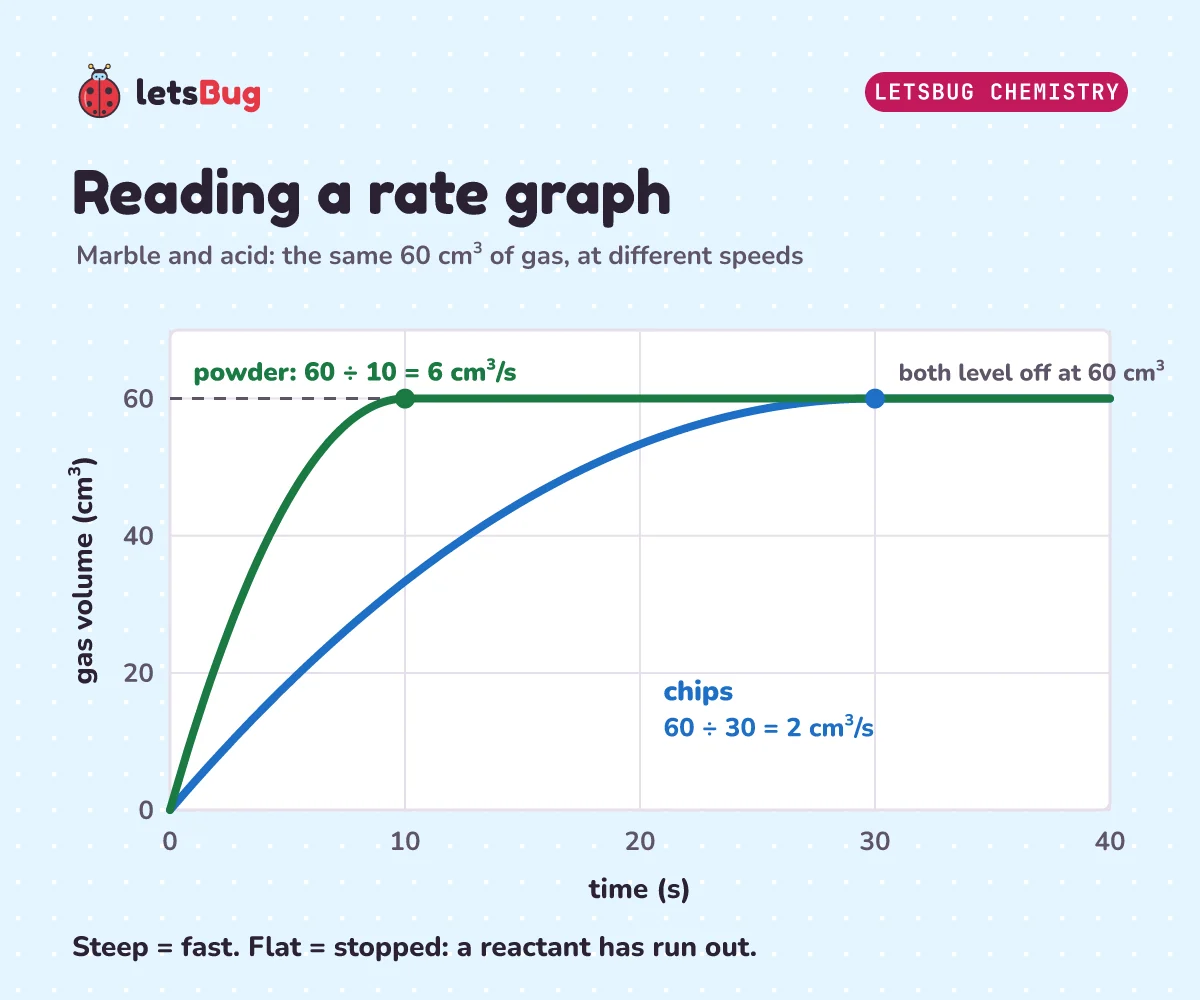
In the graph, the powder's line is steeper at the start, but both lines level off at 60 cm³. They make the same amount of product, at different speeds. To get a mean rate from a graph, read off a change in volume and the change in time it took, and divide. For the powder, that's 60 ÷ 10 = 6 cm³/s.
For the Higher Tier (the harder GCSE paper), AQA also asks for the rate at one moment, and for rates in mol/s. For the first, you draw a tangent, a straight line that just touches the curve at that time, and work out how steep it is (its gradient). Gradients of graphs are explained in distance-time and velocity-time graphs.
How does concentration affect the rate of reaction?
A higher concentration makes the reaction faster. Concentration is how much of a substance is dissolved in each dm³ of a solution (1 dm³ is 1 litre, or 1000 cm³). More concentrated means more reacting particles in the same volume, so they bump into each other more often. AQA says: "Increasing the concentration of reactants in solution, the pressure of reacting gases, and the surface area of solid reactants increases the frequency of collisions and so increases the rate of reaction."
For gases, pressure does the same job. Squeezing a gas into a smaller space packs the same particles closer together, so they collide more often.
Notice what the particles' energy is doing: nothing. They have the same energy as before. There are just more collisions each second, so there are more successful ones too.
Why does a bigger surface area increase the rate of reaction?
Only the particles on the outside of a solid can be hit. The ones inside are hidden until the outside layers have reacted. Cut the solid into smaller pieces, and many more particles are on a surface, ready to collide.
Let's measure it. A cube 2 cm along each side has 6 faces, each 2 × 2 = 4 cm². Its surface area is 6 × 4 = 24 cm². Now cut it into eight cubes, each 1 cm along a side. Each small cube has 6 faces of 1 cm², so 6 cm². Eight of them have 8 × 6 = 48 cm². It is the same mass of solid with double the surface.
Keep cutting and the surface keeps growing. This explains the sugar refinery. A cube of sugar has a small surface, so it burns slowly. Fine dust has a huge surface, and floating in the air it has oxygen all round it. So it can burn fast enough to explode. AQA asks you to explain this "in terms of surface area to volume ratio": smaller pieces have more surface for each cm³ of solid. Living cells face the same maths: see why cells are so small.
How does temperature affect the rate of reaction?
Heating makes a reaction faster, for two reasons. AQA says: "Increasing the temperature increases the frequency of collisions and makes the collisions more energetic, and so increases the rate of reaction."
- More collisions. Hot particles move faster, so they meet more often.
- More collisions with enough energy. Faster particles hit harder, so more of the collisions have at least the activation energy.
The second reason is the bigger one. Wikipedia's article on collision theory says: "Increasing the temperature increases the average kinetic energy of the molecules in a solution, increasing the number of collisions that have enough energy." The rise in how often they collide is tiny next to that. Wikipedia says it is "so small compared to the exponential factor that it cannot be measured experimentally". (The exponential factor is the part of the maths that counts the share of collisions with more energy than the activation energy.)
Picture six collisions, with a line showing the activation energy. These numbers are made up, to show the idea. When the particles are cold, only 1 of the 6 collisions has at least that much energy. When they are hot, 4 of the 6 do. For GCSE you just need both reasons. Why the second one is bigger is A-level chemistry, the course after GCSE.
This is why a fridge keeps food fresh. Wikipedia's article on food preservation says: "Cooling preserves food by slowing down the growth and reproduction of microorganisms and the action of enzymes that causes the food to rot." Microorganisms are tiny living things, such as bacteria.
How do you explain the temperature effect in an exam?
A typical question: Explain, in terms of particles, why increasing the temperature increases the rate of a reaction.
A weak answer says "the particles get more energy, so they react more". It's too vague. It doesn't mention collisions at all. A full answer has four steps:
- The particles have more kinetic energy, so they move faster.
- So they collide more frequently: more collisions per second.
- A greater proportion (share) of the collisions have energy equal to or greater than the activation energy.
- So there are more successful collisions per second.
Use these words: particles, collisions, frequency or per second, activation energy, and successful.
How does a catalyst work?
A catalyst is a substance that speeds up a reaction without being used up. Here's the myth: “a catalyst gives the particles extra energy”. It doesn't. The particles have just the same energies as before.
Instead, a catalyst gives the reaction a different route, which needs less energy. AQA says: "Catalysts increase the rate of reaction by providing a different pathway for the reaction that has a lower activation energy." The Cambridge syllabus says the same in fewer words: "State that a catalyst decreases the activation energy, Ea, of a reaction".
You can see it on a reaction profile. That is a graph of energy (going up) against the progress of the reaction (going along, from reactants to products). The reaction has to climb an energy hill before it can reach the products. The height of the hill, measured from the reactants, is the activation energy. Our diagram shows an exothermic reaction, one that gives out heat, so the products end lower than the reactants.
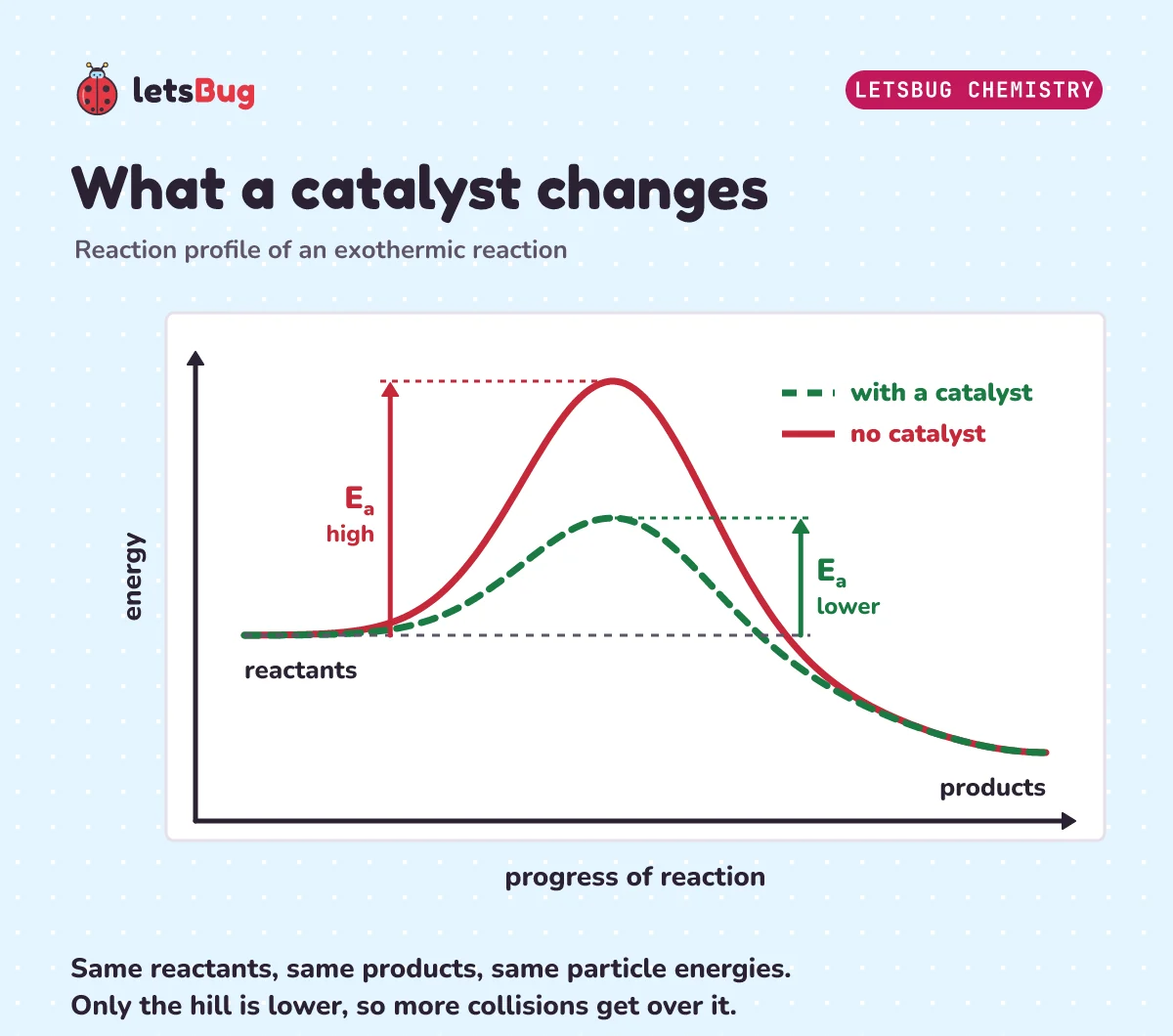
- Without a catalyst, the hill is high. Only a few collisions have that much energy.
- With a catalyst, the hill is lower. The particles have the same energies as before, but many more collisions now have at least the new, lower activation energy. So more collisions succeed each second.
And the catalyst isn't used up. AQA says: "Catalysts change the rate of chemical reactions but are not used up during the reaction." The Cambridge syllabus asks you to "State that a catalyst increases the rate of a reaction and is unchanged at the end of a reaction". So a small amount of catalyst can be used again and again. It also means the catalyst is not written as a reactant in the equation. AQA says you can spot a catalyst "because they are not included in the chemical equation for the reaction".
AQA adds: "Different reactions need different catalysts." The Haber process, which makes ammonia, uses iron: the Cambridge syllabus gives its conditions as "450 °C, 20 000 kPa / 200 atm and an iron catalyst". (kPa and atm are units of pressure; 200 atm is 200 times normal air pressure.) And "Enzymes act as catalysts in biological systems." Enzymes are the catalysts inside living things. To see what heat does to them, read does heat kill enzymes? The effect of temperature on enzymes.
What does a catalytic converter do?
Petrol cars have a catalyst in the exhaust pipe: a catalytic converter. Wikipedia says a converter "converts toxic gases and pollutants in exhaust gas from an internal combustion engine into less-toxic pollutants". Toxic means poisonous. Pollutants are substances that make the air dirty and harmful. An internal combustion engine is one that burns fuel inside it, like a car engine.
Wikipedia says many countries have rules "which in effect require three-way converters on gasoline-powered vehicles" (gasoline is the American word for petrol). Three-way means the converter "does three simultaneous tasks": it does three jobs at the same time.
The catalyst is made of precious metals, which are rare and cost a lot. Wikipedia says: "Platinum is the most active catalyst and is widely used", and "Palladium and rhodium are two other precious metals used". Two of the jobs they do:
- Poisonous carbon monoxide becomes carbon dioxide: CO + ½O₂ → CO₂. In whole numbers, that is 2CO + O₂ → 2CO₂.
- Nitrogen oxides become nitrogen gas, N₂. They are written NOx, because there are two: NO and NO₂. Wikipedia says "NOx are precursors to acid rain and smog": they help to make acid rain (rain made acidic by gases in the air) and smog (dirty, hazy air). For example: CO + NO → CO₂ + ½N₂, or in whole numbers 2CO + 2NO → 2CO₂ + N₂.
The metals are catalysts, so they aren't used up. But the catalyst alone isn't enough. Wikipedia says: "Catalytic converters require a temperature of 400 °C (750 °F) to operate effectively." So a converter only does its job well once the exhaust is hot. It's a catalyst and a high temperature working together, which is two of our four factors at once.
What factors affect the rate of reaction?
Here are the four factors side by side. Only one of them changes how much energy the particles have.
| Change | Why it's faster | Do the particles get more energy? |
|---|---|---|
| Higher concentration (or pressure) | More particles in the same volume, so more frequent collisions | No |
| Bigger surface area | More particles exposed on a surface, so more frequent collisions | No |
| Higher temperature | More frequent collisions, and more of them have at least Ea | Yes |
| Catalyst | A different route with a lower Ea, so more collisions are successful | No |
Does a faster reaction make more product?
No. The rate is how fast the product is made. How much product you get depends on how much reactant there is to use up. In the marble experiment, the powder was three times faster, but both made 60 cm³ of gas.
When there are two reactants, one usually runs out first. AQA says (in a Higher Tier topic): "The reactant that is completely used up is called the limiting reactant because it limits the amount of products." Once the limiting reactant is gone, the line on the graph goes flat.
The video ends with a challenge. In the marble experiment, use acid twice as concentrated, with the marble still running out first. What happens to the rate, and to the final volume of gas? Here's the answer. The reaction is faster, so the line is steeper at the start. But the marble is the limiting reactant and there's the same amount of it, so the final volume of gas is the same, 60 cm³.
It's different if you change the amount of the limiting reactant itself. We'll see that in a real exam question below.
Your turn. Work each one out before you open the answers.
1) From the video: an effervescent (fizzy) vitamin tablet dropped in water gives off 90 cm³ of carbon dioxide in 45 s. (Wikipedia says these tablets "are designed to dissolve in water and release carbon dioxide".) Crushed into powder, the same tablet gives the same 90 cm³ in 15 s. Find both mean rates, and explain the difference using particles.
2) A reaction makes 48 cm³ of hydrogen in 2 minutes. Calculate the mean rate in cm³/s.
3) Explain why powdered magnesium reacts faster with acid than a magnesium ribbon of the same mass.
4) A student says "a catalyst speeds up a reaction by giving the particles more energy". Explain why this is wrong.
5) Why does food last longer in a fridge? Use ideas about rate.
Show the answers
1) Whole: 90 ÷ 45 = 2 cm³/s. Powder: 90 ÷ 15 = 6 cm³/s, three times faster. The powder has a larger surface area, so more particles are exposed, and the reacting particles collide more frequently.
2) Units first: 2 minutes = 120 s. 48 ÷ 120 = 0.4 cm³/s.
3) The powder has a larger surface area (more surface for each cm³), so more magnesium particles are exposed to the acid. So there are more frequent collisions, and more successful collisions per second.
4) A catalyst does not change the particles' energies. It gives a different route (pathway) with a lower activation energy, so more of the collisions have enough energy to react.
5) At a lower temperature the particles have less kinetic energy and move more slowly. So there are fewer collisions per second, and a smaller share have at least the activation energy. The reactions that spoil food happen more slowly.
Exam questions with model answers
These are real questions from AQA's June 2023 GCSE Chemistry Paper 2, Higher Tier (the harder paper). The model answers and the marks shown with [1] are our own, in the style of GCSE mark schemes: [1] is one mark for a correct point. What examiners wrote comes from AQA's report on that exam.
Question 01.2: from mean rates to mean time (5 marks)
A student reacted zinc with sulfuric acid and timed how long it took to collect 20 cm³ of hydrogen gas. They did it four times and worked out the rate for each trial: 0.78, 0.81, 0.68 and 0.81 cm³/s. The question asks: "Determine the mean time taken to collect 20 cm³ of gas. Do not include any anomalous results." (An anomalous result is one that doesn't fit the pattern of the others.)
Model answer
0.68 cm³/s is anomalous, much lower than the others, so leave it out [1]. Mean rate = (0.78 + 0.81 + 0.81) ÷ 3 [1] = 0.80 cm³/s [1]. Rearrange the equation: mean time = volume ÷ mean rate [1] = 20 ÷ 0.80 = 25 s [1].
The examiners wrote that most students who missed full marks "scored 4 marks by failing to discard the anomalous result". (Discard means leave out.) Look at your data before you take a mean.
Question 01.3: which changes slow the reaction? (2 marks)
The student wanted the reaction to take longer. The question asks: "Which two changes would increase the mean time taken to collect 20 cm³ of gas?" It gives five boxes to tick:
- use a catalyst
- use a larger conical flask (a cone-shaped glass flask)
- use a lower temperature
- use smaller pieces of zinc
- use sulfuric acid of a lower concentration
Model answer
Use a lower temperature [1]. Use sulfuric acid of a lower concentration [1]. (A catalyst and smaller pieces of zinc would make it faster. The size of the flask doesn't change the reaction.)
The report says "more than 80% scored one mark". Of these, it says, "there was usually a conflict between a factor which would speed the reaction up and one which would slow it down". Read whether the question wants faster or slower.
Question 07.1: how does a catalyst work? (2 marks)
"Manganese dioxide catalyses the decomposition of hydrogen peroxide solution. Oxygen and water are produced." (Decomposition means one substance breaking down into simpler ones.) The question: "Explain how a manganese dioxide catalyst increases the rate of decomposition of hydrogen peroxide."
Model answer
The catalyst provides a different pathway (route) for the reaction [1], which has a lower activation energy [1].
The report says: "Most correct answers referred to the lowering of the activation energy. Many students also referred to the catalyst providing a different pathway for the reaction." It also warns: "References to changes in the number of collisions were insufficient as they did not answer the question." So for a catalyst, talk about the pathway and the activation energy.
Question 07.4: half the concentration, half the product (2 marks)
In the first experiment the student used "50 cm³ of 2.0 mol/dm³ hydrogen peroxide solution" with 1.0 g of manganese dioxide. They put the flask on a balance and recorded "the total mass lost from the conical flask every 20 seconds". The mass lost is the oxygen gas that escaped. Then: "The student repeated the investigation using 50 cm³ of 1.0 mol/dm³ hydrogen peroxide solution and 1.0 g of manganese dioxide." The student has to sketch the new line on the graph of the first results.
Model answer
A line that is less steep than the first one, because the lower concentration means less frequent collisions [1]. It levels off at half the final mass, 0.80 g, because there is half as much hydrogen peroxide [1].
Here hydrogen peroxide is the only reactant, so it is the limiting reactant. 50 cm³ = 50 ÷ 1000 = 0.050 dm³. In moles, 0.050 dm³ × 2.0 = 0.10 mol (moles count particles: see what is a mole in chemistry?). At 1.0 mol/dm³ it is only 0.050 mol, which is half. So half the oxygen is made. The report says many lines "did not level off at 0.80 g". It adds: "The most common answer was for the sketch line to finish at 1.60 g". That is the same final mass as the first experiment. Only "Around 25% of students scored both marks."
Compare it with the marble challenge above. There, the acid was in excess (more than enough), and the marble ran out first. Making the acid stronger changed the rate but not the final volume. Here, the reactant you change is the one that runs out, so the final amount changes too.
Questions people ask
Does a catalyst give particles more energy?
No. The particles have the same energies as before. A catalyst gives a different route with a lower activation energy, so more of the collisions have enough energy to react.
What is activation energy?
The minimum amount of energy that particles must have when they collide, so that they react. Its symbol is Ea. On a reaction profile it is the height of the hill above the reactants.
What is collision theory?
The idea that particles can only react when they collide, and only if the collision has at least the activation energy. The rate depends on how many successful collisions happen each second.
Is a catalyst used up in a reaction?
No. A catalyst is unchanged at the end of the reaction, so the same catalyst can be used again and again. That's why it isn't written as a reactant in the equation.
What are the four factors that affect the rate of reaction?
Concentration (or pressure, for gases), surface area, temperature, and a catalyst. AQA lists pressure separately, so it names five. Each one gives more successful collisions per second.
How do you calculate the rate of reaction?
Mean rate = amount of product made (or reactant used) ÷ time taken. For example, 60 cm³ of gas in 30 s is 60 ÷ 30 = 2 cm³/s.
Does a catalyst change the amount of product?
No. A catalyst makes the product more quickly, but the amount you get depends on how much of the limiting reactant there is.
Keep going
- Watch the full lesson, How Does a Catalyst Work? Collision Theory & Rates of Reaction, or the Short: What Does a Catalyst Do? (It Doesn't Add Energy). More in letsBug Chemistry on YouTube.
- The episode before this one, where concentration in mol/dm³ comes from: how to calculate concentration (mol/dm³) and reacting masses (episode 9).
- Catalysts in living things: does heat kill enzymes? The effect of temperature on enzymes (letsBug Biology).
- Next in letsBug Chemistry: equilibrium, where a reaction keeps going both ways, and whether equilibrium really means equal amounts (episode 11).
Checked on 29 November 2026 against the 11 sources below. Every rate, surface area and amount in moles in this post was worked out again in a Python script with exact fractions. Every quote was checked against the exact source text.
Sources
- AQA: GCSE Chemistry 8462 specification, the rate and extent of chemical change (4.6.1.1 to 4.6.1.4)
- AQA: GCSE Chemistry 8462 specification, quantitative chemistry (4.3.2.4 limiting reactants)
- AQA: GCSE Chemistry Paper 2 (higher tier) question paper, June 2023 (questions 01 and 07)
- AQA: GCSE Chemistry Paper 2 (higher tier) report on the examination, June 2023 (questions 01 and 07)
- Cambridge International: IGCSE Chemistry 0620 syllabus for 2026 to 2028 (6.2 Rate of reaction; 6.3 the Haber process)
- US Chemical Safety Board: Imperial Sugar Company dust explosion and fire
- Wikipedia: Catalytic converter (platinum, palladium, rhodium; the reactions; 400 °C)
- Wikipedia: Collision theory (temperature and the share of collisions with enough energy)
- Wikipedia: Marble (calcium carbonate, and how acids react with it)
- Wikipedia: Effervescent tablet
- Wikipedia: Food preservation (cooling)